Running a Chinese restaurant in North America comes with operational challenges that mainstream POS systems were never designed to handle. Large menus with hundreds of items. Complex modifier trees for dishes with multiple preparation styles, spice levels, and protein options. Kitchen tickets that need to display item names in both English and Chinese. Banquet and family-style dining that does not fit neatly into standard table management workflows. And staff who may be more comfortable navigating a POS interface in Chinese than in English.

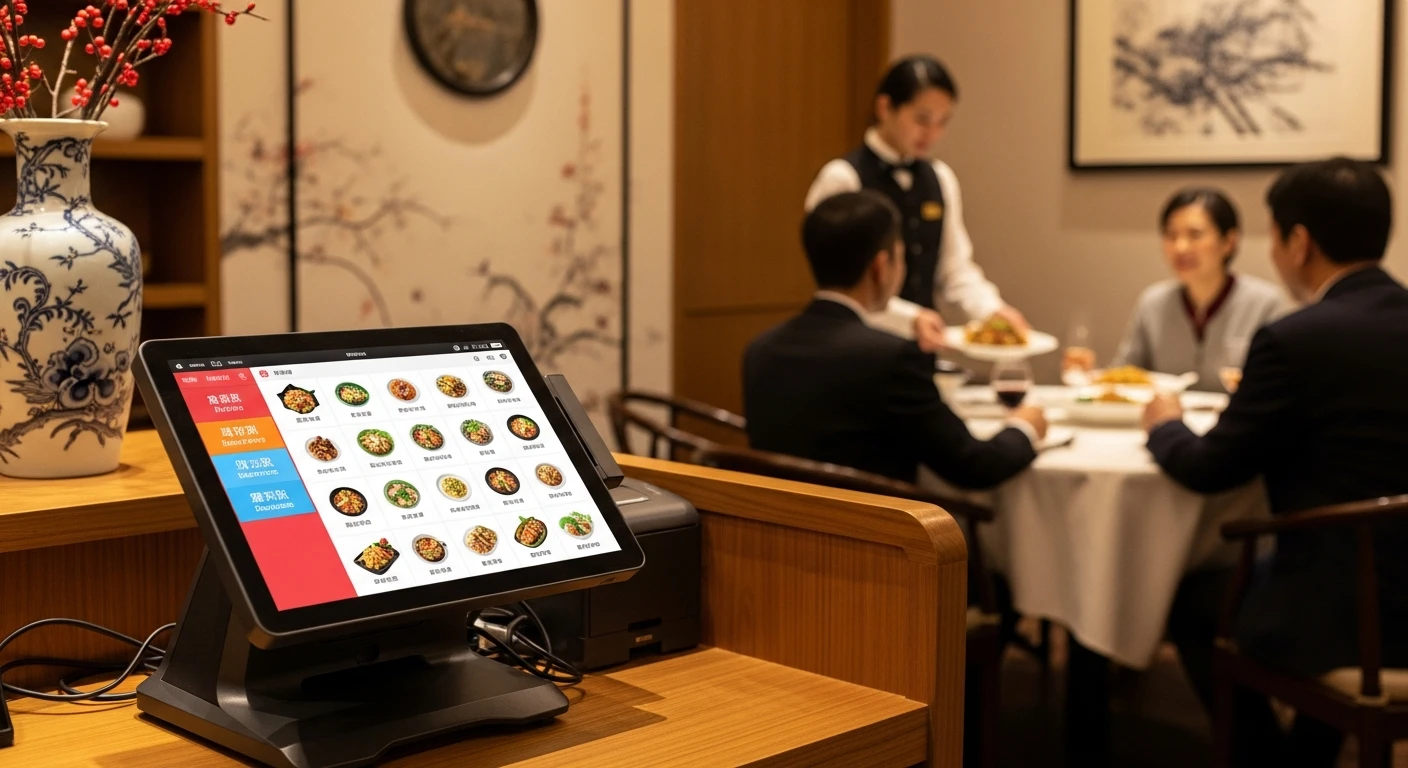
KwickPOS interface with full Chinese language support
Most popular restaurant POS systems—Toast, Square, Clover—were built for American casual dining and quick-service concepts. They work adequately for a burger joint or coffee shop, but they break down when faced with the complexity of a Chinese restaurant menu or the bilingual demands of an operation where the kitchen speaks Mandarin or Cantonese and the front of house serves English-speaking customers.
This guide examines what Chinese restaurants specifically need from a POS system and evaluates the best options available in 2026.
What Makes Chinese Restaurant POS Requirements Different
1. Complex Menu Structures and Modifiers
A typical Chinese restaurant menu can have 150 to 400+ items. Many dishes come in multiple sizes (small, medium, large), multiple preparation styles (steamed, fried, stir-fried, braised), with optional proteins (chicken, beef, shrimp, tofu), and customizable spice levels. A single dish like Mapo Tofu might have 6 to 10 modifier options.
Standard POS systems often limit the number of modifier groups or make it cumbersome to navigate deep modifier trees. When a server is taking an order for a table of eight at a busy dim sum restaurant, every extra tap adds up. The POS needs to support nested modifiers, forced modifiers, and conditional modifiers without slowing down order entry.
2. Bilingual Interface and Kitchen Tickets
In most Chinese restaurants, the front-of-house staff needs to read the POS in English (or both English and Chinese), while the kitchen team needs to read tickets in Chinese characters. This is not just a nice-to-have—it is operationally critical. A kitchen ticket that only displays "Kung Pao Chicken" in English when the wok chef reads Chinese creates errors and slowdowns.
The POS must support:
- Dual-language display on the ordering interface (English/Chinese simultaneously)
- Chinese character printing on kitchen tickets
- Configurable language settings per station (front POS in English, kitchen display in Chinese)
- Chinese character input for menu programming
3. Banquet and Large-Party Management
Chinese restaurants frequently handle banquets, pre-set menus, and family-style ordering where a table of 10 orders a fixed set of dishes to share. The POS needs to support:
- Pre-set banquet packages with fixed pricing
- Course sequencing (cold dishes first, then hot dishes, then soup, then dessert)
- Split checks across large parties with both per-item and even-split options
- Flexible deposits and pre-payments for reservations
4. Dim Sum and Cart Service
Dim sum restaurants have a unique ordering model where servers circulate with carts and stamp or scan items at the table. The POS needs to support quick item entry by category (small, medium, large, special, premium) with pricing tiers, and potentially handheld devices for roaming cart servers.
5. High-Volume Takeout and Delivery
Chinese restaurants have historically been among the highest-volume takeout operations in the restaurant industry. The POS must efficiently manage concurrent dine-in, takeout, and delivery orders without confusion, including caller ID integration, order-ahead capability, and clear kitchen routing to distinguish between takeout and dine-in tickets.
6. Multi-Concept Operations
Many Chinese restaurant owners operate multiple concepts—a hot pot restaurant, a dim sum house, and a noodle shop—sometimes under the same ownership. The POS should support multi-location management with centralized reporting while allowing each location to have distinct menus and configurations.
Top POS Systems for Chinese Restaurants in 2026
1. KwickOS (KwickPOS) — Best Overall
KwickOS was built with Asian restaurant operations as a core use case, not an afterthought. With over 4,000 restaurants on the platform—including Haidilao, the world's largest hot pot chain with 600+ locations—KwickOS has been battle-tested in some of the most demanding Chinese and Asian restaurant environments on the planet.
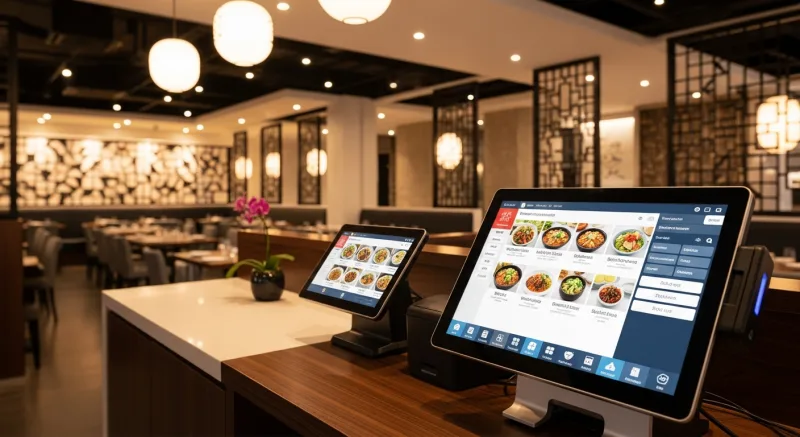
Chinese restaurant-specific features:
- Full Chinese language support: Interface, menu items, kitchen tickets, and customer-facing displays all support Chinese characters (Simplified and Traditional). Staff can switch between English and Chinese on the fly.
- Deep modifier system: Unlimited nested modifier groups with forced, optional, and conditional modifiers. Build complex menu items with any number of customization layers without slowing down order entry.
- Banquet mode: Pre-set banquet packages with course sequencing, flexible pricing, and deposit management for large-party events.
- Dim sum support: Quick-entry mode optimized for cart-based dim sum service with size-based pricing tiers.
- Multi-language kitchen tickets: Print tickets with Chinese item names for the kitchen and English names for the front of house, configurable per print station.
- Processor-agnostic: Choose your own payment processor and negotiate your own rates. Read our guide to POS processing fees to understand why this matters.
- Modular platform: Add KwickMenu for QR code ordering (great for table ordering in dim sum), KwickPhone for AI phone ordering (handles accented English and high call volumes), KwickSign for digital menu boards, and KwickTracker for multi-location analytics.
Why Chinese restaurants choose KwickOS: It is the only major POS platform where Chinese restaurant features are not a bolt-on addition but a foundational part of the product. The team behind KwickOS understands the specific operational workflows, menu structures, and language requirements that Chinese restaurants need.
Trusted by Haidilao and 4,000+ Restaurants
See why the world's top Chinese and Asian restaurants run on KwickOS.
Request a Demo2. Revel Systems
Best for: Large Chinese restaurant groups that need enterprise-level features and can invest in customization.
Revel is an iPad-based POS with strong multi-location management and an open API that allows for customization. While not specifically built for Chinese restaurants, Revel's flexibility allows operators with technical resources to configure complex menus and modifier structures. Some large Asian restaurant groups use Revel with custom integrations.
Limitations: No native Chinese language interface. Chinese character printing requires custom configuration. The learning curve is steep, and pricing is premium ($99+/month per terminal). Revel requires Revel-approved payment processing.
3. Aldelo Express
Best for: Smaller Chinese restaurants that want a budget-friendly option with basic Chinese language features.
Aldelo Express offers some Chinese language support and has a presence in the Asian restaurant market. It provides cloud-based POS functionality with menu modifier capabilities that can handle moderately complex Chinese menus. However, the modifier system is less sophisticated than KwickOS for restaurants with very large menus.
Limitations: Limited advanced features for banquet management and dim sum. Processing is handled through Aldelo's partner processors. Support resources for Chinese restaurant-specific configurations can be limited.
4. Menusifu
Best for: Chinese restaurants that prioritize Chinese-language-first operation and serve primarily Chinese-speaking communities.
Menusifu is a POS system built specifically for Asian restaurants, with a strong Chinese-first interface. It handles Chinese menu structures well and is popular with smaller Chinese restaurants. The system supports Chinese input, bilingual printing, and standard Chinese restaurant workflows.
Limitations: Smaller company with more limited support infrastructure. Fewer integrations with third-party tools. Less suitable for restaurants that need a polished English-facing interface for mixed-audience operations. Hardware options are more limited.
5. Toast / Square / Clover
Verdict: Not recommended for most Chinese restaurants.
While these are popular POS systems overall, they lack the specific features Chinese restaurants need. None offer native Chinese language interfaces. Modifier systems are designed for simpler American-style menus. Kitchen ticket printing in Chinese characters requires workarounds at best. Banquet mode and dim sum workflows are not supported.
Additionally, all three lock you into their own payment processing, adding unnecessary cost. For a detailed comparison, see our guide to Toast POS alternatives.
Feature Comparison for Chinese Restaurants
| Feature | KwickOS | Revel | Aldelo Express | Menusifu | Toast/Square |
|---|---|---|---|---|---|
| Chinese Language Interface | Full (Simplified + Traditional) | No | Partial | Full | No |
| Bilingual Kitchen Tickets | Yes | Custom config | Limited | Yes | No |
| Complex Modifier Trees | Unlimited | Advanced | Moderate | Moderate | Basic |
| Banquet Mode | Yes | Custom | Limited | Limited | No |
| Dim Sum Support | Yes | Custom | Limited | Yes | No |
| Processor-Agnostic | Yes | No | Limited | Limited | No |
| Multi-Location | Yes | Yes | Yes | Limited | Yes |
| Online Ordering (No Commission) | Yes (KwickMenu) | Add-on | Add-on | Limited | Add-on / commission |
| Digital Menu Boards | Yes (KwickSign) | No | No | No | No |
| AI Phone Ordering | Yes (KwickPhone) | No | No | No | No |
| Enterprise-Proven | Yes (Haidilao 600+ loc.) | Yes | SMB focused | SMB focused | Varies |
What to Ask During a POS Demo
When evaluating a POS system for your Chinese restaurant, bring these specific questions to every demo:
- "Show me how to enter a dish with five modifier groups." Time how many taps it takes. In a busy service, every extra second per order adds up across hundreds of orders.
- "Print a kitchen ticket in Chinese and show me what it looks like." Ask them to display the item name in Chinese characters with modifiers. If they cannot do it on the spot, the feature likely does not exist or requires custom development.
- "Walk me through a banquet order for a table of 12 with a pre-set menu." If the demo person is confused by this request, the system was not designed for Chinese restaurant operations.
- "Can my kitchen display show items in Chinese while the front POS shows English?" Per-station language configuration is essential for bilingual operations.
- "How do I handle a dim sum cart checkout?" Look for quick-entry, category-based item selection rather than scrolling through a full menu.
- "Can I choose my own payment processor?" This question alone can save you thousands per year. See our POS cost breakdown for the math.
- "How many Chinese restaurants are currently using your system?" A POS company that serves thousands of Chinese restaurants will understand your needs far better than one that serves a handful.
Real-World Example: Why Haidilao Chose KwickOS
Haidilao is the world's largest hot pot restaurant chain, operating over 600 locations globally. Hot pot service is one of the most operationally complex restaurant formats: each table has individual cooking equipment, diners order from extensive menus with dozens of broths, proteins, vegetables, and sauces, and the pace of ordering is continuous throughout the meal rather than occurring in a single burst.
Real KwickPOS installation in a Chinese restaurant
Haidilao chose KwickOS because it was the only platform that could handle:
- Massive menu complexity with hundreds of items and modifiers per location
- Full Chinese and multilingual support across global locations
- Real-time kitchen management for continuous ordering workflows
- Multi-location centralized management and reporting
- Processor-agnostic payment integration across different markets
If KwickOS can handle the scale and complexity of Haidilao's global hot pot operation, it can handle your Chinese restaurant—whether you are running a single neighborhood spot or a growing multi-location group.
The Bottom Line
Chinese restaurants have specialized POS requirements that most mainstream systems cannot adequately address. The right POS should speak your language (literally), handle your menu complexity without friction, support your unique service models (banquets, dim sum, family-style), and give you control over your payment processing costs.
For most Chinese restaurants in North America, KwickOS offers the strongest combination of Chinese language support, operational features, enterprise scalability, and cost control. It is purpose-built for the operational realities that Chinese restaurant owners face every day, backed by a track record that includes the most demanding restaurant brands in the world.
Schedule a demo, bring the questions listed above, and see for yourself whether the system can handle your specific operation. The right POS will feel like it was designed for your restaurant—because the best ones were.
Built for Chinese Restaurants, Proven at Global Scale
Join Haidilao and thousands of Chinese restaurants running on KwickOS.
Schedule Your Demo