Atlanta’s Restaurant Boom Needs Technology That Can Keep Up. Most POS Systems Can’t.
Updated March 2026 · By Tom Jin
Atlanta added more new restaurants between 2023 and 2025 than any other Southeastern metro. Over 1,200 new food-service establishments opened across Fulton, DeKalb, and Gwinnett counties during that stretch, driven by population growth that brought 80,000 new residents per year to the metro area. The city that was once known primarily for Waffle House and Chick-fil-A now operates one of the most diverse dining ecosystems in America — from the Buford Highway international corridor to Ponce City Market’s artisan food hall, from soul food institutions on Auburn Avenue to Buckhead’s white-tablecloth steakhouses.
But here is the tension: Atlanta’s restaurant growth has dramatically outpaced its restaurant technology adoption. Walk into many of these new establishments and you will find a Square terminal purchased at Best Buy or a Toast system installed because the sales rep was the first to call. The decision was made in haste, and the consequences unfold slowly — locked into processing rates that erode margins, dependent on cloud systems that falter during Georgia’s summer thunderstorms, and unable to scale when a single location becomes three.
Buford Highway: Where Forty Cuisines Share Ten Miles of Road
Buford Highway is not a restaurant district. It is a culinary United Nations stretching from Chamblee to Doraville, where Korean barbecue sits next to Salvadoran pupuserias, Vietnamese pho houses neighbor Ethiopian restaurants, and a Sichuan hot pot spot shares a strip mall with a Mexican taqueria. The corridor represents over 500 independently owned restaurants serving communities that conduct business in at least a dozen languages.
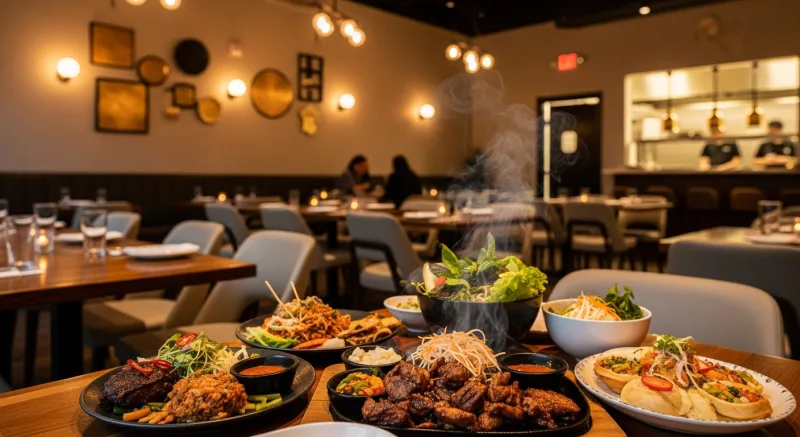
For these restaurants, language is not a nice-to-have feature in a POS system. It is the difference between functional operations and daily confusion. A Korean barbecue restaurant where the cooks read Hangul and the servers speak English needs a system where the front-of-house terminal displays English menus while the kitchen display system shows orders in Korean. Toast does not do this. Square does not do this. Clover certainly does not do this.
KwickOS supports English, Chinese, and Spanish natively across its entire interface, with each terminal independently configurable. For the significant Chinese restaurant population along Buford Highway — including hot pot, dim sum, and Cantonese seafood establishments — this means kitchen display systems that show dish names in Chinese characters, eliminating the transliteration errors that slow down kitchen production and cause wrong dishes to reach tables.
The Georgia Thunderstorm Problem That Nobody Talks About
Atlanta’s weather pattern from May through September follows a predictable cycle: morning heat builds, afternoon thunderstorms erupt between 3 PM and 6 PM, and power flickers or drops entirely across swaths of the metro area. These are not gentle rains. Georgia thunderstorms produce frequent lightning strikes that knock out Comcast nodes, trip building circuits, and leave restaurants scrambling during what should be their early dinner rush.
Cloud-dependent POS systems like Toast require constant internet connectivity to process transactions. When the Comcast node serving your stretch of Peachtree Street goes down at 5:30 PM on a July Thursday, Toast goes into limited offline mode — which means slower processing, no access to cloud features, and a prayer that transactions sync correctly when service returns. Square is even worse; its offline capabilities are minimal and unreliable.
KwickOS processes every transaction locally with 1-millisecond response times. The internet is used for cloud synchronization, remote management, and online ordering — not for processing the payment standing at your register. When Georgia Power flickers and Comcast drops, your registers keep ringing, your kitchen displays keep showing orders, and your staff keeps working without interruption. When connectivity returns, everything syncs automatically. This hybrid local-plus-cloud architecture was designed for exactly this kind of real-world unreliability.
Hartsfield-Jackson and the Airport Economy Restaurant
The world’s busiest airport sits in Atlanta, processing over 100 million passengers annually. But the airport effect on Atlanta restaurants extends far beyond the terminal food court. Hotel restaurants, convention center dining, and the entire airport-adjacent hospitality corridor in College Park and East Point operate on patterns unlike any other restaurant environment. Guests arrive at unpredictable hours. Business travelers expense everything. International passengers expect payment methods beyond standard chip-and-tap.
Restaurants within this airport economy need POS systems that handle high-volume, quick-turn dining where a table might flip four times during a two-hour lunch rush. Speed matters more than ambiance. KwickOS self-ordering kiosks allow guests to order and pay without waiting for a server, reducing the labor bottleneck that plagues understaffed airport-area restaurants. A single kiosk can process 40-50 orders per hour compared to a server managing 15-20 tables in that same timeframe.
How Crafty Crab Solved the Multi-Location Atlanta Problem
Crafty Crab Seafood operates 19 locations with 152 terminals, several of them in the Atlanta metro. Their expansion across the Southeast tested every assumption about multi-location restaurant management. Each location had slightly different menu items based on local seafood availability. Each kitchen had different staffing configurations. And the corporate office needed real-time visibility into every single location without calling individual managers.
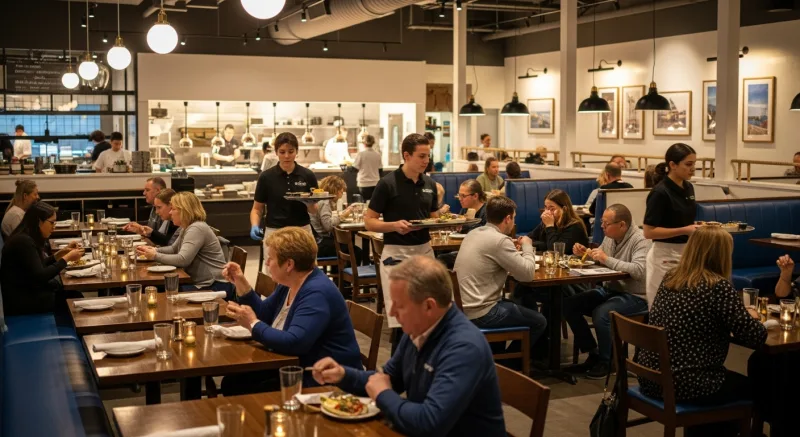
The solution was KwickOS’s centralized management with per-location customization. Crafty Crab syncs menus across all 19 locations with one click, but each location can maintain local modifications. When the Atlanta locations needed to add a seasonal crawfish boil special, they could add it to just those stores while the Tampa locations kept their standard menu. Corporate monitors all 152 terminals from a single dashboard, seeing real-time sales, labor metrics, and inventory levels without a single phone call.
This is the scale that Atlanta restaurants need to plan for. The city’s growth pattern means a successful single location almost inevitably becomes a multi-location operation. Choosing a POS system that cannot scale from one register to 152 terminals is choosing to rip out your technology during the most critical growth phase of your business.
Processing Economics: What Atlanta Restaurants Actually Pay
Atlanta’s average restaurant transaction volume ranges significantly by neighborhood. A Buckhead fine-dining establishment might process $150,000 per month in card payments. A Decatur lunch spot might do $40,000. The processing cost difference between a locked-in system and a negotiated rate is staggering at both ends.
Toast charges 2.99% plus $0.15 per transaction with no ability to use a different processor. On $100,000 monthly volume, that is $3,140 per month or $37,680 per year in processing fees. KwickOS is processor-agnostic — you choose your payment processor and negotiate your own rates. An Atlanta restaurant doing the same $100,000 monthly volume with a competitive processor at 2.2% plus $0.10 pays $2,300 per month. Annual savings: $10,080. Over a five-year lease term, that is $50,400 — enough to open a second location.
Square’s flat 2.6% plus $0.10 looks simple until you calculate what simplicity costs. On that same $100,000, Square takes $2,700 monthly. And neither Toast nor Square will let you leave without losing your entire technology stack, because the POS is the lock-in mechanism for the processing revenue. KwickOS has no stake in your processing fees. The software works with whatever processor gives you the best deal.
The Fingerprint Solution to Atlanta’s Labor Challenge
Metro Atlanta’s restaurant labor market is tight. The unemployment rate in food service hovers around 4%, meaning restaurants compete fiercely for workers and turnover rates exceed 80% annually. In this environment, every operational friction point matters — including how employees clock in and access the POS system.
Traditional POS systems use PIN codes or swipe cards. PINs get shared between employees (especially during shift changes at high-turnover restaurants). Swipe cards get lost, borrowed, or stolen. Both create security vulnerabilities and make time theft nearly impossible to detect. When an employee clocks in a friend who is running fifteen minutes late using a shared PIN, the restaurant pays for labor it did not receive.
KwickOS uses fingerprint 1:N identification — a single touch identifies the employee from the entire staff database without entering any code. No PINs to share. No cards to lose. Each transaction, each clock-in, each void, and each discount is biometrically linked to a specific person. For Atlanta restaurants dealing with 80% turnover, this eliminates the security gap that opens every time a departing employee walks out with a PIN they shared with three coworkers.
Digital Signage for Atlanta’s Food Hall Movement
Atlanta has embraced the food hall concept with particular enthusiasm. Ponce City Market, Krog Street Market, Chattahoochee Food Works, and the Municipal Market all represent the trend toward multi-vendor dining destinations. Operating inside a food hall creates unique technology requirements: limited physical space, shared seating (meaning no table-service POS workflow), high-volume counter service, and the need to stand out visually among a dozen competing stalls.
KwickSign, part of the KwickOS platform, turns any mounted screen into a dynamic digital menu board. Atlanta food hall vendors can update pricing, highlight specials, and rotate eye-catching visuals without printing a single poster. When the lunch rush hits and you want to promote your $12 combo, it updates across all screens instantly. When an ingredient runs out, the menu adjusts in real time. This digital presence matters in food halls where foot traffic passes your stall in seconds and the visual menu is your only sales pitch.
Gift Cards, Loyalty, and the Atlanta Brunch Culture
Atlanta’s brunch culture is not a trend. It is a way of life. From Midtown to East Atlanta Village, weekend brunch is the social event that drives some restaurants’ entire weekly revenue. A restaurant that does 40% of its sales between 10 AM and 2 PM on Saturday and Sunday needs technology that captures those customers and brings them back.
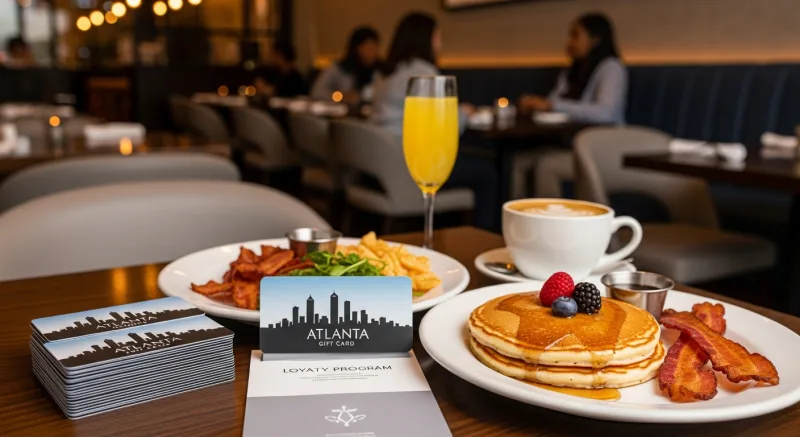
KwickOS integrates gift cards, loyalty points, and membership programs directly into the POS — no third-party app, no separate system, no additional monthly fee. A customer who waits 45 minutes for a brunch table and spends $60 earns loyalty points that pull them back next weekend instead of letting them try the new place down the street. Physical and digital gift cards drive new customer acquisition when existing customers buy them for friends. Membership programs create recurring revenue for restaurants that offer monthly brunch packages or priority seating.
Toast charges extra for its loyalty program. Square’s loyalty is a separate product with its own pricing tier. KwickOS includes it as part of the platform, because loyalty is not an add-on feature — it is fundamental to how restaurants retain customers.
KwickDriver vs. DoorDash in the Atlanta Delivery Market
Atlanta’s sprawl creates enormous delivery demand. Unlike dense cities where walking to a restaurant is common, metro Atlanta’s car-dependent geography means delivery is the default for many customers. DoorDash, UberEats, and Grubhub collectively take 20-30% commission on every order — a margin-destroying toll that Atlanta restaurants accept because they see no alternative.
KwickDriver offers an alternative. At $2 per delivery plus $6.99 per five miles, a $30 delivery order costs the restaurant $2 through KwickDriver versus $7.50-$9.00 through DoorDash. An Atlanta restaurant processing 30 delivery orders per day saves roughly $180 daily, or $5,400 per month. Over a year, that is $64,800 — money that was previously leaving the restaurant and going to a Silicon Valley company.
The delivery infrastructure connects directly to KwickOS’s online ordering system through KwickMenu, which processes orders through the restaurant’s own website rather than a third-party marketplace. Customers order from you, not from a platform that also shows them your competitors.
What Atlanta Restaurants Should Demand from Their POS
Atlanta’s restaurant market is growing too fast and operating under too much competitive pressure to settle for POS systems designed for simpler environments. The technology you install today determines your operational ceiling for the next five years. Before you sign a contract, verify these capabilities:
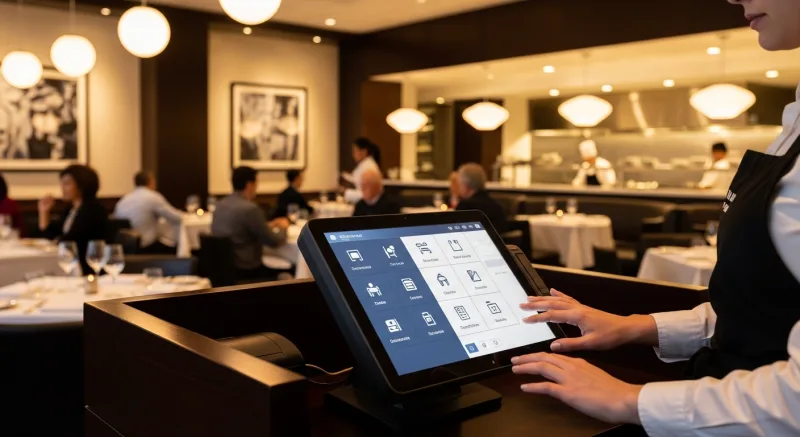
- Processor independence — Atlanta’s volume justifies aggressive rate negotiation; do not surrender that leverage
- Offline processing — Georgia thunderstorm season will test your connectivity; local processing keeps you running
- Multi-language support — Buford Highway alone justifies Chinese-language kitchen displays
- Multi-location scalability — If your restaurant succeeds, you will expand; plan for it now
- Fingerprint identification — 80% turnover demands security that does not depend on shareable credentials
- Integrated delivery — Atlanta’s sprawl makes delivery essential; flat-rate pricing protects margins
- Digital signage — Food halls and high-traffic locations need dynamic visual menus
- Built-in loyalty and gift cards — Brunch culture thrives on repeat customers; capture them without a separate system
Atlanta is no longer a second-tier restaurant city. It competes with New York, Chicago, and Los Angeles for culinary relevance. The technology running its restaurants should reflect that ambition, not undercut it.
Atlanta restaurant owners: Call (888) 355-6996 or visit KwickOS.com to see what processor-agnostic, offline-capable POS technology looks like in practice.

Founder & CIO of KwickOS · 30 Years IT · 20 Years Restaurant Industry
Tom built KwickOS after running restaurants and IT companies for decades. He relocated the company to a 10,000 sq ft office in 2023 and now serves 5,000+ businesses across all 50 states, processing over $2M in daily sales.