Silicon Valley Built the Future of Tech. Its Restaurants Are Stuck in the Past.
Updated March 2026 · By Tom Jin
The best Silicon Valley Built the Future of Tech. Its Restaurants Are Stuck ... handles everything from checkout to closing — without extra apps or workarounds. The irony is thick enough to cut with a sushi knife. San Jose sits at the epicenter of the global technology industry. Apple, Google, Adobe, Cisco, and hundreds of other tech companies operate within a 20-mile radius. The people building artificial intelligence, designing smartphones, and engineering self-driving cars eat lunch at restaurants running on POS systems that were obsolete before their latest product shipped. The world’s most technologically sophisticated workforce eats in restaurants using the world’s most commoditized technology.
San Jose and the greater Silicon Valley support over 6,000 restaurants serving a metro area of 2 million people with a median household income exceeding $130,000. The dining public is tech-literate, UX-sensitive, and expects digital experiences that match the standards they apply to consumer software. A restaurant with a clunky POS-driven online ordering experience loses the Apple engineer who evaluates interfaces professionally.
The Vietnamese Capital of America
San Jose has the largest Vietnamese population of any city outside Vietnam. The Vietnamese community, concentrated in the Story Road and Tully Road corridors and anchored by the Grand Century Mall, has built a restaurant scene of extraordinary depth: pho houses, banh mi shops, broken rice specialists, bun bo Hue joints, and Vietnamese coffee cafes that collectively represent the most comprehensive Vietnamese dining experience in the Western world.
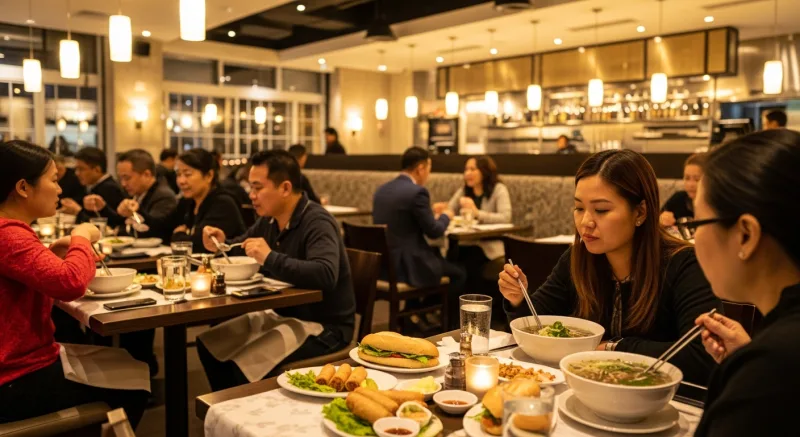
These restaurants operate with kitchen staffs who work in Vietnamese and, in many cases, use Chinese characters for certain menu items (Vietnamese cuisine shares vocabulary with Chinese cooking). KwickOS’s Chinese-language KDS support serves the subset of Vietnamese restaurants where Chinese characters are used for kitchen production. The visual KDS formatting with icon-based modifiers and color coding communicates across the Vietnamese-English language gap for operations that do not use Chinese characters.
For the Vietnamese restaurant economy, processing costs are a critical concern. A pho restaurant with $12-$15 average tickets and 300 daily transactions pays 4%+ effective processing through Toast. KwickOS with a competitive processor brings that under 2.5%. On 300 daily transactions at $13 average, the annual savings exceeds $19,000 — meaningful money for a family-owned pho house on Story Road.
The Tech Campus Lunch Economy
Apple Park, Google’s Googleplex, and the corporate campuses of Sunnyvale, Mountain View, and Cupertino create a lunch economy where the restaurants that serve tech workers compete not just with each other but with the free or subsidized food that many tech companies provide on campus. The restaurants that win this competition do so on quality, convenience, and speed — not price.
KwickMenu online pre-ordering is the essential tool for competing in the tech campus lunch market. A Google engineer who orders from their desk at 11:50 and picks up at 12:05 has a reason to leave campus for lunch. A restaurant that requires the engineer to stand in line for 8 minutes does not compete with the free cafeteria 200 feet from their desk. The integration between KwickMenu ordering and KDS production ensures the food is ready precisely when the engineer arrives.
KwickOS loyalty programs provide the other competitive advantage against campus dining: accumulated value. An engineer who has earned 600 loyalty points at your restaurant will walk past the free cafeteria because the free entree they are about to earn has more personal satisfaction than the adequate cafeteria meal.
Santana Row: San Jose’s Premium Dining District
Santana Row is an upscale mixed-use development that concentrates San Jose’s finest dining in a walkable, European-style district. Restaurants here serve the tech executive dinner crowd with average tickets of $65-$120 per person. At these volumes — $200,000-$400,000 monthly in card transactions — processor independence through KwickOS saves $25,000-$50,000 annually compared to Toast’s locked rates.
Membership programs through KwickOS serve Santana Row’s premium dining segment. A restaurant offering a $150/month wine club membership with exclusive tastings and priority seating creates predictable recurring revenue while building the VIP customer community that upscale dining depends upon. The membership management integrates into KwickOS — enrollment, billing, benefit tracking, and redemption all happen within the POS.
Japantown and the Historic Asian Food District
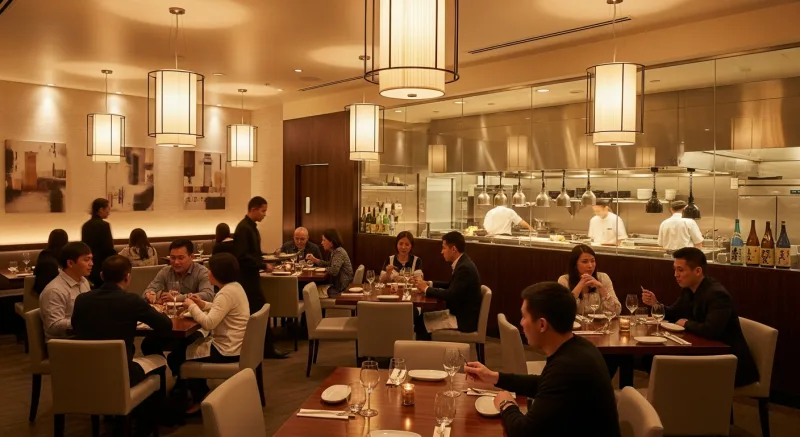
San Jose’s Japantown is one of only three remaining Japantowns in the United States. The restaurants here preserve Japanese culinary traditions while serving a broader customer base that includes the tech workforce and the university community. KwickOS’s flexible menu architecture handles the precision of Japanese cuisine — omakase course configurations, sashimi grade specifications, and sake pairings — with modifier trees that present each customization step cleanly.
The Earthquake Factor
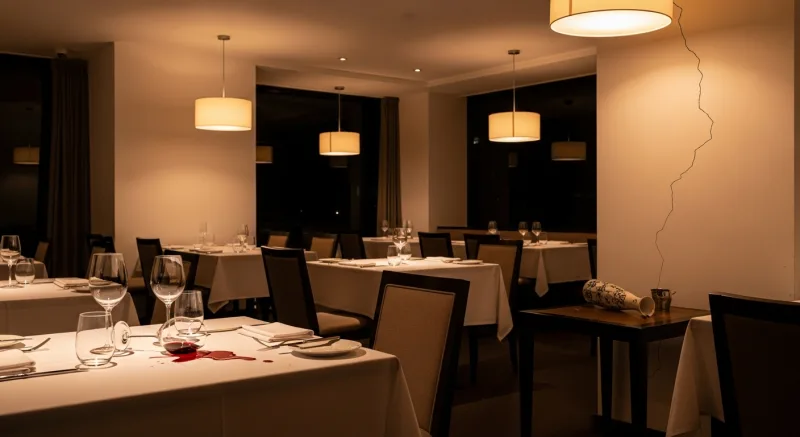
San Jose sits on the Hayward Fault, and the USGS estimates a 33% probability of a magnitude 6.7+ earthquake on this fault within the next 30 years. When it occurs, the infrastructure disruption will be similar to what San Francisco faces but amplified by Silicon Valley’s dependence on data center connectivity. KwickOS local processing ensures restaurants keep transacting through infrastructure disruption. All critical data resides locally with cloud backup. The POS does not depend on a data center that may itself be affected by the seismic event.
Convention Center and SAP Center Events
The San Jose McEnery Convention Center and SAP Center host tech conferences, concerts, and sporting events that create volume surges for downtown restaurants. KwickOS self-ordering kiosks handle event-driven crowds. Local processing at 1-millisecond speed ignores the cellular congestion from thousands of convention attendees. Gift card sales during events capture visitors for future return trips.
Milpitas, Fremont, and the South Bay Indian Food Corridor
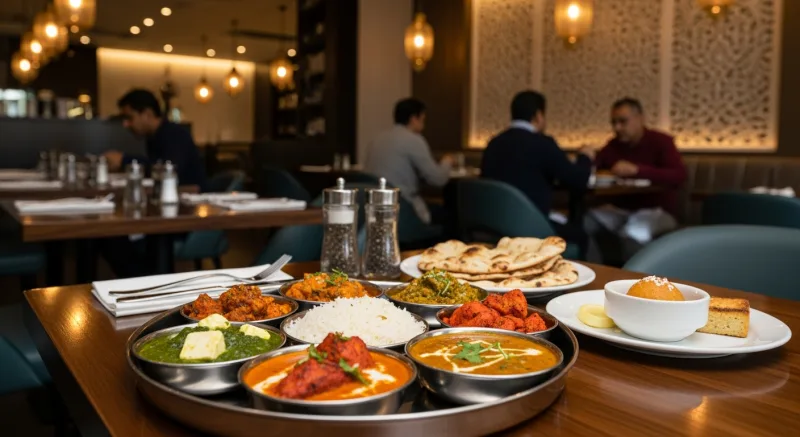
The Milpitas-Fremont corridor supports one of the largest concentrations of Indian restaurants outside of India. Dosa houses, biryani specialists, chaat counters, and fine-dining Indian restaurants serve the South Bay’s enormous Indian-American community. KwickOS’s configurable modifier trees handle Indian menu complexity: thali platters with six component selections, dosa builds with filling and chutney options, and biryani combos with protein and accompaniment choices. The KDS displays each build as a structured ticket that the kitchen scans and produces without interpretation delay.
San Jose POS Priorities
- UX-quality online ordering — Tech workers evaluate ordering interfaces by professional standards
- Vietnamese restaurant economics — Story Road pho houses need sub-2.5% processing rates
- Processor independence — Santana Row volumes save $25-50K annually with negotiated rates
- Pre-order for campus competition — Beating free tech cafeterias requires 5-minute guaranteed pickup
- Earthquake offline processing — Hayward Fault proximity makes cloud-only systems architecturally risky
- Loyalty vs. free campus food — Accumulated points compete with free cafeteria convenience
- Membership for premium dining — Santana Row VIP programs create recurring revenue
- Indian menu complexity — Milpitas-Fremont thali and dosa builds need deep modifier trees
Silicon Valley invests in the best technology for every industry except the one that feeds it. San Jose restaurants deserve POS innovation that matches the innovation happening in every building around them.
San Jose restaurant owners: Call (888) 355-6996 or visit KwickOS.com to see what happens when restaurant technology matches Silicon Valley standards.
Turn One-Time Diners into Regulars: Built-In Gift Cards & Loyalty
Most POS companies treat gift cards and loyalty as afterthoughts — expensive add-ons that cost $50-100/month extra. KwickOS includes them at no additional charge because we believe they are essential revenue tools, not luxury features.
Gift Cards That Actually Drive Revenue
Here is what most restaurant owners do not realize: gift card buyers spend an average of 20-40% more than the card's face value. A $50 gift card typically generates $60-70 in actual spending. KwickOS supports both physical gift cards and electronic gift cards that customers can purchase, send, and redeem through their phones.
- Physical gift cards — branded plastic cards that sit on your counter and sell themselves during holidays
- E-gift cards — customers buy and send digitally via text or email, perfect for last-minute gifts
- Balance tracking — real-time balance across all your locations, no manual reconciliation
- Reload capability — customers top up their balance, creating a built-in prepayment habit
Loyalty Points That Keep Them Coming Back
KwickOS loyalty is not a punch card from 2005. It is a digital points system that tracks every dollar spent and automatically rewards your best customers:
- Earn points on every purchase — configurable ratio (e.g., $1 = 1 point, or $1 = 10 points)
- Tiered rewards — silver, gold, platinum levels to incentivize higher spending
- Birthday rewards — automated birthday offers that bring customers back during their special month
- Points-for-payment — customers redeem points directly at checkout, seamless for your staff
Membership Programs
For restaurants running VIP programs or subscription models (like monthly coffee clubs), KwickOS membership management handles recurring billing, exclusive pricing tiers, and member-only menu items — all within the same system your cashier already uses.
The bottom line: Toast charges $75/month extra for loyalty. Square's loyalty starts at $45/month. KwickOS includes gift cards, e-gift cards, loyalty points, and membership management in every plan. That is $540-900/year you keep in your pocket.

Founder & CIO of KwickOS · 30 Years IT · 20 Years Restaurant Industry
Tom built KwickOS after running restaurants and IT companies for decades. He relocated the company to a 10,000 sq ft office in 2023 and now serves 5,000+ businesses across all 50 states, processing over $2M in daily sales.