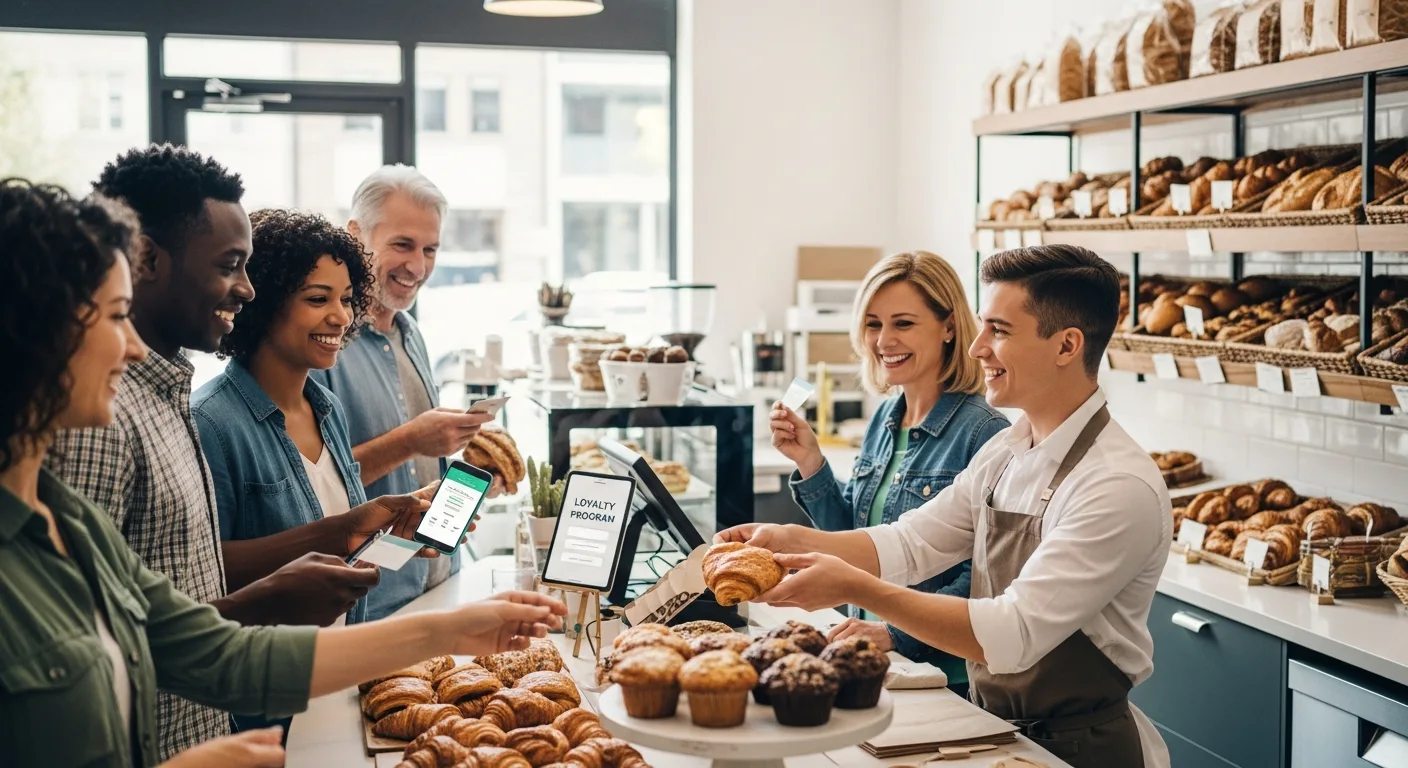
The bakery industry has a peculiar problem that coffee shops and restaurants do not share: almost every product is an impulse purchase. Nobody drives across town specifically for a croissant. They stop at whichever bakery is closest, smells best, or has the shortest line. That impulse-driven buying pattern means bakeries lose customers to convenience far more than to competition. A loyalty program does not just reward repeat behavior — it creates a reason to bypass the closer option and drive to yours.
Industry data tells a clear story. Bakeries with active loyalty programs see 35% more repeat visits than those without. Gift card holders spend 20-40% more per transaction than cash or credit customers. And subscription programs — where customers prepay for a weekly box or daily coffee-and-pastry combo — generate predictable revenue that smooths the feast-or-famine cycle bakeries know too well.
But the software you choose matters more than the strategy you design. A loyalty program that requires customers to download an app will capture maybe 15% of your customer base. One that works with a phone number at checkout captures 60% or more. A program that costs $75/month eats into margins that are already thin. One that is built into your POS at no extra cost starts generating ROI from day one.
What Bakery Loyalty Programs Need to Do (That Most Software Gets Wrong)
Bakeries operate differently from every other food service category, and generic loyalty software misses critical details. Here is what bakery-specific loyalty needs to handle:
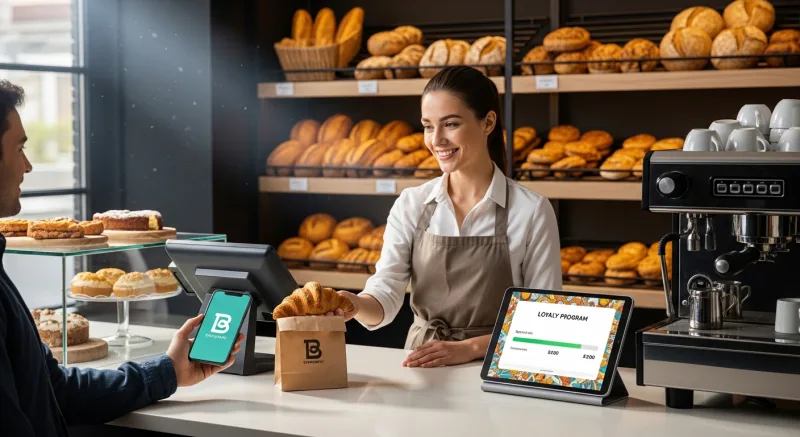
Low average ticket, high frequency. The average bakery transaction is $8-12. Earning meaningful rewards on an $8 purchase requires a points system calibrated for small tickets. A program designed for $40 restaurant tickets will feel impossibly slow to bakery customers — they will abandon it before earning their first reward.
Morning rush speed. Bakery peak hours are brutal: 7-9 AM and the lunch window. Any loyalty system that adds more than 3 seconds to checkout is a non-starter. Phone number lookup at the terminal is the fastest method. QR code scanning works if the reader is positioned well. Asking customers to open an app during the morning rush is operational suicide.
Product variety with seasonal rotation. Bakeries change their offerings constantly — seasonal flavors, holiday specials, limited runs. Your loyalty program needs to support bonus point events ("double points on any pumpkin item this week") without requiring a support ticket or programmer to configure.
Pre-order and subscription logic. The most profitable bakery loyalty programs include a subscription tier: pay $29/month, get a pastry and coffee every weekday. That model requires the loyalty system to integrate with the POS so the subscription is recognized automatically at checkout, not manually tracked by staff.
The 7 Loyalty Program Models That Work for Bakeries
1. Points-Per-Dollar (The Foundation)
The simplest model: customers earn points on every purchase and redeem them for free items. For bakeries, the sweet spot is 1 point per dollar spent, with redemption at 50-75 points for a free pastry or small coffee. That means a customer spending $10/visit earns a free item every 5-8 visits — frequent enough to feel attainable, infrequent enough to protect margins.
Configure bonus tiers to drive behavior: 2x points on weekday afternoons (when traffic drops), 3x points on new menu items (to drive trial), and 5x points during the first week after signup (to create immediate engagement).
2. Punch Card (Digital, Not Paper)
The classic "buy 9, get the 10th free" model still works — but only digitally. Paper punch cards have a 70% loss rate and are trivially counterfeited (anyone with a hole punch can give themselves a free sandwich). Digital punch cards tracked through the POS have a 0% fraud rate and provide actual data: who is using them, how often, and what they are buying.
For bakeries, the best configuration is category-specific: a coffee punch card (buy 7 coffees, get one free) and a pastry punch card (buy 10 pastries, get one free) running simultaneously. This encourages cross-purchasing between categories.
3. Tiered Membership Rewards
Create three tiers based on annual spend:
- Fresh (default): 1 point per dollar, birthday reward
- Regular ($300+/year): 1.5x points, early access to seasonal items, free upsize on drinks
- VIP ($600+/year): 2x points, free birthday cake (up to $30 value), exclusive tasting events, 10% off catering orders
The psychology here is powerful. A customer spending $8/week ($416/year) automatically qualifies for the Regular tier. To reach VIP, they need to increase to about $12/week — a modest upsell that the tier incentive naturally drives.
4. Birthday and Anniversary Rewards
Birthday rewards are the highest-ROI element of any bakery loyalty program, and it is not close. Here is why: the average birthday reward email has a 45% open rate (compared to 20% for regular marketing emails) and a 35% redemption rate. When a bakery customer comes in to redeem their free birthday cupcake or cookie, they bring friends. The average birthday reward redemption visit generates $22 in total sales — on a reward that cost the bakery $3 in product.
Best practice: send the birthday reward 7 days before the actual birthday (so they can plan a visit), with a 14-day redemption window. Offer a free item rather than a discount — "free cupcake of your choice" feels more generous than "$3 off" even though the cost is the same.
5. Gift Card Programs
Gift cards are the most underused tool in bakery loyalty, and the data on why they should not be is overwhelming. Gift card holders spend 20-40% more than the card value on average. A $25 gift card generates $30-35 in total spending. And 6-10% of gift card balances are never redeemed — that is pure profit.
For bakeries, gift cards serve a dual purpose: they are a loyalty tool for existing customers and a customer acquisition tool. When someone gives a bakery gift card as a present, they are sending a new customer to your door with money already committed to spending there.
Configure your gift card program with these options: physical cards for in-store display ($25, $50, $100 denominations), digital e-gift cards for online purchase, and automatic reload options for regular customers who want to prepay.
6. Subscription and Prepaid Models
This is where bakery loyalty programs are heading in 2026, and early adopters are seeing remarkable results. The subscription model works like this:
- Daily Coffee Club: $49/month for one drip coffee every day ($2.50 value x 30 = $75 retail value). The bakery gives a perceived 35% discount but gains a guaranteed daily visit, and most subscribers add a pastry ($4-6) at least 3x/week.
- Weekend Baker's Box: $25/month for a curated box of 6 pastries every Saturday. Predictable production planning, zero waste on those items, and customers feel like they are in an exclusive club.
- Catering Subscription: For office customers — $199/month for a weekly delivery of assorted pastries for the office. Locks in B2B revenue that would otherwise be one-off orders.
7. Referral Rewards
The cheapest customer acquisition channel is a referral from an existing customer. Configure your loyalty program to reward both parties: the referrer gets 50 bonus points, and the new customer gets a free pastry on their first visit. Track referrals by unique codes or links tied to each loyalty member.
Software Comparison: What Bakeries Actually Pay
Here is the reality of loyalty program pricing in 2026:
| Platform | Loyalty Cost | Gift Cards | Subscriptions |
|---|---|---|---|
| Toast | $75/month add-on | Extra fee | Not supported |
| Square | $45/month (Loyalty Plus) | Included | Limited |
| Clover | $39-99/month (third-party apps) | $9.95/month | Not native |
| KwickOS | $0 (built-in) | Included | Supported |
Over a year, the difference is stark: Toast's loyalty program costs $900/year just for the loyalty module. Square costs $540/year. KwickOS includes loyalty, gift cards, points, tiered rewards, and customer CRM as part of the base platform — $0 additional.
How to Configure Points for a Bakery (Exact Settings)
Generic loyalty defaults are designed for restaurants with $30+ average tickets. Bakeries need different math. Here are the exact configurations that work:
Points earning rate: 10 points per dollar spent (not 1 point per dollar — the higher number feels psychologically more rewarding). A $9 purchase earns 90 points, which feels meaningful.
Redemption thresholds:
- 500 points = free cookie or small pastry ($3 value)
- 800 points = free large pastry or small coffee ($5 value)
- 1,200 points = free specialty coffee or sandwich ($7 value)
- 2,000 points = free cake slice or large specialty drink ($9 value)
At 10 points per dollar, a customer spending $10/visit earns a free cookie after 5 visits, a free coffee after 8 visits. That is the right pace — fast enough to keep engagement, slow enough to protect your margins at under 8% reward cost.
Bonus point events: Schedule these monthly to maintain engagement:
- Double points on new menu item launches (drives trial)
- Triple points on slow days — typically Tuesday and Wednesday afternoons
- 5x points during enrollment week for new members (creates immediate account activity)
- Birthday month: 2x points all month long, plus the free birthday item
Real Bakery Results: What Loyalty Actually Delivers
Bakeries implementing comprehensive loyalty programs see measurable results within 60-90 days:
- Visit frequency increases 35%. The average non-loyalty customer visits a bakery 1.8 times per month. Loyalty members visit 2.4 times per month. Over a year, that is 7 additional visits per customer.
- Average ticket increases 12%. Loyalty members spend more per visit because they are "earning" something. The points psychology works.
- Gift card revenue spikes during holidays. Bakeries with gift card programs see 15-20% of November-December revenue come from gift card purchases — money collected before products are delivered.
- Subscription programs hit 85% retention. Once a customer subscribes to a weekly box or daily coffee plan, the monthly churn rate is under 15%. That is recurring revenue bakeries never had before.
Baked Cravings, which runs KwickOS on a PaxA35 terminal in a self-serve kiosk setup at Lego Land, uses the built-in loyalty system to capture tourist customers who would otherwise be one-time visitors. By enrolling kiosk customers with just a phone number, they have built a re-engagement list that drives online orders from customers who first discovered them at the theme park.
Implementation: Week-by-Week Launch Plan
Week 1: Foundation. Configure your points system in the POS. Set earning rates, redemption thresholds, and bonus multipliers. Create your tier structure. Design and order physical gift cards if desired.
Week 2: Staff training. Every employee should be able to explain the program in under 15 seconds: "Would you like to earn points toward free pastries? I just need your phone number." Practice the enrollment flow until it takes under 5 seconds at checkout.
Week 3: Soft launch. Enroll customers without heavy promotion. Fix any workflow issues that arise during the morning rush. Adjust the enrollment script based on what staff report is working.
Week 4: Full launch. Add counter signage. Post on social media. Send an email to your existing customer list. Set a goal of enrolling 50% of transactions in the first month.
Month 2-3: Optimize. Review redemption data. If nobody is reaching the first reward tier, lower the threshold. If everyone is redeeming immediately, raise it slightly. Add your first bonus point event. Launch the birthday rewards program.
Month 4-6: Expand. Introduce the subscription model. Launch the referral program. Begin gift card promotions for upcoming holidays. By month 6, your loyalty program should be generating measurable increases in visit frequency and average ticket.
Mistakes That Kill Bakery Loyalty Programs
Requiring an app download. Only 15-20% of customers will download a dedicated bakery app. Phone-number-based enrollment captures 4x more members. Your POS should support both, but phone number should be the default.
Rewards that take too long. If a customer visiting twice a week cannot earn their first reward within 3 weeks, the program feels like a scam. Bakery programs need faster cycles than restaurant programs because the ticket is lower.
No communication after enrollment. Signing up a customer and then never contacting them is worse than not having a program at all. Automated messages should fire at: enrollment confirmation, first reward earned, reward ready to redeem, birthday approach, and 30-day inactivity ("We miss you — here is 50 bonus points to come back").
Treating all customers the same. Your daily regulars and your once-a-month visitors should not be in the same tier. Tiered programs recognize and reward your best customers, which makes them feel valued and spend more.
Why KwickOS Loyalty Works for Bakeries
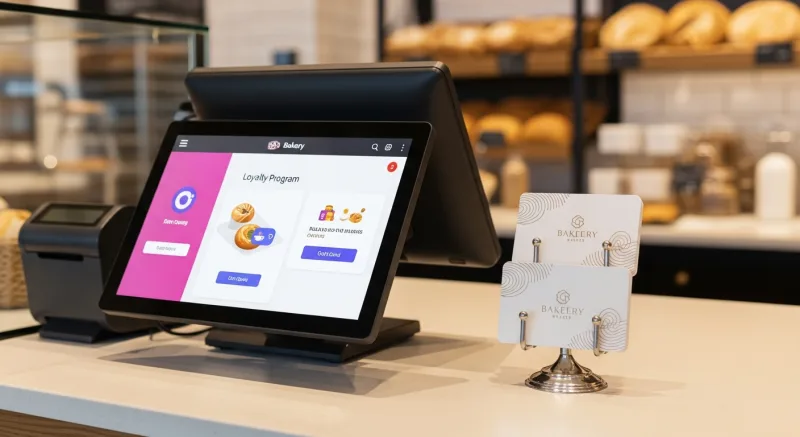
KwickOS includes the full loyalty engine — points, tiers, gift cards, birthday rewards, customer CRM, and automated messaging — at no additional monthly cost. The system is configured directly in the POS, so there is no third-party integration to maintain, no separate login for staff, and no sync delay between the loyalty system and the register.
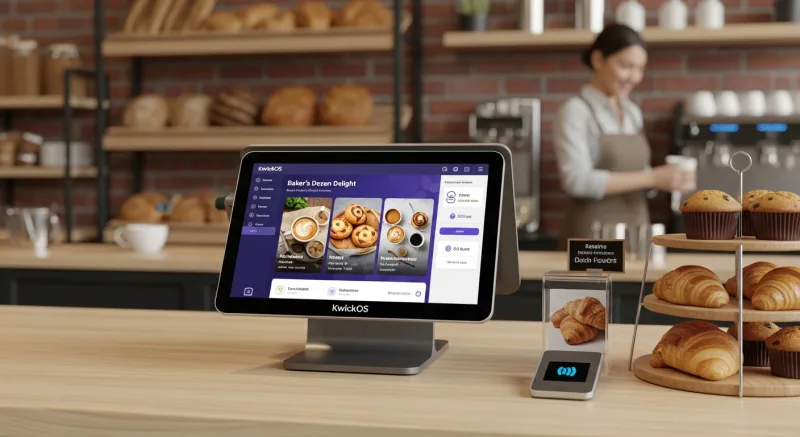
Points are calculated and displayed in real time at checkout. Staff see the customer's name, tier, points balance, and available rewards the moment they enter a phone number. Gift cards are sold and redeemed through the same terminal. Birthday rewards trigger automatically based on the enrollment date.
Because KwickOS is processor-agnostic, bakeries keep 100% of their credit card processing revenue — there is no loyalty system surcharge hidden inside an inflated processing rate. And because the system runs on a hybrid local+cloud architecture, loyalty lookups happen in 1ms locally rather than waiting for a cloud round-trip during the morning rush.
Launch Your Bakery Loyalty Program This Week
KwickOS includes loyalty, gift cards, tiered rewards, and customer CRM at no extra cost. See how bakeries are turning walk-ins into weekly regulars.
Book Your Free Demo