Start With the Math. It Is Worse Than You Think.
Take a restaurant doing $10,000 per month in delivery orders through DoorDash or UberEats. That is a modest number — many restaurants in urban areas do two or three times that. Here is what the platform takes before you see a dollar:
| Commission Tier | Rate | Monthly Cost | Annual Cost | 3-Year Cost |
|---|---|---|---|---|
| DoorDash Basic | 15% | $1,500 | $18,000 | $54,000 |
| DoorDash Plus | 25% | $2,500 | $30,000 | $90,000 |
| DoorDash Premier | 30% | $3,000 | $36,000 | $108,000 |
| UberEats Standard | 15% | $1,500 | $18,000 | $54,000 |
| UberEats Premium | 30% | $3,000 | $36,000 | $108,000 |
Read that again: $18,000 to $36,000 per year — on just $10,000 per month in delivery orders. That is the salary of a part-time manager. The down payment on a kitchen renovation. A year of marketing budget that could actually build your brand.
And that is the published rate. It does not include the additional costs that most restaurant operators overlook.
The Costs They Do Not Put on the Contract
Commission percentages are only the beginning. Third-party delivery platforms extract value from restaurants in at least six additional ways:
1. Menu Price Inflation
To offset commissions, most restaurants raise menu prices on delivery apps by 15% to 20%. A $14 entree becomes $16.80. Customers notice. Some order less. Others leave negative reviews about pricing. You absorb the brand damage either way.
2. Marketing and Boost Fees
DoorDash charges an additional 1.5% to 6% for "DashPass" visibility and search ranking boosts. UberEats runs a similar program. Without paying these fees, your listing gets buried beneath competitors who do pay. So the 15% tier is really 16.5% to 21%. The 30% tier is really 31.5% to 36%.
On $10,000 per month in orders, that is an extra $150 to $600 per month — $1,800 to $7,200 per year — on top of the base commission.
3. Refund Chargebacks You Did Not Cause
When a delivery driver leaves food on a wrong doorstep, spills a drink, or takes 90 minutes on a 30-minute delivery, the customer complains. The platform issues a refund. In many cases, the restaurant absorbs part or all of that cost, even though the error happened during delivery — a process the restaurant has zero control over.
4. Customer Data You Never Receive
Every order through DoorDash or UberEats generates customer data — name, email, phone number, order history, preferences, frequency. The platform keeps all of it. You get none of it. You cannot send a follow-up email. You cannot offer a loyalty discount. You cannot run a targeted promotion to bring a lapsed customer back.
In a direct ordering model, every single order builds your customer database. Over 12 months, a restaurant doing 500 delivery orders per month accumulates 6,000 customer records — an asset worth thousands in future marketing value.
5. Brand Dilution
On DoorDash, your restaurant appears in a feed alongside 40 to 100 competitors. The platform actively encourages comparison shopping. Your logo is a tiny thumbnail. Your brand story is invisible. You are reduced to a menu and a rating number.
6. Dependency and Rate Increases
Once a restaurant becomes dependent on third-party delivery volume, the platform has leverage. Commission rates have only gone up since these platforms launched. DoorDash's original commission was 10%. It is now 15% to 30%. There is nothing stopping another increase.
How Third-Party Platforms Engineered This Dependency
Understanding the business model helps explain why the fees are what they are — and why they are unlikely to decrease.
DoorDash, UberEats, and Grubhub are not technology companies that happen to deliver food. They are marketplace platforms that monetize the gap between restaurants and customers. Their business model requires them to:
- Acquire customers through heavy advertising ($500M+ annually across the industry) and subsidized delivery fees.
- Insert themselves between the restaurant and the customer, owning the relationship and the data.
- Extract commission on every transaction, indefinitely, because the restaurant never gets direct access to the customer.
This is a toll booth model. Every time a customer who already knows and loves your restaurant orders through DoorDash, you pay the toll. Not once — on every single order, forever.
Consider a loyal customer who orders from your restaurant twice per month through DoorDash, with an average order of $45. At a 25% commission rate:
- Per order commission: $11.25
- Monthly commission on this one customer: $22.50
- Annual commission on this one customer: $270
That customer already knows your restaurant. They chose you specifically. Yet you pay $270 per year for the privilege of having DoorDash relay their order to your kitchen. Multiply that by 100 repeat customers and you are looking at $27,000 per year in commissions on orders that would have come to you anyway — if you had a direct ordering channel.
The KwickOS Alternative: Own Your Delivery Channel
The solution is not to abandon delivery. Delivery revenue is real, growing, and customers expect it. The solution is to own the ordering and delivery process so the revenue stays in your business.
KwickOS provides three integrated modules that replace the third-party delivery model entirely:
KwickMenu: Commission-Free Online Ordering
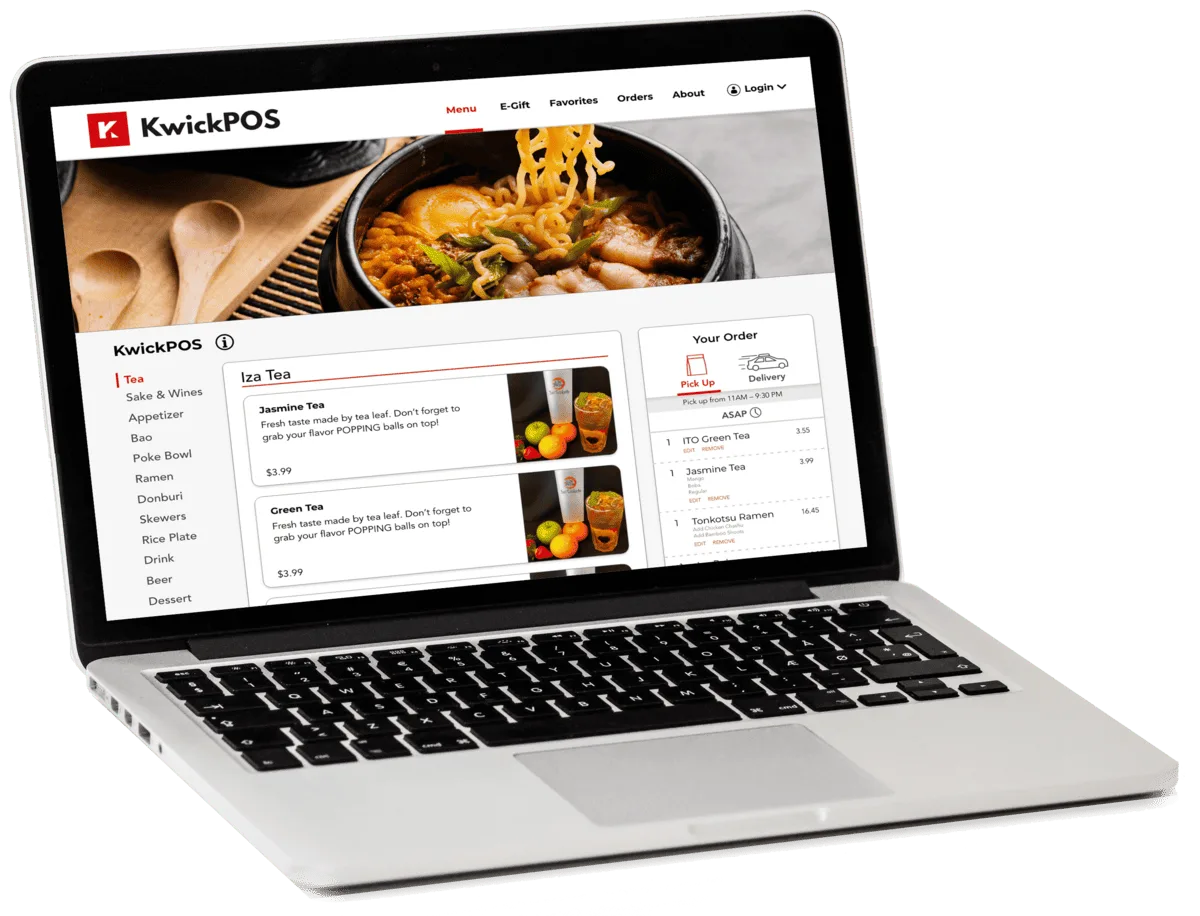
KwickMenu is an online ordering system built directly into the KwickPOS platform. It gives your restaurant a branded ordering page — accessible via your website, Google Business Profile, social media, or QR codes — where customers order and pay without any per-order commission.
Key capabilities:
- Zero commission per order. No percentage-based fees. No per-order technology charges. Orders flow directly to KwickPOS and your kitchen display.
- Real-time menu sync. Update a price, mark an item 86'd, or add a special — changes appear on the online menu instantly because KwickMenu runs on the same database as your POS.
- Customer data ownership. Every order captures the customer's name, contact information, and order history. You own this data. Use it for email marketing, loyalty programs, and targeted promotions.
- QR code and link ordering. Generate QR codes for table tents, flyers, receipts, and packaging. Customers scan and order directly — no app download required.
KwickDriver: Your Own Delivery Fleet at a Flat Fee
The most common objection to leaving third-party platforms is: "But who will deliver the food?" KwickDriver solves this with an on-demand delivery network available at a transparent flat rate:
- $2.00 flat fee per delivery dispatch
- $6.99 per 5 miles of delivery distance
No percentage of order value. No hidden surcharges. No boost fees.
Let us compare this directly to DoorDash on a typical $45 delivery order going 3 miles:
| Cost Component | DoorDash (25% Tier) | KwickDriver |
|---|---|---|
| Commission / Delivery Fee | $11.25 (25% of $45) | $8.99 ($2.00 + $6.99) |
| Marketing Boost (avg 3%) | $1.35 | $0.00 |
| Total Cost to Restaurant | $12.60 | $8.99 |
| Restaurant Keeps | $32.40 (72%) | $36.01 (80%) |
That is $3.61 more per order in the restaurant's pocket. On 300 delivery orders per month, that adds up to $1,083 per month — $12,996 per year — in additional retained revenue.
Now scale this to the DoorDash Premier tier at 30%:
| Cost Component | DoorDash (30% Tier) | KwickDriver |
|---|---|---|
| Commission / Delivery Fee | $13.50 (30% of $45) | $8.99 ($2.00 + $6.99) |
| Marketing Boost (avg 3%) | $1.35 | $0.00 |
| Total Cost to Restaurant | $14.85 | $8.99 |
| Restaurant Keeps | $30.15 (67%) | $36.01 (80%) |
The difference: $5.86 per order. On 300 orders per month: $1,758 per month. $21,096 per year.
And here is what the math looks like on pickup orders — where there is no delivery at all:
| Scenario | DoorDash Pickup (6-15%) | KwickMenu Direct Pickup |
|---|---|---|
| Commission on $45 Order | $2.70 - $6.75 | $0.00 |
| Annual Cost (200 orders/mo) | $6,480 - $16,200 | $0 |
For pickup orders, DoorDash charges 6% to 15% even though they do not deliver anything. The customer drives to your restaurant, picks up the food, and DoorDash takes a cut for displaying your menu on their app. With KwickMenu, pickup orders cost you nothing beyond your standard payment processing rate.
KwickTracker: Real-Time Delivery Management
When you run your own delivery operation, you need visibility into where drivers are, which orders are en route, and how long deliveries are taking. KwickTracker provides:
- Live driver GPS tracking integrated directly into the KwickPOS dashboard.
- Automated dispatch that assigns orders to the nearest available driver.
- Customer-facing tracking links so customers can see their delivery status in real time — just like DoorDash, but under your brand.
- Delivery time analytics to identify bottlenecks and improve service speed.
The customer experience matches or exceeds what DoorDash offers. The difference is that you control it, you own the data, and you keep the revenue.
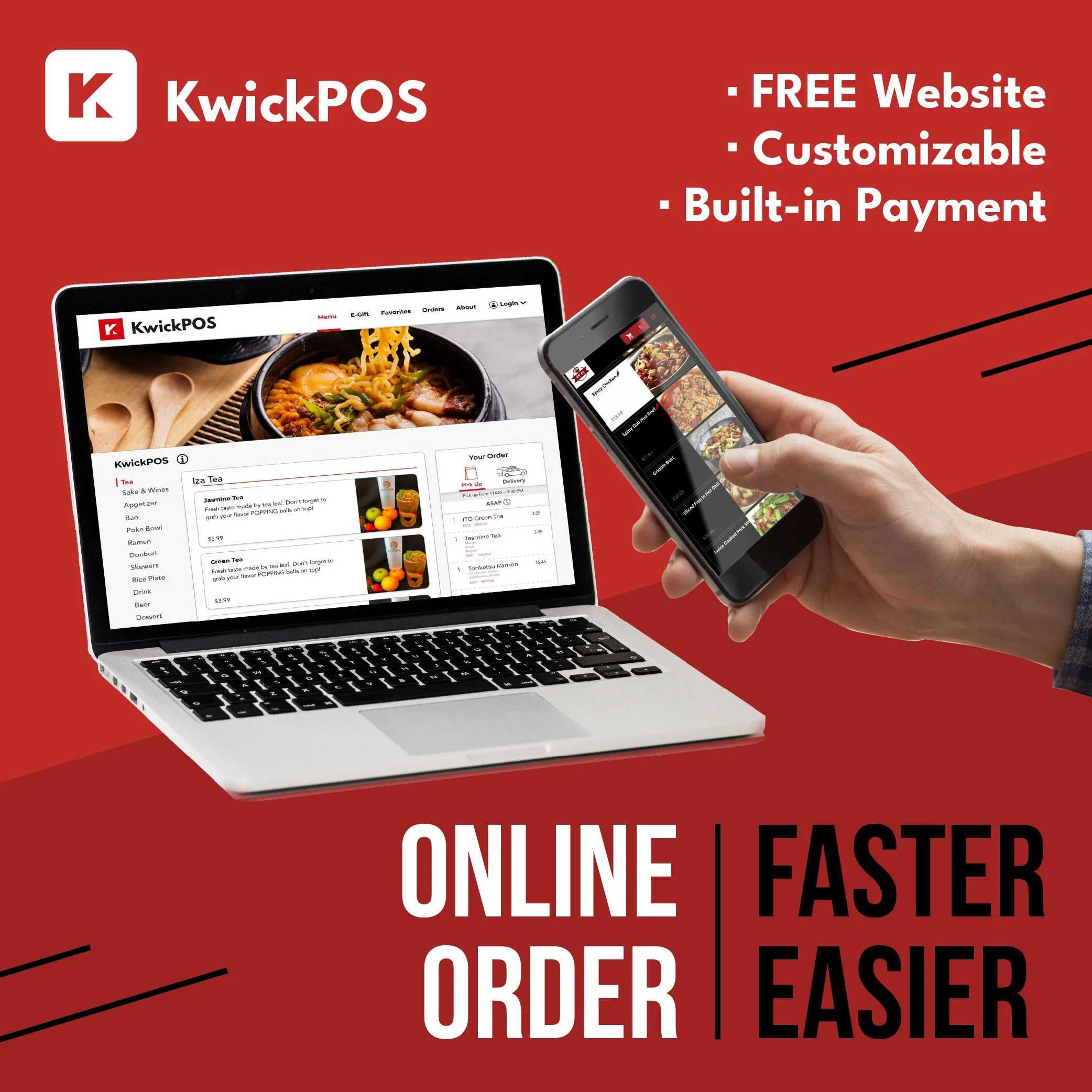
Real-World Example: Tiger Sugar International Dessert
Tiger Sugar International Dessert operates 2 stores with 2 kiosks running on KwickOS. Their approach to direct ordering illustrates how the strategy works in practice.
Tiger Sugar uses electronic receipts — generated automatically through KwickPOS — that include direct order links and QR codes. Every in-store customer who receives an electronic receipt gets a frictionless path to order online next time without going through a third-party app.
This is not a complicated marketing strategy. It is a system design decision: build the direct ordering link into every touchpoint — receipts, kiosk screens, packaging — so the next order comes directly to you instead of through a platform that takes 15% to 30%.
Tiger Sugar is one of 5,000+ active merchants already running on the KwickOS platform, many of whom have adopted this same receipt-to-reorder workflow to convert third-party customers into direct customers.
Addressing the Elephant: "But DoorDash Brings Me New Customers"
This is the most common argument for staying on third-party platforms, and it contains a grain of truth. DoorDash and UberEats do function as discovery platforms. Customers searching "Thai food near me" will find restaurants they have never tried. That has real value.
But here is what restaurant operators get wrong: they treat DoorDash as a permanent ordering channel instead of what it actually is — a customer acquisition channel.
Think about it this way. If a customer discovers your restaurant through DoorDash and orders once, you paid $11.25 (on a $45 order at 25%) for that acquisition. That is expensive, but it is in the range of a reasonable customer acquisition cost for a restaurant.
The problem is that you continue paying $11.25 on every subsequent order from that same customer. The second order. The tenth order. The fiftieth order. You are paying acquisition cost on a customer you already acquired.
The smart strategy is a two-step approach:
- Use DoorDash for discovery. Maintain a presence — potentially with a limited menu — so new customers can find you.
- Convert every DoorDash customer to direct ordering immediately. Include a flyer in every third-party delivery bag with a clear offer: "Order direct at [yoursite.com] — save 10% on your next order." Give them a reason to switch. Make it easy with a QR code that goes straight to your KwickMenu ordering page.
Let us model the economics of this hybrid approach:
| Metric | 100% DoorDash | Hybrid (Convert 40% to Direct) |
|---|---|---|
| Monthly Delivery Orders | 300 | 300 (180 DoorDash + 120 Direct) |
| Avg Order Value | $45 | $45 |
| Monthly Revenue | $13,500 | $13,500 |
| DoorDash Commission (25%) | $3,375 | $2,025 (on 180 orders) |
| KwickDriver Cost (120 orders) | $0 | $1,079 (120 x $8.99) |
| Total Platform/Delivery Cost | $3,375 | $3,104 |
| Monthly Savings | — | $271 |
| Annual Savings | — | $3,252 |
At 40% conversion, you save $3,252 per year. That is a conservative estimate. Restaurants that actively promote direct ordering — with flyers, receipt links, social media, and staff training — typically convert 40% to 60% of repeat delivery customers within six months.
At 60% conversion (180 direct, 120 DoorDash), the annual savings climb to $7,776. At 80% conversion, they exceed $12,000.
And remember: every direct order also gives you the customer's data, which lets you market to them, build loyalty, and drive future orders without paying anyone a commission.
The Full Financial Picture: Year-Over-Year Savings
Here is what a restaurant doing $10,000 per month in delivery saves by progressively shifting orders to KwickOS direct ordering over three years:
| Year | % Direct Orders | DoorDash Commission Paid | KwickDriver Cost | Total Delivery Cost | vs. 100% DoorDash |
|---|---|---|---|---|---|
| Year 1 | 40% | $18,000 | $10,069 | $28,069 | Save $1,931 |
| Year 2 | 65% | $10,500 | $16,362 | $26,862 | Save $3,138 |
| Year 3 | 80% | $6,000 | $20,138 | $26,138 | Save $3,862 |
| 3-Year Cumulative Savings | $8,931 | ||||
These are delivery order savings alone. The pickup order savings are even more dramatic because KwickMenu is completely commission-free. A restaurant converting 200 monthly pickup orders from DoorDash (at 10% average commission) to KwickMenu direct ordering saves an additional $10,800 per year — with zero delivery costs involved.
Combined savings on delivery and pickup orders by shifting to direct ordering: $15,000 to $40,000+ per year, depending on volume and current commission tier. For a business operating on 5-10% net margins, this can be the difference between profit and loss.
The Playbook: How to Make the Switch
Transitioning from third-party platforms to direct ordering is not an overnight process. It is a 90-day rollout that, when executed correctly, shifts the majority of your delivery revenue to commission-free channels.
Week 1-2: Set Up the Infrastructure
- Activate KwickMenu and configure your online ordering page with current menu, pricing, hours, and delivery zones.
- Set up KwickDriver for delivery dispatch or configure your own driver fleet within KwickTracker.
- Generate QR codes linking to your direct ordering page.
- Test the full order flow end to end: customer places order, order appears in KwickPOS, kitchen prepares, driver delivers.
Week 3-4: Launch Direct Ordering Promotion
- Place QR code table tents on every table and counter.
- Insert flyers in every third-party delivery bag: "Order direct. Save 10%. Scan here."
- Update your Google Business Profile "Order" button to link to your KwickMenu page instead of DoorDash.
- Post your ordering link on Instagram, Facebook, and your website.
- Configure electronic receipts (like Tiger Sugar) to include direct ordering links automatically.
Month 2-3: Optimize and Scale
- Use KwickTracker analytics to monitor direct vs. third-party order ratios.
- Launch a loyalty program (available through KwickOS CRM) that rewards direct orders only.
- Send email and SMS campaigns to your growing direct-order customer database.
- Consider reducing your DoorDash visibility tier (and commission rate) as direct volume increases.
Month 3 and Beyond: Maintain and Grow
- Target 60%+ of delivery orders through direct channels.
- Use customer data for seasonal promotions, new menu item announcements, and re-engagement campaigns.
- Continue including direct ordering materials in every third-party delivery to capture remaining DoorDash customers.
Calculate Your Commission Savings
Tell us your monthly delivery volume and current platform. We will show you exactly what you would save with KwickOS direct ordering and KwickDriver delivery.
Get Your Custom Savings ReportThe Bottom Line: Your Delivery Revenue Belongs to You
DoorDash and UberEats built a $60 billion industry by inserting themselves between restaurants and their customers. They spend billions on marketing to ensure that when a customer wants to order from your restaurant, they do it through a platform that charges you 15% to 30% for the transaction.
The math is unambiguous. A restaurant doing $10,000 per month in delivery orders through DoorDash at a 25% commission rate pays $30,000 per year in commissions. By shifting those orders to KwickMenu for commission-free ordering and KwickDriver at a flat $2.00 + $6.99 per 5 miles, that same restaurant keeps $12,000 to $21,000 more per year.
Over five years, the difference is $60,000 to $100,000+ in retained revenue. That is not a rounding error. That is the difference between a restaurant that struggles and one that invests in better food, better staff, and better growth.
5,000+ active merchants are already running on KwickOS. The platform, the delivery infrastructure, and the direct ordering tools exist today. The only question is how much longer you want to pay the toll.
For more on reducing your total restaurant technology costs, see our guides on payment processing fees and commission-free online ordering setup.
Stop Paying 30% on Every Delivery Order
Join 5,000+ merchants using KwickOS for commission-free ordering, flat-rate delivery, and real-time tracking — all in one platform.
Schedule a Demo