27,000 Restaurants, 8.3 Million People, and One POS Decision That Changes Everything
Updated March 2026 · By Tom Jin
27,000 Restaurants, 8.3 Million People, and One POS Decision That C... requires understanding the local market, regulations, and customer expectations in New York. New York City operates 27,000 restaurants across five boroughs. The number alone is staggering, but the operational intensity behind it defies comprehension. Manhattan restaurants pay $200-$400 per square foot in commercial rent. A 600-square-foot kitchen in Midtown costs more than a three-bedroom house in most American cities. The minimum wage is $16 per hour. Food costs are the highest in the continental United States. And the competition is not five other restaurants on your block — it is the twenty other restaurants on your block, plus the ghost kitchens, the food halls, the street vendors, and the delivery apps showing every alternative within a mile.
In this environment, the POS system is not a back-office tool. It is a margin-preservation device. Every basis point in processing fees, every second of transaction lag, and every missing feature that requires a paid add-on directly affects whether a New York restaurant survives past its first year — and 60% of them do not.
Flushing: The Largest Chinatown in the Western Hemisphere
Flushing, Queens, has surpassed Manhattan’s Chinatown as the largest Chinese dining concentration in the Western Hemisphere. Over 300 Chinese restaurants line Main Street, Roosevelt Avenue, and the surrounding blocks — representing every regional Chinese cuisine from Cantonese dim sum to Dongbei dumplings to Fujianese seafood. The scale of Chinese dining in Flushing requires POS technology that treats Chinese language support as a primary function, not a translation afterthought.
KwickOS renders Chinese characters natively across all screens. Kitchen display systems show dish names in the characters that cooks read, not romanized approximations that create confusion. Dim sum operations track items added from circulating carts to open checks, with dual-language display that serves both Chinese-speaking staff and English-speaking customers. The modifier tree handles the complexity of a 250-item dim sum menu where each item has steaming method, sauce, and preparation modifiers.
Flushing restaurants also serve a massive Chinese tourist population. Self-ordering kiosks displaying menus in Chinese characters with photos serve tourists who may not speak English and who prefer a visual ordering experience over verbal communication with a server. KwickOS kiosks process these orders directly to the KDS, eliminating the language barrier that slows counter service during peak hours.
Manhattan Rent Economics and Processing Rebellion
A Manhattan restaurant paying $30,000 monthly in rent cannot afford an additional $3,000-$6,000 monthly in locked-in processing fees. Yet this is precisely what Toast imposes: 2.99% plus $0.15 on transaction volumes that routinely reach $150,000-$300,000 monthly for Midtown and downtown restaurants. On $200,000 monthly volume, Toast extracts $6,130 in processing — $73,560 annually. Added to Manhattan rent, this processing cost becomes a significant percentage of total occupancy expense.
KwickOS processor independence lets Manhattan restaurants negotiate rates that reflect their volume leverage. A $200,000-per-month restaurant with KwickOS and a competitive processor at 2.0% plus $0.10 pays $4,200 monthly — $50,400 annually. The $23,160 annual savings is equivalent to six months of a line cook’s salary. Over a five-year lease, that is $115,800 — the deposit on a second location.
Brooklyn’s 400-Square-Foot Kitchen Challenge
Brooklyn restaurants in Williamsburg, Bushwick, and Park Slope operate in spaces that were designed as retail storefronts, auto repair shops, or apartments. Kitchens measure 200-400 square feet. Every piece of equipment competes for space with every other piece of equipment, and every square inch of counter is actively used during service.
KwickOS wall-mounted tablets replace countertop terminals. Wall-mounted KDS screens replace paper ticket rails. A 10-inch tablet POS station on a shelf bracket occupies zero counter space. A 15-inch KDS screen on a wall bracket provides more information than a 3-foot ticket rail while taking only vertical space. In a Brooklyn kitchen where the distance between the stove and the prep table is 24 inches, this footprint difference affects how cooks move during service.
The Delivery Capital of America
New York processes more delivery orders per capita than any other American city. Dense population, extreme weather months, small apartments without full kitchens, and a cultural comfort with delivery that predates the app era all contribute. For many NYC restaurants, delivery represents 30-50% of total revenue — a percentage that makes delivery economics a survival-level concern.
DoorDash, UberEats, and Grubhub collectively extract $2-3 billion annually from New York restaurants through commission fees. A single restaurant paying 25% commission on $50,000 monthly in delivery orders sends $12,500 per month to platforms — $150,000 annually. KwickDriver at $2 per delivery on 1,000 monthly orders costs $2,000. The difference of $10,500 per month — $126,000 annually — is not a savings calculation. It is a business transformation.
KwickMenu online ordering drives customers to the restaurant’s own website for ordering. A customer who discovers the restaurant through Google and orders directly through KwickMenu generates a commission-free transaction. Combined with KwickDriver delivery, the restaurant retains 95% of order revenue instead of 70-75%.
Haidilao and Enterprise-Scale NYC Operations
Haidilao Hot Pot operates 600+ locations worldwide, including high-profile New York locations. At this scale, POS technology must handle global operations, multi-language requirements, and compliance across jurisdictions while maintaining the fast, responsive service that individual locations demand. KwickOS powers operations at this scale — demonstrating enterprise capability that small-footprint POS companies cannot match.
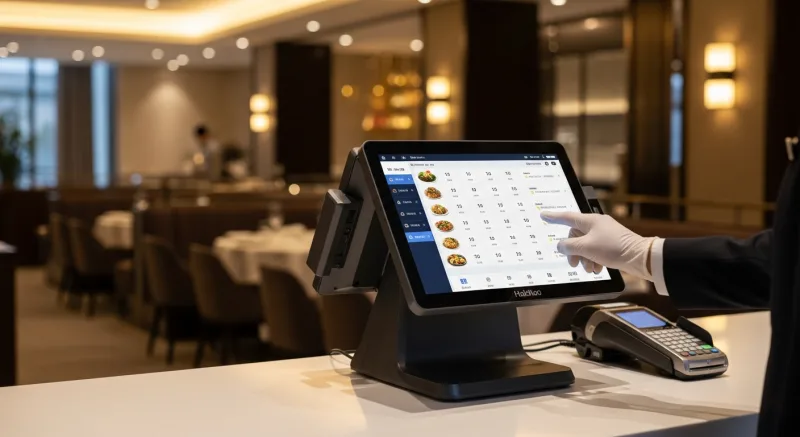
For New York specifically, Haidilao’s model demonstrates how KwickOS handles the unique demands of hot pot service: open-ended ordering where items are added throughout a 90-minute meal, complex inventory tracking of dozens of protein and vegetable components, and real-time kitchen capacity management that prevents over-commitment during peak hours. The same POS that serves a 600-location global chain serves a 30-seat restaurant in the East Village with equal capability.
The Bodega-to-Restaurant Pipeline
New York’s bodegas and delis occupy a unique space between convenience store and restaurant. Many serve hot food, made-to-order sandwiches, and fresh-squeezed juices alongside packaged goods. The POS technology for these hybrid operations must handle both retail and food service workflows on the same system. KwickOS accommodates this dual functionality with configurable menu categories that distinguish between prepared food (subject to food service tax) and packaged goods (standard sales tax).
For the thousands of NYC bodegas contemplating a transition from basic cash registers to modern POS, KwickOS runs on existing hardware — any tablet or touchscreen — without the proprietary terminal purchase that Toast and Clover require. A bodega owner investing in technology can start with a $250 tablet rather than an $800 proprietary terminal, testing the system before committing significant capital.
Jackson Heights: Queens International Dining
Jackson Heights concentrates Indian, Nepali, Tibetan, Colombian, Mexican, and Bangladeshi restaurants in one of the most culinarily diverse neighborhoods on earth. Kitchen staffs speak a dozen languages. Menu items span five continents. Customer bases include both ethnic communities and adventurous Manhattan diners who travel to Queens specifically for authenticity.
KwickOS’s multilingual capability and flexible menu architecture serve this diversity. Spanish-language terminals for Colombian and Mexican restaurants. Complex modifier trees for Indian restaurants where a thali plate involves six or seven component selections. Visual KDS displays that communicate across language barriers through color coding and icons rather than relying exclusively on text. Each restaurant configures KwickOS for its specific operational reality rather than adapting its operations to fit a generic POS template.
NYC Winter and the Outdoor Dining Pivot
Since 2020, New York restaurants have operated year-round outdoor dining in structures ranging from elegant heated enclosures to plastic-wrapped tables on the sidewalk. This permanent outdoor dining expansion requires POS technology that moves with the service: tablets for servers working outdoor sections, mobile payment processing at the curbside table, and KDS integration that treats outdoor orders identically to indoor orders.
KwickOS tablets function as portable POS stations that servers carry between indoor and outdoor sections. Orders from the heated sidewalk structure route to the same KDS as orders from table 12 inside. The kitchen sees no difference. Payment processes at the outdoor table without the server navigating through the crowded dining room to a stationary terminal. In New York, where outdoor dining is no longer seasonal but year-round, this portable capability is a permanent operational requirement.
Fingerprint Security in New York’s Revolving Door
New York restaurant staff turnover exceeds 100% annually in many establishments. The combination of high cost of living, intense working conditions, and abundant alternatives means employees move between restaurants constantly. Traditional POS security based on PINs is worthless in this environment. PINs are shared on day one, departed employees’ codes remain active indefinitely, and managers cannot track which of their 40 employees authorized which void or discount.
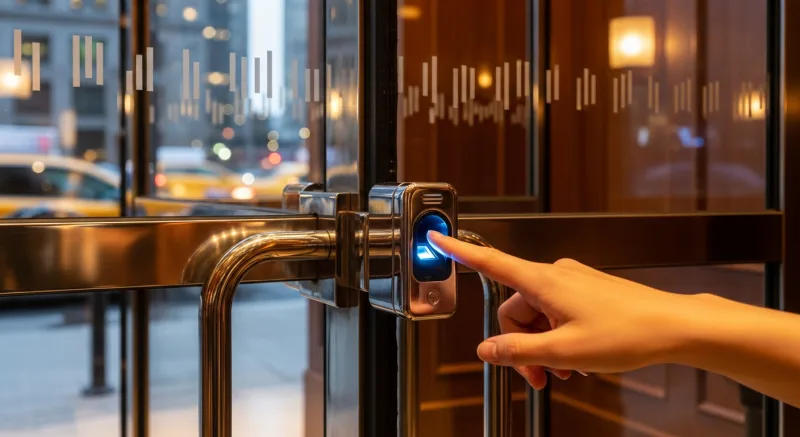
KwickOS fingerprint 1:N identification biometrically links every action to a specific person. In a restaurant where 40 employees rotate across three shifts, the fingerprint system provides accountability that would require a full-time security manager to achieve manually. Toast does not offer fingerprint identification. It relies on PINs. In New York’s turnover environment, that is not security. It is a suggestion.
NYC POS Non-Negotiables
New York is the hardest restaurant market in America. The technology serving it should be equally formidable.
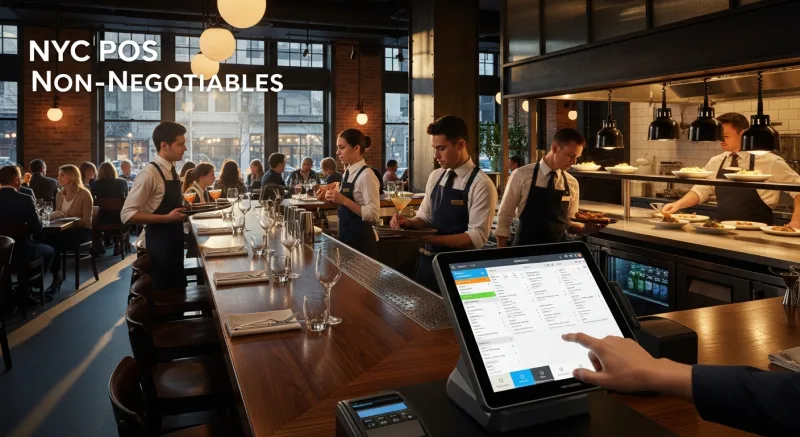
- Processor independence — Manhattan volumes save six figures annually with negotiated rates
- Native Chinese language — Flushing’s 300+ Chinese restaurants need character-level KDS accuracy
- Compact hardware — Brooklyn and East Village kitchens measure space in inches
- Flat-rate delivery — $2 per delivery vs 25% commission is a $126K annual difference at NYC volume
- Enterprise scalability — From 30-seat restaurants to 600-location global chains on one platform
- Outdoor dining portability — Year-round sidewalk service needs mobile POS capability
- Fingerprint security — 100% annual turnover makes PIN-based security meaningless
- Multi-language for Queens — Jackson Heights alone needs six language accommodations
Twenty-seven thousand restaurants cannot all be wrong about the importance of food. But many of them are wrong about technology. The right POS decision saves enough money to keep a New York restaurant alive.
New York restaurant owners: Call (888) 355-6996 or visit KwickOS.com to calculate what processor freedom saves at your volume.
Turn One-Time Diners into Regulars: Built-In Gift Cards & Loyalty
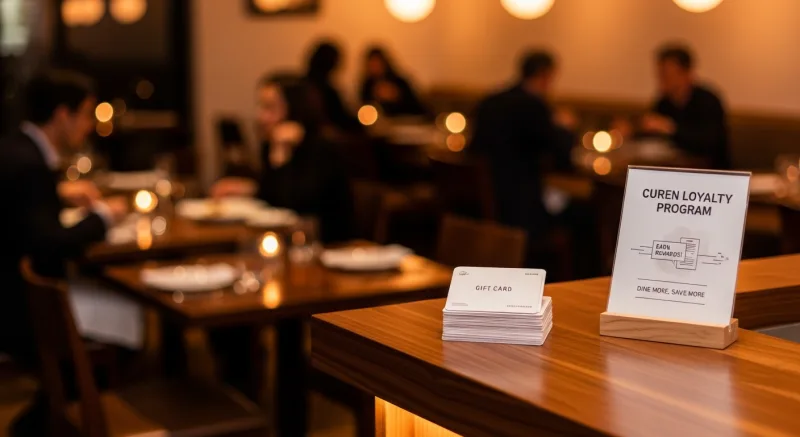
Most POS companies treat gift cards and loyalty as afterthoughts — expensive add-ons that cost $50-100/month extra. KwickOS includes them at no additional charge because we believe they are essential revenue tools, not luxury features.
Gift Cards That Actually Drive Revenue
Here is what most restaurant owners do not realize: gift card buyers spend an average of 20-40% more than the card's face value. A $50 gift card typically generates $60-70 in actual spending. KwickOS supports both physical gift cards and electronic gift cards that customers can purchase, send, and redeem through their phones.
- Physical gift cards — branded plastic cards that sit on your counter and sell themselves during holidays
- E-gift cards — customers buy and send digitally via text or email, perfect for last-minute gifts
- Balance tracking — real-time balance across all your locations, no manual reconciliation
- Reload capability — customers top up their balance, creating a built-in prepayment habit
Loyalty Points That Keep Them Coming Back
KwickOS loyalty is not a punch card from 2005. It is a digital points system that tracks every dollar spent and automatically rewards your best customers:
- Earn points on every purchase — configurable ratio (e.g., $1 = 1 point, or $1 = 10 points)
- Tiered rewards — silver, gold, platinum levels to incentivize higher spending
- Birthday rewards — automated birthday offers that bring customers back during their special month
- Points-for-payment — customers redeem points directly at checkout, seamless for your staff
Membership Programs
For restaurants running VIP programs or subscription models (like monthly coffee clubs), KwickOS membership management handles recurring billing, exclusive pricing tiers, and member-only menu items — all within the same system your cashier already uses.
The bottom line: Toast charges $75/month extra for loyalty. Square's loyalty starts at $45/month. KwickOS includes gift cards, e-gift cards, loyalty points, and membership management in every plan. That is $540-900/year you keep in your pocket.

Founder & CIO of KwickOS · 30 Years IT · 20 Years Restaurant Industry
Tom built KwickOS after running restaurants and IT companies for decades. He relocated the company to a 10,000 sq ft office in 2023 and now serves 5,000+ businesses across all 50 states, processing over $2M in daily sales.