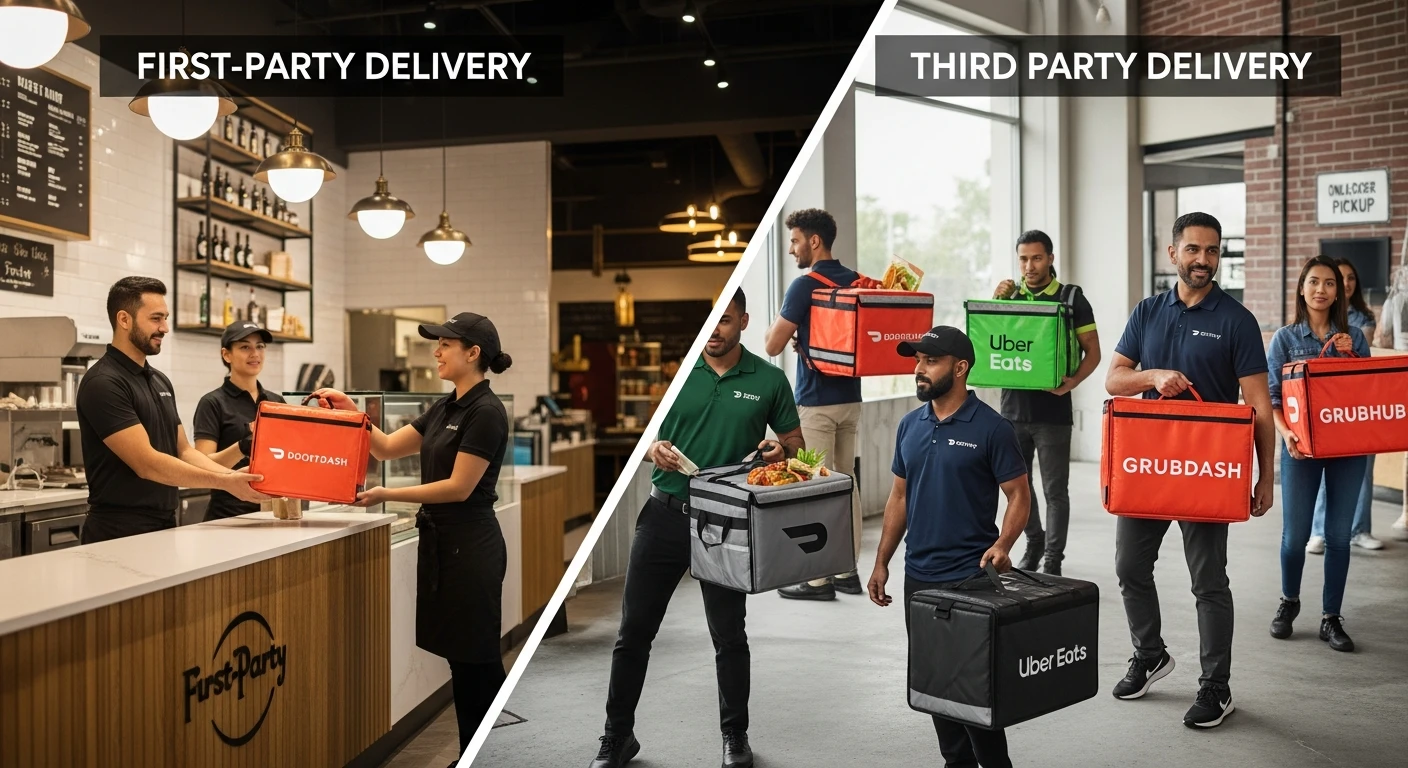
Comparing First-Party vs Third-Party Delivery goes beyond feature checklists — it's about total cost of ownership and daily usability. Here is a number that should make every restaurant owner pause: a $40 delivery order through DoorDash, after the platform takes its 15% to 30% commission, leaves the restaurant with $28 to $34 in revenue. After subtracting food costs (approximately 30%, or $12) and packaging ($1.50 to $2.50), the restaurant nets $13.50 to $19.50 on that order. On the same $40 order placed through the restaurant's own website and delivered by a flat-fee service, the restaurant keeps the full $40 minus food, packaging, and a delivery fee of $8.99 — netting approximately $17.50 to $23.50.
The difference is $4 to $6 per order. That might not sound like a lot. But a restaurant processing 30 delivery orders per day — a modest volume for an urban restaurant — loses $120 to $180 per day in commission costs, or $43,800 to $65,700 per year. That is not a rounding error. That is a full-time employee's salary. That is a kitchen renovation. That is the difference between a profitable delivery program and one that generates revenue without generating profit.
This article is not an argument against third-party delivery. There are legitimate reasons to be on DoorDash, UberEats, and Grubhub. But there are equally legitimate reasons — financial, strategic, and operational — to build a first-party delivery channel. The right answer for your restaurant depends on your specific situation, and making an informed decision requires understanding the full cost structure of each approach.
How Third-Party Delivery Commissions Actually Work
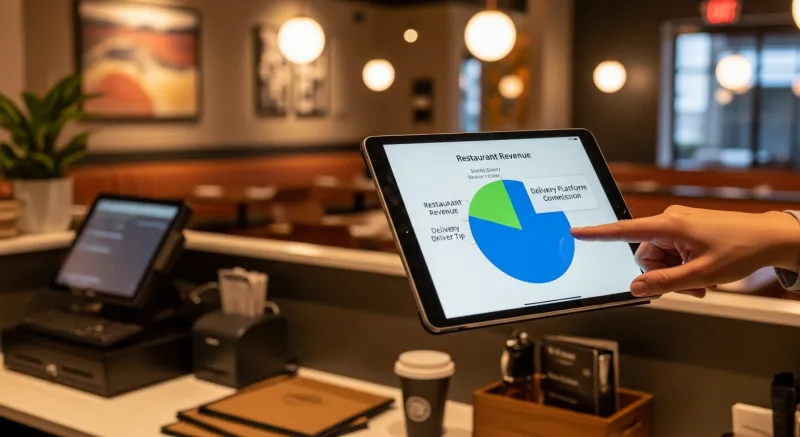
Third-party delivery platforms charge restaurants in several ways, and the headline commission rate does not tell the full story. Here is the breakdown for the three major platforms as of 2026:
| Platform | Commission Rate | What's Included | Additional Fees |
|---|---|---|---|
| DoorDash | 15% / 25% / 30% | 15% = pickup only; 25% = basic delivery; 30% = DashPass promotion + wider delivery radius | Marketing fees, sponsored listings ($6-$9 per order for promoted placement) |
| UberEats | 15% / 25% / 30% | Similar tier structure to DoorDash, with 30% tier providing highest visibility | Uber One promotion fees, marketing spend |
| Grubhub | 15% / 20% / 25% | Delivery commission varies by service level and marketing participation | Promotion fees, loyalty program participation |
The tier structure creates a difficult dynamic. At the lowest tier (15%), the platform provides minimal visibility — your restaurant appears deep in search results, behind competitors who pay higher commissions. To get meaningful order volume, most restaurants end up on the 25-30% tier, which is where the commission becomes financially painful.
And the commission is calculated on the full order subtotal, including taxes in some markets. A $50 order at 30% commission costs the restaurant $15 before any food is prepared.
The Hidden Costs Beyond Commission
Commission rates tell only part of the cost story. Third-party delivery introduces several additional costs that do not appear in the commission calculation:
- Packaging costs increase. Third-party orders require delivery-grade packaging — sealed containers, tamper-evident stickers, insulated bags. These cost $1.50 to $3.00 per order more than standard dine-in or takeout packaging.
- Order accuracy issues are costly. When a DoorDash customer receives a wrong item, they request a refund through the platform. DoorDash refunds the customer and charges the error back to the restaurant — often without investigation. Restaurants report that 5% to 10% of third-party order refund chargebacks are for issues caused by the driver (wrong delivery, spilled food) rather than the kitchen.
- Menu price inflation creates customer resistance. Many restaurants mark up their menu prices by 15% to 30% on third-party platforms to offset commissions. Customers see the inflated prices, compare them to the dine-in menu, and feel gouged. This damages the brand even if the financial logic is sound.
- Tablet chaos. Each third-party platform provides its own tablet. A restaurant on DoorDash, UberEats, and Grubhub has three additional tablets on the counter, each buzzing with orders that must be manually managed. The tablets do not integrate with the POS. Orders must be re-entered or manually confirmed. The operational overhead during a rush is significant.
- Customer data loss. This is the strategic cost that most restaurants underestimate. When a customer orders through DoorDash, DoorDash owns that customer relationship. The restaurant does not get the customer's email address. The restaurant cannot market to them directly. The restaurant cannot offer them a loyalty incentive. If the restaurant leaves DoorDash, the customer does not follow — because the customer thinks of themselves as a DoorDash user, not as the restaurant's customer.
On a $40 order, that is $6 to $12 paid to the platform. For a restaurant doing 30 delivery orders per day, the annual commission cost ranges from $65,700 to $131,400. This is revenue that never reaches the restaurant's bank account.
The First-Party Alternative: How It Works
First-party delivery means orders come through a channel the restaurant controls — typically the restaurant's own website or app — and delivery is handled either by the restaurant's own drivers or by a flat-fee delivery service.
The key difference: there is no percentage-based commission. The restaurant keeps 100% of the order revenue and pays only for the delivery logistics.
There are three approaches to first-party delivery:
1. In-House Drivers
The restaurant hires its own delivery drivers, either as employees or contractors. The restaurant controls the entire experience: when the driver leaves, how the food is packaged, how the customer is greeted at the door.
The challenge is cost. A full-time delivery driver costs $30,000 to $40,000 per year in wages, insurance, and vehicle costs. Unless the restaurant processes 50+ delivery orders per day, a full-time driver is hard to justify economically. Part-time drivers help, but scheduling and reliability become issues.
2. Flat-Fee Delivery Networks
Services like KwickDriver provide delivery logistics at a flat per-delivery fee rather than a percentage commission. The restaurant receives the order through its own system, and a driver from the network picks up and delivers the food.
KwickDriver's fee structure is transparent and predictable: $2.00 flat fee per delivery + $6.99 per 5 miles. Compare this to the percentage-based model:
| Order Size | DoorDash (25%) | DoorDash (30%) | KwickDriver (3mi delivery) |
|---|---|---|---|
| $25 order | $6.25 | $7.50 | $8.99 |
| $40 order | $10.00 | $12.00 | $8.99 |
| $60 order | $15.00 | $18.00 | $8.99 |
| $80 order | $20.00 | $24.00 | $8.99 |
| $100 order | $25.00 | $30.00 | $8.99 |
The pattern is clear: percentage-based fees punish higher-ticket orders. A $100 catering order on DoorDash costs the restaurant $25 to $30 in commission. The same order delivered through KwickDriver costs $8.99. The restaurant keeps $16 to $21 more per large order.
For restaurants with average delivery tickets above $35 to $40, flat-fee delivery is almost always more economical than third-party commissions. And as ticket size increases, the savings accelerate.
3. Hybrid Approach
Many restaurants use a hybrid strategy: first-party delivery for orders placed through their own channels, with third-party platforms used selectively for visibility and customer acquisition. This is often the pragmatic choice, and we will discuss it in detail later in this article.
The Customer Data Question
Beyond the immediate financial comparison, there is a strategic question that deserves serious consideration: who owns the customer relationship?
When a customer orders through your website, you get their name, email address, phone number, order history, and preferences. You can email them next week with a promotion. You can send them a birthday offer. You can notify them when you add a new menu item. You can build a loyalty program that rewards repeat business. You can retarget them with online ads. The customer is your customer.
When the same customer orders through DoorDash, you get none of that information. DoorDash sends you an order with a masked phone number and a delivery address. After the order is complete, you have no way to reach that customer. DoorDash can — and does — market your competitors to them the next time they open the app.
This is not a theoretical concern. It is the fundamental business model of third-party platforms. They aggregate demand across thousands of restaurants and sell access to that demand through commissions. The more dependent you become on their traffic, the more leverage they have over your commission rate. And the less direct customer data you accumulate, the harder it becomes to build the direct relationships that would reduce your dependence.
It is a dependency trap, and it tightens over time.
KwickOS addresses this directly through its integrated online ordering and CRM & Loyalty modules. Every order placed through a KwickOS-powered ordering page captures the customer's data in the restaurant's own database. The marketing module enables direct outreach — email, SMS, promotions — to those customers. The restaurant builds its own customer list, independent of any platform.
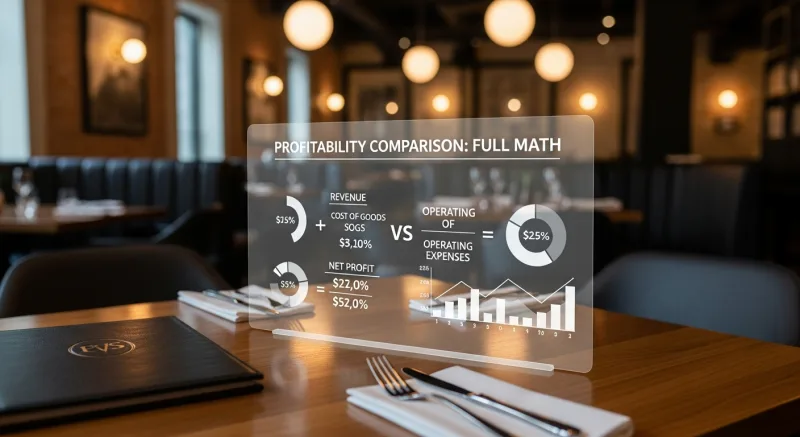
The Profitability Comparison: Full Math
Let us build a complete profitability comparison for a restaurant doing 30 delivery orders per day with an average ticket of $45.
| DoorDash (25%) | DoorDash (30%) | First-Party + KwickDriver | |
|---|---|---|---|
| Order revenue | $45.00 | $45.00 | $45.00 |
| Platform commission | -$11.25 | -$13.50 | $0.00 |
| Delivery cost | $0.00 (included in commission) | $0.00 (included in commission) | -$8.99 |
| Food cost (30%) | -$13.50 | -$13.50 | -$13.50 |
| Packaging | -$2.00 | -$2.00 | -$2.00 |
| Net per order | $18.25 | $16.00 | $20.51 |
| Daily net (30 orders) | $547.50 | $480.00 | $615.30 |
| Annual net (365 days) | $199,838 | $175,200 | $224,585 |
The annual difference between DoorDash at 30% commission and first-party with KwickDriver is $49,385. That is the real cost of third-party dependence for a restaurant doing 30 deliveries per day at $45 average ticket.
Even compared to DoorDash's lower 25% tier, first-party delivery nets $24,747 more per year.
And this comparison does not account for the value of customer data ownership, the elimination of tablet chaos, or the ability to market directly to delivery customers for repeat business.
When Third-Party Delivery Makes Sense
Despite the commission costs, there are scenarios where third-party delivery is the right choice — or at least the right complement to a first-party program:
1. New Restaurant Awareness
A restaurant that just opened has no customer base for delivery. Nobody knows to visit your website and order delivery because nobody knows you exist. DoorDash and UberEats function as discovery platforms — the equivalent of a restaurant listing in a food directory. The 25-30% commission is, in effect, a customer acquisition cost.
The strategic error is treating this as a permanent arrangement. Use third-party platforms to acquire customers, then convert them to first-party ordering through in-bag marketing (a card in every delivery bag with a discount code for ordering directly), loyalty incentives, and better pricing on your own channel.
2. Low Delivery Volume
If your restaurant processes fewer than 10 delivery orders per day, the absolute dollar cost of commissions is modest — $15 to $30 per day on a $30 average ticket at 30% commission. At that volume, the operational simplicity of letting DoorDash handle everything (ordering, driver dispatch, customer service) may be worth the premium. The calculus changes as volume grows.
3. Geographic Expansion Testing
Third-party platforms let you test demand in areas beyond your usual delivery radius without committing to expanded logistics. If you are considering opening a second location, seeing consistent DoorDash order volume from a specific neighborhood is valuable market intelligence.
4. Promotional Periods
Short-term campaigns on third-party platforms can drive awareness during a launch, a rebrand, or a seasonal push. The key is to treat the commission as marketing spend with a defined budget and timeline, not as a permanent cost of delivery.
Building Your First-Party Delivery Channel
Transitioning delivery volume from third-party to first-party requires three things: an ordering platform, a delivery solution, and a reason for customers to switch.
The Ordering Platform
Your first-party ordering must be as easy as DoorDash. That is the bar. If your website ordering flow is clunky, slow, or requires creating an account before placing an order, customers will abandon it and go back to the app they already have installed.
KwickOS online ordering is built for this. The customer visits your website, browses a visual menu, customizes their order, and pays — all without downloading an app or creating an account. The order flows directly into your POS and KDS, identical to any other order. There is no tablet to manage, no manual re-entry, and no sync delay. KwickMenu, the online ordering component, currently drives 500,000+ clicks per month across the KwickOS merchant network — demonstrating that customers will order directly when the experience is good.
The Delivery Solution
Unless you are ready to hire drivers, you need a delivery network. KwickDriver integrates directly with KwickOS: when a delivery order comes in through online ordering, the system dispatches a driver automatically. The restaurant does not need to call anyone, manage a separate app, or coordinate logistics manually.
The flat-fee structure — $2.00 + $6.99 per 5 miles — makes delivery cost predictable. You know exactly what each delivery will cost before the order is prepared. There are no surge pricing surprises, no commission rate changes, and no mandatory marketing fees.
The Migration Strategy: Converting Customers to Direct Ordering
The hardest part of building a first-party delivery channel is convincing customers who already order through DoorDash to switch to your website. Here are the strategies that work:
- In-bag inserts in every delivery order. Include a card or sticker in every delivery bag — including DoorDash orders — that says: "Order direct at [your website] and save 10% on your next order." This is your most effective conversion tool because it reaches customers at the moment they are enjoying your food.
- Lower prices on your own channel. If you mark up prices by 20% on DoorDash to cover commissions, offer the menu at regular prices on your website. The customer sees the price difference and has a financial incentive to switch. You still make more money on the direct order even at the lower price.
- Loyalty rewards exclusive to direct orders. Use your CRM and loyalty system to offer points, rewards, or free items that are only available when ordering directly. "Order 5 times directly and get a free appetizer" is a compelling reason to bookmark your website instead of opening the DoorDash app.
- Google Business Profile optimization. Update your Google listing with a direct ordering link. When customers Google your restaurant, the first action they see should be "Order Online" linking to your site — not a DoorDash page.
- Social media links. Every Instagram post, every Facebook update, every TikTok video should link to your direct ordering page. Never link to your DoorDash listing from your own social accounts — you are paying for customers you already have.
The conversion does not happen overnight. Plan for a 6 to 12-month transition where you gradually shift volume from third-party to first-party. Track the ratio monthly. A realistic target is 60% first-party / 40% third-party after the first year, moving toward 80/20 by year two.
The Delivery Fee Question: Who Pays?
One of the most common concerns about first-party delivery is the delivery fee. DoorDash charges the customer a delivery fee, but it is partially subsidized and often waived for DashPass subscribers. Your first-party delivery needs a fee structure, and someone has to pay for it.
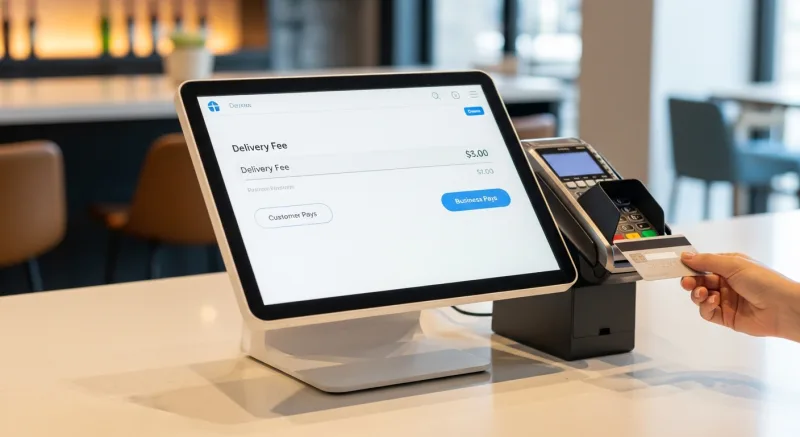
There are three models:
- Customer pays the full delivery fee. This is the most transparent approach. The customer sees a $6.99 delivery fee at checkout. Some customers will balk. But remember — DoorDash also charges delivery fees (typically $2.99 to $7.99), plus a service fee (typically 15% of the order), plus a small order fee for orders under $10 to $15. When customers do the total-cost comparison, your direct ordering with an $8.99 delivery fee is often cheaper than DoorDash's commission-inflated prices plus their fees.
- Restaurant absorbs the delivery fee. Offer "free delivery" and absorb the KwickDriver cost as an operating expense. This maximizes conversion from DoorDash but reduces per-order profitability. The math works for restaurants with high-ticket orders (where $8.99 is a small percentage of the total) but not for low-ticket operations.
- Minimum-order threshold for free delivery. The best of both worlds. Offer free delivery on orders over $40 or $50, and charge the delivery fee on smaller orders. This encourages larger orders (which are more profitable) while covering delivery costs on smaller ones. Most customers respond positively to minimum-order thresholds because the value exchange is clear.
The Technology Stack That Makes It Work
First-party delivery requires integration between several systems. If those systems do not talk to each other, the operational friction will push you back to DoorDash within a month.
Here is what a functional first-party delivery stack looks like:
| Component | Function | Integration Requirement |
|---|---|---|
| Online ordering website | Customer-facing menu and checkout | Must sync menu and prices with POS in real time |
| POS system | Processes orders, manages inventory | Must receive online orders as if entered at the terminal |
| Kitchen display system | Routes delivery orders to kitchen stations | Must show delivery timing and distinguish from dine-in |
| Delivery dispatch | Assigns drivers, tracks deliveries | Must trigger automatically when delivery order is confirmed |
| CRM / loyalty | Captures customer data, manages rewards | Must capture every direct-order customer automatically |
| Payment processing | Handles online payments | Must support all payment methods, processor-agnostic |
KwickOS provides all six components as a single integrated platform. Online ordering, POS, KDS, delivery dispatch (through KwickDriver), CRM, and payment processing are all part of the same system. There is no third-party integration to configure, no middleware to maintain, and no sync delay between systems. A delivery order placed on the restaurant's website appears on the kitchen display within seconds, the driver is dispatched automatically, and the customer's data is captured in the CRM — all without any manual intervention.
This is the operational advantage that makes first-party delivery sustainable. The reason many restaurants try first-party delivery and give up is not because the economics do not work — it is because managing five separate systems (website, POS, KDS, delivery service, CRM) is operationally exhausting. When it is one system, the operational burden is no different from processing a dine-in order.
Making the Decision for Your Restaurant
Here is a practical decision framework:
- If you do fewer than 10 deliveries per day and your restaurant is less than one year old: use third-party platforms primarily, but set up direct ordering immediately to begin capturing customer data. Include in-bag inserts to start migrating customers.
- If you do 10-30 deliveries per day: you should be running a hybrid model. Use third-party for discovery and acquisition, but actively migrate your regular customers to direct ordering. The commission savings at this volume fund the migration effort.
- If you do 30+ deliveries per day: first-party delivery should be your primary channel. The annual savings of $25,000 to $50,000+ are too significant to leave on the table. Use third-party platforms only for incremental customer acquisition, with a clear migration funnel from third-party to direct.
- If your average ticket is above $50 (catering, family meals, large group orders): first-party with flat-fee delivery is overwhelmingly favorable at any volume. A 30% commission on a $100 catering order is $30. KwickDriver's flat fee on the same order is $8.99. The savings per order make the business case obvious.
Use our profit margin calculator to model the specific impact on your margins, and our processing fee calculator to understand the full cost picture when you combine delivery savings with processor-agnostic payment processing.
Take Control of Your Delivery Revenue
KwickOS combines online ordering, KwickDriver delivery dispatch, and CRM in one platform. Keep 100% of your order revenue and own every customer relationship.
Become a PartnerNeed a POS that works anywhere? The KwickOS Food Truck POS supports offline mode and mobile payments for on-the-go businesses.