Open Google on your phone right now. Type "restaurants near me."
Three businesses show up at the top — with their star ratings, photos, hours, and a big blue "Directions" button. That's the Google 3-Pack. It gets 75% of all clicks from local searches.
Now scroll down. Past the three. Past the ads. Past the organic results. That's where every other restaurant in your area lives. And nobody is scrolling that far when they're hungry.
Here's the thing: the restaurants in that 3-Pack aren't necessarily the best restaurants in town. They're the restaurants that understand local SEO. They've done the work to tell Google exactly what they are, where they are, and why they deserve to be shown first.
The good news? Local SEO for restaurants isn't rocket science. It's a checklist. And if you follow it methodically, you can outrank restaurants that have been in your market for decades — because most of them have never done any of this.
This guide covers everything: Google Business Profile optimization, NAP consistency, citation building, review strategy, local backlinks, schema markup, and the mobile optimization that ties it all together. We'll use real numbers and real timelines so you know exactly what to expect.
Why Local SEO Matters More Than Any Other Marketing Channel
Before we dive into tactics, let's talk about why this matters more than Instagram posts, flyer drops, or even paid ads.
46% of all Google searches have local intent. That means nearly half of every search typed into Google is someone looking for something nearby. For restaurants specifically, the numbers are even more dramatic:
- 76% of "near me" searchers visit a physical business within 24 hours
- 28% of those visits result in a purchase
- "Restaurants near me" gets over 20 million searches per month in the US alone
- The top 3 local results capture 75% of all clicks
But it gets worse: if your restaurant doesn't appear in local search results, you're paying for that invisibility every single day. Every customer who searches "Thai food near me" or "best brunch in [your city]" and finds your competitor instead of you — that's revenue walking through someone else's door.
And that's not all: unlike paid ads that stop working the moment you stop paying, local SEO compounds over time. Every review, every citation, every optimized element builds on the last. Six months of consistent effort creates a moat that competitors can't easily replicate.
Step 1: Claim and Optimize Your Google Business Profile
Your Google Business Profile (GBP) is the single most important factor in local search rankings. It's the listing that appears in the 3-Pack, and it's the first thing most customers see. If you do nothing else from this guide, do this.
The Basics (Do These Today)
- Claim your listing at business.google.com if you haven't already. If someone else claimed it (a previous owner, a marketing agency), request ownership transfer immediately.
- Choose the right primary category. This is the #1 ranking factor for GBP. If you're a sushi restaurant, your primary category should be "Sushi Restaurant" — not just "Restaurant." Google offers over 4,000 categories. Be specific.
- Add secondary categories. You can add up to 9 additional categories. A pizza shop might add "Pizza Delivery," "Italian Restaurant," and "Catering Service." Each category you add helps you appear in more search queries.
- Verify your NAP. Your Name, Address, and Phone number must be exactly correct. Not close — exact. "123 Main St" and "123 Main Street" are different to Google. Pick one format and use it everywhere.
- Set your hours. Include regular hours, holiday hours, and special hours. Restaurants that list inaccurate hours get penalized by Google when users report them as wrong.
- Add your website URL. Link directly to your homepage or a location-specific page if you have multiple locations.
The Optimizations (Do These This Week)
- Write a compelling business description (750 characters max). Include your cuisine type, neighborhood, and what makes you different. Use natural keywords like "authentic Szechuan Chinese restaurant in downtown Dallas."
- Upload 20+ high-quality photos. Businesses with photos get 42% more direction requests and 35% more website clicks. Include: exterior (so people can find you), interior (atmosphere), food photos (at least 10 dishes), staff, and menu.
- Add your menu. Google lets you add menu items directly. This helps you rank for specific dish searches like "pad thai near me" or "best ramen in Houston."
- Enable messaging. GBP messaging lets customers text you directly. Google favors profiles that use more of its features.
- Post weekly updates. Google Business Posts are mini-blog posts that appear on your listing. Share specials, events, new menu items, or seasonal offers. Restaurants that post weekly see 2x more profile interactions than those that don't.
Here's the thing: most restaurant owners claim their GBP and then never touch it again. That's like unlocking the front door of your restaurant but never turning the lights on. The listing exists, but it's not working for you.
Want a deeper dive? Read our complete Google Business Profile optimization guide.
Step 2: Fix Your NAP Consistency (The Silent Ranking Killer)
NAP stands for Name, Address, Phone. And it's the most boring, most overlooked, and most impactful local SEO factor after GBP optimization.
Google builds confidence in your business information by checking it across the internet. If your name, address, and phone number are the same on your website, GBP, Yelp, TripAdvisor, Facebook, and 50 other directories — Google trusts that information and ranks you higher.
If there are inconsistencies? Google gets confused. And confused Google doesn't rank you.
Common NAP Mistakes That Are Hurting You Right Now
- "Joe's Pizza" on your website vs. "Joe's Pizza & Pasta" on Yelp vs. "Joe's Pizza Inc." on your Facebook page
- "123 Main St, Suite 4" on GBP vs. "123 Main Street #4" on your website
- Your old phone number still listed on a directory you forgot about
- A previous address showing up on data aggregators
But it gets worse: these inconsistencies don't just exist on sites you control. Data aggregators like Foursquare, Data.com, and Localeze distribute your business information to hundreds of directories automatically. One wrong entry at the source level can propagate errors across the entire internet.
How to Fix It
- Audit your current listings. Search your restaurant name + city on Google. Check the first 3 pages. Note every listing where your NAP is wrong or outdated.
- Pick your canonical NAP. Decide on the exact format you'll use everywhere. Write it down. This is your source of truth.
- Fix the big four first: Google Business Profile, Yelp, Facebook, and Apple Maps. These carry the most weight.
- Submit to data aggregators. Update your information on Foursquare (which feeds Apple Maps), Data.com, and Localeze. This cascades corrections to hundreds of smaller directories.
- Manually fix the rest. Work through your audit list and update each directory. Yes, it's tedious. It's also worth thousands of dollars in organic visibility.
For multi-location restaurants like T. Jin China Diner (15 stores across multiple cities), NAP consistency becomes exponentially more complex — and more important. Each location needs its own verified GBP listing, its own consistent NAP, and its own set of citations. A centralized POS platform with multi-location management capabilities makes it easier to keep location data synchronized across digital channels.
Step 3: Build Local Citations (Quantity and Quality)
A citation is any online mention of your restaurant's name, address, and phone number — whether or not it includes a link to your website. Citations are a core ranking signal for Google's local algorithm.
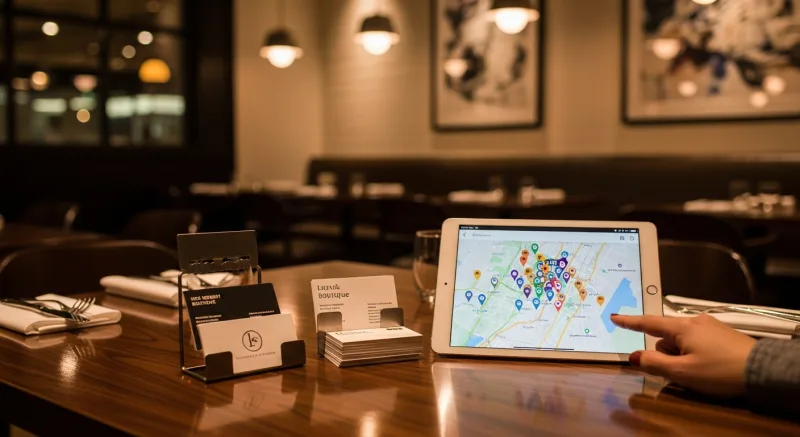
Think of citations as votes of confidence. The more places your correct NAP appears online, the more Google trusts that your business is real, active, and located where you say it is.
Where to Build Citations
Tier 1 — Essential (complete within 1 week):
- Google Business Profile
- Yelp
- Facebook Business Page
- Apple Maps (via Foursquare)
- Bing Places
- TripAdvisor
- OpenTable (if applicable)
Tier 2 — Important (complete within 1 month):
- YellowPages.com
- BBB (Better Business Bureau)
- Chamber of Commerce (local)
- Foursquare
- Zomato
- MenuPages / Allmenus
- Local newspaper/magazine restaurant directories
Tier 3 — Industry-Specific (complete within 3 months):
- Your state restaurant association directory
- Local food blogger directories
- Tourism board listings
- Neighborhood association websites
- Local event calendars
Most restaurants in competitive markets need 40 to 80 quality citations to rank well. The key word is "quality" — a listing on the local Chamber of Commerce website carries more weight than a listing on some random directory nobody has heard of.
Step 4: Master Your Review Strategy
Reviews are the second most important local ranking factor after GBP optimization. But it's not just about having reviews — it's about three specific metrics Google tracks:
- Quantity: How many reviews you have total
- Quality: Your average star rating
- Velocity: How frequently you receive new reviews
That third one — velocity — is the one most restaurants miss. A restaurant with 200 reviews but none in the last 3 months will lose ground to a competitor with 80 reviews that gets 5 to 10 new ones every month.
And that's not all: 1 star on your Google rating equals approximately 9% in revenue. Moving from 3.5 to 4.5 stars isn't a vanity metric — it's a $40,000 to $90,000 revenue difference for a typical restaurant.
How to Get More Reviews (Without Being Weird About It)
- Create a direct review link. In your GBP dashboard, find the "Ask for reviews" short link. This takes customers straight to the review form — no searching required.
- Print QR codes. Put them on receipts, table tents, or the check presenter. "Enjoyed your meal? Scan to leave a review." Our guide to QR code implementation covers the technical setup.
- Train your staff. The best time to ask is at the point of positive feedback. When a customer says "That was amazing," the server says "Thank you! We'd love it if you shared that on Google — there's a QR code on your receipt."
- Follow up digitally. If you capture customer emails through your POS system's email marketing tools, send a thank-you email 2 hours after their visit with a review link.
- Respond to every review. Every single one. Positive reviews get a personalized thank-you. Negative reviews get a professional, empathetic response with a resolution offer. Google measures response rate and speed.
For a deeper look at turning reviews into revenue, read our complete review management guide.
Step 5: Earn Local Backlinks
Backlinks — links from other websites to yours — are a ranking factor for both organic search and the local pack. But for local SEO, the emphasis is on local links.
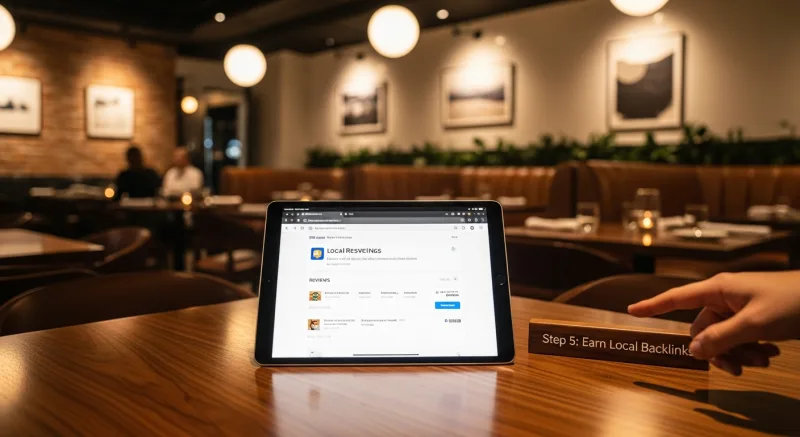
A link from the New York Times is great for general SEO, but a link from your city's food blog, the local newspaper, or a community organization carries more weight for local rankings.
Local Link Building Strategies That Work for Restaurants
- Sponsor local events. Youth sports teams, charity runs, school fundraisers, food festivals. Most will link to sponsors on their event page.
- Partner with food bloggers. Invite local food bloggers for a complimentary tasting. Most will write about it and link to your site. One authentic blog post is worth more than 50 directory listings.
- Get featured in "best of" lists. Local magazines and websites publish annual "best restaurant" lists. Nominate yourself. Reach out to the editors. Offer to be included in roundups.
- Join local business associations. Chamber of Commerce, downtown business district, restaurant association. All provide member directories with backlinks.
- Host community events. Wine tastings, cooking classes, charity dinners. These generate press coverage and links from event listing sites.
- Cross-promote with neighboring businesses. The boutique next door, the hotel down the street — offer to link to them if they link to you. Google sees these local interconnections as relevance signals.
Aim for 5 to 10 new local backlinks per quarter. That pace is sustainable and builds authority steadily over time.
Step 6: Add Local Schema Markup to Your Website
Schema markup is code you add to your website that tells Google exactly what your business is in a language it can parse perfectly. Think of it as a translator between your website and Google's algorithm.
For restaurants, the most important schema types are:
- LocalBusiness / Restaurant schema: Your name, address, phone, hours, cuisine type, price range, and menu URL
- Menu schema: Individual menu items with names, descriptions, and prices
- Review / AggregateRating schema: Your average rating and review count
- Event schema: For special events, live music, or themed dinners
Here's the thing: schema doesn't directly improve your rankings, but it dramatically improves how your listing appears in search results. Restaurants with schema markup are more likely to appear in rich results — those enhanced listings with star ratings, price ranges, and hours that dominate the search page.
If your website runs on a POS-integrated platform, check whether your system supports automatic schema generation. KwickOS's integrated restaurant technology stack can publish structured data directly from your menu and business profile, keeping your schema always in sync with your actual operations.
Step 7: Optimize for Mobile (Because That's Where Local Searches Happen)
61% of all Google searches happen on mobile devices. For restaurant searches specifically, that number jumps to over 80%. If your website isn't mobile-optimized, you're failing the majority of your potential customers.
Google also uses mobile-first indexing, which means it evaluates the mobile version of your website to determine rankings — even for desktop searches.
Mobile Optimization Checklist
- Page speed under 3 seconds. 53% of mobile visitors leave a page that takes more than 3 seconds to load. Compress images, minimize code, and use a CDN.
- Click-to-call button. Your phone number should be tappable on every page. Make it prominent — in the header, not buried in the footer.
- Click-to-directions. Link your address to Google Maps so customers can get directions with one tap.
- Readable without zooming. Font size minimum of 16px. Buttons with at least 44x44px touch targets. No horizontal scrolling.
- Menu accessible on mobile. If your menu is a PDF, it's a problem. PDFs are nearly impossible to read on phones. Use HTML menu pages or a system that generates mobile-friendly menus automatically.
- Online ordering integration. When someone finds your restaurant on their phone, make it dead simple to order. Having integrated online ordering — not a redirect to a third-party app — keeps the customer on your site and keeps the data in your system.
Multi-location brands like Crafty Crab Seafood (19 stores, 152 terminals) manage this at scale by using a unified platform where menu updates, hours changes, and location data sync automatically across their website and all listings — no manual updates for each location.
Step 8: Track, Measure, and Improve
Local SEO isn't a one-time project. It's an ongoing process. Here's what to track monthly:
| Metric | Where to Find It | Target |
|---|---|---|
| GBP views | Google Business Profile Insights | Month-over-month growth |
| Direction requests | GBP Insights | 10%+ growth per quarter |
| Phone calls from GBP | GBP Insights | Track trends, not absolutes |
| Website clicks from GBP | GBP Insights + Google Analytics | 15%+ growth per quarter |
| Review count and rating | GBP dashboard | 5-10 new reviews/month, 4.2+ rating |
| Local keyword rankings | SEMrush, BrightLocal, or Whitespark | Top 3 for primary keywords within 6 months |
| Citation accuracy | BrightLocal or Moz Local | 95%+ consistency score |
Your POS system's built-in analytics can tie this data back to actual revenue. When you see a spike in GBP direction requests, does it correlate with higher foot traffic and sales? That connection between digital visibility and real revenue is what makes local SEO measurable — and justifiable.
The Local SEO Timeline: What to Expect
Let's be honest about timelines. Local SEO is not instant gratification. Here's a realistic expectation:
- Week 1-2: Claim and optimize GBP, fix NAP on your website and top directories. You may see small ranking improvements within days.
- Month 1-2: Build Tier 1 and Tier 2 citations, implement schema markup, start review generation. Rankings begin to shift.
- Month 3-4: Citation propagation kicks in, review velocity builds, local backlink outreach starts producing results. You should see meaningful ranking improvements.
- Month 5-6: Compounding effects. If you've been consistent, you should be in or near the 3-Pack for your primary keywords.
- Month 6-12: Dominance. Continue building reviews, links, and content. By this point, you're building a moat that competitors need months to overcome.
The restaurants that win at local SEO are not the ones that do everything perfectly on day one. They're the ones that show up consistently, month after month. Just like running a restaurant — it's about the daily discipline, not a single grand gesture.
The Bottom Line: Your Restaurant's Digital Front Door
Your Google listing is your restaurant's digital front door. Right now, more customers find you through Google than through any other channel — more than word of mouth, more than social media, more than walking past your physical location.
And unlike a paid advertising campaign that costs money every month, local SEO is an investment that compounds. The reviews you earn this month help you rank next month. The citations you build this quarter strengthen your authority next quarter. The backlinks you earn this year keep working for years.
You're leaving money on the table every day your restaurant doesn't appear in the 3-Pack. Not hypothetical money — real customers, making real searches, choosing real competitors because Google showed them first.
Start with your Google Business Profile. Fix your NAP. Ask for reviews. Do it this week, not next month. Because your competitors aren't waiting — and neither are your hungry customers.
Get Found. Get Chosen. Get Busy.
KwickOS gives restaurants the integrated tools — online ordering, QR codes, email marketing, and analytics — that turn local search visibility into revenue. See how it works.
Get a Demo