You spent $4,200 on a professional photographer. You hired a part-time social media manager. You are posting three times a week, using all the right hashtags, and your Reels have smooth transitions with trending audio.
And yet — your follower count has flatlined at 847, your posts get 23 likes (mostly from your staff), and you cannot point to a single customer who walked through the door because of Instagram.
Here's the thing: you are not alone. A 2025 study from the National Restaurant Association found that 78% of restaurant owners consider social media "important" to their business, but only 12% can tie a single dollar of revenue back to their social media efforts.
That is not a social media problem. That is a strategy problem.
Because the restaurants that are winning on social media in 2026 are not the ones with the best cameras or the biggest budgets. They are the ones who understand one fundamental truth: social media for restaurants is not about going viral. It is about getting discovered by the 50,000 people who live within a 10-mile radius of your front door.
This guide breaks down the exact tactics, platforms, and content types that are driving real foot traffic for restaurants right now — not vanity metrics, not "brand awareness," but actual customers sitting in actual seats spending actual money.
The Restaurant Social Media Landscape in 2026: What Changed
Before we get into tactics, you need to understand why the playbook from even two years ago no longer works.
Instagram's algorithm now favors Reels over everything else. Static food photos that used to get 500 likes now get 50. The platform is pushing video because that is where users spend time. If you are still posting flat-lay photos of your entrees and hoping for discovery, you are playing a game that ended in 2024.
But it gets worse: TikTok has become the new Yelp for Gen Z and younger Millennials. A 2025 Pew Research study showed that 39% of adults aged 18-34 use TikTok to discover new restaurants — ahead of Google Maps (36%) and Instagram (31%). When someone searches "best tacos near me" on TikTok, your restaurant either shows up or it does not exist.
And that's not all: Google Business Profile is now a social platform. Google Posts, Q&A, photo uploads, and review responses all function like social media content — and they directly influence whether you appear in the local 3-pack when someone searches "restaurants near me." If you are ignoring your GBP, you are ignoring the platform that drives the most measurable foot traffic of all.
So the 2026 restaurant social media stack looks like this:
| Platform | Primary Role | Content Type | Posting Frequency |
|---|---|---|---|
| Discovery + brand building | Reels (80%), Stories (15%), Static (5%) | 2-3x/week | |
| TikTok | Viral reach + Gen Z discovery | Short-form video (15-45 seconds) | 3-5x/week |
| Google Business Profile | Direct reservations + local SEO | Posts, photos, review responses | 2x/week + daily reviews |
| Community + events + 40+ demographics | Events, group engagement, shares | 2-3x/week |
Notice what is not on the list: X (Twitter), Pinterest, LinkedIn. Unless you are a celebrity chef or a B2B food supplier, these platforms do not drive foot traffic for local restaurants. Focus your energy where the customers actually are.
The 2-Post Formula: Why Less Is More
Here is a number that will save you from burnout: two high-quality posts per week on Instagram generate more customer visits than seven mediocre ones.
How do we know? A 2025 analysis of 1,200 restaurant Instagram accounts by Later.com found that accounts posting 2-3 times per week had a 4.7% engagement rate, while accounts posting daily had a 1.9% engagement rate. The algorithm penalizes low-engagement posts by reducing your reach on subsequent content. One bad post drags down your next three.
Let's do the math on what consistent, quality posting actually delivers:
- 2 Reels per week = 104 Reels per year
- Average reach per Reel for a local restaurant account: 2,000-5,000 views
- Conservative conversion rate from view to profile visit: 3%
- Profile visit to website/directions click: 8%
- Website visit to actual diner: 15%
At the low end: 104 Reels × 2,000 views × 3% × 8% × 15% = ~75 new customers per year from Instagram alone.
At the high end with strong content: 104 × 5,000 × 3% × 8% × 15% = ~187 new customers.
Add TikTok (which has 2-3x the organic reach of Instagram for new accounts) and Google Business Profile, and you are looking at 250 to 340 new customers per year from a combined social media effort of about 6-8 posts per week across all platforms.
At an average check of $35, that is $8,750 to $11,900 in new revenue per year — from content you create on your phone in 20 minutes per post.
Now here is where it gets interesting.
The 5 Content Types That Actually Drive Foot Traffic
Not all restaurant content is created equal. After analyzing thousands of restaurant social media accounts, five content categories consistently outperform everything else.
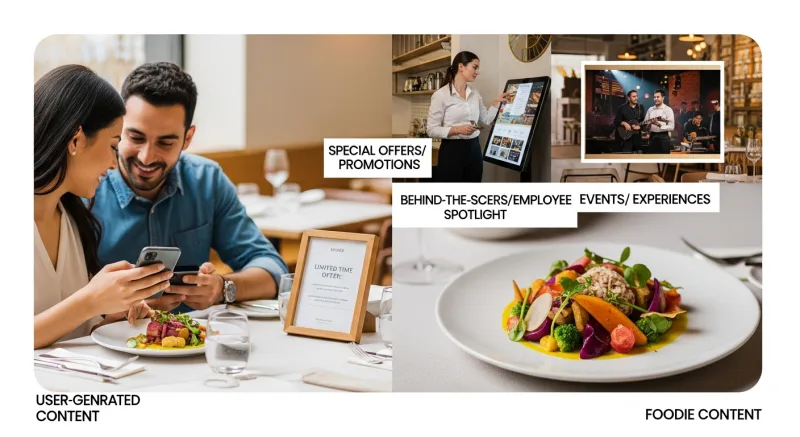
1. The "Process Shot" (Behind-the-Scenes Kitchen Content)
A 15-second video of your chef torching a crème brûlée will outperform a professional photo of the finished dessert every single time. Why? Because process is inherently more engaging than product. The sizzle, the flip, the pour, the caramelization — these are sensory triggers that photos cannot replicate.
Rockin' Rolls Sushi Express, a 3-location sushi chain with 49 iPad self-ordering stations, started posting 20-second sushi rolling videos on TikTok. No editing, no music, no captions — just hands, fish, and rice. Their most-watched video hit 340,000 views and drove a measurable spike in first-time diners who mentioned TikTok when placing orders at the kiosk.
The lesson: your kitchen is a content studio. You just need to point your phone at it.
2. The "Staff Personality" Post
People do not connect with brands. They connect with people. A quick video introducing your head chef, your bartender's signature cocktail technique, or your server's menu recommendation builds the kind of parasocial relationship that turns a scroll into a visit.
Here's the thing: these posts also solve your staffing problem indirectly. When potential employees see your team having fun and being celebrated on social media, your restaurant becomes a place they want to work. Two problems, one content type.
3. User-Generated Content (UGC)
The most powerful social media content for your restaurant is content you did not create. When a customer posts a photo of your food and tags you, that is a third-party endorsement more credible than anything you could produce.
The numbers are staggering: UGC generates 6.9x higher engagement than brand-created content, and 79% of people say UGC "highly impacts" their purchasing decisions.
How to generate more UGC:
- Make your space Instagrammable. One feature wall, one neon sign, or one visually stunning dish is enough to trigger the "I need to post this" impulse.
- Create a branded hashtag and print it on your menus, table tents, and receipts. Something simple like #EatAtShogun or #CraftyCrabMoment.
- Repost everything. When customers see that you share their content, they are 3x more likely to post again. It is a self-reinforcing cycle.
Tiger Sugar, which runs 2 self-ordering kiosks across their locations, prints their Instagram handle directly on their cups. Every customer walking down the street with a Tiger Sugar drink becomes a walking billboard — and many of them photograph that distinctive brown sugar drip pattern and post it without being asked.
4. The "Limited-Time Offer" Urgency Post
Scarcity drives action. A post saying "New seasonal pasta — available this weekend only" will outperform "Check out our new pasta" by 3-4x in engagement and conversion. Why? Because the fear of missing out is a stronger motivator than the desire to gain something.
This is loss aversion at work. "You will miss our weekend-only black truffle ramen" hits harder than "Come try our new black truffle ramen." The first creates urgency. The second creates awareness. Urgency wins.
But it gets worse for restaurants that do not use this tactic: your competitors are. Every restaurant Instagram account that posts "weekend special — 48 hours only" is capturing impulse visits that could have been yours.
Pro tip: your POS system should make this easy. With a system like KwickOS, you can create a limited-time menu item, set it to automatically appear and disappear on your QR code ordering menu and self-ordering kiosks at the right times, and track exactly how many units sold. That gives you the data to prove which social media promotions actually drove orders.
5. The "Before You Visit" Informational Post
Parking instructions. How to find the entrance. What to order on your first visit. How the ordering process works. These are not exciting posts — but they remove friction, and friction is the silent killer of restaurant visits.
Think about it: a potential customer sees your food on TikTok, visits your profile, wants to go — but hesitates because they do not know if there is parking, if they need a reservation, or what the vibe is like. An informational highlight reel on Instagram (or a pinned TikTok) that answers these questions can convert that hesitation into a visit.
Platform-Specific Strategies That Work Right Now
Instagram: The Discovery Engine
Instagram in 2026 is a video platform that happens to support photos. Accept this and plan accordingly.
What works:
- Reels under 30 seconds with a hook in the first 1.5 seconds (the food sizzle, the pour, the reveal)
- Location tags on every post. This is non-negotiable. Location-tagged posts get 79% more engagement than those without
- Local hashtags over generic ones. #DallasEats (500K posts, local audience) beats #FoodPorn (300M posts, global noise)
- Stories for daily engagement. Polls ("Which special should we run this weekend?"), countdowns for events, and behind-the-scenes snippets
- Highlights organized by category: Menu, Specials, Reviews, How to Visit, Events
What to stop doing: Posting professional food photography as static images. Paying for follower-growth services. Using 30 hashtags (Instagram has confirmed this can hurt reach — use 3-5 targeted ones). Posting without a caption that invites conversation.
TikTok: The Reach Machine
TikTok's algorithm does not care how many followers you have. A restaurant with 200 followers can get 100,000 views on their first video if the content connects. This makes it the single best platform for restaurant discovery.
The TikTok content formula for restaurants:
- Hook (0-2 seconds): Extreme close-up of the most visually appealing moment — the cheese pull, the sear, the plating
- Process (2-15 seconds): Show the creation, the preparation, the assembly
- Reveal (15-20 seconds): The finished dish in its full glory
- CTA (20-25 seconds): "Link in bio for our menu" or "Come find us at [address]"
And that's not all: TikTok's search functionality is becoming a genuine competitor to Google for local discovery. Optimize your profile bio with your city name and cuisine type — "Best sushi in Dallas | Family-owned since 2019" — because that is what people are searching for.
Google Business Profile: The Conversion Machine
GBP is the most underrated social media channel for restaurants because it does not feel like social media. But think about it: Google Business Profile posts appear when someone is actively searching for a place to eat. That intent is worth 10x an Instagram impression.
For a deep dive on optimizing your profile, read our complete Google Business Profile guide. The short version for social media purposes:
- Post weekly updates (specials, events, new menu items)
- Respond to every review within 24 hours (this is social engagement that Google rewards with higher rankings)
- Upload 5-10 new photos per month
- Use the Q&A feature proactively — post and answer your own common questions
How to Create a Week of Content in 2 Hours
The number-one reason restaurant owners abandon social media is time. You are running a restaurant. You do not have time to be a content creator.
Here is the system that works:
Monday (30 minutes): Batch film. During prep time, film 5-8 short clips. Do not worry about editing. Just capture the most visually interesting moments: the flame on the wok, the bread coming out of the oven, the cocktail being poured. Use a cheap phone tripod ($15 on Amazon) propped on a shelf.
Tuesday (30 minutes): Edit and schedule. Use CapCut (free) to trim clips to 15-30 seconds, add trending audio, and add a text overlay hook. Schedule posts using Later, Planoly, or Meta Business Suite (all have free tiers).
Wednesday (15 minutes): Engage. Reply to every comment and DM from the past week. Comment on 5-10 posts from local food bloggers and neighboring businesses. This reciprocal engagement is how you grow a local following without paying for ads.
Thursday (15 minutes): Repost UGC. Search your location tag and branded hashtag. Repost 1-2 customer photos or videos to your Stories (with credit). Send a thank-you DM to each creator.
Friday (30 minutes): GBP and review responses. Upload new photos to Google Business Profile, publish a weekend special post, and respond to any new reviews.
Total time: 2 hours per week. That is less time than you spend on a single food delivery complaint — and it generates far more revenue.
Measuring What Matters: Social Media ROI for Restaurants
Followers and likes are vanity metrics. Here are the numbers that actually matter:
| Metric | What It Tells You | How to Track It |
|---|---|---|
| Profile visits → website clicks | How effectively your profile converts curiosity into action | Instagram/TikTok native analytics |
| "How did you hear about us?" responses | Direct attribution of social media to foot traffic | Train staff to ask; add to online ordering checkout |
| Promo code redemptions | Revenue directly attributable to specific posts | Create social-only promo codes in your POS system |
| Direction requests (GBP) | High-intent actions from Google searchers | Google Business Profile Insights |
| Saves and shares (not likes) | Content that people want to return to or recommend | Instagram/TikTok native analytics |
The key to measurement is connecting your social media efforts to your POS data. When you run a social-media-only promotion ("Show this post for a free appetizer"), your POS system needs to track how many were redeemed, the average check size for those tables, and whether those customers returned.
This is where an integrated platform matters. With a system like KwickOS, you can create promo codes, track redemptions, link them to customer profiles in your CRM, and see the full picture — from Instagram impression to repeat customer — in one dashboard. Compare that to manually counting paper coupons and hoping the math works out.
The $5/Day Ad Strategy That Outperforms $500 Campaigns
Once you have 20+ organic posts and know what content resonates with your audience, paid promotion becomes a multiplier — not a crutch.
Here's the thing: you do not need a big ad budget. The most effective restaurant advertising strategy on Instagram and Facebook is brutally simple:
- Identify your top-performing organic post from the past 30 days (highest saves + shares, not likes)
- Boost it for $5-$15/day for 5-7 days
- Target: 5-10 mile radius around your restaurant, ages 25-55, interests in "dining out" and "restaurants"
- Measure: Track direction requests, website clicks, and promo code redemptions
A restaurant spending $5/day ($150/month) on boosted posts targeted within a 5-mile radius typically sees a $3-$7 return for every dollar spent. That is $450 to $1,050 in attributable monthly revenue from a $150 investment.
Why does this work better than elaborate ad campaigns? Because you are boosting content that has already proven it resonates organically. You are not guessing — you are amplifying winners.
Multi-location operators have an even bigger advantage here. T. Jin China Diner, which manages 15 locations with 75 terminals, can run location-specific promotions across all stores simultaneously — each targeting the unique 5-mile radius around that specific location. When your multi-location management system lets you push a promo to all stores with one click and track performance per location, paid social becomes a precision tool rather than a guessing game.
Common Mistakes That Are Costing You Customers
Before we wrap up, let us address the mistakes we see most often. If you are doing any of these, stop immediately — each one is actively driving potential customers away.
- Ignoring comments and DMs. A potential customer asks "Do you have outdoor seating?" in your comments. You don't reply for 4 days. They went somewhere else 4 days ago. Treat every comment like a customer standing at your host stand.
- Posting only food photos. If your feed is 100% plated dishes, you look like a stock photo account. Mix in people, process, personality, and place. The 80/20 rule: 80% value and entertainment, 20% promotional.
- Not responding to negative reviews on Google. A thoughtful response to a 1-star review can actually increase trust. Read our review management guide for templates that turn critics into advocates.
- Linking to a website that is not mobile-optimized. 87% of social media users are on mobile. If they click through to your site and it loads slowly or looks broken on a phone, you just lost them forever.
- No call to action. Every post should tell the viewer what to do next: visit, order, call, follow. Do not make them guess.
Your 30-Day Social Media Kickstart Plan
Week 1: Audit your current profiles. Update your bio with city name, cuisine type, and hours. Set up Instagram Highlights (Menu, Reviews, How to Visit). Claim and optimize your Google Business Profile.
Week 2: Film your first batch of 8-10 kitchen clips. Post your first 2 Reels and 2 TikToks. Respond to every Google review you have not yet addressed.
Week 3: Launch your branded hashtag. Print it on receipts and table tents. Repost your first UGC. Create and share a social-media-only promo code (tracked through your POS).
Week 4: Review your analytics. Identify your top-performing post. Boost it with $5/day for 7 days. Set up your weekly 2-hour content creation schedule. Ask 10 customers "How did you hear about us?" and track the answers.
By the end of 30 days, you will have a functioning social media engine that requires 2 hours per week to maintain and generates measurable foot traffic. That is not a promise — that is math.
The Bottom Line
Restaurant social media marketing in 2026 is not about going viral. It is about showing up consistently on the platforms where your local customers are already looking for their next meal.
Two posts per week. Behind-the-scenes video. User-generated content. Local hashtags. Google Business Profile. That is the formula. It costs almost nothing, takes 2 hours per week, and can deliver 250 to 340 new customers per year.
The restaurants that will struggle are the ones still posting once a month, ignoring TikTok, and treating Google reviews as an afterthought. The restaurants that will win are the ones that treat social media as what it actually is: the lowest-cost, highest-reach customer acquisition channel available to any local business.
You are already cooking the content. You just need to point a camera at it.
Turn Social Media Followers Into Repeat Customers
KwickOS connects your social media promotions to your POS, online ordering, and CRM — so you can track every customer from first click to fifth visit.
Calculate Your Social Media ROI