The best Restaurant Email Marketing handles everything from checkout to closing — without extra apps or workarounds. Running a restaurant without the right marketing is like driving without a dashboard. You are pouring money into social media and watching the returns shrink every quarter. Instagram's organic reach is down to 5.2%. Facebook is barely 2%. Every month the algorithm changes, and every month your posts reach fewer of the people who already said they want to hear from you.
But it gets worse: you do not own your social media followers. Meta could change their algorithm tomorrow — they have done it 14 times in the past three years — and your 8,000 followers become 400 impressions.
Here's the thing: there is one marketing channel where you own the audience, the algorithm never changes, and the average return is $42 for every $1 spent. That is not a typo. According to the Data & Marketing Association, email marketing delivers a 4,200% ROI — the highest of any marketing channel in existence.
And yet, 67% of independent restaurants do not send a single marketing email per month. They are leaving thousands of dollars on the table every week.
This guide shows you exactly how to build a restaurant email list from zero, what to send, when to send it, and how to automate the entire system so it generates revenue while you focus on running your kitchen.
Why Email Beats Every Other Marketing Channel for Restaurants
Before we get into tactics, you need to understand why email is not just another marketing channel — it is the only channel where the math consistently works in your favor.
| Channel | Avg. ROI | You Own the Audience? | Cost Per Reach |
|---|---|---|---|
| Email Marketing | $42 per $1 | Yes | $0.01-0.03 per contact |
| Google Ads | $8 per $1 | No | $1.50-4.00 per click |
| Instagram Ads | $5 per $1 | No | $0.70-2.00 per click |
| Facebook Organic | Declining | No | "Free" but 2% reach |
| Direct Mail | $7 per $1 | Yes | $0.50-2.00 per piece |
And that's not all: email has a structural advantage no other channel can match. When someone gives you their email address, they are explicitly saying "I want to hear from you." No algorithm stands between your message and their inbox. No bidding war determines whether they see your Tuesday special. You send it, they get it.
For a restaurant, this is transformative. Your biggest challenge is not getting new customers — it is getting existing customers to come back one more time per month. Email is the most efficient tool for exactly that problem.
Step 1: Build Your Email List (The Right Way)
The number one mistake restaurants make with email marketing is waiting to build a list. They think they need 5,000 subscribers before it is worth sending anything. Wrong. A list of 200 engaged local diners is more valuable than 5,000 random followers on Instagram.
Here's the thing: you are already interacting with potential subscribers every single day. You just need to capture them. Here are the seven highest-converting collection methods for restaurants:
1. Digital Receipts at Checkout
This is the easiest win. When a customer pays, your POS asks if they want a digital receipt. They type in their email. You now have a subscriber who has literally just paid you money — the highest-intent lead possible.
Restaurants using KwickOS capture an average of 23 new email addresses per day through digital receipts alone. That is 690 new subscribers per month without lifting a finger.
2. WiFi Gate
Require an email address to access your guest WiFi. Most customers will trade their email for free internet without a second thought. A busy restaurant can collect 30-50 emails per day through WiFi gates. Just make sure your WiFi login page includes a clear opt-in checkbox for marketing emails — CAN-SPAM compliance matters.
3. Online Ordering
Every online order requires an email address. If you are using a platform like KwickOS Online Ordering, these emails are automatically added to your CRM. If you are using DoorDash or UberEats, you do not get the customer's email — they do. That is $47,000 worth of customer data flowing to a third party. (See our data ownership guide for the full breakdown.)
4. Table Tents and QR Codes
A simple table tent that says "Get 10% off your next visit — scan to join our VIP list" converts at 8-12% of seated customers. The QR code links to a landing page with a name and email field. Total cost: $30 for 50 printed table tents. Expected return in the first month: 200-400 new subscribers.
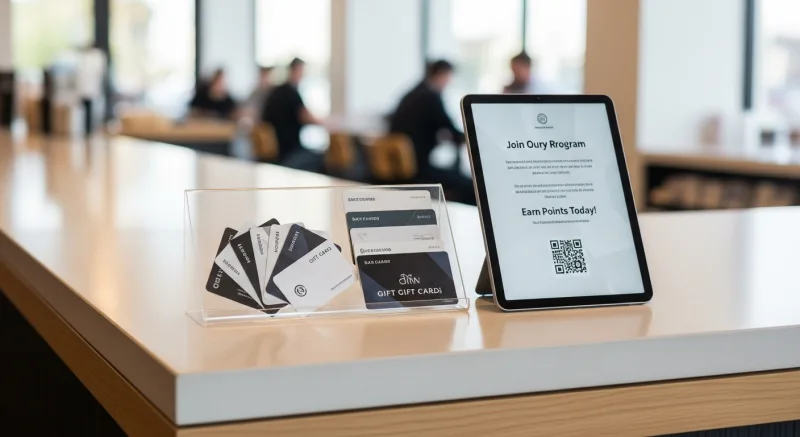
5. Loyalty Program Enrollment
Your loyalty program is an email collection machine in disguise. "Sign up for rewards" is a more compelling ask than "join our email list." Tiger Sugar, a KwickOS customer with 2 stores, built a list of 2,800 subscribers in four months by enrolling every kiosk customer into their loyalty program — which captures emails automatically.
6. Website Popup
Add a popup to your website that offers a free appetizer or 15% off the first visit in exchange for an email. Time it to appear after 10 seconds or when the visitor scrolls 50% down the page. Average conversion rate: 3-5% of website visitors. If your site gets 2,000 monthly visitors, that is 60-100 new subscribers per month.
7. In-Store Signage
A sign at the host stand or near the register with a QR code and a clear incentive. "Text EMAIL to 55555" or "Scan for a free dessert on your birthday." Keep the ask simple, the reward specific.
Using three or four of these methods simultaneously, most restaurants can build a list of 500-1,000 subscribers within 60 days. That is enough to start generating measurable revenue from email.
Step 2: Segment Your List (Stop Sending the Same Email to Everyone)
Here is where most restaurant email programs die. The owner builds a list of 800 people, sends the same "Weekly Specials" blast to all of them, watches open rates drop from 35% to 12% over three months, and concludes "email doesn't work for restaurants."
But it gets worse: every time someone ignores your email, inbox providers like Gmail notice. Too many ignored emails and your future messages land in the Promotions tab — or worse, spam. Bad segmentation doesn't just waste your time. It actively destroys your ability to reach the subscribers who do care.
Here are the five segments every restaurant should create:
| Segment | Definition | What to Send Them | Expected Open Rate |
|---|---|---|---|
| VIP Regulars | Visited 4+ times in 60 days | Exclusive previews, early access, VIP events | 35-45% |
| Active Customers | Visited 1-3 times in 60 days | New menu items, seasonal specials, events | 25-35% |
| At-Risk | No visit in 30-60 days | Win-back offer ("We miss you — $10 off") | 20-28% |
| Lapsed | No visit in 60-120 days | Aggressive win-back ("Your $15 credit expires Friday") | 15-20% |
| New Subscribers | Signed up but never visited (or visited once) | Welcome sequence with first-visit incentive | 40-50% |
The key insight: your VIP regulars and your lapsed customers should never receive the same email. A VIP regular does not need a discount to come back — they need to feel special. A lapsed customer needs a reason and a deadline.
This kind of segmentation requires a POS system that actually tracks customer behavior and connects it to your email platform. Systems like KwickOS with built-in CRM and loyalty tracking do this automatically. If your POS does not track customer visit frequency, you are flying blind.
Step 3: Set Up These 5 Automated Email Sequences
Automated emails — sometimes called "drip campaigns" or "sequences" — are emails that send themselves based on customer behavior. You set them up once, and they generate revenue for months or years without any additional work.
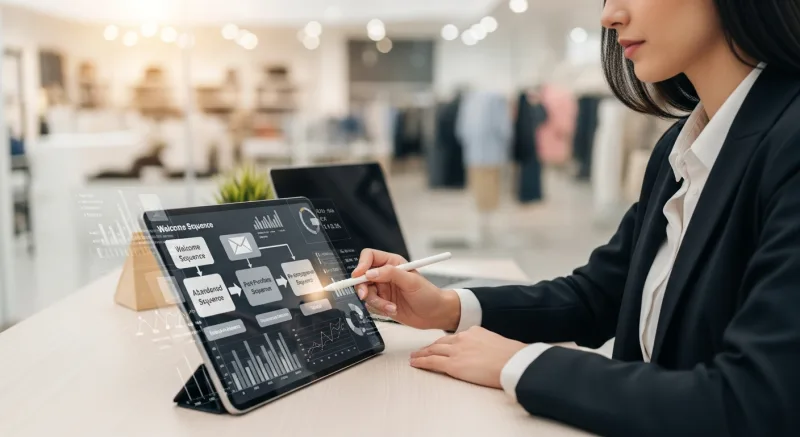
Here's the thing: automated emails generate 320% more revenue per email than manual broadcast campaigns. They are not a nice-to-have. They are the foundation of your entire email program.
Sequence 1: Welcome Series (3 Emails Over 7 Days)
Email 1 (Immediately): "Welcome to [Restaurant Name] — here's your [10% off / free appetizer]." Include the offer code, your hours, location with a Google Maps link, and one sentence about what makes your restaurant unique.
Email 2 (Day 3): "Our story" — a short, genuine story about the owner, the cuisine, or a specific dish. People connect with people, not businesses. Include a mouth-watering photo of your signature dish.
Email 3 (Day 7): "Your [offer] expires tomorrow" — urgency drives action. This email alone typically converts 8-12% of new subscribers into first-time visitors.
Expected result: 15-25% of new subscribers visit within 14 days of signing up.
Sequence 2: Birthday Campaign
Send an email 7 days before the customer's birthday with a free dessert, free entree, or dollar-amount credit. Birthday emails have a 481% higher transaction rate than standard promotional emails.
Why? Because nobody eats their birthday dinner alone. A $12 free dessert offer brings in a table of four spending $120+. The math is absurdly good.
Crafty Crab Seafood, a KwickOS customer with 19 locations, uses automated birthday emails tied to their loyalty program. Each location sends an average of 180 birthday emails per month, and 34% of recipients redeem within 10 days — always with a group. Their estimated revenue from birthday emails alone: $4,200 per location per month.
Sequence 3: Win-Back (The Money Recovery Machine)
This is where email marketing pays for itself many times over. When a customer has not visited in 30 days, trigger this sequence:
Email 1 (Day 30): "We haven't seen you in a while — here's $5 off your next visit." Soft, friendly.
Email 2 (Day 45): "Your $10 credit is waiting — but it expires this Friday." Urgency plus a larger incentive.
Email 3 (Day 60): "Last chance: $15 off before we say goodbye." This is the loss-aversion trigger. Nobody wants to lose $15 they already "have."
Average win-back rate across all three emails: 12-18% of lapsed customers return. On a list of 500 lapsed customers, that is 60-90 people walking back through your door — people who might have never returned otherwise.
To put that in dollars: if your average check is $38, winning back 75 customers generates $2,850 in recovered revenue from a sequence you set up once.
Sequence 4: Post-Visit Follow-Up
Send an email 24 hours after a customer dines with you. Thank them, ask for a Google review (include a direct link), and offer a small incentive for their next visit. This email does double duty: it drives repeat visits AND boosts your Google review count, which improves your Google Business Profile ranking.
Sequence 5: Re-engagement for Cold Subscribers
If a subscriber has not opened any of your emails in 90 days, send a final "Do you still want to hear from us?" email. If they do not open or click, remove them from your active list. This keeps your list healthy and your deliverability high. A clean list of 600 engaged subscribers outperforms a bloated list of 3,000 that mostly ignores you.
Step 4: Manual Campaigns That Actually Get Opened
Automated sequences handle the heavy lifting, but you still need to send regular campaigns for time-sensitive promotions, seasonal menus, events, and news. Here is how to make those campaigns work:
Subject Lines That Drive Opens
Your subject line is the entire marketing campaign. If nobody opens the email, nothing else matters.
Rules that work for restaurants:
- Numbers first: "$7 lunch special" beats "Check out our new lunch special"
- Urgency: "Tonight only" and "Ends Friday" outperform open-ended offers by 22%
- Personalization: Including the customer's first name increases open rates by 26%
- Curiosity gap: "The dish we almost didn't put on the menu" — open loops work
- Loss framing: "Don't miss your $10 credit" beats "You have a $10 credit" — loss aversion is real
What to avoid: ALL CAPS, multiple exclamation points, the word "free" in the subject line (spam trigger), and emoji overload. One emoji is fine. Five makes you look desperate.
Send Times That Matter
For restaurants, timing is everything:
- Tuesday or Wednesday at 10-11 AM for lunch promotions (people are planning lunch)
- Thursday at 4-5 PM for weekend dinner specials (people are making weekend plans)
- Sunday at 9-10 AM for brunch promotions
Never send on Monday (inbox overload from the weekend) or Saturday (lowest open rates for restaurants). And never send more than twice per week — the unsubscribe math gets ugly fast.
Step 5: Measure What Matters (And Ignore What Doesn't)
Most restaurant owners look at open rates and call it a day. That is like checking your ingredient costs but never looking at your actual food cost percentage. You need to track the metrics that connect email activity to revenue.
| Metric | What It Tells You | Benchmark |
|---|---|---|
| Open Rate | Are your subject lines working? | 20-30% (aim for 25%+) |
| Click Rate | Is your content compelling? | 2.5-5% |
| Redemption Rate | Are people actually showing up? | 8-15% for offers |
| Revenue Per Email | What is each email worth? | $0.15-0.50 |
| List Growth Rate | Is your collection working? | 10-15% per month (early stage) |
| Unsubscribe Rate | Are you sending too much or too irrelevant? | Below 0.5% per send |
The most important metric is revenue per email sent. If you send an email to 800 people and 24 of them redeem an offer at an average check of $42, that email generated $1,008 in revenue. Divide by 800 and your revenue per email is $1.26. Track this over time. If it drops below $0.10, your segmentation or content needs work.
How Your POS System Makes or Breaks Your Email Program
Everything in this guide — automated sequences, behavioral segmentation, birthday campaigns, win-back triggers — depends on one thing: your POS system's ability to track customer behavior and connect it to your email platform.
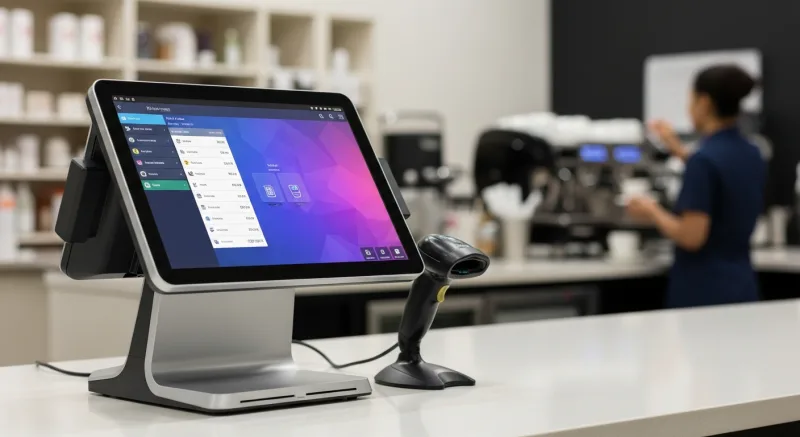
Most POS systems treat email as an afterthought. They capture a name and email at checkout and that is it. No visit tracking, no purchase history, no automated triggers.
T. Jin China Diner runs 15 locations with 75 KwickOS terminals. Their CRM automatically tracks every customer across all 15 stores, segments by visit frequency and spending patterns, and triggers birthday and win-back emails without any manager involvement. The result: their email program runs on autopilot and generates an estimated $8,400 per month in attributable revenue across all locations.
This is the power of an all-in-one system. When your POS, CRM, loyalty program, and online ordering all share the same database, every customer interaction enriches the data that powers your email marketing. No CSV exports, no manual syncing, no third-party integrations breaking at 2 AM.
Compare that to a setup where your POS is Toast (which does not share customer emails with third-party tools unless you pay for Toast Marketing), your loyalty is a separate app, and your email is Mailchimp. Three systems, three databases, zero automation. You are paying $3,000-$8,000 more per year in processing fees to a locked processor AND getting worse marketing tools.
The 90-Day Email Marketing Launch Plan
Here is your step-by-step roadmap to go from zero to a revenue-generating email program in 90 days:
Days 1-7: Foundation
- Choose an email platform (or use your POS's built-in CRM if it has one)
- Set up email collection at 3-4 touchpoints (digital receipts, WiFi gate, table tents, website popup)
- Create your welcome sequence (3 emails)
Days 8-30: Build and Test
- Goal: 200-500 subscribers
- Send your first manual campaign (a simple seasonal menu announcement)
- Set up your birthday campaign
- Track which collection method is performing best — double down on it
Days 31-60: Automate and Segment
- Goal: 500-1,000 subscribers
- Set up your win-back sequence
- Create your five core segments
- Begin sending segmented campaigns (different content for VIPs vs. new subscribers)
- Set up post-visit follow-up with Google review request
Days 61-90: Optimize and Scale
- Goal: 1,000+ subscribers
- A/B test subject lines (send two versions to 20% of your list, send the winner to the rest)
- Clean your list (remove 90-day non-openers)
- Calculate revenue per email and cost per acquisition
- Set up re-engagement sequence for cold subscribers
By day 90, you should have a self-sustaining email program that generates $1,500-3,000+ per month in attributable revenue for a single location — with most of it coming from automated sequences that require zero ongoing effort.
Common Mistakes That Kill Restaurant Email Programs
Before you launch, avoid these traps:
- Buying email lists. Never. Ever. Purchased lists have open rates below 2%, destroy your sender reputation, and violate CAN-SPAM. Build your list organically.
- No mobile optimization. 68% of emails are opened on mobile. If your email looks broken on a phone, you lose two-thirds of your audience instantly.
- Sending without a clear CTA. Every email needs one clear action: "Reserve a table," "Order online," "Claim your $10 credit." One CTA. Not three. Not five.
- Ignoring unsubscribes. An unsubscribe rate above 0.5% per send means you are emailing too often, your content is irrelevant, or both. Fix it before your deliverability tanks.
- No tracking system. If you cannot track which email drove which visit, you cannot optimize. Your POS should connect email opens and clicks to actual in-store transactions. Check our restaurant analytics guide for the KPIs that matter.
The Bottom Line
Email marketing is not glamorous. It does not go viral. It does not win awards. But it does something far more important: it reliably puts customers in seats, week after week, at a cost of pennies per person.
You are currently paying $1.50-4.00 per click on Google Ads to reach people who may or may not be hungry. Meanwhile, you could be reaching 800 proven customers — people who have already eaten at your restaurant and enjoyed it — for less than $25 total.
The restaurants that thrive in 2026 and beyond will not be the ones with the most Instagram followers. They will be the ones with the best email lists and the smartest automation. And the smartest automation starts with a POS system that treats customer data as a revenue-generating asset, not an afterthought.
Start collecting emails today. Set up your welcome sequence this week. Launch your first campaign by Friday. In 90 days, you will wonder why you waited this long.
Turn Every Transaction Into a Subscriber
KwickOS captures customer emails automatically through digital receipts, loyalty enrollment, and online ordering — then powers automated campaigns that drive repeat visits. See it in action.
Get a Demo