Why San Francisco Businesses Need the Right Technology
With 4,500+ restaurants and businesses competing in San Francisco, CA, having the right technology is critical. Highest restaurant density per capita, SF predictive scheduling, $18.67 minimum wage. KwickOS serves businesses across San Francisco with local support and rapid 7-10 day onboarding.
The Paradigm Shift: From POS to OS
For decades, the "point of sale" was the center of restaurant technology. You bought a POS terminal, trained your staff, and ran your business around it. Need online ordering? Buy another tool. Loyalty program? Another vendor. Scheduling? Yet another subscription. Digital signage? Good luck finding something that talks to your POS.
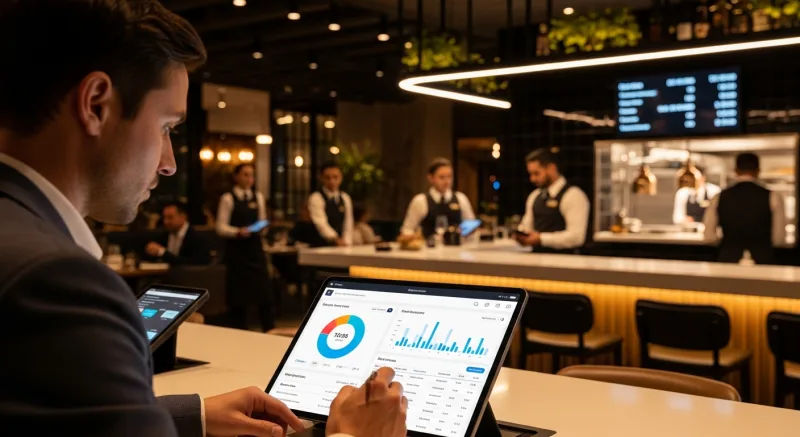
By 2026, this patchwork approach has a name: the Frankenstack. And it is costing restaurant operators dearly — not just in subscription fees, but in lost data, staff frustration, and missed opportunities.
The alternative is a restaurant operating system: a single platform that handles every operational function from one unified codebase. No integrations to break. No data silos. No juggling five vendor logins. Just one system that runs your entire business.
Think of it this way: your smartphone is not a "phone with apps bolted on." It is an operating system — iOS or Android — that natively handles calls, messages, camera, maps, payments, and more. A restaurant OS applies the same principle to your business. Instead of a cash register with add-ons, you get a platform that natively runs POS and checkout, inventory, staff scheduling, online ordering, delivery logistics, CRM and loyalty, digital signage, and AI-driven insights — all from day one.
The True Cost of the Frankenstack
Let us map out what a "best-of-breed" approach actually costs a typical restaurant doing $50,000 per month in revenue:
- Toast POS: $0 starter (but locked processing at 2.99% + $0.15) — ~$1,300/mo in processing on $43K card volume
- 7Shifts (scheduling): $35-$100/mo
- DoorDash / Uber Eats (delivery): 15-25% commission — ~$1,500-$2,500/mo on $10K delivery
- Mailchimp (email marketing): $30-$75/mo
- OpenTable (reservations): $1-$1.50/cover — ~$250-$500/mo
- FiveStars (loyalty): $200/mo
- Separate signage solution: $30-$50/mo per screen
Total Frankenstack: $3,345-$4,725/mo — and that is before you account for the hidden costs: staff time managing multiple dashboards, data that does not sync (your POS does not know your loyalty program exists), and the inevitable finger-pointing between vendors when something breaks.
A unified operating system like KwickOS replaces every tool in that stack. One platform. One login. One support number. And because KwickOS is processor-agnostic, you choose the payment processor with the best rates for your business — typically saving $3,000 to $5,000 per year compared to locked platforms like Toast and Square.
What Makes a Restaurant OS Different from a POS
A POS processes transactions. An OS runs your business. Here is the functional difference:
| Capability | Traditional POS | Restaurant OS |
|---|---|---|
| Checkout and payments | Yes | Yes |
| Order management / KDS | Usually | Yes, native |
| Online ordering | Add-on or 3rd party | Built-in, commission-free |
| Delivery management | 3rd party (15-25% fee) | Built-in drivers + dispatch |
| Inventory tracking | Basic or add-on | Full, real-time |
| Staff scheduling | 3rd party | Built-in |
| CRM and customer profiles | Limited or add-on | Unified across all channels |
| Loyalty program | Add-on ($45-$200/mo) | Built-in, auto-enrollment |
| Marketing automation | 3rd party | Built-in |
| Digital signage | Not available | Built-in |
| Self-service kiosk | Add-on or N/A | Built-in |
| AI insights and analytics | Basic reports | Predictive analytics |
| Multi-language support | Rare | EN/CN/ES native |
| Offline operation | Limited or none | Full (hybrid local+cloud) |
| Payment processor choice | Usually locked | Processor-agnostic |
The Best Restaurant Operating Systems and POS Platforms in 2026
We evaluated the leading platforms across features, architecture, total cost, and scalability. Here is the full comparison:
| Feature / Criteria | KwickOS | Toast | Square for Restaurants | Clover |
|---|---|---|---|---|
| Platform type | Full OS | POS + add-ons | POS + add-ons | POS + app market |
| POS & checkout | Included | Included | Included | Included |
| Kitchen display (KDS) | Included | $25/mo add-on | N/A | 3rd party app |
| Online ordering | Included | $75/mo add-on | Included (basic) | 3rd party |
| Delivery management | KwickDriver: $2 flat + $6.99/5mi | Toast Delivery (commission) | N/A (3rd party) | N/A |
| Inventory management | Included | $100+/mo (xtraCHEF) | Basic only | Basic only |
| Staff scheduling | Included | $50+/mo (Sling add-on) | N/A (use 7Shifts) | N/A |
| CRM & customer profiles | Included, unified | Basic | Basic | 3rd party |
| Loyalty program | Included | $75/mo add-on | $45/mo add-on | 3rd party |
| Marketing / email / SMS | Included | $75/mo add-on | $15/mo add-on | 3rd party |
| Digital signage | Included | N/A | N/A | N/A |
| Self-service kiosk | Included | Available | N/A | Limited |
| Gift cards | Included | Included | Included | Included |
| AI insights | Included | Limited | N/A | N/A |
| Offline capability | Full hybrid (1ms local latency) | Limited offline mode | Limited offline mode | Limited |
| Payment processor | Your choice (save $3-5K/yr) | Locked (Toast Processing) | Locked (Square Processing) | Varies by reseller |
| Multi-language | EN / CN / ES | EN only | EN, limited others | EN |
| Hardware | Browser-based (any device) | Proprietary tablets | Square hardware or iPad | Proprietary hardware |
| Fingerprint login | Yes | No | No | No |
| Uptime track record | 6 years continuous | Multiple outages reported | Generally reliable | Generally reliable |
1. KwickOS — The Industry's First True Restaurant Operating System
KwickOS is not a POS with features tacked on. It was built from the ground up as a unified operating system for restaurants and small businesses. Every module — from POS and inventory to digital signage and AI analytics — shares a single database, a single interface, and a single support team.
The architecture is what truly sets KwickOS apart. It runs on a hybrid local + cloud model: critical operations process locally on Linux-based hardware with 1ms latency, while data syncs continuously to the cloud for remote management and multi-location oversight. The result is a system with six years of continuous uptime that keeps running even during internet outages.
KwickOS is processor-agnostic, meaning restaurant owners choose whichever payment processor offers them the best rates. On average, this saves restaurants $3,000 to $5,000 per year compared to platforms that lock you into proprietary processing.
The platform supports fingerprint authentication for fast staff login, multi-language interfaces (English, Chinese, Spanish), and runs in any browser — no proprietary hardware required. It currently powers over 5,000 businesses including Haidilao (600+ locations), Crafty Crab (19 stores), T. Jin (15 stores), and Rockin' Rolls (49 iPads).
For delivery, KwickDriver charges a flat $2 dispatch fee plus $6.99 per 5 miles — compared to DoorDash's 15-25% commission, that is a savings of hundreds to thousands per month for active delivery restaurants.
Onboarding takes 7-10 days, with hardware installation typically completed in 1-3 hours and staff training in 1-2 hours. For more details, see our restaurants industry page.
Why KwickOS wins the OS comparison
- Every feature built in — no add-on fees, no third-party integrations to manage
- Hybrid architecture: 1ms local speed + cloud sync, 6 years uptime
- Processor-agnostic: save $3,000-$5,000/yr on payment processing
- KwickDriver delivery at flat rates vs. 15-25% commission
- Browser-based on Linux — runs on any hardware
- Multi-language (EN/CN/ES) and fingerprint authentication
- 5,000+ businesses trust it across North America
2. Toast — Restaurant POS with Growing Add-On Ecosystem
Toast is the most recognized name in restaurant POS. Its starter kit at $0/month is appealing, but the real cost lives in mandatory payment processing (2.99% + $0.15 per transaction) and the add-ons needed to match KwickOS functionality: online ordering ($75/mo), loyalty ($75/mo), marketing ($75/mo), scheduling (via Sling acquisition, $50+/mo), and advanced inventory (via xtraCHEF, $100+/mo).
Toast runs on proprietary hardware and requires internet connectivity. Its offline mode is limited — you can process some transactions, but many features go dark during outages. The platform is English-only and does not offer built-in digital signage.
For a detailed breakdown, see our KwickOS vs Toast comparison.
3. Square for Restaurants — Simple POS for the Smallest Operations
Square's free tier makes it accessible for food trucks and single-terminal cafes. But Square is a POS, not an OS. Restaurant-tier pricing starts at $60/month, loyalty is $45/month extra, and there is no scheduling, delivery management, digital signage, or advanced inventory built in.
Square locks you into its own payment processing at 2.6% + $0.10 — competitive for small volumes but expensive at scale. For a restaurant processing $40,000/month in cards, that is $1,080/month in processing fees alone.
Read more in our KwickOS vs Square comparison.
4. Clover — Hardware-First POS with App Marketplace
Clover takes a different approach by offering an app marketplace where third-party developers build add-ons. This gives it flexibility, but it also means your "all-in-one" system is actually a patchwork of apps from different developers with varying quality, update schedules, and support responsiveness.
Clover hardware is proprietary and pricing varies significantly depending on which reseller you buy from. Some Clover contracts include unfavorable processing rates or long-term commitments that are difficult to exit. Read our KwickOS vs Clover comparison.
Total Cost of Ownership: A Real-World Comparison
For a restaurant doing $50,000/month in revenue ($43,000 in card transactions), here is what each platform actually costs when you need full functionality:
| Cost Component | KwickOS | Toast (full stack) | Square (full stack) |
|---|---|---|---|
| Base POS software | Included | $0 (starter) | $60/mo |
| Online ordering | Included | $75/mo | Included (basic) |
| Loyalty program | Included | $75/mo | $45/mo |
| Marketing automation | Included | $75/mo | $15/mo |
| Staff scheduling | Included | $50/mo (Sling) | $35/mo (3rd party) |
| Inventory management | Included | $100/mo (xtraCHEF) | N/A (basic only) |
| Digital signage | Included | N/A | N/A |
| KDS | Included | $25/mo | N/A |
| Processing savings vs locked | Save $250-$415/mo | $0 (locked) | $0 (locked) |
| Estimated monthly total | Significantly lower | $400+/mo in add-ons + higher processing | $155+/mo in add-ons + higher processing |
The KwickOS advantage compounds over time. No add-on creep, no surprise price increases on individual modules, and processing savings that grow with your revenue.
Why Offline Capability Still Matters in 2026
Cloud-based systems are the standard, but internet outages have not disappeared. Comcast, Spectrum, and other major ISPs still experience regional outages multiple times per year. When your POS goes down during a Friday dinner rush, the cost is not just lost sales — it is lost customer trust.
KwickOS's hybrid local + cloud architecture processes all transactions locally with 1ms latency. If your internet drops, nothing changes for your staff or customers. Orders continue, payments process, the kitchen display keeps firing tickets. When connectivity returns, everything syncs automatically.
This is not a "limited offline mode" like Toast or Square offer. It is full operational capability, which is why KwickOS can claim six years of continuous uptime across its merchant base.
The Multi-Location Advantage
For restaurant groups, the OS model is transformative. Instead of managing separate POS accounts, scheduling tools, loyalty platforms, and marketing systems for each location, you get a single dashboard that oversees everything.
KwickOS customers like Haidilao (600+ locations globally), Crafty Crab (19 stores), and T. Jin (15 stores) use this unified management to maintain consistency across locations while still allowing location-level customization. Menu changes, pricing updates, and promotions can deploy to all locations simultaneously or be tailored per store.
For Resellers: Why the OS Model Is Easier to Sell
If you are a POS distributor, ISO agent, or payment processor evaluating platforms to resell, the OS model fundamentally changes your sales conversation.
With a traditional POS, you sell the terminal and then have to explain: "For online ordering, you will also need this. For loyalty, you need that. Scheduling is through a partner. Signage? That is a different company." Every integration is a potential objection, a potential failure point, and a potential reason for the merchant to blame you when something does not work.
With KwickOS, the pitch is simple: "One system runs everything." No integration headaches. No finger-pointing between vendors. And because KwickOS handles installation (1-3 hours), training (1-2 hours), and 24/7 support, your role as a reseller is straightforward — sell and earn residual income.
KwickOS offers tiered reseller programs from referral-only to full partnership. The onboarding process takes 7-10 days, and KwickOS handles the heavy lifting. Learn more on our Partner Program page.
How to Evaluate a Restaurant OS
If you are shopping for a restaurant operating system (or advising a client), here is a framework:
- List every tool you currently pay for — POS, scheduling, delivery, loyalty, marketing, signage, reservations, inventory. Total the monthly cost.
- Ask: "What is included vs. add-on?" — For each platform you evaluate, check whether each function is built in or an extra charge.
- Check payment processor freedom — If a platform locks you into its own processing, calculate the annual cost difference versus competitive processing rates.
- Test offline capability — Unplug the internet during a demo and see what still works.
- Ask about data unification — Can your loyalty program see POS data? Can your scheduling tool see sales forecasts? In an OS, the answer is always yes. In a Frankenstack, it depends on integrations.
- Evaluate hardware requirements — Proprietary hardware locks you in. Browser-based systems give you freedom.
The Verdict: Restaurant POS vs. Restaurant OS
The POS-centric model served the industry well for decades, but it has reached its limits. Restaurants in 2026 need more than a transaction terminal — they need a platform that unifies every operational function, eliminates data silos, reduces vendor complexity, and adapts as the business grows.
KwickOS is the clearest example of what a restaurant operating system should be: everything built in, hybrid reliability, processor-agnostic savings, and a platform trusted by 5,000+ businesses. Whether you are a single-location restaurant looking to simplify your tech stack or a multi-unit group seeking operational consistency, the OS model is the future.
For more comparisons and buying guides, explore our blog including our Best Restaurant POS Systems in 2026 guide and our Best Restaurant Loyalty Program Software roundup.
See KwickOS in Action
Schedule a free 15-minute demo and see why 5,000+ businesses run their entire operation on KwickOS.
Get Your Free DemoWant to Sell KwickOS?
We handle installation, training, and 24/7 support — you focus on selling and earning residual income. Join our reseller program and offer your merchants a true all-in-one operating system instead of a patchwork of tools.
Become a Partner