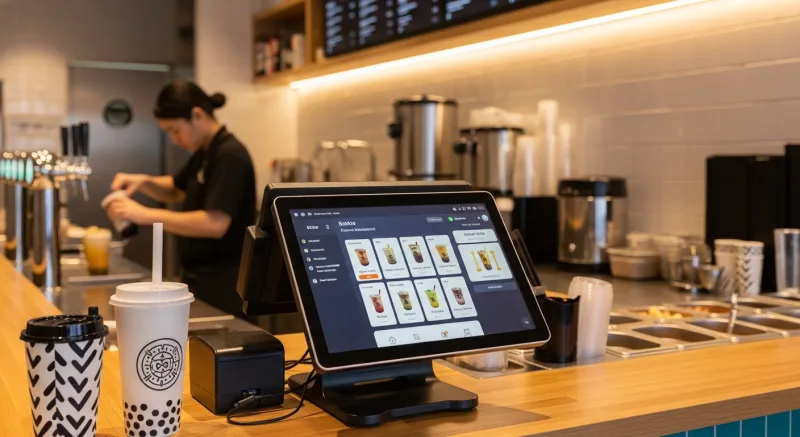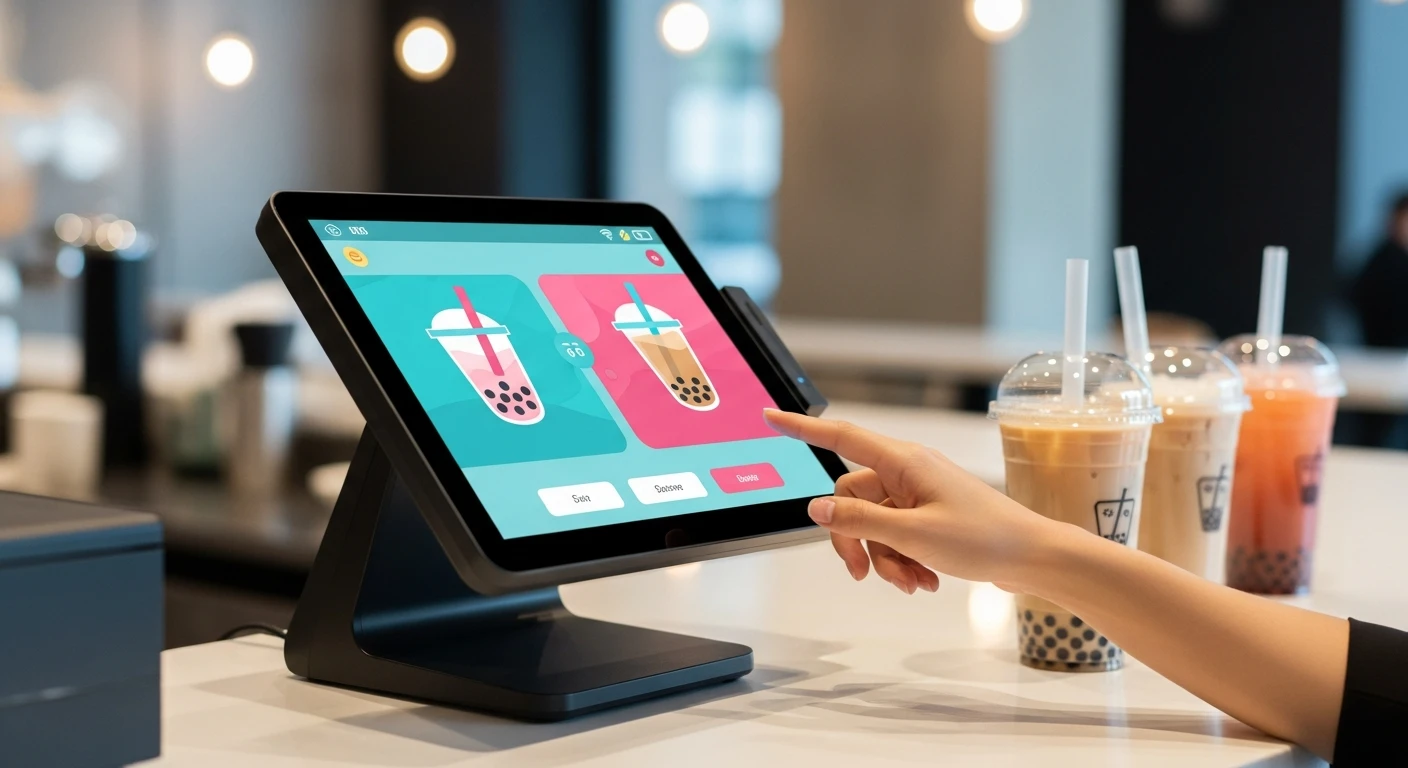
Bubble tea is not simple. A customer who orders a "large taro milk tea, 50% sugar, less ice, add boba and coconut jelly, with oat milk" has specified 6 variables on a single drink. Multiply that by 200 orders during afternoon rush, and you have a production complexity that rivals a full-service restaurant kitchen — all happening at a counter with 2-3 staff members. A POS system records the order. An operating system routes it to the right station, displays it on the KDS with color-coded urgency, tracks the ingredients consumed, enrolls the customer in loyalty, remembers their customization for next time, and updates the digital menu board if any topping runs low.
Tiger Sugar International Dessert demonstrates this at scale. Operating two stores with KwickOS-powered kiosks, they have built their entire customer flow around the operating system: self-service ordering with minimal steps, electronic receipts with automatic loyalty enrollment, and customization memory that lets returning customers reorder their exact drink with one tap. The kiosk does not just take orders — it manages the entire customer relationship.
The Boba Tech Stack Problem
A typical bubble tea shop in 2026 runs on this disconnected tech stack:
- POS system (Square, Toast, or Clover): $30-79/month
- Online ordering platform (ChowNow, DoorDash Storefront): $100-200/month or 15-25% commission
- Loyalty app (Stamp Me, FiveStars): $30-75/month
- Kitchen display (separate KDS app or printed tickets): $0-50/month
- Digital menu board (ScreenCloud, Yodeck): $20-40/month
- Delivery service (DoorDash, UberEats): 15-25% per order
Total: $180-444/month before delivery commissions. For a boba shop averaging $15,000/month in revenue with 8-12% net margins, that is $1,200-1,800 in net profit. The tech stack alone can consume 10-37% of net profit. An operating system that combines all of these functions eliminates the fragmentation and dramatically reduces the total cost.
What a Bubble Tea Operating System Includes
1. Self-Service Kiosk With Customization Flow
The kiosk is the centerpiece of modern boba operations. Tiger Sugar's KwickOS kiosks use a minimal-step personalization flow: customers select their drink, then walk through sugar level, ice level, toppings, and milk options in a guided sequence that takes under 30 seconds. The kiosk captures the phone number for loyalty, displays the points earned, and offers one-tap reordering on return visits.
The difference between a kiosk running a POS and a kiosk running an OS: the POS kiosk takes the order and payment. The OS kiosk also enrolls in loyalty, remembers preferences, upsells toppings based on popularity data, adjusts recommendations based on inventory levels, and displays estimated wait time based on current KDS queue depth.
2. Kitchen Display System With Station Routing
A busy boba shop has 2-3 stations: tea brewing, drink assembly (ice, milk, shaking), and topping prep. The KDS must route each component of the order to the correct station. A taro milk tea with boba sends the tea brew instruction to station 1 and the boba prep to station 3, while station 2 waits for both components before final assembly.
KwickOS's built-in KDS handles this station routing natively. The same KDS flexibility that Shogun Japanese Hibachi uses for their hibachi station displays works equally well for boba station routing — different product categories automatically route to the station configured for them.
3. Online Ordering With Customization Parity
A fatal mistake many boba shops make: their online ordering platform offers fewer customization options than in-store ordering. The customer who orders online and gets "regular sugar" instead of their preferred "30% sugar" is a customer who stops ordering online — or stops ordering entirely. KwickMenu provides full customization parity: every sugar level, ice level, topping, and milk option available in-store is available online, with the same modifiers and pricing.
4. Loyalty With Customization Memory
Covered in depth in our bubble tea loyalty guide, the key OS advantage is that loyalty is not a separate system. The customer's preference data (their exact drink customization) is stored in the same database as their loyalty points, their order history, and their CRM profile. This creates a unified customer view that a fragmented tech stack cannot achieve.
5. Digital Signage That Updates in Real Time
Boba menus change frequently: seasonal flavors, limited-time offerings, topping availability. KwickSign updates the digital menu board automatically when the POS menu changes. Run out of crystal boba? Mark it unavailable in the system and it disappears from the menu board, the kiosk ordering flow, and the online ordering page — all simultaneously, all automatically.
6. Delivery at a Price That Works for Boba
Boba delivery is tricky: drinks need to arrive before the ice melts and the toppings settle. Speed matters more than in any other delivery category. KwickDriver at $2 flat + $6.99/5mi enables fast, affordable delivery. At a $7 average drink price, DoorDash's 25% commission ($1.75) per drink makes delivery barely profitable. KwickDriver's flat fee keeps the margin intact, and the integrated dispatch means the driver gets the order as soon as the barista seals the cup.
7. Multi-Language Interface
Boba shops frequently employ staff who speak Chinese, Vietnamese, Korean, or Spanish as their primary language. KwickOS supports English, Chinese, and Spanish natively. The barista sees the KDS in their preferred language while the customer-facing kiosk displays in English — or whatever language the customer selects. This is not a translation layer; it is built into the OS at every level.
The Hybrid Cloud Advantage for Boba
Boba shops in food courts, mall kiosks, and shared commercial spaces often have unreliable WiFi. Cloud-only POS systems (Toast, Square) fail when connectivity drops — the kiosk goes dark, the KDS stops displaying orders, and the register cannot process payments. KwickOS's hybrid local+cloud architecture keeps everything running locally at 1ms latency. The kiosk takes orders, the KDS displays them, payments process, and loyalty points accrue — all without internet. When connectivity returns, everything syncs.
Tiger Sugar's kiosk locations in high-traffic areas benefit directly from this. A kiosk that goes offline during Saturday afternoon rush loses $200-500 in sales per hour. A kiosk that keeps running regardless of connectivity loses nothing.
Processor Freedom and Boba Margins
Boba margins are healthy (75-80% gross on beverages) but net margins are thin (8-12%) because of rent, labor, and ingredient costs. Payment processing fees are a significant line item: on $15,000/month in card sales, Toast's 2.99% + $0.15 rate costs $464/month. A processor-agnostic system like KwickOS lets shops negotiate better rates — 2.2-2.5% is achievable for high-volume beverage businesses. At 2.3%, the same $15,000/month costs $355/month. The $109/month savings is $1,308/year — real money for a boba shop operating on thin margins.
Scaling From 1 to 5+ Locations
The boba industry is built on multi-unit expansion. A successful single location typically opens a second within 18 months. An operating system makes this scalable because every location runs on the same platform: same menu management (update once, sync everywhere), same loyalty program (customers earn and redeem across all locations), same reporting dashboard (see all stores in one view), and same employee management (staff can work at any location with the same fingerprint).
Crafty Crab Seafood's one-click menu sync across 19 locations demonstrates this at scale. The same capability applies to boba chains: update a seasonal drink or change a topping price at headquarters, and every location's POS, kiosk, online ordering page, and digital signage updates automatically.
Implementation: Boba Shop OS in 7 Days
Day 1: Hardware installation and menu configuration. KwickOS runs on standard hardware — existing tablets, monitors, and receipt printers typically work. Kiosk setup includes the customer-facing ordering flow, loyalty enrollment prompt, and payment integration.
Day 2-3: Staff training. Baristas learn the KDS in under 30 minutes. Front desk staff learn the POS in under an hour. Kiosk operation requires zero ongoing staff training — it is self-service by design.
Day 4-5: Fine-tune KDS station routing for your specific layout. Configure digital signage templates. Activate online ordering through KwickMenu.
Day 6-7: Launch loyalty program and delivery through KwickDriver. System is fully operational.
Tiger Sugar reported operator proficiency in under 5 minutes for basic operations, echoing Shogun Japanese Hibachi's experience with KwickOS. The web-based interface on Linux requires minimal training — if your staff can use a smartphone, they can use the system.
Total Cost of Ownership: OS vs. Patchwork
| Item | Patchwork (per month) | KwickOS (per month) |
|---|---|---|
| POS | $69 | All included |
| Kiosk Software | $50-99 | |
| Online Ordering | $100-200 | |
| Loyalty | $45-75 | |
| Digital Signage | $25-40 | |
| Delivery Commission | 15-25% per order | |
| Total Monthly | $289-483 + delivery % | One unified price + $2 flat delivery |
Run Your Boba Empire on One Platform
KwickOS combines POS, kiosk, KDS, loyalty, signage, online ordering, and delivery into one system. See how Tiger Sugar uses it to power minimal-step ordering across 2 locations.
Book Your Free Demo