Your dumpster is full of money.
That is not a metaphor. The average full-service restaurant throws away $25,000 to $35,000 worth of food every year. Add in the energy wasted by aging equipment, the water running through inefficient dishwashers, and the premium you are paying for packaging that goes straight to a landfill — and you are looking at $40,000 to $60,000 in annual waste that sustainability practices could cut by 50% or more.
Here's the thing: the restaurant industry produces 11.4 million tons of food waste annually. It accounts for 33% of commercial building energy consumption. And it uses five times more water per square foot than any other type of commercial building.
Those are not just environmental problems. They are profit problems. Every kilowatt you waste, every gallon that runs down the drain, every container of prep that gets tossed — that is money leaving your business. And unlike labor or rent, these are costs you can cut without reducing quality, service, or hours.
But it gets worse: your competitors are already figuring this out. The restaurants that are investing in sustainability are not doing it because they are tree-huggers. They are doing it because their accountants told them to. A 2025 National Restaurant Association report found that restaurants with formal sustainability programs operate at 2.3 percentage points higher net margins than those without.
On a million dollars in revenue, that is $23,000 more profit — every year.
This guide covers 10 specific sustainability practices that pay for themselves. No virtue signaling. No expensive overhauls. Just smart operational changes that reduce waste, cut costs, and — as a bonus — make your restaurant more attractive to the 72% of diners who say sustainability influences where they eat.
1. Run a Food Waste Audit (Savings: $8,000–$12,000/Year)
You cannot fix what you do not measure. And most restaurant owners have no idea how much food they are actually throwing away.
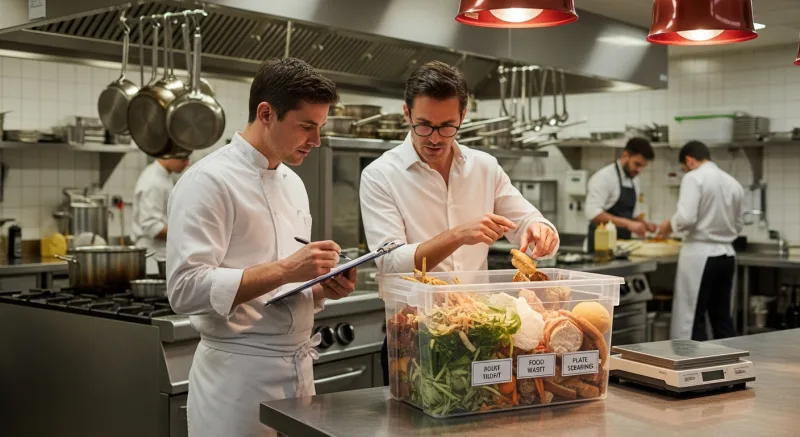
A food waste audit is simple: for seven consecutive days, every item that goes into the trash gets weighed, categorized, and logged. Prep waste, plate waste, spoilage, overproduction — all of it. The process takes about 15 minutes per shift and requires nothing more than a kitchen scale and a tracking sheet.
The results are always shocking. The average restaurant wastes 4% to 10% of purchased food before it ever reaches a customer. For a restaurant spending $20,000/month on food, that is $800 to $2,000 per month going directly into the trash.
And that's not all: once you see where the waste is happening, the fixes are usually obvious. Overproduction of soup on Mondays? Cut the batch size. Lettuce spoiling before Friday? Adjust your ordering schedule. Plates coming back with untouched sides? Rethink your portion sizes.
We wrote a complete guide to conducting a restaurant waste audit — including free tracking templates and a step-by-step protocol. If you do nothing else from this article, do this. It is the highest-ROI sustainability practice in the restaurant industry.
Smart POS systems make waste tracking even easier. When your analytics dashboard shows you exactly what sold and what did not — broken down by hour, day, and season — you can adjust prep quantities with surgical precision instead of guessing.
2. Switch to ENERGY STAR Kitchen Equipment (Savings: $4,000–$9,000/Year)
Commercial kitchens are energy monsters. The average restaurant spends $2,500 to $6,000 per month on utilities, and 60% to 70% of that goes to kitchen equipment — fryers, ovens, refrigeration, dishwashers, and HVAC fighting the heat they produce.
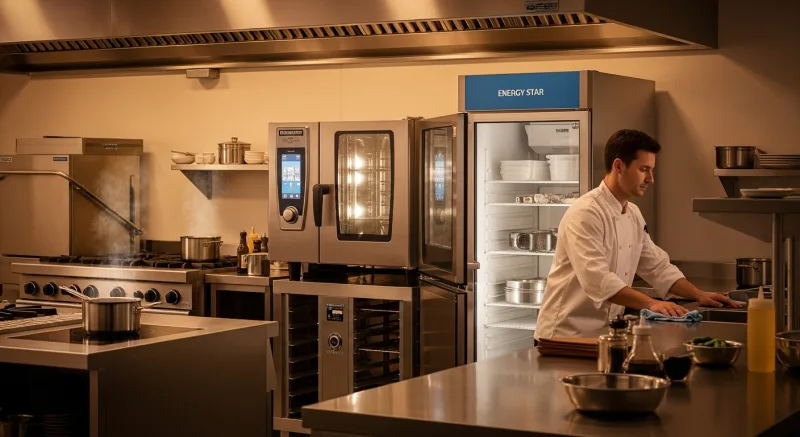
ENERGY STAR-certified commercial kitchen equipment uses 10% to 50% less energy than standard models. The savings by equipment type are significant:
| Equipment | Annual Energy Savings | Annual Cost Savings | Typical Payback Period |
|---|---|---|---|
| Commercial fryer | 30–50% | $800–$1,200 | 1–2 years |
| Convection oven | 20–30% | $500–$900 | 2–3 years |
| Walk-in refrigerator | 35–45% | $600–$1,400 | 1–3 years |
| Commercial dishwasher | 25–40% | $400–$800 | 1–2 years |
| Ice machine | 15–25% | $200–$500 | 2–3 years |
Here's the kicker: you do not need to replace everything at once. Start with the oldest, most energy-hungry equipment. Most utility companies offer rebates of $50 to $500 per appliance for upgrading to ENERGY STAR models. And under Section 179, you can deduct the full purchase price in the year you buy it — not depreciated over seven years.
Want to know exactly how much your current equipment is costing you? Our free restaurant calculators can help you estimate utility savings for specific equipment upgrades.
3. Implement FIFO Inventory Management (Savings: $3,000–$6,000/Year)
First In, First Out is not a new concept. But here is the reality: most restaurants practice FIFO in theory and chaos in practice.
When deliveries come in during a rush, boxes get stacked on top of older product. When a new case of tomatoes arrives, it goes in front because the walk-in is packed and nobody has time to rotate. When the prep cook grabs avocados, they take the closest ones — which are the freshest ones.
The result? Spoilage rates of 5% to 8% instead of the 1% to 2% that proper FIFO achieves. On $240,000 in annual food purchases, that gap costs you $7,200 to $14,400 per year.
Technology changes the game here. Modern inventory management systems — integrated directly into your POS — track what came in, when it came in, and when it needs to be used. Automated alerts flag items approaching expiration. Purchase history data shows exactly how much of each item you actually use per week, so you stop over-ordering.
Crafty Crab Seafood, running 19 locations on KwickOS, uses one-click menu sync and centralized inventory tracking to ensure every location maintains proper rotation. When you are managing 152 terminals across 19 stores, you cannot rely on manual FIFO — you need a system that enforces it automatically.
4. Cut Water Usage by 30% (Savings: $2,000–$5,000/Year)
The average restaurant uses 5,800 gallons of water per day. At current commercial water rates of $0.005 to $0.015 per gallon (including sewer charges), that is $10,000 to $32,000 per year just on water.
The biggest offenders are not where most owners think. Pre-rinse spray valves — the handheld sprayers used to rinse dishes before they go into the dishwasher — account for nearly a third of kitchen water use. A standard pre-rinse valve uses 3.0 gallons per minute. A WaterSense-certified replacement uses 1.28 gallons per minute. Cost: $50. Annual savings: $1,000 or more.
Other high-impact water savings:
- Fix leaks immediately. A single dripping faucet at one drip per second wastes 3,000 gallons per year. A leaking toilet wastes 200 gallons per day.
- Install aerators on hand-washing sinks. Reduces flow from 2.2 GPM to 0.5 GPM. Cost: $5 per faucet.
- Run dishwashers only when full. A commercial dishwasher uses the same water whether it is half-full or completely loaded. Scheduling wash cycles to maximize loads saves 15% to 25% on water use.
- Thaw food in the refrigerator, not under running water. Running water thawing wastes 300 to 500 gallons per day in a busy kitchen.
- Use waterless woks where possible. Common in Asian restaurants, waterless cooking techniques save 5,000+ gallons per month. Restaurants like T. Jin China Diner, operating 15 locations, track utility costs across every store — that kind of visibility makes it easy to spot which locations are using (and wasting) the most water.
5. Source Locally When the Math Works (Savings: $1,500–$4,000/Year)
Let's be clear: "buy local" is not always cheaper. A case of organic heirloom tomatoes from the farm down the road can cost twice what Sysco charges for conventional.
But here's where local sourcing does save money: reduced spoilage and reduced waste. Produce that traveled 50 miles arrives fresher and lasts longer than produce that traveled 1,500 miles. The shelf life difference is typically 2 to 4 days — which means fewer items hitting the trash before you can use them.
The smart approach is selective local sourcing. Identify the 5 to 10 items where local sourcing offers a combination of better quality, comparable price, and longer usable life. For most restaurants, this means seasonal produce, eggs, bread, and herbs — not proteins or dry goods.
There is also a marketing angle. Menus that call out local farms and suppliers see 8% to 15% higher order rates on those items, according to Cornell's Food and Brand Lab. A $24 "grilled chicken breast" becomes a $28 "pasture-raised chicken from Miller Family Farm, served with seasonal vegetables from Oak Creek Gardens" — and customers happily pay the premium.
6. Eliminate Single-Use Where It Does Not Matter (Savings: $1,200–$3,500/Year)
Not all single-use items are created equal. Straws? Customers barely notice when they are gone. Takeout containers? You need those. The key is identifying where single-use adds zero value to the customer experience and eliminating it.
Quick wins that save money and reduce waste:
- Switch to ask-first for straws and utensils. Instead of automatically including plastic straws and cutlery with every order, include them only when requested. Most restaurants report a 70% to 80% reduction in straw and cutlery usage with no customer complaints.
- Replace paper napkin dispensers with cloth napkins for dine-in. A full-service restaurant goes through 100 to 150 paper napkins per table per day. At $0.02 to $0.04 per napkin, that is $1,500 to $4,000 per year. A cloth napkin laundering service costs roughly half that.
- Use refillable condiment containers. Those little portion cups of ketchup, soy sauce, and ranch dressing cost $0.05 to $0.15 each. Refillable bottles on the table cost pennies per serving.
- Ditch disposable to-go bags for branded reusable bags. Offer them at $1 to $2 — customers keep using them and your brand travels around town.
For takeout and delivery, sustainable packaging costs more upfront but can be a competitive differentiator. Restaurants using KwickDriver for delivery ($2 flat + $6.99 per 5 miles, versus the 15% to 25% commission charged by DoorDash and UberEats) already save enough on delivery fees to absorb the small premium on sustainable containers.
7. Install Smart Lighting and HVAC Controls (Savings: $2,500–$5,000/Year)
Lighting and HVAC account for 25% to 35% of a restaurant's energy costs. And in most restaurants, both run at full power from open to close — regardless of whether the dining room is full or empty.
Smart controls change that:
- LED lighting. If you have not switched from fluorescent or incandescent to LED, you are overpaying by 50% to 75% on lighting costs. LED bulbs last 25,000 to 50,000 hours versus 1,000 for incandescent. A full restaurant LED retrofit typically costs $1,500 to $3,000 and pays for itself in under a year.
- Occupancy sensors. Install motion sensors in restrooms, storage areas, offices, and break rooms. Lights in these areas are on 100% of the time but needed less than 30%. Cost: $30 to $60 per sensor.
- Programmable thermostats. Set your HVAC to reduce output during closed hours and ramp up 30 minutes before opening. A 5-degree setback during 10 non-operating hours per day reduces HVAC costs by 10% to 15%.
- Kitchen exhaust hood controls. Variable-speed exhaust hoods that adjust airflow based on cooking activity save 30% to 50% on exhaust energy and reduce the load on your HVAC system — which is constantly fighting the heat being pulled out of the kitchen.
The total investment for smart lighting and HVAC controls in a 2,500-square-foot restaurant is typically $3,000 to $6,000. The annual savings of $2,500 to $5,000 mean a payback period of 12 to 18 months — and the savings continue for a decade or more.
8. Start a Composting Program (Savings: $800–$2,400/Year)
Wait — composting saves money? It does, and the math is straightforward.
Commercial waste hauling is priced by volume. The more trash you produce, the more pickups you need, the more you pay. A typical restaurant pays $500 to $1,200 per month for waste hauling. Food waste — which is heavy and takes up significant dumpster space — accounts for 30% to 40% of that volume.
Diverting food scraps to composting reduces your hauler volume and can allow you to downsize your dumpster or reduce pickup frequency. The savings on hauling fees typically offset 80% to 100% of the composting service cost — and in many cities, composting services are actually cheaper per pickup than trash hauling because composters can sell the finished product.
Here's the thing: composting also helps with tip #1 (waste auditing). When staff are required to separate compostable waste from trash, they become much more aware of how much food is being wasted. Restaurants that implement composting programs report a 15% to 20% reduction in total food waste within the first three months — not because of the composting itself, but because of the awareness it creates.
9. Digitize Everything You Can (Savings: $1,500–$3,000/Year)
Paper costs money. Printing costs money. And in a restaurant, paper gets wet, lost, and ignored.
Here is where digitization delivers real sustainability and cost savings:
- Digital receipts. The average restaurant prints 200 to 400 receipts per day. At $0.02 to $0.05 per receipt (paper + ink + printer wear), that is $1,500 to $7,000 per year. Digital receipts via email or SMS cost nothing per transaction and give you a customer email address for marketing. Tiger Sugar uses electronic receipts tied to their loyalty program through KwickOS self-ordering kiosks — capturing customer data while eliminating paper waste.
- Digital checklists. Replace paper health inspection checklists, temperature logs, and opening/closing procedures with digital versions. They are easier to audit, cannot get lost, and save 10 to 20 pages per day.
- Kitchen display systems instead of paper tickets. A busy restaurant prints 300+ kitchen tickets per day. A KDS eliminates all of them — and improves order accuracy. Shogun Japanese Hibachi switched to customized KDS station displays through KwickOS and had their team proficient in under 5 minutes. No more lost tickets, no more paper waste, and faster ticket times.
- QR code menus for specials and seasonal items. Instead of reprinting menus every time you change a special, use QR code ordering to display dynamic menus that update instantly — at zero printing cost.
The hybrid local+cloud architecture of modern POS systems matters here. When your system processes transactions locally at 1ms latency instead of waiting for cloud round-trips, digital receipts and KDS updates happen instantly — no lag that frustrates staff or slows down service. And if your internet drops, everything keeps working because the data lives locally.
10. Track, Report, and Market Your Sustainability Efforts (Value: Priceless)
Here is the practice that ties everything else together — and it costs almost nothing.
72% of diners say sustainability influences their restaurant choice. Among diners aged 18 to 34, that number is 83%. But here is the catch: they cannot support what they do not know about.
If you are doing the work, you need to tell people about it. Not in a preachy way — in a factual, specific way:
- "We diverted 12 tons of food waste from the landfill last year through our composting partnership with [local composter]."
- "Our kitchen uses 40% less energy than industry average thanks to ENERGY STAR equipment installed in 2025."
- "100% of our seafood comes from MSC-certified sustainable fisheries."
Put it on your menu. Put it on your Google Business Profile. Put it on your social media. Include it in your email marketing. Not as the main message — as proof that you run a thoughtful, well-managed operation.
And that's not all: sustainability metrics give you data for continuous improvement. When you know your food waste percentage, energy cost per cover, and water cost per day, you can set targets and track progress. That is what separates restaurants that save $5,000 from restaurants that save $31,000 — the ones tracking their numbers keep finding new ways to improve.
Modern POS analytics make this tracking automatic. When your system already knows your sales, your inventory usage, and your operating hours, calculating sustainability metrics is just a matter of adding utility data to the equation. Multi-location operators like Crafty Crab Seafood, running 19 stores on a centralized platform, can compare sustainability metrics across locations and roll out winning practices chain-wide.
The Total Savings Picture
Let us add it all up for a typical full-service restaurant doing $1 million in annual revenue:
| Practice | Annual Savings (Low) | Annual Savings (High) | Implementation Cost |
|---|---|---|---|
| Food waste audit + reduction | $8,000 | $12,000 | $0 (staff time only) |
| ENERGY STAR equipment | $4,000 | $9,000 | $5,000–$15,000 (offset by rebates) |
| FIFO inventory management | $3,000 | $6,000 | $0–$100/month (POS module) |
| Water conservation | $2,000 | $5,000 | $200–$500 |
| Local sourcing (selective) | $1,500 | $4,000 | $0 |
| Single-use reduction | $1,200 | $3,500 | $0–$500 |
| Smart lighting + HVAC | $2,500 | $5,000 | $3,000–$6,000 |
| Composting program | $800 | $2,400 | $0–$200/month |
| Digitization | $1,500 | $3,000 | Included with modern POS |
| Marketing + tracking | Indirect | Indirect | $0 |
| Total | $24,500 | $49,900 | $8,200–$22,300 (Year 1) |
Even at the low end, $24,500 in annual savings on a restaurant with 5% to 8% net margins has the same profit impact as generating an additional $300,000 to $490,000 in revenue. And unlike revenue growth, these savings require no additional labor, food cost, or marketing spend.
The implementation costs are front-loaded. By year two, the annual savings flow straight to your bottom line.
Where to Start
Do not try to do all ten at once. Here is the recommended sequence, ordered by ROI and ease of implementation:
- Week 1: Run a food waste audit. Zero cost, highest savings potential.
- Week 2: Install low-flow spray valves and faucet aerators. Under $100 total, saves $1,000+/year.
- Week 3: Switch to digital receipts and implement KDS if your POS supports it.
- Month 2: Implement FIFO with your POS inventory module. Start tracking spoilage data.
- Month 3: Begin selective local sourcing. Start with 3 to 5 seasonal items.
- Month 4: Get quotes for LED retrofitting and ENERGY STAR equipment replacements.
- Month 6: Launch a composting program. Contact local composting services for quotes.
- Ongoing: Track your sustainability metrics monthly and communicate progress to customers.
The restaurants saving $31,000 or more per year did not get there overnight. They got there by making one change at a time, tracking the results, and reinvesting the savings into the next improvement. The compounding effect is what makes sustainability so powerful — each practice reinforces the others.
Your technology stack is the foundation that makes all of this trackable and manageable. A processor-agnostic POS system that already saves you $3,000 to $8,000 per year on processing fees gives you the budget to invest in sustainability improvements. And the analytics, inventory management, and digital tools built into that same system make every practice on this list easier to implement and measure.
The dumpster is still full of money. The question is whether you are going to keep throwing it away.
Track Waste, Cut Costs, Go Green
KwickOS gives you the inventory tracking, analytics, and digital tools to make every sustainability practice measurable — and profitable. See it in action.
Get a Demo