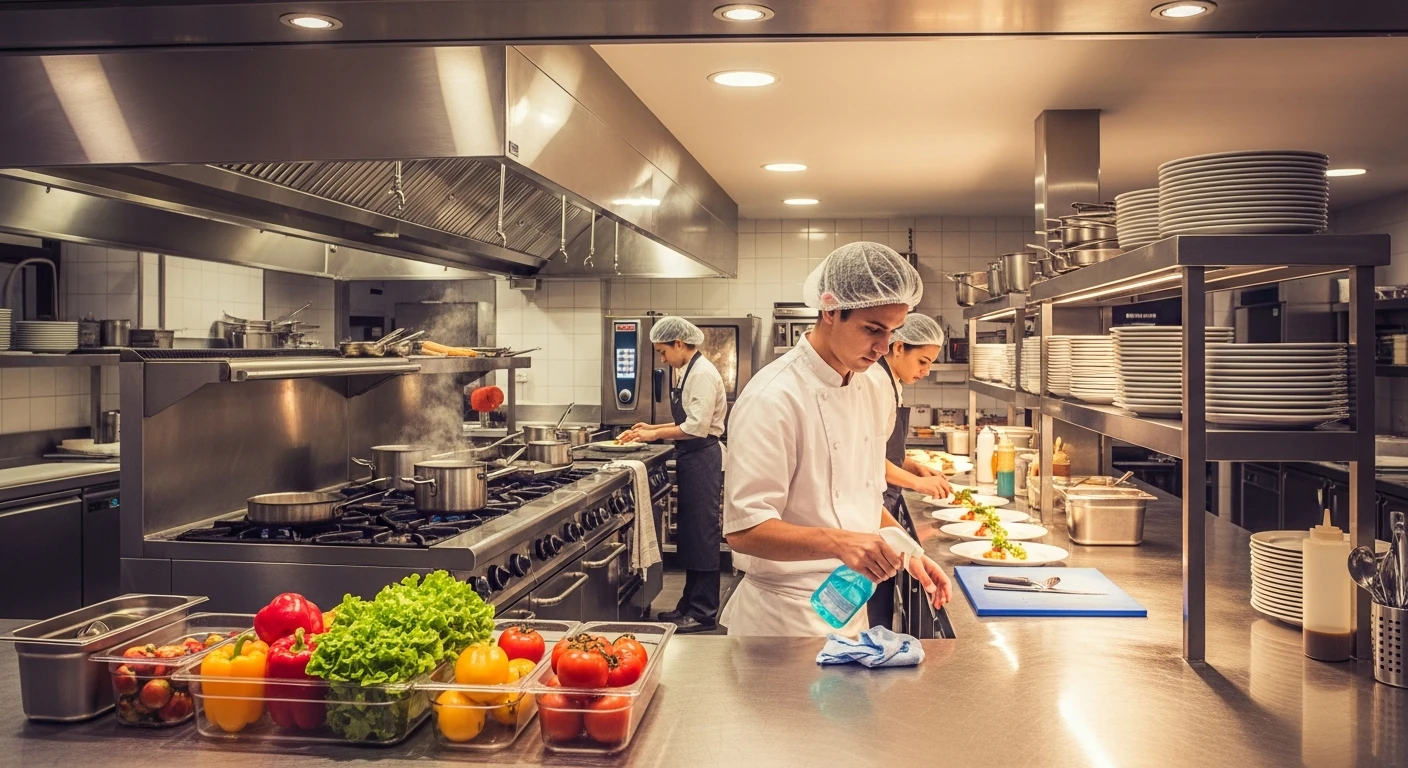
Running a restaurant without the right POS system is like driving without a dashboard. You get a knock on the back door during Tuesday lunch rush. It is the health inspector. No warning. No appointment.
Your stomach drops. When was the last time someone checked the walk-in temps? Did the opener actually sanitize the prep surfaces this morning? Is that handwashing sign still up in the dish pit?
If those questions make you nervous, you are not alone. According to the FDA, 60% of restaurants receive at least one critical violation during routine inspections. Not because restaurant owners do not care about food safety. Because they do not have a system that makes compliance automatic.
Here's the thing: the restaurants that consistently score 95+ on health inspections are not spending more time on food safety than you are. They are spending their time differently. They have checklists that run themselves, temperature logs that cannot be faked, and accountability systems that catch problems before an inspector ever walks through the door.
This guide gives you the exact system. Every checklist item. Every temperature threshold. Every common violation and how to prevent it. By the time you finish reading, you will have everything you need to make your next health inspection the easiest one you have ever had.
The Real Cost of a Failed Health Inspection
Before we get into prevention, let us talk about what is actually at stake — because it is far more than the fine on the violation notice.
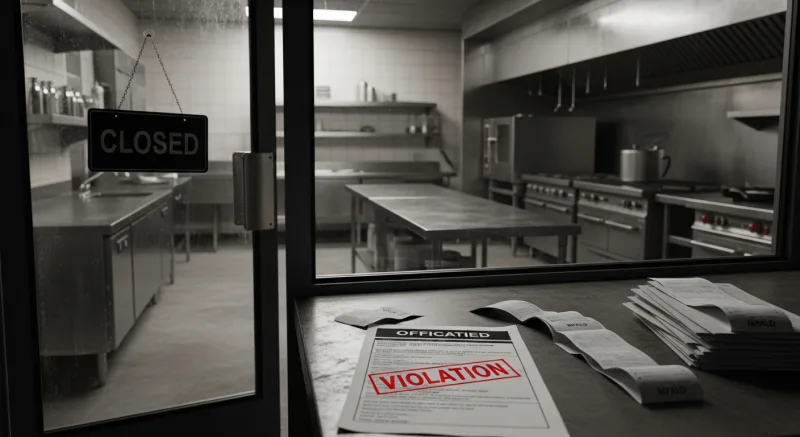
A single critical violation can trigger:
- Direct fines: $200 to $1,000+ per violation depending on your jurisdiction. Multiple violations compound. A bad inspection in New York City can run $2,000 to $5,000 in a single visit.
- Mandatory re-inspection fees: Most health departments charge $150 to $400 for follow-up inspections. If you fail the re-inspection, the fees double.
- Temporary closure: Critical violations — like a pest infestation, no hot water, or food held at dangerous temperatures — can result in immediate shutdown until the problem is corrected. Every day closed is $2,000 to $8,000 in lost revenue for the average restaurant.
- Public record damage: Health inspection scores are public. Yelp displays them prominently. Google shows them in local search results. A study by the National Bureau of Economic Research found that a one-star decrease in Yelp's hygiene rating corresponds to a 5-9% decrease in revenue.
- Insurance increases: Repeated violations can cause your liability insurance premiums to increase by 10-25%.
Add it up and a single bad inspection can cost your restaurant $10,000 or more when you factor in fines, closure, lost revenue, and long-term reputation damage.
But it gets worse: the damage compounds. Once you have a failed inspection on your record, inspectors visit more frequently, scrutinize more carefully, and are less forgiving on borderline issues. A clean record earns you the benefit of the doubt. A dirty record puts you under a microscope.
The 5 Most Common Critical Violations (And How to Prevent Each One)
Health codes vary by state and county, but the FDA Food Code forms the foundation for nearly every jurisdiction. These five violations account for over 75% of critical findings nationwide.
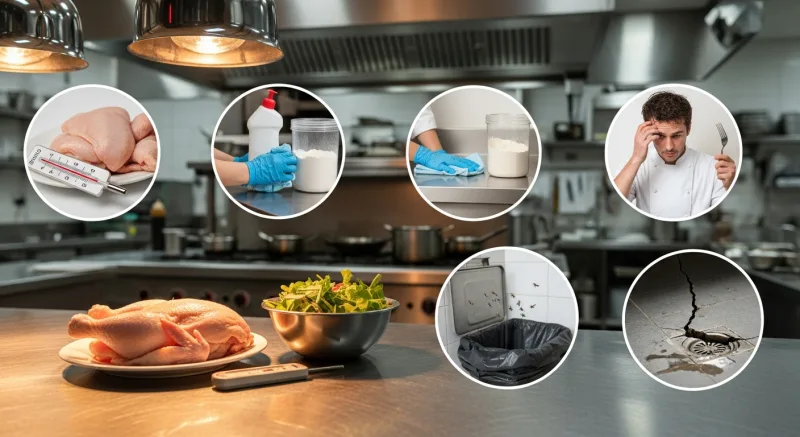
1. Improper Food Holding Temperatures (25% of All Critical Violations)
This is the number-one reason restaurants fail inspections. The temperature danger zone — 41°F to 135°F — is where bacteria double every 20 minutes. An inspector's first move is almost always pulling out a thermometer and checking your hot-holding and cold-holding units.
Prevention system:
- Check and log walk-in cooler, walk-in freezer, and all reach-in temperatures at opening, mid-shift, and closing. Target: coolers at 38°F or below, freezers at 0°F or below.
- Check and log hot-holding temperatures every 2 hours during service. Target: 135°F or above.
- Use digital probes, not the thermometer built into the equipment. Built-in thermometers drift by 5-10°F over time and inspectors know this.
- Calibrate all thermometers weekly using the ice-point method (32°F in ice water).
- Post the temperature danger zone chart in every prep area and walk-in. Make it impossible to forget.
And that's not all: many restaurants lose points not because the food is actually at an unsafe temperature, but because they cannot prove it was held safely. Paper logs are the weakest link. Inspectors know that staff backfill paper logs at the end of the shift — writing "38°F" for every time slot without actually checking. Digital temperature logging with timestamps eliminates this problem entirely.
Multi-location operators like T. Jin China Diner (15 stores, 75 terminals) solve this at scale by running all operations through a unified system. When temperature logs, staff clock-ins, and opening checklists all live in one platform, the owner can verify compliance across every location from a single dashboard — no phone calls, no guesswork, no surprises when the inspector shows up at store #11.
2. Inadequate Handwashing (18% of Critical Violations)
This one sounds basic. It is basic. And it is the second most common reason restaurants fail inspections.
Inspectors check for: handwashing sinks accessible and unblocked, soap and paper towels stocked, water at 100°F minimum, and — most importantly — whether staff are actually washing between tasks. They watch. They time it. The FDA requires 20 seconds of scrubbing.
Prevention system:
- Audit every handwashing station daily. Soap, paper towels, warm water, signage. No exceptions.
- Never — ever — use a handwashing sink for anything else. Not rinsing produce. Not dumping mop water. Not soaking dishes. This is an automatic critical violation.
- Train new hires on handwashing during their first hour. Not their first day — their first hour. Make them demonstrate proper technique before they touch any food.
- Post handwashing reminders in the language your staff actually speaks. If your kitchen team speaks Spanish and Mandarin, your handwashing signs should be in English, Spanish, and Mandarin.
Here's the thing: multilingual signage is not just a nice-to-have. Inspectors specifically check that safety information is posted in languages your staff can read. Systems like KwickOS that operate natively in English, Chinese, and Spanish make this seamless — training materials, checklists, and safety protocols all display in the employee's preferred language. Shogun Japanese Hibachi got their entire team operational in under 5 minutes partly because the interface speaks their team's language from day one.
3. Cross-Contamination (15% of Critical Violations)
Raw chicken stored above ready-to-eat salad in the walk-in. A cutting board used for raw beef and then for slicing tomatoes without sanitizing. These are the violations that make inspectors write in capital letters.
Prevention system:
- Color-coded cutting boards: red for raw meat, green for produce, blue for seafood, yellow for poultry, white for dairy and bread. Post the chart above the prep area.
- Walk-in organization rule: ready-to-eat items on top shelves, raw proteins on bottom shelves, always in the order of cooking temperature (produce top, then seafood, then whole meat, then ground meat, then poultry at the bottom).
- Separate prep areas for raw and cooked food. If your kitchen is too small for separate areas, separate by time — prep all raw proteins first, sanitize everything, then prep ready-to-eat items.
- Label and date everything that enters the walk-in. The 7-day rule: any prepared food without a use-by date gets thrown out during inspection.
4. Improper Food Storage and Labeling (12% of Critical Violations)
Inspectors open your walk-in and look for three things: labels, dates, and organization. Unlabeled containers are an automatic violation. Missing date marks on prepared foods are an automatic violation. Food stored on the floor — even if it is in a sealed container — is an automatic violation.
Prevention system:
- Every container gets a label with: item name, prep date, and use-by date. No exceptions. Buy dissolvable labels that come off cleanly — inspectors also check for label residue on containers.
- FIFO (First In, First Out) is not optional. New inventory goes behind old inventory. Every time. Train every person who stocks a shelf.
- Nothing touches the floor. All food and single-use items must be stored at least 6 inches off the ground. Invest in enough shelving to make this easy.
- Chemicals stored separately from food. This means a separate shelf, ideally a separate area. Cleaning chemicals above food items is a critical violation that can result in immediate closure.
Restaurants with strong inventory management systems catch labeling and dating problems before the inspector does. When your POS tracks inventory in real time, you see exactly what was prepped when, what is approaching expiration, and what should have been used yesterday. It turns a manual memory exercise into an automated alert.
5. Dirty or Poorly Maintained Equipment (10% of Critical Violations)
Grease buildup inside the hood vent. Mold in the ice machine. A cracked cutting board with food particles embedded in the cracks. Inspectors check every piece of equipment — including the ones you forget about.
Prevention system:
- Create a cleaning schedule that covers every piece of equipment, not just the obvious ones. Ice machines: weekly. Hood vents: monthly (professional deep clean quarterly). Soda nozzles: daily. Can opener blades: after every use.
- Replace worn equipment before it becomes a violation. Cracked cutting boards, fraying gaskets on cooler doors, chipped food-contact surfaces — these are all citations waiting to happen.
- Clean-as-you-go culture. The difference between restaurants that pass and restaurants that scramble is not a better deep-cleaning routine. It is whether staff clean during service, not just after.
The Daily Inspection-Ready Checklist
The restaurants that score 97+ on every inspection do not prepare for inspections. They follow a daily system that keeps them inspection-ready at all times. Here is the checklist, broken into three shifts:
Opening Checklist (Before First Customer)
- Check and log all cooler and freezer temperatures
- Verify handwashing stations: soap, towels, warm water, signage
- Inspect prep surfaces — clean, sanitized, no damage
- Check sanitizer buckets — proper concentration (150-400 ppm quaternary ammonium or 50-100 ppm chlorine)
- Review walk-in: FIFO organization, all items labeled and dated, nothing on the floor
- Verify pest traps — no activity, traps in place
- Check employee hygiene: clean uniforms, hair restraints, no jewelry on hands/wrists
- Confirm all food safety certifications are posted and current
Mid-Shift Checklist (During Service)
- Re-check hot-holding temperatures (must be 135°F+)
- Re-check cold-holding temperatures on the line (must be 41°F or below)
- Observe handwashing compliance — are staff washing between tasks?
- Check that sanitizer buckets have not been diluted or contaminated
- Verify dish machine is hitting proper temperatures (wash: 150°F+, rinse: 180°F+ for high-temp; or proper chemical concentration for low-temp)
- Check floor for spills, debris, standing water
Closing Checklist (After Last Customer)
- Final temperature log for all units
- Label and date all prepared foods going into storage
- Discard any prepared food past its use-by date
- Deep clean all food-contact surfaces
- Empty and sanitize all trash receptacles
- Check that all exterior doors are sealed (pest prevention)
- Verify walk-in doors close and seal properly
- Manager sign-off on completed checklist
And here is the critical point: this checklist is worthless on paper. Paper checklists get checked off without being done. They get lost. They get filled in retroactively. An inspector who finds a perfectly completed paper checklist and a cooler at 47°F knows exactly what happened — nothing.
Digital checklists with timestamps, photo verification, and manager alerts solve this problem. When a line cook checks the walk-in temperature at 6:15 AM and the system logs it as 6:15 AM with the actual reading, that is documentation an inspector trusts. When the manager gets an automatic alert that the mid-shift temp check was not completed by 2 PM, that is accountability that prevents violations.
How Technology Replaces the Weakest Link
The weakest link in every food safety system is human memory. Your staff knows the rules. They attended the training. They passed the food handler certification. And then during a Friday night rush, they forget to check the steam table temperature because they are in the weeds with 47 covers and a two-top sending back their steak.
But it gets worse: in a multi-location operation, the problem multiplies. You cannot be in every kitchen at once. You cannot verify that every opening manager at every location actually completed the morning checklist.
This is where your POS and operational platform becomes a food safety tool — not just a sales tracking tool.
Crafty Crab Seafood runs 19 stores with 152 terminals. When one location gets flagged for a temperature issue, the operations team can push updated protocols to all 19 locations with a single click. Menu sync, checklist sync, safety protocol sync — it all happens from one dashboard. That is the difference between a single-store problem and a chain-wide incident.
The most effective restaurant technology for health inspection compliance includes:
- Digital temperature logging with automatic alerts when readings fall outside safe ranges
- Task management that assigns cleaning and safety checks to specific employees with time-stamped completion tracking
- Inventory tracking that flags items approaching expiration before they become violations
- Employee authentication that verifies who completed which safety task. Fingerprint-based clock-in systems like KwickOS's 1:N biometric authentication ensure that the person who signed off on the checklist is actually the person who did the work — not someone logging in on a colleague's behalf.
- Offline capability that keeps logs running even when the internet goes down. A hybrid local-cloud system ensures your temperature logs and safety checklists are never interrupted by a connection issue — everything syncs when connectivity returns.
The Night-Before-Inspection Emergency Checklist
Let us be honest — sometimes you get a tip that the inspector is coming tomorrow. Maybe a neighboring restaurant just got visited, and your health department works the block. Here is what to focus on if you have 12 hours to prepare.
But here is the key: this is not a substitute for the daily system above. This is triage. If you are doing this regularly, you have a system problem, not a preparation problem.
- Walk the walk-in. Pull everything out of date. Re-label anything without a label. Reorganize to ensure proper vertical storage order. Clean the floor and check the door gasket.
- Check every thermometer. Calibrate or replace anything that reads more than 2°F off from ice-point.
- Handwashing stations. Stock soap, towels, and verify hot water at every station. Remove anything stored in or near the sink.
- Sanitizer concentration. Mix fresh buckets. Test with strips. Post the concentration chart.
- Employee files. Verify every person on tomorrow's schedule has a current food handler certification. Print or download copies to have on hand.
- Pest check. Walk the perimeter. Check behind equipment. Look under sinks. Inspect the dumpster area. If you see anything, call your pest control company for an emergency service.
- Equipment deep spots. Ice machine, can opener, soda nozzles, the underside of prep tables, the inside of the microwave. These are inspector favorites.
- Floors and walls. Grout, cove base, behind equipment. Inspectors will move things. Check what is behind them first.
Building a Culture That Passes Every Time
The restaurants with the best health inspection records share three characteristics that have nothing to do with checklists:
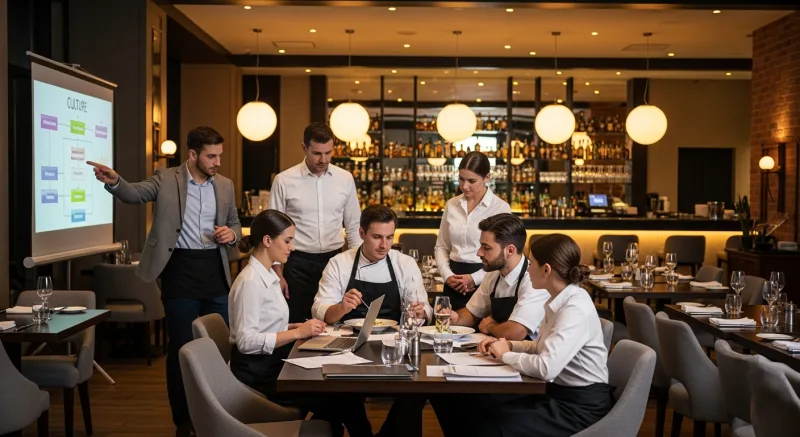
1. They tie food safety to employment, not to inspection. At these restaurants, food safety violations are treated like cash handling violations — seriously, consistently, and with consequences. Not because inspectors are scary, but because food safety is part of the job description.
2. They make compliance easier than non-compliance. When the sanitizer bucket is right next to the prep station, people use it. When the labels and markers are mounted on the wall above the prep table, people label things. When the thermometer is hanging on the walk-in door, people check the temperature. Remove friction and compliance becomes the default.
3. They celebrate scores publicly. Post your inspection score where staff can see it. When you hit 97+, make it a team win. When you drop below your standard, make it a team conversation — not a blame session. Restaurants that treat food safety as a point of pride develop staff who take ownership of it.
Diva Nail Beauty achieved a 90% efficiency increase across 4 stores when they automated their operational tracking. The same principle applies to food safety: when the system handles the tracking, the team can focus on the actual work. Automation does not replace accountability — it makes accountability visible and consistent.
What to Do During the Inspection
When the inspector arrives, your behavior matters almost as much as your compliance.
- Be present. Assign a manager to walk with the inspector. Answer questions directly and honestly. Do not volunteer problems, but do not hide them either.
- Take notes. Write down everything the inspector flags, even if it is a minor observation, not a formal violation. These notes become your improvement plan.
- Fix immediately. If the inspector points out something you can fix on the spot — a missing label, a sanitizer bucket that needs refreshing, a hand sink that needs paper towels — fix it immediately. Many inspectors will note it as "corrected on-site" rather than a formal violation.
- Show your documentation. If you have digital temperature logs, cleaning schedules, and training records, offer to show them. Inspectors give restaurants credit for strong systems even if they find a minor issue.
- Do not argue. If you disagree with a finding, note it calmly and follow up through your health department's formal appeal process. Arguing during the inspection makes everything worse.
- Ask for guidance. Most inspectors are willing to explain exactly what they want to see and how to prevent future violations. They would rather help you pass than catch you failing. Ask what they recommend.
After the Inspection: The 48-Hour Rule
Whatever violations or observations the inspector noted, address them within 48 hours. Not because the follow-up deadline is that soon — it usually is not — but because momentum matters.

- Review every finding with your management team within 24 hours.
- Create a corrective action plan for each violation with a specific owner and deadline.
- Update your daily checklists to include any new items the inspection revealed.
- Retrain any staff member whose actions contributed to a violation.
- Document everything. When the re-inspection happens, you want to show exactly what you changed and when.
Use your POS system's employee management features to assign corrective tasks, track completion, and document training. When the follow-up inspector asks what you did to fix the problem, "we retrained staff and updated our digital checklists" is a much stronger answer than "we talked to the kitchen about it."
The Bottom Line
Health inspections are not tests you cram for. They are snapshots of your daily operation. The restaurants that score 97+ every time are not doing anything heroic on inspection day — they are following a system that makes compliance the default, every day, in every shift.
The system is simple: daily checklists with accountability, digital temperature logs that cannot be faked, staff trained in the language they actually speak, and technology that turns manual memory into automated alerts.
You are paying the consequences of every missed temperature check, every backfilled paper log, every "I'll label it later" that turned into an unlabeled container sitting in your walk-in when the inspector opened the door. The average restaurant loses $10,000 per failed inspection. Over five years, that is a new POS system, a kitchen renovation, or a year's salary for a sous chef — spent on completely preventable violations.
Stop preparing for inspections. Start running a system that makes preparation unnecessary.
Run Your Restaurant Like a 97-Score Operation
KwickOS gives you digital checklists, temperature logging, multilingual training, and multi-location oversight — all in one platform. See how operators like Crafty Crab manage food safety across 19 stores.
Get a Demo