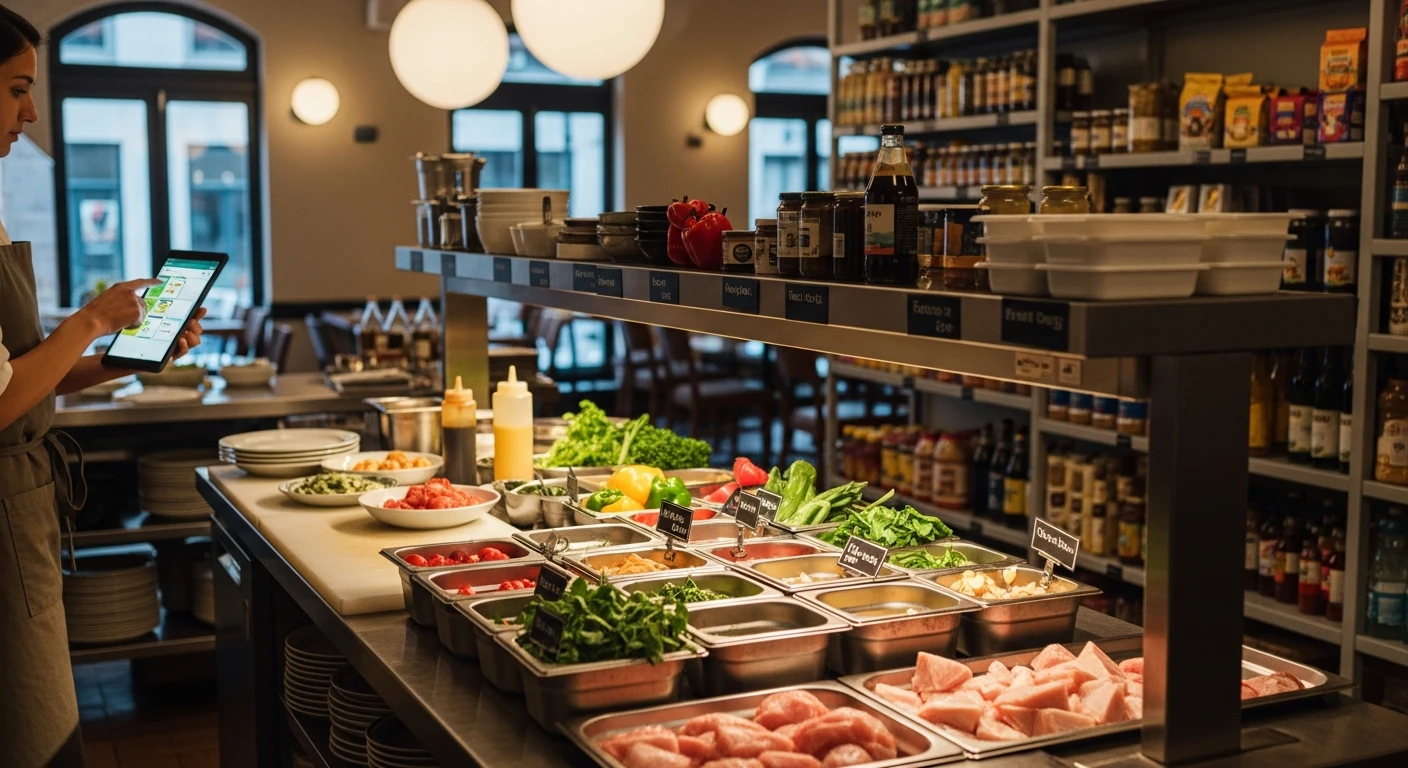
Food costs are the second-largest expense for most restaurants, typically accounting for 28% to 35% of total revenue. Yet the National Restaurant Association estimates that restaurants waste between 4% and 10% of the food they purchase before it ever reaches a customer's plate. For a restaurant generating $1 million in annual revenue, that translates to $12,000 to $35,000 thrown away each year.
Effective restaurant inventory management is the most direct path to reducing food waste, controlling costs, and improving your bottom line. This guide covers the systems, processes, and best practices that separate profitable restaurants from those that bleed money through disorganized stockrooms and unchecked waste.
Why Inventory Management Matters More Than You Think
Most restaurant owners focus on increasing revenue through marketing, menu changes, or longer hours. While those strategies matter, improving inventory management delivers faster, more reliable results because it directly reduces your largest variable cost.
Consider the math: a restaurant operating on a 5% net profit margin that reduces food waste by just 2% of revenue has effectively increased net profit by 40%. No marketing campaign can deliver that kind of return with that level of certainty.
Beyond the financial impact, poor inventory management creates a cascade of operational problems:
- Menu inconsistency: Running out of key ingredients forces 86'd items and disappointed customers
- Over-ordering: Excess stock leads to spoilage, especially for perishable items
- Theft and shrinkage: Without accurate tracking, employee theft and vendor short-deliveries go undetected
- Inaccurate food costing: If you don't know what you have, you can't calculate what your dishes actually cost
- Cash flow pressure: Tying up capital in excess inventory restricts your ability to cover other expenses
The Fundamentals: How Restaurant Inventory Works
Key Inventory Metrics Every Owner Should Track
| Metric | Formula | Target Range |
|---|---|---|
| Food Cost Percentage | (Cost of Goods Sold / Food Revenue) x 100 | 28% - 35% |
| Inventory Turnover Ratio | COGS / Average Inventory Value | 4 - 8 times per month |
| Sitting Inventory | Current Inventory Value / Average Daily COGS | 5 - 7 days of supply |
| Waste Percentage | (Waste Value / Total Purchases) x 100 | Below 4% |
| Variance | Theoretical Usage - Actual Usage | Below 2% |
COGS: The Number That Controls Your Profitability
Cost of Goods Sold (COGS) is the total cost of all food and beverage used during a specific period. The standard formula is:
COGS = Beginning Inventory + Purchases - Ending Inventory
Calculating COGS weekly rather than monthly gives you a much faster feedback loop. If food costs spike in week two, you can investigate and correct the issue before it compounds through the rest of the month.
10 Best Practices for Restaurant Inventory Management
1. Conduct Inventory Counts on a Consistent Schedule
Physical inventory counts should happen at the same time, on the same day, every week. Consistency is critical because it allows you to compare apples to apples across periods. Most successful restaurants count inventory twice per week: once before the weekend rush and once at the start of the new week.
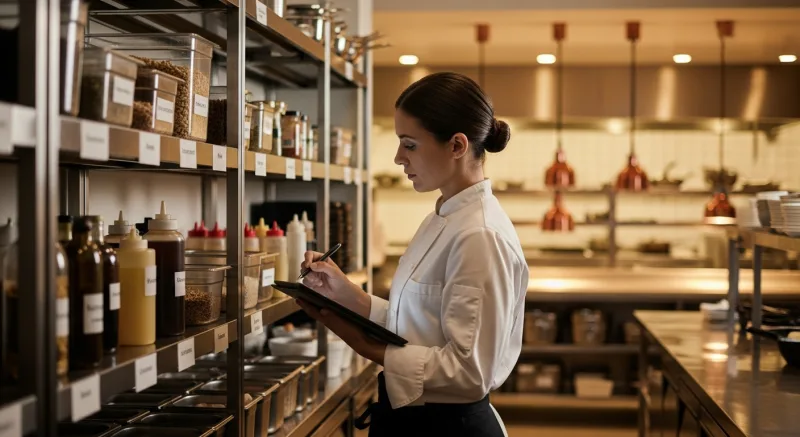
Assign the same team members to count inventory each time. Familiarity with the stockroom layout and product locations dramatically improves counting speed and accuracy.
2. Use the FIFO Method Religiously
First In, First Out (FIFO) is the most important stock rotation principle in food service. Every delivery should be unpacked, dated, and placed behind existing stock. This simple practice prevents older ingredients from being buried behind newer ones and significantly reduces spoilage.
Train every team member who handles receiving or stock rotation on FIFO. Label all items with the date received and use color-coded day-of-the-week labels for perishable prep items.
3. Standardize Recipes with Exact Measurements
Standardized recipes are the bridge between your menu and your inventory. Every dish should have a documented recipe specifying exact ingredient quantities, preparation methods, and plating instructions. Without standardized recipes, you cannot calculate theoretical food costs or identify variance between what you should have used and what you actually used.
4. Set Par Levels for Every Item
Par levels define the minimum and maximum quantities of each ingredient you should have on hand at any given time. Setting accurate par levels prevents both stockouts and over-ordering. Base your par levels on:
- Historical sales data for each menu item
- Delivery schedules from your vendors
- Seasonal variations in demand
- Shelf life of each ingredient
- Buffer stock for unexpected demand spikes
5. Track Waste Actively, Not Passively
Create a waste log and require kitchen staff to record every item that gets thrown away, including the reason (spoilage, overproduction, customer return, prep error). This data is invaluable for identifying patterns. If you are throwing away a case of lettuce every week, you either need to adjust your par levels, find a new use for the ingredient, or change suppliers.
Track Inventory in Real Time with KwickOS
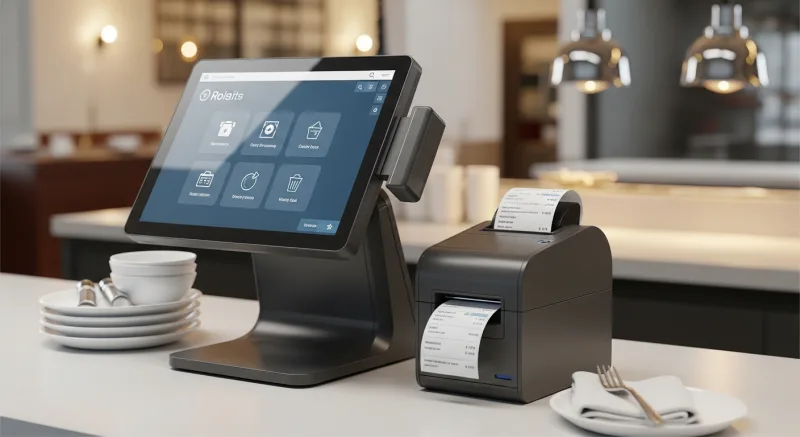
KwickOS integrates inventory tracking directly with your POS, so stock levels update automatically with every sale. Set par levels, get low-stock alerts, and view food cost reports without spreadsheets.
See KwickOS Inventory Features6. Build Strong Vendor Relationships
Your suppliers are partners in your inventory management system. Establish clear communication channels and expectations:
- Negotiate delivery schedules that align with your par levels and storage capacity
- Request itemized invoices that match your inventory categories
- Verify every delivery against the purchase order at the time of receipt, checking weights, quantities, and quality
- Maintain relationships with at least two vendors for critical items to avoid supply disruptions
7. Conduct Regular Menu Engineering
Menu engineering is the practice of analyzing each menu item's profitability and popularity to optimize your menu for maximum margin. Categorize every item into one of four quadrants:
| Category | Popularity | Profitability | Strategy |
|---|---|---|---|
| Stars | High | High | Promote heavily; protect recipe consistency |
| Plow Horses | High | Low | Re-engineer recipe to improve margin; reduce portion slightly or substitute cheaper ingredients |
| Puzzles | Low | High | Increase visibility through menu placement, staff recommendations, or specials |
| Dogs | Low | Low | Remove from menu or completely rework the recipe |
This analysis directly impacts inventory management because removing low-performing items reduces the number of ingredients you need to stock, which simplifies ordering and reduces waste.
8. Separate Storage Areas by Category and Temperature
Organized storage is the physical foundation of inventory management. Structure your walk-in cooler, freezer, and dry storage with clearly labeled shelves for each category: proteins, dairy, produce, dry goods, beverages, and cleaning supplies. Never store cleaning chemicals near food items.
9. Calculate and Monitor Actual vs. Theoretical Food Cost
Theoretical food cost is what your food cost should be based on your standardized recipes and POS sales data. Actual food cost is calculated from your physical inventory counts and purchase records. The difference between these two numbers is your variance, and it tells you how much food is being lost to waste, theft, overportioning, or unrecorded comps.
A healthy variance is below 2%. If your variance is consistently above 3%, investigate immediately. The most common causes are:
- Overportioning by kitchen staff (retraining needed)
- Unrecorded waste or spoilage
- Employee theft
- Vendor delivery shortages not caught at receiving
- Inaccurate recipes or incorrect product costs in your system
10. Use Technology to Automate What You Can
Manual inventory management with spreadsheets and clipboards is error-prone and time-consuming. Modern food inventory systems integrate directly with your POS to automatically deduct ingredients from inventory as items are sold. This gives you real-time visibility into stock levels, automates purchase order generation, and produces accurate food cost reports without hours of manual data entry.
Manual vs. Digital Inventory Systems
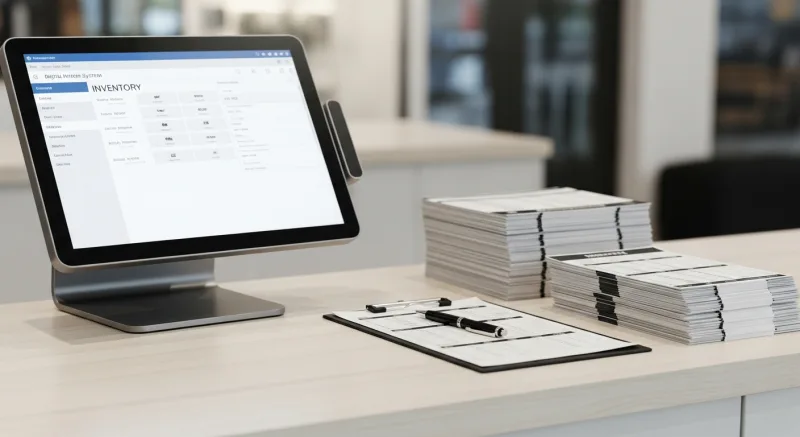
| Feature | Manual (Spreadsheets/Clipboards) | Digital (POS-Integrated System) |
|---|---|---|
| Time per inventory count | 2 - 4 hours | 30 - 60 minutes |
| Real-time stock visibility | No (only accurate at count time) | Yes (updates with every sale) |
| Automatic reorder alerts | No | Yes (triggered at par levels) |
| Food cost reporting | Manual calculation required | Automatic, real-time reporting |
| Variance tracking | Possible but labor-intensive | Automatic with POS integration |
| Error rate | High (data entry mistakes common) | Low (automated calculations) |
| Multi-location support | Very difficult to manage | Centralized dashboard across all locations |
How to Reduce Food Waste in Your Restaurant
Beyond the inventory management practices above, these targeted strategies help minimize waste throughout your operation:
- Repurpose trim and byproducts: Vegetable scraps become stock, stale bread becomes croutons, overripe fruit becomes dessert sauces or cocktail ingredients
- Use daily specials strategically: Feature ingredients approaching their shelf life in specials to move them before they expire
- Right-size your prep: Use sales forecasting data to prepare only what you expect to sell. Batch prep in smaller quantities during slower periods
- Train on portion control: Use scales, portioning tools, and visual guides so every team member plates consistently
- Monitor plate waste: If customers consistently leave a specific component uneaten, reduce the portion or rethink the component
- Optimize storage conditions: Proper temperature, humidity, and storage containers extend shelf life significantly. Invest in quality containers and monitor cooler temperatures daily
"Reducing food waste by 1% of revenue in a restaurant with a 5% profit margin has the same bottom-line impact as increasing sales by 20%. Inventory management is the highest-leverage activity in restaurant operations."
Inventory Management for Multi-Location Restaurants
Managing inventory across multiple locations adds layers of complexity. Each location may have different sales volumes, menu variations, and local vendor relationships. A centralized inventory system is essential for multi-location operations. It allows you to:
- Compare food costs and waste percentages across locations to identify underperformers
- Standardize recipes, par levels, and ordering procedures across all units
- Consolidate purchasing to negotiate better vendor pricing
- Transfer excess inventory between locations instead of letting it spoil
- Generate consolidated reports for ownership and management review
KwickOS supports multi-location inventory management with centralized dashboards and location-level detail. Chains like Haidilao, operating 600+ locations on KwickOS, use this capability to maintain consistency and control costs at scale. Compare KwickOS to other platforms to see how multi-location features stack up.
Cut Food Waste and Boost Profits
KwickOS gives you real-time inventory tracking, automated par level alerts, food cost reporting, and multi-location management in one platform. No spreadsheets required.
Schedule a KwickOS DemoGetting Started: Your First 30 Days
If you are currently managing inventory manually or not managing it at all, here is a practical 30-day plan to get on track:
- Week 1: Conduct a complete physical inventory count. Document every item, its current quantity, unit cost, and location. This is your baseline
- Week 2: Standardize your top 20 menu items with exact recipes and ingredient quantities. Calculate theoretical food cost for each
- Week 3: Set par levels for your top 50 ingredients based on the last four weeks of sales data. Begin placing orders based on par levels instead of gut instinct
- Week 4: Conduct your second full inventory count. Calculate your actual food cost, compare it to theoretical, and identify your variance. Set a goal to close the gap
Within 30 days of implementing these practices, most restaurants see measurable improvements in food cost percentage and waste reduction. Over 90 days, those improvements compound as your team builds the habits and systems that sustain long-term profitability. For a broader view of opening and running a profitable restaurant, see our complete guide to opening a restaurant.