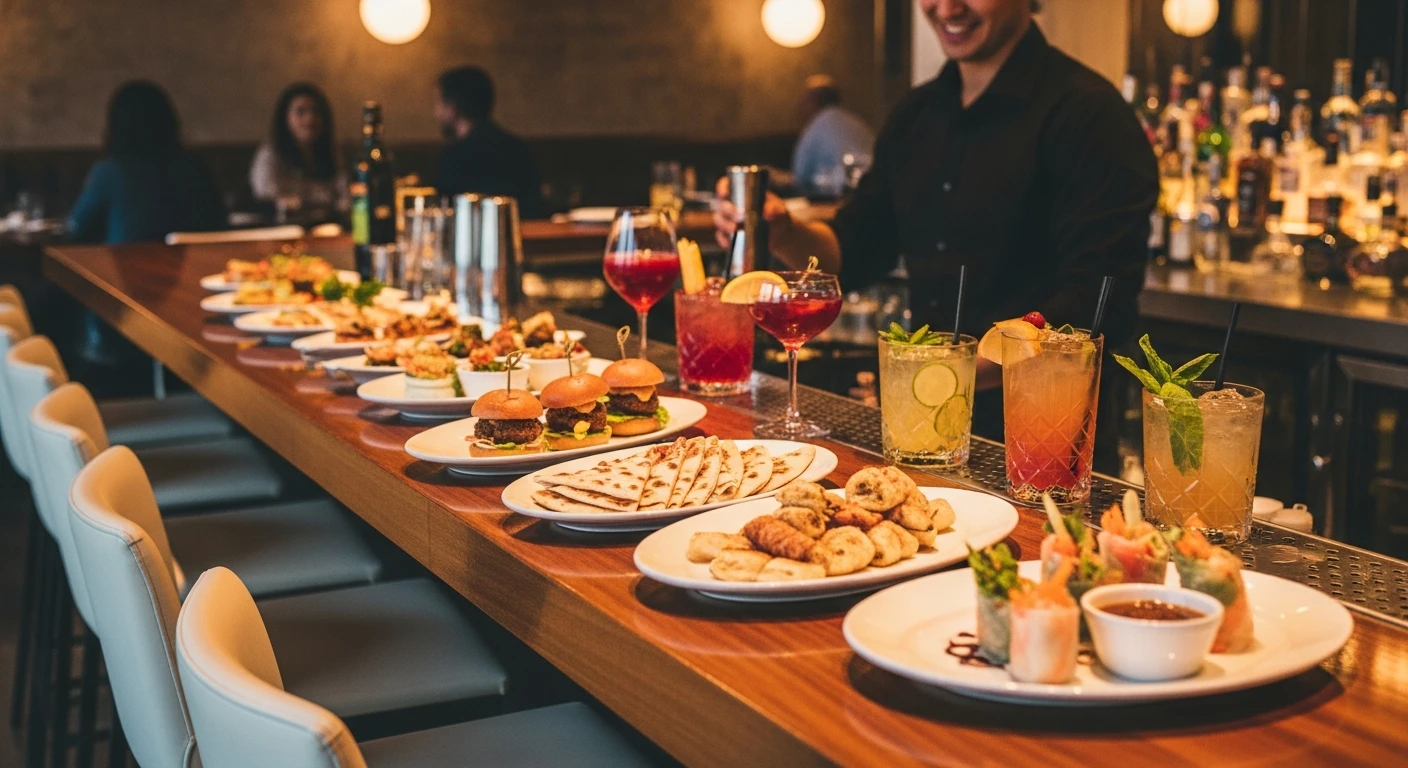
You launched happy hour to fill empty seats between lunch and dinner. It worked — sort of. The bar fills up, the noise level rises, and it feels like business is booming.
Then you pull the numbers.
Your average check dropped 34%. Your pour costs spiked to 28%. And the "regulars" who show up every Tuesday at 4:00 PM? They leave at 6:01, right before your full-price dinner menu kicks in. You're subsidizing their drinking habit and calling it a marketing strategy.
Here's the thing: the problem isn't happy hour itself. The problem is that most restaurants design happy hour around one question — "how cheap can we go?" — when they should be asking a completely different question.
The right question is: how do I make every discounted dollar bring back $3 to $5 in full-price revenue?
That's the math that separates restaurants bleeding money from 3 to 6 PM from restaurants that turned those dead hours into their most profitable daypart per labor dollar spent. And we're going to break down exactly how they do it.
The Real Cost of a Bad Happy Hour (And Why Most Restaurants Get It Wrong)
Let's start with uncomfortable math. A typical restaurant running a "half-price appetizers and $2 off all drinks" happy hour on a Tuesday looks like this:
| Metric | Regular Service | Typical Happy Hour | Difference |
|---|---|---|---|
| Average check per person | $38 | $22 | -42% |
| Food cost % | 30% | 42% | +12 pts |
| Pour cost % | 18% | 28% | +10 pts |
| Gross margin per cover | $24.70 | $10.56 | -57% |
| Labor (server + bartender) | $18/hr | $18/hr | $0 |
See the problem? Your labor cost doesn't go down just because your prices did. That bartender costs $18/hour whether she's pouring $12 cocktails or $7 happy hour specials. Your gross margin per cover dropped 57%, but your fixed costs stayed exactly the same.
But it gets worse. The real damage isn't the lower margins on happy hour covers — it's the cannibalization of dinner revenue. When happy hour runs until 7 PM (a common mistake), guests who would have come in at 6:30 and ordered full-price entrees instead arrive at 5:30, load up on discounted apps and drinks, and leave before the dinner rush. You didn't gain a customer. You discounted one you already had.
And that's not all. There's a behavioral cost that never shows up on your P&L: price anchoring. When guests experience your $7 margarita three times a week during happy hour, your $12 margarita during dinner feels unreasonable. You've trained them to believe the "real" price is the discounted one.
The 5 Rules of a Profitable Happy Hour
The restaurants making money during happy hour follow a specific playbook. None of it is complicated, but all of it requires discipline.
Rule 1: Discount Dollars, Not Percentages
This is the single most important pricing decision you'll make. "$1 off all draft beers" is dramatically more profitable than "20% off all drinks."
Why? Because a percentage discount scales with price. 20% off a $14 craft cocktail costs you $2.80. 20% off a $6 domestic draft costs you $1.20. But "$1 off" costs exactly $1 regardless of what they order — and it psychologically encourages trading up.
When the discount is a flat dollar amount, a guest thinking "well, everything is $1 off anyway" is more likely to order the $13 Old Fashioned (now $12) than the $5 Bud Light (now $4). Your discount stays fixed. Their spending goes up.
| Drink | Regular Price | $1 Off | Your Margin | 20% Off | Your Margin |
|---|---|---|---|---|---|
| Domestic draft | $6.00 | $5.00 | 82% | $4.80 | 80% |
| Craft beer | $8.00 | $7.00 | 79% | $6.40 | 73% |
| House cocktail | $12.00 | $11.00 | 82% | $9.60 | 77% |
| Premium cocktail | $15.00 | $14.00 | 84% | $12.00 | 80% |
Notice how the margin gap widens on higher-priced drinks? With the flat $1 discount, your premium cocktails still generate 84% margins. With 20% off, they drop to 80%. Across 200 cocktails per week during happy hour, that 4-point difference is $240/week — $12,480/year in margin you're leaving on the table.
Rule 2: Engineer Food Pairings That Drive Drink Orders
The biggest mistake in happy hour food menus: treating food as another thing to discount. Food during happy hour should have one job — make people stay longer and order more drinks.
That means salty, shareable, high-margin items that come out fast. Not discounted entrees. Not elaborate specials that bog down the kitchen. Small plates priced at $5-$9 that take under 4 minutes to prepare.
Here's what works:
- Loaded fries / nachos ($6-$7) — Food cost under $1.50. Margin: 78-85%. Salty, shareable, and everyone orders another round of drinks while picking at them.
- Flatbreads ($7-$9) — Food cost under $2.00. Margin: 75-82%. Look premium, feel like a deal, and take 6 minutes in a pizza oven.
- Wings (6-piece, $7) — Food cost around $2.10. Margin: 70%. The original happy hour food. Messy enough that people need napkins and another drink.
- Sliders (3-pack, $8) — Food cost around $2.80. Margin: 65%. Not as high-margin but they feel substantial enough to justify "staying for one more."
The key: price these items individually, but design your menu layout to nudge combo ordering. "Pick any 2 small plates for $11" sounds like a deal (it is — sort of) but guarantees a minimum food spend and extends dwell time by 15-20 minutes. Every additional 15 minutes in a bar seat correlates with 0.7 additional drinks ordered.
That's $47 more per table, on average, when you combine a food-pairing strategy with the right dwell time. Now you understand the headline.
Rule 3: Set a Hard Stop — And Make It Early
Your happy hour should end at 6:00 PM. Not 6:30. Not 7:00. Not "whenever it slows down."
Here's why the hard stop matters. Dinner service at most restaurants ramps up between 6:00 and 6:30 PM. If happy hour bleeds into that window, three things happen:
- Cannibalization. Early diners order from the happy hour menu instead of full-price dinner items. You just gave a 30% discount to someone who was going to pay full price.
- Table turnover drops. Happy hour guests who got a 6:00 PM extension occupy tables that should be flipping for dinner covers at $45-$65 per person.
- Kitchen confusion. Running two menus (happy hour and dinner) simultaneously creates ticket chaos, especially for kitchens that aren't built for high-volume small plates and full entrees at the same time.
The best operators end happy hour at 6:00 PM sharp and use the transition as a psychological trigger. "Last call for happy hour!" at 5:45 creates urgency — guests rush to order one more round at the discounted price, often adding a food item to "justify" the extra drink. That final surge is often the most profitable 15 minutes of happy hour.
Shogun Japanese Hibachi figured this out when they customized their KDS station displays to separate happy hour tickets from dinner prep. The result: zero overlap confusion, and their kitchen staff — who were proficient on the system within 5 minutes of training — could switch between modes without missing a beat.
Rule 4: Track Happy Hour as Its Own Profit Center
Most POS systems lump happy hour sales into your daily totals. That's a problem, because you can't optimize what you can't measure.
You need to track happy hour as a separate daypart with its own P&L. That means:
- Revenue per labor hour during happy hour vs. dinner vs. lunch
- Average check per cover — are people spending $18 or $28?
- Drink-to-food ratio — ideally 65:35 (drinks to food). Below 60:40 means your food is too cheap and people are using happy hour as a discount dinner.
- Conversion rate — what percentage of happy hour guests stay for dinner? This is the number that determines whether happy hour is marketing (good) or a margin drain (bad).
- Guest count trend — is happy hour bringing in new faces, or are you just discounting for the same 30 regulars?
This is where your POS system earns its keep. A system that supports daypart-based reporting — with automatic time-based menu switching and separate category tracking — gives you clean data without manual work. You should be able to pull a happy hour P&L in under 30 seconds.
T. Jin China Diner runs 15 locations with 75 terminals, and their management team monitors happy hour performance across every store in real time through remote dashboards. When one location's happy hour food cost crept above 40%, they spotted it the same day and adjusted portions before it became a trend. That kind of visibility is the difference between a profitable program and a slow bleed.
Rule 5: Use Happy Hour to Build Your Dinner Business
The ultimate goal of happy hour isn't to make money from 3 to 6 PM. It's to fill tables from 6 to 9 PM.
Every profitable happy hour program includes at least one mechanism to convert happy hour guests into dinner customers. Here are the ones that work:
- "Stay for dinner" incentive. A card placed on every happy hour table: "Stay for dinner and get a complimentary appetizer with any entree." Cost to you: $2-$3 in food cost. Value of a dinner cover: $38-$52. This converts 12-18% of happy hour guests into dinner guests at most restaurants.
- Preview menu items. Offer one dinner entree as a happy hour "preview" at full price. Guests who try it during the social, low-pressure happy hour atmosphere are 3x more likely to order it on a return dinner visit.
- Loyalty capture. Use happy hour as a low-friction moment to enroll guests in your loyalty program. "Join our loyalty club and your next happy hour drink is on us." The email address you capture is worth far more than the $2 drink cost. Use it to send dinner promotions, event invitations, and birthday offers.
Crafty Crab Seafood, which operates 19 locations with 152 terminals, uses their loyalty program to track exactly how many happy hour guests convert to dinner and weekend visits. Their data shows that loyalty members acquired during happy hour have a 47% higher lifetime value than guests acquired through other channels — because the first visit is low-commitment, but the repeat visits are at full price.
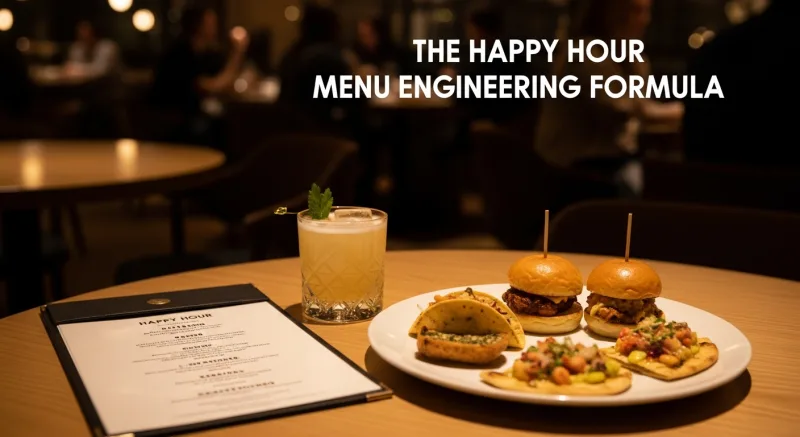
The Happy Hour Menu Engineering Formula
Now let's get specific. Here's how to build a happy hour menu that drives profit instead of destroying it.
Drink Menu: The 4-3-2 Structure
Offer exactly:
- 4 beer options — 2 domestic drafts, 2 craft/import. $1 off each.
- 3 cocktails — 2 house specials (batched for speed, $2 off), 1 premium feature ($1 off). Use batched cocktails to reduce bartender labor per drink.
- 2 wines — 1 house red, 1 house white by the glass. $1 off.
That's 9 drink options. Not 20. Not your entire drink menu at a discount. Nine carefully selected items that are fast to pour, high-margin, and easy for the bartender to execute at volume.
Why this matters: a bartender can serve 15-20 customers per hour when the happy hour menu is focused. When "everything is discounted," that same bartender is making custom cocktails at happy hour prices and serving 8-12 customers per hour. You just doubled your labor cost per drink.
Food Menu: The Anchor Strategy
Your happy hour food menu needs an anchor item — a single dish priced at $5 that feels like an absurd deal. This is your loss leader, but it's not actually a loss.
Example: $5 truffle fries. Food cost: $1.10. Margin: 78%. It sounds premium. It photographs well for Instagram. And when someone orders "$5 truffle fries," they always add something else — because truffle fries alone aren't dinner. That "something else" is your $8 flatbread (margin: 80%) or $7 wings (margin: 70%).
The $5 anchor isn't about making money on the fries. It's about pulling people in the door and creating an order pattern that averages $16-$19 in food per table.
Programming Happy Hour in Your POS: What You Need
A profitable happy hour requires POS technology that can actually support the strategy. Here's what to look for:
- Daypart-based automatic pricing. The system should switch to happy hour prices at 3:00 PM and back to regular prices at 6:00 PM — automatically, without a manager pressing a button. Manual switching creates errors (someone forgets) and opportunities for abuse (a bartender extends the prices for a friend at 6:15).
- Separate reporting by daypart. You need to see happy hour revenue, food cost, pour cost, and labor cost as a standalone P&L. If your POS lumps it all into "daily sales," you're flying blind.
- Multi-location sync. If you operate more than one location, happy hour pricing changes should deploy across all terminals simultaneously. Crafty Crab manages this across 19 stores with one-click menu sync — a pricing change at headquarters reaches all 152 terminals in under a minute.
- Item-level speed tracking. Know which happy hour items take the longest to prepare. If your $7 sliders take 12 minutes but your $6 flatbread takes 5 minutes, the flatbread is generating more revenue per kitchen minute. Adjust your menu placement accordingly.
The right POS system doesn't just process transactions during happy hour — it gives you the data to continuously optimize the program. Every week, you should be reviewing which items sell, which items generate the best margins, and which items drive additional drink orders.
Happy Hour Marketing That Fills Seats Without Devaluing Your Brand
Here's where most restaurants make their second-biggest mistake: they market happy hour as a discount event. "HALF OFF EVERYTHING!" screams the Instagram post, complete with a neon-filtered photo of a martini.
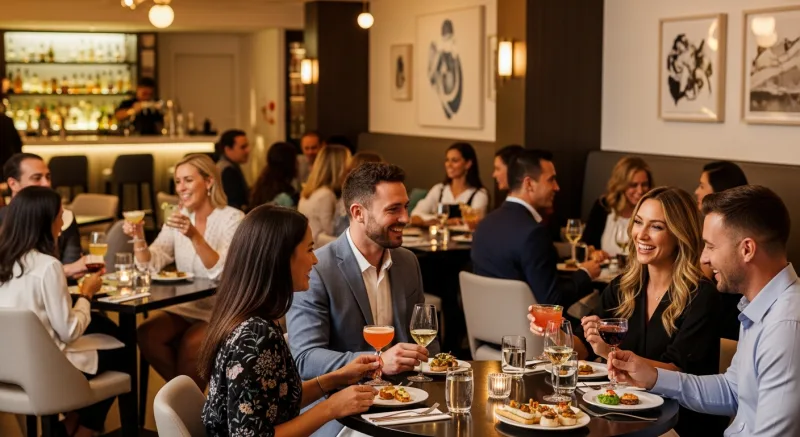
That messaging attracts exactly the wrong customer — someone motivated purely by price who will never visit at full price.
Instead, market happy hour as an experience:
- "Wind down Wednesday" — position it as a ritual, not a deal
- "Chef's snack hour" — focus on exclusive small plates only available during happy hour
- "The after-work crew" — build community identity around the regulars
- "Cocktail lab" — feature a rotating craft cocktail each week that's only available during happy hour
The pricing information should be secondary — mentioned but not the headline. "Join us for Wind Down Wednesday, 3-6 PM. Featured cocktails, chef's snack menu, and $1 off draft beers." The value proposition is the experience. The discount is just the nudge.
Use your email list and Google Business Profile to promote happy hour events. Post the weekly featured cocktail every Monday. Share behind-the-scenes photos of the bartender preparing batched cocktails. Let the food speak for itself.
State-by-State Legal Check: Where Happy Hour Gets Complicated
Before you finalize your happy hour program, check your state's alcohol laws. Some states restrict or ban happy hour drink specials entirely:
- Prohibited or heavily restricted: Alaska, Indiana, Massachusetts, North Carolina, Oklahoma, Rhode Island, Utah, Vermont
- Restricted practices (varies by state): Two-for-one deals, free drinks, unlimited drink specials, and "all you can drink" offers are banned in many states even where happy hour is otherwise legal
- Food-only workaround: In states where drink specials are banned, you can still run a "food happy hour" with discounted appetizers — and your drink revenue will still increase because more people are in the building
Always consult your state's Alcoholic Beverage Control (ABC) board for current regulations. Laws change, and a violation can cost you your liquor license — a risk no discount is worth taking.
Putting It All Together: The $47 Per Table Formula
Let's run the complete math on a well-engineered happy hour vs. a typical discount-everything approach.
| Metric | Discount Approach | Engineered Approach |
|---|---|---|
| Average drinks per table | 4.2 | 5.8 |
| Average drink price (after discount) | $5.50 | $8.20 |
| Drink revenue per table | $23.10 | $47.56 |
| Food items per table | 1.5 | 2.3 |
| Food revenue per table | $9.75 | $16.10 |
| Total per table | $32.85 | $63.66 |
| Blended margin | 58% | 76% |
| Gross profit per table | $19.05 | $48.38 |
The engineered approach generates $29.33 more gross profit per table. With 15 tables turning during a 3-hour happy hour (a modest estimate for a mid-size restaurant), that's $440 more profit per day. Over a 5-day happy hour week, that's $2,200/week — $114,400/year in additional gross profit from the same 3-hour window.
That's not a rounding error. That's a full-time employee's salary, generated from a daypart most restaurants treat as a throwaway.
Your Happy Hour Launch Checklist
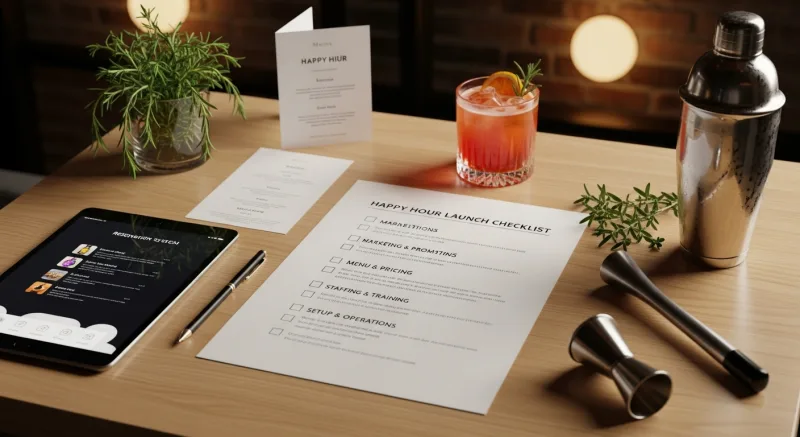
- Audit your current happy hour — pull daypart reports and calculate your actual gross margin during happy hour hours. If you don't have daypart reporting, that's your first fix.
- Set your time window — 3:00 PM to 6:00 PM, Tuesday through Thursday to start. Add Friday only if you can staff it without pulling from dinner prep.
- Build your 4-3-2 drink menu — select high-margin, fast-pour items. Set flat dollar discounts ($1-$2 off), not percentages.
- Design your food anchor — one $5 item that pulls people in, surrounded by $6-$9 shareable plates.
- Program your POS — set up automatic daypart pricing, separate reporting categories, and if multi-location, sync across all terminals.
- Train your team — bartenders should know which drinks are batched, servers should suggest food pairings, and everyone should mention the "stay for dinner" incentive.
- Market as an experience — name it, brand it, promote it weekly. Feature the cocktail, not the discount.
- Review weekly — check your happy hour P&L every Monday. Adjust items that aren't selling. Double down on what's working.
Happy hour isn't a discount strategy. It's a revenue architecture problem — and the restaurants that treat it that way are the ones turning 3 dead hours into their most efficient profit generator.
Want to see the numbers for your restaurant? Our profit margin calculator can help you model different happy hour scenarios against your actual costs.
Turn Happy Hour Into a Profit Center
KwickOS gives you daypart-based pricing, automatic menu switching, and per-hour profit tracking — so you always know if happy hour is making or losing money.
Get a Demo