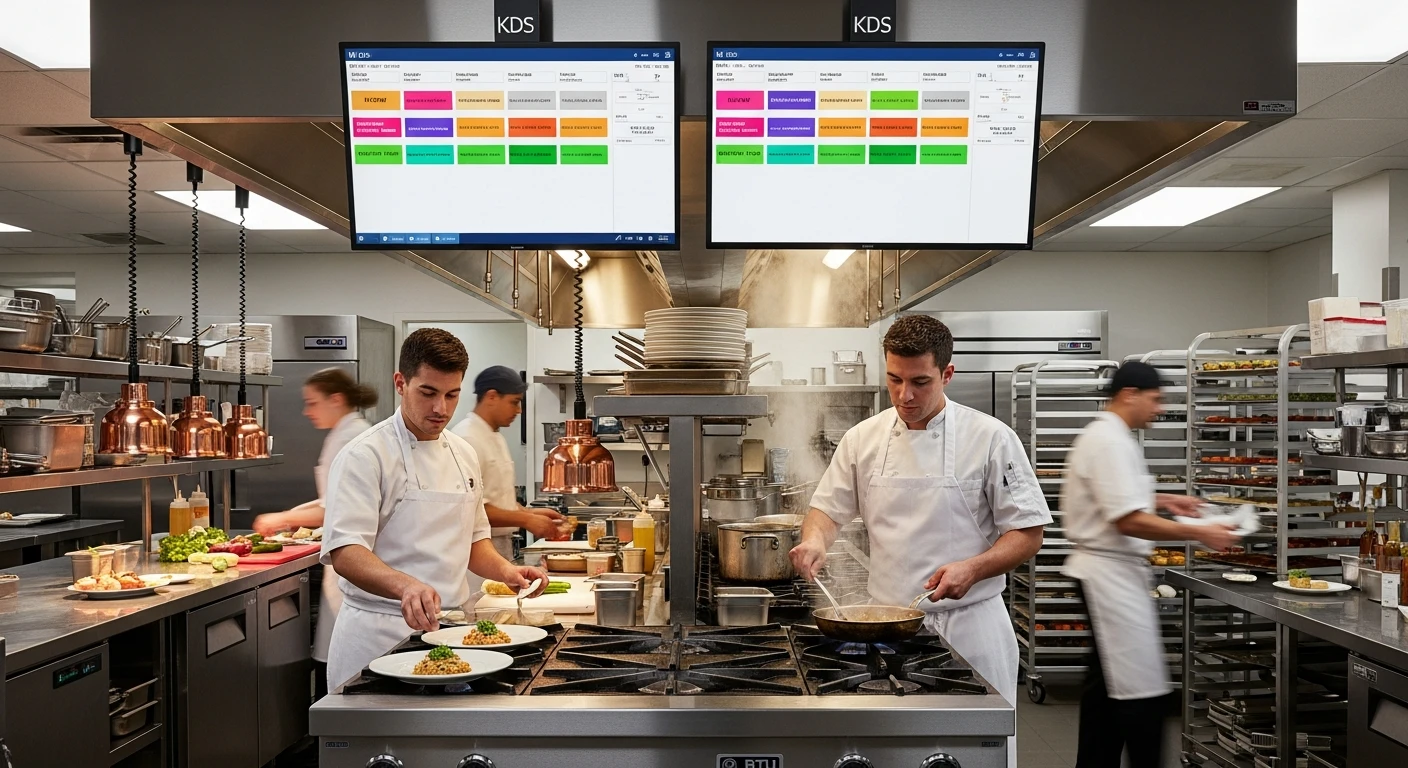
For restaurant operators, Ghost Kitchens isn't optional — it's the backbone of daily operations. You signed your lease, built out a beautiful dining room, hired front-of-house staff, and opened your doors. Now you are paying $8,000 to $15,000 a month in rent for a kitchen that operates at full capacity for maybe four hours a day.
The lunch rush ends at 1:30. The dinner rush does not start until 5:30. That is four hours of idle kitchen capacity — equipment depreciating, fixed costs accumulating, and staff standing around folding napkins.
Here's the thing: your competitors already figured out what to do with those hours.
They launched a second restaurant brand. No new lease. No new buildout. No new dining room. Just a different name, a delivery-optimized menu, and a listing on DoorDash that started generating $3,000 to $15,000 in additional monthly revenue within 60 days.
They turned dead kitchen hours into a ghost kitchen.
And that is exactly what this guide will show you how to do — step by step, with real numbers, real case studies, and the operational details most "ghost kitchen guides" conveniently skip over.
What a Ghost Kitchen Actually Is (And Why the Definition Matters)
The term "ghost kitchen" gets thrown around loosely, so let us be precise. There are three distinct models, and choosing the wrong one can cost you tens of thousands of dollars:
Model 1: Virtual Brand from Existing Kitchen — You create a new restaurant brand that operates entirely through delivery platforms, using your existing kitchen, staff, and ingredients during off-peak hours. Startup cost: $2,000 to $5,000. Risk: minimal.
Model 2: Shared/Commissary Kitchen Space — You rent a dedicated kitchen in a facility built exclusively for delivery-only restaurants. Companies like CloudKitchens and Kitchen United rent these spaces for $3,000 to $8,000/month. Startup cost: $15,000 to $35,000. Risk: moderate.
Model 3: Standalone Ghost Kitchen — You lease a commercial space, build out a kitchen from scratch, and operate one or more delivery-only brands. Startup cost: $50,000 to $200,000. Risk: high.
But it gets worse: most articles about ghost kitchens push you toward Model 2 or 3 because that is where the real estate companies make money. They want you to sign a lease.
The smartest move for existing restaurant owners is almost always Model 1. You already have the kitchen. You already have the staff. You already have the food cost relationships with suppliers. Why would you pay $5,000/month for a second kitchen when your current one sits idle for 40% of operating hours?
The $180,000 Math: How Virtual Brands Generate Revenue
Let us break down the economics of launching a virtual brand from your existing kitchen. These are conservative numbers based on industry averages and operator reports:
| Metric | Conservative | Moderate | Aggressive |
|---|---|---|---|
| Daily delivery orders | 15 | 25 | 40 |
| Average order value | $28 | $32 | $35 |
| Monthly revenue | $12,600 | $24,000 | $42,000 |
| Annual revenue | $151,200 | $288,000 | $504,000 |
| Food cost (30%) | $45,360 | $86,400 | $151,200 |
| Packaging ($1.50/order) | $8,100 | $13,500 | $21,600 |
| Platform commissions (25%) | $37,800 | $72,000 | $126,000 |
| Net profit (before labor) | $59,940 | $116,100 | $205,200 |
Wait — did you catch that? Platform commissions just ate $37,800 to $126,000 of your revenue. At 25% commission, DoorDash and UberEats take more than your food cost on every single order.
And that's not all: those commission numbers assume you stay on third-party platforms forever. There is a much better path — but we will get to that in a moment.
Step 1: Choose a Concept That Travels Well
Not every cuisine works for delivery. The number one reason ghost kitchens fail is not marketing or operations — it is choosing a menu that arrives at the customer's door looking nothing like it left the kitchen.
High-performing delivery categories (ranked by reorder rate):
- Wings and fried chicken — holds temperature, travels well, high margin
- Burgers and smash burgers — comfort food with strong delivery demand
- Bowl concepts (poke, grain bowls, rice bowls) — compact, stackable, customizable
- Pizza and flatbreads — established delivery category, proven packaging
- Asian stir-fry and noodles — quick prep, strong flavors hold up in transit
- Baked goods and desserts — high margin, low labor, works as add-on brand
Categories that struggle with delivery:
- Anything with crispy components that steam in packaging (tempura, french fries unless vented)
- Delicate plating or presentation-dependent dishes
- Items that require immediate consumption (soufflés, certain egg dishes)
- Large-format shared dishes that do not portion well for individual delivery
Here's the thing: your virtual brand does not need to match your existing restaurant's cuisine. A sushi restaurant can launch a wings brand. A Chinese restaurant can launch a burger concept. The only requirement is that your kitchen can produce the food efficiently with existing equipment.
Rockin' Rolls Sushi Express, which runs 3 stores with 49 iPad self-ordering stations on KwickOS, built their entire model around delivery-optimized sushi rolls — items specifically designed to hold up during a 30-minute delivery window. Their KDS integration routes delivery orders to a separate prep station so dine-in and delivery production never compete for the same space.
Step 2: Build a Menu Designed for Profit, Not Variety
Your ghost kitchen menu should be the opposite of your dine-in menu. Fewer items. Higher margins. Maximum ingredient overlap with what you already stock.
The 15-item rule: Top-performing virtual brands operate with 12 to 18 menu items. That is it. Every item beyond 18 increases prep complexity, inventory waste, and ticket times without proportionally increasing revenue.
Now here is where menu engineering gets interesting for ghost kitchens. Unlike dine-in, where customers browse the full menu, delivery platform algorithms reward restaurants with high conversion rates. That means:
- Your top 3 items will generate 60% of revenue. Invest all your photography budget and description effort there.
- Modifier-based customization beats menu breadth. Offer 8 wing flavors as modifiers on one item rather than 8 separate menu listings.
- Bundle meals aggressively. A "Family Wing Pack" at $39.99 has better margins than four individual orders because packaging and handling costs are amortized.
- Price for delivery. Your delivery menu prices should be 15-20% higher than dine-in to offset platform commissions. Customers expect this.
Use our food cost calculator to model margins on each menu item before you launch. You want every item above 65% gross margin after food cost — no exceptions.
Step 3: Set Up Your Operations Without Chaos
This is where most ghost kitchen launches fall apart. You are about to add a second stream of orders to a kitchen that already has its own rhythm. Without the right systems, the result is missed tickets, confused line cooks, and food that sits under a heat lamp while your Expo tries to figure out which order goes to DoorDash and which goes to Table 12.
But it gets worse: if you are managing orders from multiple delivery platforms, you now have 3-4 tablets on your counter, each with its own notification sound, its own order format, and its own confirmation process. Your staff hates it. Your error rate goes up. Your reviews go down.
The fix is order aggregation. A POS system that pulls orders from DoorDash, UberEats, Grubhub, and your own online ordering into a single interface — and routes them to your kitchen display system automatically.
Crafty Crab Seafood runs 19 locations with 152 terminals on KwickOS. When they added delivery-only menu items across locations, their one-click menu sync pushed updates to every store simultaneously. No location-by-location manual entry. No version mismatches. The kitchen display system routes delivery orders to a dedicated station view, separated from dine-in tickets, so the line never gets confused about what goes in a bag versus what goes on a plate.
Operational checklist for launch:
- Designate a physical staging area for delivery orders (a shelf, a rack, or a counter section)
- Set up separate KDS routing for ghost kitchen tickets
- Stock delivery-specific packaging (branded bags, tamper-evident seals, insulated containers)
- Configure your POS to track ghost kitchen revenue and food costs as a separate profit center
- Brief your kitchen staff — they need to know the new menu items and the priority hierarchy between dine-in and delivery
- Set delivery-specific prep times in your POS (delivery food should be ready 2-3 minutes before estimated driver arrival)
Step 4: The Platform Commission Trap (And How to Escape It)
Let us revisit those commission numbers from earlier. On a $30 delivery order through DoorDash at 25% commission:
| Line Item | Amount |
|---|---|
| Order total | $30.00 |
| DoorDash commission (25%) | -$7.50 |
| Food cost (30%) | -$9.00 |
| Packaging | -$1.50 |
| Labor allocation | -$4.00 |
| Your profit | $8.00 |
Now look at the same order through your own online ordering system with flat-fee delivery:
| Line Item | Amount |
|---|---|
| Order total | $30.00 |
| KwickDriver fee ($2 + $6.99) | -$8.99 (paid by customer) |
| Your platform commission | $0.00 |
| Food cost (30%) | -$9.00 |
| Packaging | -$1.50 |
| Labor allocation | -$4.00 |
| Your profit | $15.50 |
That is $7.50 more profit per order. On 25 orders per day, that is $187.50 daily — $5,625 per month — $67,500 per year that stays in your pocket instead of going to DoorDash.
The strategy is not to avoid third-party platforms entirely. Use them for discovery — let new customers find your virtual brand on DoorDash. But convert those customers to your own ordering channel as fast as possible. Include a card in every delivery bag: "Order direct next time at [your website] — get 10% off." Every customer you convert from DoorDash to direct ordering is worth an extra $7.50 per order for life.
KwickDriver charges a flat $2 base fee plus $6.99 for up to 5 miles — paid by the customer, not the restaurant. Compare that to DoorDash's 15-30% commission on the entire order total. For a ghost kitchen doing $24,000/month in delivery sales, the difference is $72,000 per year in saved commissions.
Step 5: Multi-Brand Strategy — Running 2-3 Concepts from One Kitchen
Once your first virtual brand is profitable, the economics of adding a second and third brand are even better. You have already solved the operational challenges. Your staff knows the delivery workflow. Your packaging station is set up. Adding another brand is mostly a matter of menu development and platform listings.
Here's the thing: delivery platform algorithms favor restaurants with more listings. Each virtual brand gets its own search position, its own reviews, and its own ranking. Running three brands gives you three chances to appear in a customer's search results instead of one.
Multi-brand ingredient overlap strategy:
- Brand 1 (Wings): chicken wings, sauces, fries, celery, ranch
- Brand 2 (Burgers): ground beef, buns, fries, lettuce, tomato, sauces
- Brand 3 (Rice Bowls): proteins from Brands 1 and 2, rice, vegetables, Asian sauces
Notice the overlap. Fries appear in two brands. Proteins from the wing and burger brands get repurposed in rice bowls. Sauces are variations of the same base. You are running three "restaurants" with maybe 30% more ingredient SKUs than a single brand would require.
T. Jin China Diner operates 15 stores with 75 terminals on KwickOS. Their centralized management dashboard lets them monitor real-time sales, inventory, and labor across every location — the same infrastructure that makes multi-brand ghost kitchen operations manageable at scale. When you can see exactly how much chicken you are using across all brands from a single screen, you never over-order and you never run out mid-shift.
Step 6: Marketing a Restaurant Nobody Can Visit
Ghost kitchens have a unique marketing challenge: there is no storefront, no walk-in traffic, and no word-of-mouth from diners who "loved the atmosphere." Your entire brand exists online.
What actually drives ghost kitchen orders:
- Platform search ranking. On DoorDash, ranking is determined by conversion rate, order volume, ratings, and delivery speed. The first 30 days are critical — platforms give new restaurants a boost in visibility. Use this window to offer promotions that drive volume and collect reviews.
- Photography. On delivery platforms, your photos ARE your storefront. Professional food photography increases conversion by 30-40%. Budget $500 to $1,000 for a professional shoot of your top 5 items. This is not optional — it is the highest-ROI marketing spend for a virtual brand.
- Google Business Profile. Yes, even delivery-only brands should have a Google Business Profile. List your brand with your kitchen's address, mark it as delivery-only, and link directly to your own ordering page. This captures customers searching "[cuisine type] delivery near me."
- Social media as a menu. Instagram and TikTok function as visual menus for ghost kitchens. Post preparation videos, unboxing shots (what the customer sees when they open the bag), and behind-the-scenes content. You do not need millions of followers — you need to reach people within your delivery radius.
- Direct ordering incentives. Every delivery bag should contain a physical card driving customers to your website. "Skip the app fees — order direct and save 10%." This is how you migrate from 25% commission to zero commission over time.
Tiger Sugar runs 2 stores with 2 self-ordering kiosks on KwickOS. Their minimal-step personalization approach — letting customers customize drinks in as few taps as possible — translates directly to ghost kitchen ordering. The fewer steps between "I'm hungry" and "order confirmed," the higher your conversion rate. Apply this same principle to your online ordering flow: pre-built combos, one-tap reorder, saved favorites.
The Technology Stack That Makes It Work
Running a ghost kitchen without the right technology is like running a restaurant without a kitchen — technically possible, but you will lose money doing it. Here is the minimum viable tech stack:
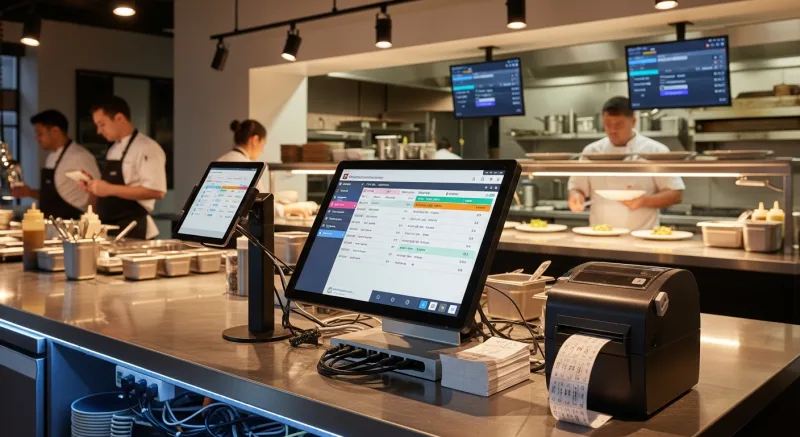
- POS with delivery platform integration — Aggregates orders from all platforms into one system. Eliminates the multi-tablet nightmare.
- Kitchen Display System (KDS) — Routes delivery orders to the correct station with visual differentiation from dine-in tickets. See our KDS guide for setup details.
- Online ordering system — Your own branded ordering website and app, commission-free, integrated with your POS.
- Delivery management — Either in-house drivers or a flat-fee dispatch service that does not eat your margins.
- Inventory tracking — Cross-brand ingredient tracking so you know exactly what you are using across all virtual brands.
- Analytics — Per-brand P&L reporting, item-level profitability, and delivery time tracking.
KwickOS bundles all of this — POS, KDS, online ordering, KwickDriver delivery, inventory, and analytics — into a single platform. Because it runs on a hybrid local + cloud architecture, order processing happens at 1ms local latency rather than the 20ms cloud round-trip that other systems require. When you are processing delivery orders from four platforms simultaneously during a dinner rush, that speed difference is the difference between a 12-minute ticket time and a 15-minute ticket time.
And because KwickOS is processor-agnostic, you are not paying an extra $3,000 to $8,000 per year in inflated processing fees on top of your delivery commissions. When your margins are already tight from platform commissions, the last thing you need is your POS company taking another 0.5-0.8% off every transaction.
Common Ghost Kitchen Mistakes (And How to Avoid Them)
Mistake 1: Launching with too many menu items. Start with 12 to 15 items. You can always add more. You cannot easily recover from negative reviews caused by inconsistent execution on a 40-item menu your kitchen was not ready for.
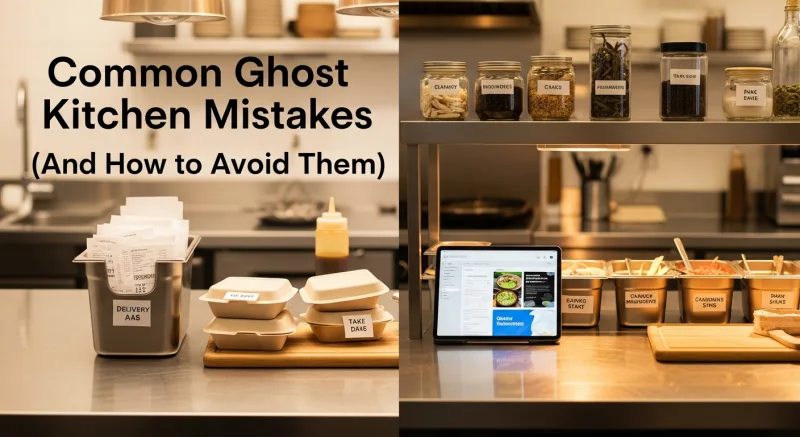
Mistake 2: Ignoring packaging. Your food travels 15 to 30 minutes before it reaches the customer. Invest in vented containers for fried items, sealed containers for sauced items, and tamper-evident bags for everything. Bad packaging destroys good food — and generates 1-star reviews that tank your platform ranking.
Mistake 3: Not tracking ghost kitchen costs separately. If you lump ghost kitchen revenue and expenses into your main restaurant P&L, you will never know if the virtual brand is actually profitable. Set up separate cost centers in your POS. Track food cost, labor, packaging, and commissions independently.
Mistake 4: Staying on third-party platforms forever. Use DoorDash and UberEats to build initial volume and brand recognition. But every month, your goal should be to shift a higher percentage of orders to your own direct ordering channel. Target: 30% direct orders within 6 months, 50% within 12 months.
Mistake 5: Competing with your own restaurant. Your virtual brand should target a different cuisine, a different price point, or a different daypart than your main restaurant. If your Italian restaurant launches a virtual Italian delivery brand, you are just cannibalizing your own orders and paying a 25% commission for the privilege.
Is a Ghost Kitchen Right for You?
Not every restaurant should launch a virtual brand. But if three or more of these apply to you, the opportunity is worth pursuing:
- Your kitchen has significant idle capacity (less than 70% utilization during off-peak hours)
- You are in a market with strong delivery demand (urban or dense suburban areas)
- Your staff has bandwidth during slow periods
- You have storage space for additional packaging and any new ingredients
- Your current POS can handle multi-platform order aggregation
- You are willing to invest 60-90 days before expecting profitability
The restaurants that succeed with ghost kitchens treat them as a real business, not an afterthought. They invest in menu development, packaging, photography, and the technology to run it efficiently. And they have a plan to migrate customers from commission-heavy platforms to direct ordering — because that is where the real margin lives.
Baked Cravings took this concept even further. Operating a self-serve kiosk at Lego Land on a PaxA35 terminal through KwickOS, they proved that a delivery-and-kiosk-only concept — with zero traditional dining room — could generate consistent revenue in a high-traffic location. No servers, no hosts, no dining room lease. Just great product and smart technology.
Ready to Launch Your Ghost Kitchen?
KwickOS gives you everything you need: multi-platform order aggregation, KDS routing, commission-free online ordering, and KwickDriver delivery at a flat $2 + $6.99 — not 25%. See how much more you will keep.
Calculate Your Delivery Savings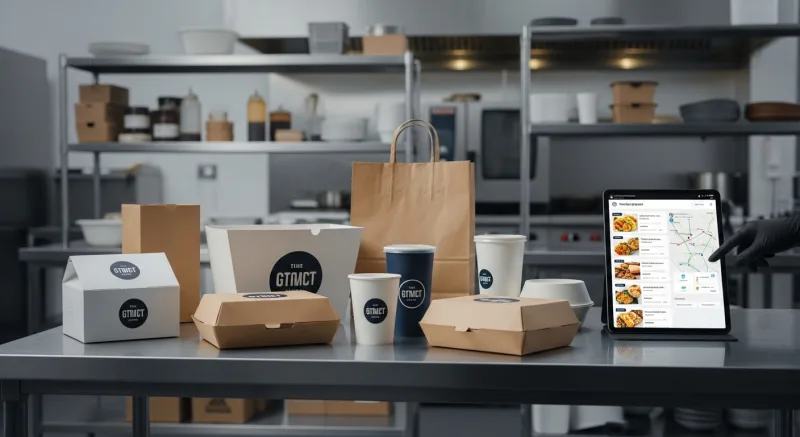
Running a mobile kitchen? Check out the KwickOS Food Truck POS — designed for compact spaces and on-the-go operations.