The best AI in Restaurants handles everything from checkout to closing — without extra apps or workarounds. You're running a restaurant in 2026, and you can't open your inbox without someone pitching you an "AI solution."
AI-powered menus. AI-powered hiring. AI-powered everything. It's exhausting. And when everything claims to be artificial intelligence, it's impossible to tell what actually works from what's just a spreadsheet with a chatbot bolted on.
Here's the thing: while most restaurant owners are tuning out the noise, a small group is quietly pocketing an extra $18,000 per year by deploying AI in exactly the right places. Not the flashy places. Not the sci-fi places. The boring, operational places where dollars actually leak out of a restaurant.
And the gap between restaurants that adopt these tools and those that don't? It's widening every month.
This guide cuts through the hype and shows you the 8 AI applications that are delivering real, measurable ROI for restaurant owners right now — not in some theoretical future, but today. We'll show you how each one works, what it costs, what it saves, and whether it's worth your time.
1. Demand Forecasting: Know Tomorrow's Sales Before They Happen
You're throwing away $8,000 to $15,000 in food every year because you're guessing how many covers you'll do on a rainy Tuesday versus a sunny Friday before a holiday weekend.
But it gets worse: you're also overstaffing slow nights and understaffing busy ones — another $5,000 to $12,000 in wasted labor annually.
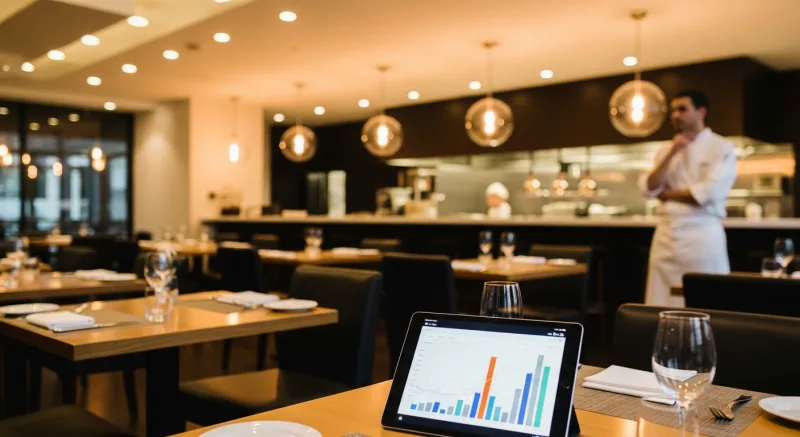
AI demand forecasting eliminates both problems at once. These systems analyze your historical POS data — every transaction, every item, every 15-minute window — alongside external signals like weather forecasts, local events, school schedules, and holiday calendars. The result is a daily prediction of how many covers you'll serve, which menu items will sell, and when your peak windows will hit.
What it looks like in practice: On Sunday night, your system tells you that Tuesday will be 22% busier than a typical Tuesday because of a college basketball game at the arena two blocks away. You prep 22% more protein, schedule two extra line cooks, and pull the slow-moving appetizer off the specials board in favor of quick-turn items. Tuesday comes. You nail it — no waste, no 86'd items, no overtime.
Restaurants using demand forecasting report 15-25% reduction in food waste and 10-18% improvement in labor cost percentage. For a restaurant doing $1.2 million in annual revenue, that's $12,000 to $18,000 back in your pocket.
And that's not all: because the AI gets smarter every week (it's constantly learning from your actual results versus its predictions), accuracy improves from ~70% in month one to ~90% by month six.
The catch? Demand forecasting only works as well as the data feeding it. If your POS system stores sales data locally and doesn't sync to the cloud, or if your provider restricts API access to your own data, the AI has nothing to learn from. This is one of the reasons data ownership matters so much — your historical sales data is the raw material that makes forecasting possible.
2. Voice Ordering: Your Phone Stops Going to Voicemail
How many phone orders did your restaurant miss last week?
Don't guess. Check your missed call log. If you're like the average full-service restaurant, the answer is somewhere between 15 and 40 calls per week that either went to voicemail, got a busy signal, or rang out while your host was seating a table.
At an average phone order of $35, that's $525 to $1,400 per week in revenue you never captured. Multiply that by 52 weeks and you're looking at $27,000 to $72,800 in annual lost sales — from phone calls alone.
Here's the thing: AI voice ordering doesn't replace your staff. It answers the calls your staff can't get to. The system picks up on the first ring, takes the customer's order conversationally (in English, Spanish, or Chinese), confirms the details, processes payment, and sends the ticket straight to your KDS. When the customer does need a human — a special request, a complaint, a large catering inquiry — the AI routes the call to your team.
Restaurants deploying voice AI report that 30-45% of phone orders are now handled entirely by the system during peak hours, freeing up front-of-house staff to focus on the guests standing in front of them.
KwickOS integrates voice ordering through KwickPhone, which supports English, Chinese, and Spanish — the same three languages built into the POS itself. That multilingual capability isn't just a nice feature for diverse markets. It's a revenue unlock: if 20% of your customer base prefers ordering in Spanish, and your current phone setup only handles English, you're leaving that revenue on the table every single day.
3. Dynamic Menu Pricing: Stop Leaving Money on the Table
Airlines have done it for decades. Hotels do it every day. Uber does it every minute. But when someone suggests dynamic pricing for restaurants, most owners recoil.
"My customers would hate it."
Would they? You already charge different prices for lunch and dinner. You already have happy hour specials and weekend brunch markups. Dynamic pricing just makes those adjustments smarter and more granular.
AI-powered dynamic pricing analyzes real-time demand, inventory levels, and time-of-day patterns to suggest price adjustments — usually within a narrow band of 5-15% — that maximize revenue without alienating customers.
A practical example: Your POS data shows that your lobster mac and cheese sells out every Friday by 7:30 PM but barely moves on Tuesdays. The AI suggests pricing it $2 higher on Fridays (when demand exceeds supply) and $3 lower on Tuesdays as a special (when you need to move inventory before it degrades). Friday customers don't blink at $2 — they were going to order it anyway. Tuesday customers feel like they're getting a deal. Your food cost drops because you're selling the lobster before it spoils.
Early adopters of dynamic menu pricing report 3-8% revenue increases without any measurable decrease in customer satisfaction or visit frequency. On $1 million in annual food sales, that's $30,000 to $80,000.
But it gets worse for restaurants that ignore this: as more competitors adopt dynamic pricing, the ones still using static menus will increasingly find themselves underpriced during high-demand periods and overpriced during slow ones. Both scenarios cost you money.
This works especially well for multi-location operators. Crafty Crab Seafood, which runs 19 locations with 152 terminals on KwickOS, can push menu price adjustments to all stores with a single click. The AI learns that the Baltimore location has different demand patterns than the Houston location and adjusts recommendations accordingly. That kind of per-location intelligence is impossible to manage manually at scale.
4. Automated Scheduling: The End of the Sunday Night Spreadsheet
You're spending 3-5 hours every week building the schedule. You're texting employees at 10 PM to cover tomorrow's shift. You're paying overtime because you overstaffed Thursday and understaffed Saturday to compensate.
This is the single easiest AI win for any restaurant, regardless of size.
AI scheduling systems pull your sales data (by day, by hour, by season), cross-reference employee availability and labor law compliance (break requirements, overtime thresholds, minor restrictions), and generate an optimized schedule in minutes. When someone calls out sick, the AI identifies the best replacement based on skill set, availability, and overtime status — then sends them a text.
Restaurants using AI scheduling report:
- 18-30% reduction in overtime costs
- 40-60% less time spent building schedules
- 15-25% improvement in schedule adherence (fewer no-shows when employees pick their preferred shifts)
For a restaurant spending $400,000/year on labor, an 18% reduction in overtime alone saves $7,200 to $14,400 annually.
And that's not all: AI scheduling feeds directly into demand forecasting. When both systems share data, the AI doesn't just know you need 6 people on Saturday — it knows you need 4 from 11 AM to 2 PM, 6 from 5 PM to 8 PM, and 3 from 8 PM to close. That precision is impossible to achieve manually.
Diva Nail Beauty, which operates 4 locations with automated commission tracking on KwickOS, saw a 90% increase in operational efficiency after automating their scheduling and employee management. For service businesses where labor is the dominant cost, AI scheduling isn't optional — it's table stakes.
5. AI-Powered Inventory Management: Your Walk-In Stops Being a Black Hole
The average restaurant wastes 4-10% of the food it purchases. At a food cost of $350,000 per year, that's $14,000 to $35,000 in the dumpster — literally.
Traditional inventory management relies on manual counts, gut feelings, and the hope that your prep cook actually FIFO'd the chicken. AI inventory systems automate the entire process by connecting your POS sales data to your purchasing data to your recipes, creating a real-time picture of what you have, what you need, and what's about to go bad.
Here's the thing: the AI doesn't just count. It predicts. It knows you'll sell 47 chicken entrees this weekend because it's pulling from the demand forecast. It knows you have 31 portions prepped. It automatically generates a purchase order for the gap — and it routes that order to whichever supplier has the best price this week.
Pattern interrupt: Want to know the scariest number in your restaurant? Calculate your theoretical food cost (what your food cost should be based on recipes and sales mix) versus your actual food cost. The gap between those two numbers is pure waste — theft, spoilage, over-portioning, and bad purchasing. AI inventory management closes that gap by making the invisible visible.
T. Jin China Diner, which operates 15 stores with 75 terminals on KwickOS, uses real-time remote monitoring to track inventory across all locations from a single dashboard. When the AI detects that Location 7 is burning through scallions at twice the rate of Location 12 with similar sales volume, that's an immediate flag: either Location 7 is over-portioning, or there's waste (or theft) that needs investigation.
Use our food cost calculator to benchmark your current numbers before implementing any changes. You can't improve what you don't measure.
6. Chatbots and Automated Guest Communication: Never Miss a Reservation Again
Your customers don't want to call you. Not for a reservation. Not for your hours. Not to ask if you have outdoor seating.
They want to text, DM, or chat — and they want an answer in under 60 seconds. If they don't get one, they go to the next restaurant in their Google results. (And you already know how important your Google Business Profile is for capturing those diners.)
AI chatbots handle the 80% of guest inquiries that don't require human judgment: hours, location, parking, menu questions, reservation booking, waitlist additions, and allergen information. They work 24/7, respond instantly, and never have a bad day.
But it gets worse for restaurants without automated communication: every unanswered message on Instagram, every unreturned inquiry through Google Business Profile, every "we'll get back to you" that never gets back to them — those are customers who chose your competitor instead. Research shows that businesses that respond to inquiries within 5 minutes are 21x more likely to convert than those that respond after 30 minutes.
The best implementations feed chatbot data back into your CRM. When a regular customer asks about tonight's specials via text, the system knows their order history, dietary preferences, and visit frequency — and personalizes the response accordingly. "Hi Sarah — tonight we have the pan-seared halibut you loved last month, plus a new short rib special. Want your usual table at 7?"
That level of personalization used to require a veteran maitre d' with a photographic memory. Now it runs on software.
7. Computer Vision for Kitchen Operations: The KDS Gets Smarter
This one sounds futuristic, but it's already in production kitchens.
Computer vision systems use cameras mounted above prep stations and the pass to monitor food quality, portion sizes, and plating consistency in real time. When a dish deviates from the standard — the protein is undersized, the garnish is missing, the presentation doesn't match the photo — the system flags it before the plate leaves the kitchen.
Why this matters financially: Portion inconsistency is one of the most expensive and invisible problems in restaurant operations. If your recipe calls for a 6-ounce chicken breast and your cooks are consistently plating 7 ounces, you're giving away 16% more protein on every plate. On a menu item that sells 40 times per day, that's 40 extra ounces — 2.5 pounds — of chicken per day that you paid for but didn't charge for. At $4/pound, that's $10/day or $3,650/year on a single menu item.
Shogun Japanese Hibachi, running on KwickOS, uses customized kitchen display station configurations so each cook sees exactly what they need to prepare. Adding computer vision to this workflow means the system doesn't just tell the cook what to make — it verifies that what they made matches the spec. The operator reported that new cooks reach proficiency in under 5 minutes because the system provides real-time visual feedback.
This technology is still expensive for single-location operators (camera systems plus software run $300-$800/month), but for multi-location groups doing $5M+ in annual food sales, the portion control savings alone can deliver 3-5x ROI.
8. AI-Powered Marketing and Customer Retention: The Right Message to the Right Customer
You're sending the same email blast to every customer on your list. "20% off this weekend!" goes to your most loyal regulars (who would have come anyway — you just discounted them for no reason) and your lapsed customers (who haven't been in 6 months and need a different message entirely).
You're paying for that mistake twice: once in unnecessary discounts to loyal customers, and again in ineffective outreach to lapsed ones.
AI marketing tools segment your customer base automatically and send targeted messages based on behavior, not demographics. The loyal customer who visits every week gets a thank-you message and early access to the new seasonal menu. The lapsed customer who hasn't visited in 90 days gets a stronger incentive with a personal touch. The new customer who visited once gets a "we'd love to see you again" with a recommendation based on what they ordered.
Restaurants using AI-segmented marketing report 35-50% higher email open rates and 2-3x improvement in redemption rates compared to batch-and-blast campaigns. The math is straightforward: if your email list has 5,000 subscribers and AI segmentation brings in an extra 40 visits per campaign at an average check of $45, that's $1,800 per campaign or $21,600/year on biweekly campaigns.
Tiger Sugar, which operates 2 stores with 2 self-ordering kiosks on KwickOS, captures customer data through electronic receipts linked to the loyalty program. Every kiosk transaction enriches the customer profile — favorite customizations, visit frequency, average spend — giving the AI more data to personalize marketing and drive repeat visits with minimal steps for the customer.
The AI Stack: What Actually Works Together
Here's where it gets interesting. These 8 applications don't just work independently — they compound when connected through a unified platform.
Demand forecasting feeds inventory management and scheduling. Inventory data informs dynamic pricing. Voice ordering and chatbot interactions feed the CRM. Marketing AI uses CRM data to target the right customers. And all of it flows through your POS.
This is why your choice of POS platform matters more than any individual AI tool. A closed system that restricts data access and third-party integrations limits you to whatever AI features the POS vendor decides to build (and charge for). An open, processor-agnostic platform gives you the freedom to connect best-in-class AI tools as they emerge.
Consider the difference: Toast's AI features are whatever Toast ships, on Toast's timeline, at Toast's price. You can't bring your own demand forecasting tool or connect a third-party voice ordering system. You're locked into their ecosystem for everything — processing fees, software features, and now AI capabilities.
KwickOS takes the opposite approach. Because the platform is built on open APIs and runs on a hybrid local-plus-cloud architecture, any AI tool that can read sales data through a standard API can plug in. You choose the best demand forecasting system, the best voice ordering provider, the best scheduling AI — and they all share data through the same platform.
For multi-location operators like Haidilao (600+ locations worldwide), that flexibility isn't a nice-to-have. It's the only way to deploy AI at scale without being held hostage by a single vendor's development roadmap.
Where to Start (Without Overspending)
You don't need all 8 applications. You need the right 2-3 for your situation.
If you're a single-location restaurant under $1M in revenue: Start with automated scheduling and AI-segmented marketing. These have the lowest implementation cost and fastest payback period. Combined savings: $8,000-$16,000/year.
If you're doing $1-3M with high phone order volume: Add voice ordering and demand forecasting. Combined savings: $18,000-$35,000/year.
If you're a multi-location operator: Implement the full stack. At scale, the compounding effect of connected AI systems delivers savings that single-point solutions can't match. Operators running 5+ locations on KwickOS typically see $40,000-$100,000+ in annual savings across all applications.
The one thing you should do regardless of your size: make sure your POS isn't the bottleneck. If your system locks you into proprietary processing and restricts data access, you're not just overpaying for transactions — you're cutting yourself off from the AI tools that could transform your operation.
Check our POS comparison tool to see how your current system stacks up on data access, integration capability, and processor freedom. Those three factors will determine how much AI can do for your restaurant over the next 3-5 years.
Ready to Future-Proof Your Restaurant?
KwickOS is the open, processor-agnostic platform that connects to any AI tool — so you're never locked out of the next breakthrough. See how it works for your operation.
Get a Demo