For restaurant operators, Restaurant Staffing Crisis isn't optional — it's the backbone of daily operations. You posted the job listing three weeks ago. You've gotten four applications. One didn't show up for the interview. One lasted two shifts. The other two wanted $22/hour for a position you budgeted at $16.
Sound familiar?
You're not alone. The National Restaurant Association reports that 1.4 million restaurant positions remain unfilled heading into 2026. The quit rate in food service is roughly double the national average. And every owner you talk to says the same thing: "I just can't find people."
But here's the thing: some restaurants aren't struggling. Some are fully staffed. Some have waiting lists of applicants. And they're not in magical labor markets or paying $30/hour for dishwashers.
They're doing seven specific things differently. And most of them cost less than a single bad hire.
The Real Cost of the Staffing Crisis (It's Worse Than You Think)
Before we get into solutions, let's quantify the problem — because most owners dramatically underestimate what turnover actually costs.
When a line cook quits on a Thursday night, the immediate cost is obvious: scrambling to cover the shift, overtime for the cooks who stay, slower ticket times, angry customers, a one-star review from the couple who waited 45 minutes for their entrees.
But it gets worse.
The hidden costs stack up fast:
- Recruiting costs: Job postings ($75-$300/each on Indeed or Poached), time spent screening resumes and conducting interviews (roughly 6-8 hours of manager time per hire)
- Training costs: 2-4 weeks of reduced productivity from the new hire, plus the training time of whoever is showing them the ropes instead of doing their own job
- Error costs: New employees make more mistakes — wrong orders, wasted food, broken equipment, slower service
- Morale costs: Every time someone quits, the remaining team absorbs extra work, gets burned out faster, and starts thinking about quitting themselves
The total? $3,500 to $6,000 to replace a single hourly employee. For a manager, it's $15,000 or more. A restaurant with 20 employees and 75% annual turnover is spending $52,500 to $90,000 per year just replacing people who leave.
That's not a staffing problem. That's a profit problem. And that's not all — it's a compounding profit problem, because the instability drives away your best people first. The ones who have options leave. The ones who don't stay and disengage.
Now, let's talk about what actually works.
Strategy 1: Replace Labor-Intensive Tasks with Technology
This isn't about replacing humans with robots. It's about eliminating the tasks that humans hate doing so you need fewer people and the ones you have can focus on what matters — hospitality.
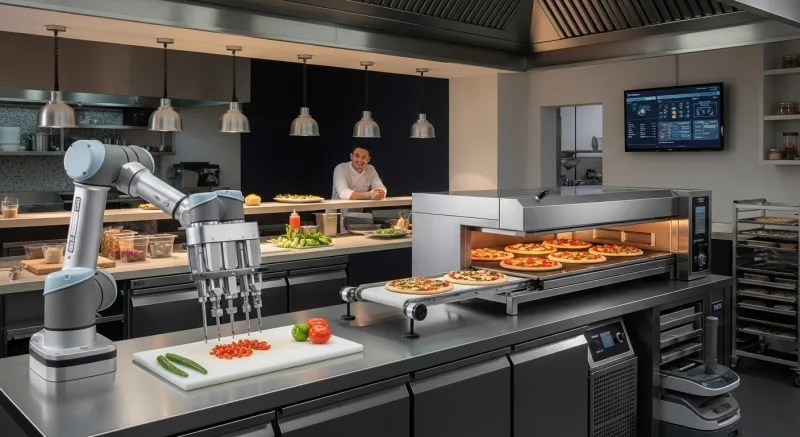
Here's where to start:
Self-ordering kiosks and QR code ordering eliminate the need for dedicated order-takers. Rockin' Rolls Sushi Express runs 3 locations with 49 iPad self-ordering stations. Customers browse the menu, customize their orders, and pay — all without a server taking the order. The result? They need fewer front-of-house staff, average order sizes went up 23% (people add more when they're not feeling rushed by a server), and the staff they do have focus entirely on food running and hospitality.
And that's not all. Tiger Sugar operates 2 stores with 2 self-ordering kiosks designed for minimal-step personalization — customers select their customizations in just a few taps. Electronic receipts with loyalty integration mean no paper, no manual tracking, and faster throughput during rush hours.
Kitchen display systems (KDS) replace paper ticket printers and the chaos of lost tickets, illegible handwriting, and verbal order callouts. Shogun Japanese Hibachi uses customized KDS displays for their hibachi stations — each station sees only the orders relevant to them, color-coded by cook time. New kitchen staff reach proficiency in under 5 minutes because the system tells them exactly what to make and when.
Automated scheduling software eliminates the 3-5 hours per week managers spend building schedules, handling swap requests, and chasing people for availability. That's 150-250 hours per year of manager time returned to actually managing the restaurant.
The math is compelling. If technology lets you operate with 2-3 fewer front-of-house positions, that's $60,000 to $90,000 per year in labor savings — not to mention the elimination of turnover costs for those positions.
Want to see what self-ordering and KDS integration looks like in practice? Compare how KwickOS handles it versus Toast.
Strategy 2: Fix Your Onboarding (The First 72 Hours Determine Everything)
Here's a stat that should change how you think about new hires: 33% of restaurant employees who quit do so within the first 30 days. Most of them decide they're going to quit within the first 72 hours.
Why? Because most restaurant onboarding looks like this: "Here's your apron, shadow Maria today, ask if you have questions." That's not onboarding. That's abandonment with an apron.
Here's the thing: the restaurants that retain employees treat the first three days like a structured program, not an afterthought.
Day 1: Tour the restaurant. Introduce every team member by name. Explain how the kitchen and front-of-house communicate. Show them the POS system — not just "here's how to ring in an order," but "here's where to find the modifier screen, here's how to split a check, here's what to do when the printer jams." Walk them through a full service mentally before they touch a single table.
Day 2: Shadow a strong employee (not whoever happens to be working). Practice taking 3-5 tables with a buddy watching. Debrief at the end of the shift — what went well, what was confusing.
Day 3: Supervised solo. They run their own section but with someone checking in every 20 minutes. End-of-shift feedback from a manager, not just a coworker.
This structure costs you nothing except intentionality. And it dramatically reduces the "I'm lost and nobody cares" feeling that drives early quits.
One operational detail that makes a massive difference: choose a POS system that's genuinely easy to learn. If your new server spends their first three shifts struggling with a clunky interface, they're frustrated before they even interact with a customer. Shogun Japanese Hibachi's staff reach full proficiency on KwickOS in under 5 minutes — that's not marketing fluff, that's their actual onboarding experience. When the technology doesn't create a learning curve, your people can focus on learning the menu, the culture, and the hospitality standards.
Strategy 3: Structured Retention Bonuses (Not Just Higher Wages)
Raising starting wages feels like the obvious answer. But here's the problem: if you raise your starting wage from $16 to $19 and the restaurant down the street raises theirs to $20, you're back to square one — except now your labor cost is permanently higher.
Retention bonuses solve a different problem. They reward loyalty, not just showing up on day one.
Here's a structure that works:
| Milestone | Bonus | Cumulative Investment |
|---|---|---|
| 30 days (no call-outs) | $150 | $150 |
| 90 days | $350 | $500 |
| 6 months | $500 | $1,000 |
| 1 year | $1,000 | $2,000 |
Total cost to keep an employee for a full year: $2,000. Cost to replace them if they quit: $3,500 to $6,000. The math is obvious.
But it gets worse if you don't do this. Without retention incentives, you're not just losing the employee — you're losing the $3,500 you already spent recruiting and training them, plus the $3,500 you'll spend on their replacement. That's a $7,000 swing on a single position.
Tie the bonuses to specific, measurable criteria: attendance record, completing cross-training milestones, or passing a skills assessment. This turns the bonus from a handout into a two-way investment.
Strategy 4: Cross-Train Everyone (Build Resilience, Not Dependence)
When your only prep cook calls out sick on a Saturday morning, what happens? If the answer is "panic," you have a single-point-of-failure problem.
Cross-training solves three problems at once:
- Resilience: When someone calls out, another team member can cover without the shift falling apart
- Reduced headcount: A team of 12 cross-trained employees can cover the same operational needs as 15 specialists
- Employee engagement: Learning new skills breaks monotony, increases perceived value, and gives employees a path to higher pay
Here's the thing: cross-training only works if it's systematic, not random. Create a skills matrix — a simple grid of every position and every employee, with checkmarks showing who's trained on what. Identify gaps. Set a goal: every employee should be proficient in at least two positions within 90 days.
A POS system that supports role-based permissions makes this operationally clean. With KwickOS, you can assign different access levels per role — a server cross-training on expo doesn't need access to void transactions or cash drawer counts. Fingerprint 1:N authentication means employees can log in instantly at any station without remembering PINs or swiping cards, so switching between roles mid-shift is seamless.
Multi-location operators get even more from cross-training. T. Jin China Diner runs 15 stores with 75 terminals — when one location is short-staffed, they can move cross-trained employees between locations because everyone uses the same system. Real-time remote monitoring lets the management team see which locations need help before the GM even calls.
Strategy 5: Flexible Scheduling (Meet Them Where They Are)
The workforce has fundamentally changed. According to the Bureau of Labor Statistics, 47% of food service workers are under 25. Many are students. Many are parents working a second job. Many are gig workers who value flexibility above everything — including hourly wage.
Rigid scheduling — "you work Tuesday through Saturday, 11 to close, no exceptions" — is a relic. The restaurants winning the staffing war offer:
- Shift bidding: Post available shifts and let employees claim them, rather than assigning fixed schedules
- Split shifts: Let someone work lunch and dinner with a break in between, rather than a straight 10-hour shift
- Minimum hours guarantees: Promise 25 hours/week minimum so employees have income stability without requiring full-time rigidity
- Shift swapping: Let employees swap shifts directly through a scheduling app, with manager approval, rather than the manager playing middleman
This isn't about being soft. It's about recognizing reality. A server who can pick up shifts around her class schedule stays for 2 years. A server forced into a fixed schedule she can't sustain quits in 2 months. You do the math on which one costs less.
Technology makes flexible scheduling operationally feasible. Without a digital scheduling system, managing shift swaps and variable availability is a nightmare. With one, it's automated. Managers spend minutes instead of hours, and employees feel in control of their work-life balance.
Strategy 6: Automate the Tasks Employees Hate Most
Ask your employees what they hate about their job. It's not the cooking. It's not the serving. It's the side work nobody wants to do — manual inventory counts, handwritten prep lists, closing checklists on paper, end-of-night cash counting discrepancies.
Every manual process you automate does two things: it reduces labor hours and it reduces frustration.
Diva Nail Beauty automated their commission tracking across 4 locations with 4 terminals. Before automation, managers spent hours calculating tips and commissions by hand — a tedious process that was also error-prone, leading to disputes and resentment. After implementing automated commission calculation through their POS, they saw a 90% increase in operational efficiency on that task alone. Stylists could see their commissions in real time, disputes vanished, and managers got hours back every week.
Here's where to focus your automation efforts:
| Manual Task | Hours/Week Wasted | Automated Solution |
|---|---|---|
| Inventory counting | 4-8 hours | POS-integrated inventory with low-stock alerts |
| Schedule building | 3-5 hours | Automated scheduling with availability input |
| Commission/tip calculation | 2-4 hours | Automated POS commission tracking |
| Menu updates across locations | 2-6 hours | One-click menu sync |
| End-of-day reporting | 1-2 hours | Automated daily reports to email |
Crafty Crab Seafood runs 19 stores with 152 terminals. When they need to update a menu item — price change, new modifier, seasonal special — they do it once and it syncs to all 19 locations instantly. Before? Someone had to log into each terminal at each location and make the change manually. That's not a staffing strategy directly, but it's hours of manager time freed up every week to actually manage people instead of managing menus.
Want to calculate how much time your team wastes on manual tasks? Try our labor cost calculator to see the dollar impact.
Strategy 7: Build a Pipeline (Stop Hiring Reactively)
Most restaurants only start hiring when someone quits. That's reactive hiring, and it's the most expensive, desperate, and ineffective way to find people.
Proactive hiring means you're always building a pipeline — even when you're fully staffed. Here's how:
Keep job postings live. Even when you don't have an immediate opening, keep a "We're always looking for great people" posting on your website and social media. Collect applications into a database. When someone quits, you already have 5-10 candidates to call instead of starting from scratch.
Employee referral bonuses. Your best employees know other good workers. Offer $200-$500 for a referral that stays 90+ days. This is cheaper than any job board and produces better candidates because your people don't want to refer someone who'll make them look bad.
Partner with local culinary programs and high schools. Contact your local community college culinary program and high school career centers. Offer stage opportunities (short working interviews) and position yourself as a training ground. These students become your farm team.
Build a "boomerang" culture. When good employees leave for school, travel, or personal reasons, leave the door open. Send a text every few months: "Hope you're doing well. If you ever want to come back, you have a spot." Rehiring a former employee costs almost nothing in training — they already know your systems, your menu, and your culture.
The goal is to shift from "who can we get right now?" to "who's in our pipeline?" That shift alone reduces time-to-fill from 3-4 weeks to 3-4 days — and eliminates the desperation hires that turn over in 30 days anyway.
Putting It All Together: The Staffing Math
Let's model what happens when a 20-employee restaurant implements these seven strategies:
| Metric | Before | After |
|---|---|---|
| Positions needed | 20 | 17 (tech replaces 3 FOH roles) |
| Annual turnover rate | 75% | 40% (retention strategies) |
| Employees replaced/year | 15 | 7 |
| Replacement cost/employee | $4,500 | $4,500 |
| Annual turnover cost | $67,500 | $31,500 |
| Labor savings (3 fewer positions) | — | $75,000 |
| Retention bonus cost | — | $20,000 |
| Net annual savings | — | $91,000 |
$91,000 per year. For a restaurant operating on 5-8% net margins, that's equivalent to generating an additional $1.1 million to $1.8 million in revenue. Except you don't need more customers, more marketing, or more tables to get it.
And that doesn't even account for the harder-to-measure benefits: better customer experience from a stable team, lower food waste from experienced cooks, higher average tickets from servers who know the menu and upsell naturally, and the sheer mental relief of not constantly being in hiring-crisis mode.
The Bottom Line
The restaurant staffing crisis is real, but it's not unsolvable. The restaurants thriving in 2026 aren't the ones offering the highest wages — they're the ones that made their operations more efficient, their onboarding more intentional, their scheduling more flexible, and their culture more worth staying for.
Technology plays a central role in all seven strategies. Not as a gimmick, but as infrastructure — the kind that eliminates busywork, reduces the number of people you need, and makes the people you have more productive and more satisfied.
The question isn't whether you can afford to invest in these strategies. It's whether you can afford not to — when every unfilled position costs you $3,500 to $6,000 and every month of understaffing erodes your reviews, your revenue, and your remaining team's willingness to stick around.
Run a Leaner, Happier Team
KwickOS replaces manual tasks with automation — self-ordering kiosks, KDS, automated scheduling, and commission tracking. See how restaurants like yours are solving the staffing crisis with technology.
Get a Demo