The problem is brutally common: You run a nail salon with commission-based pay, and every payday turns into an argument. Technicians think they were shorted. Tips don't add up. You spend 6+ hours doing math that still comes out wrong—and every mistake chips away at the trust that keeps your best people from walking out the door.
It gets worse the more you grow. Lisa Chen, owner of Diva Nail Beauty, ran 4 stores across Dallas-Fort Worth with 28–35 technicians. Each service category carried a different commission rate. Tips had to be split across multiple techs on the same ticket. Manual tracking meant $1,200/month in payroll errors and at least one dispute every single pay period. She was losing experienced technicians—and the $32,000+ in annual revenue each one took with them.
Here is how she fixed it. After switching to automated commission tracking, Lisa cut payroll processing from 6–8 hours to 45 minutes per week, logged zero disputes in 6 months, and eliminated $624/month in buddy-punching losses. This is her full story.
But here is what most salon owners don't realize until it's too late.
I have worked with dozens of nail salons, spas, and beauty businesses across North America over the past decade. I can tell you with certainty that the single most corrosive issue in these businesses is not competition, not rent, not even finding good technicians. It is the payroll argument. The moment an employee believes they were shorted on their commission or their tips were miscounted, trust evaporates. And once trust goes, that technician takes her client book and walks across the street to the competitor.
Lisa's story at Diva Nail Beauty is not unusual. But the way she solved it is worth telling in full, because it changed not just her payroll process but the entire culture of her four-store operation.
The Friday Nightmare: Manual Commission Math Across Four Stores
Diva Nail Beauty operates four locations across the Dallas-Fort Worth metro area, with four POS terminals total. The business offers a full menu: manicures, pedicures, acrylics, gel extensions, dip powder, waxing, eyelash extensions, facials, and massage. At any given time, Lisa employs between 28 and 35 technicians across all locations.
Now here is where it gets really complicated. Each service category carries a different commission rate. Nail technicians earn 40% commission on nail services. Massage therapists earn 50%. Waxing and facial specialists earn 35%. Some senior technicians have negotiated custom rates—42% or 45%—based on experience and client retention.
Now layer in tips. A client comes in, gets a manicure and a pedicure from one technician, then a facial from another. She pays on a single ticket and leaves a $30 tip. How does that tip get split? By service price? By time spent? By some unspoken rule that changes depending on who is working that day?
The manual process worked like this: Each technician would write her name on the service ticket. At the end of the day, a manager would tally the tickets. Tips were recorded in a notebook. On Friday, Lisa or her office manager would manually calculate each technician's gross commission across all tickets for the week, then subtract any product charges (some salons charge technicians for supplies), add tips, and arrive at a net payout.
And that is when things start to fall apart.
The errors were inevitable. A ticket with an illegible name. A tip that was recorded on the wrong day. A split service where one technician forgot to write her name on the ticket. A new hire whose commission rate was 38% for the first 90 days but accidentally got calculated at 40%.
And then there was the harder problem: buddy punching. Lisa suspected that some technicians were clocking in for each other, inflating hours and making it impossible to reconcile commission-based pay against time-based minimums. She had no way to prove it without standing at the door herself.
Why This Problem Is Universal in the Nail and Beauty Industry
And here is the thing—this is not just Lisa's problem.
If you run a commission-based salon, you already know everything I just described. The nail and beauty industry runs on commission. It is the standard compensation model, and it is fiendishly complex to administer.
Here is a simplified example of what a single client ticket can look like from a payroll perspective:
Sample Ticket: Client Jane Doe — Saturday 2:00 PM
That is one ticket. A busy salon processes 40 to 60 tickets per day, each averaging $78 in services. Multiply that across a week. Multiply that across four stores. You are looking at nearly a thousand tickets that need to be broken down, attributed to the correct technician, calculated at the correct rate, and reconciled with tips.
Now consider the scenarios that make it worse:
- Split services: Two technicians work on the same client simultaneously—one does the left hand, another does the right, during a busy Saturday rush. Who gets credit?
- Service upgrades mid-appointment: A client comes in for a basic manicure but upgrades to gel with nail art. The commission rate might change. The technician might not update the ticket.
- Product sales at checkout: A technician recommends a cuticle oil and the client buys it. Does the technician get commission on product? At what rate?
- Cash tips vs. credit card tips: Credit card tips are traceable. Cash tips often are not. This creates resentment between technicians who work different shifts.
- Booth renters vs. employees: Some salons have a hybrid model. The POS needs to track both.
Manual systems cannot handle this gracefully. Spreadsheets break. Notebooks get lost. And the human cost is real: every payroll dispute is a small fracture in the relationship between owner and employee. Enough fractures and the employee leaves, often taking loyal clients with her.
How KwickOS Solved Commission Tracking at Diva Nail Beauty
So what changed everything?
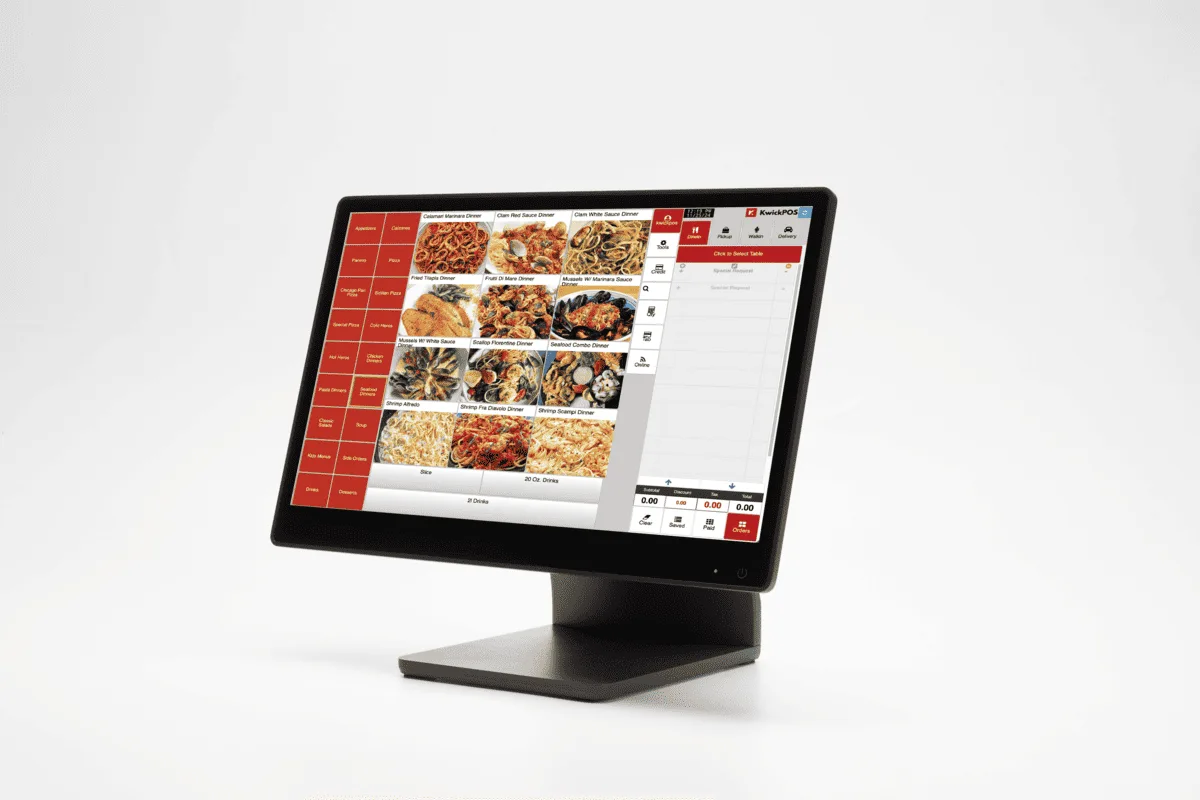
Lisa first heard about KwickOS from another salon owner at a trade show. What caught her attention was not the hardware or the interface—it was a single sentence: "It calculates commission per service per technician automatically, including tip allocation on split tickets."
That sentence described the exact problem she had been unable to solve for four years.
The implementation across Diva Nail Beauty's four locations took less than two weeks. Here is what changed.
Automatic Commission Calculation Per Service Per Employee
In KwickOS, every service in the menu is assigned a commission rate. Every technician profile includes a default commission tier, with the ability to set custom overrides per service category. When a technician rings up a service, the system instantly calculates her commission and records it.
There is no manual math. There is no end-of-week reconciliation. The commission is calculated at the moment the service is entered into the system, and it updates in real time as tickets are modified.
For Lisa, this meant that at any moment during the week, she could pull up a technician's running commission total. No more Friday surprises. (Try our free business calculators to estimate your own potential savings.)
Correct Tip Allocation Per Service on the Same Ticket
This is the feature that salon owners tell me matters more than anything else. When a client pays a single tip on a multi-service, multi-technician ticket, KwickOS allocates that tip proportionally based on the service revenue each technician generated on that ticket.
In the example above, Maria performed $100 worth of services and Tanya performed $18. The total service revenue on the ticket is $118. Maria receives 84.75% of the tip ($21.19) and Tanya receives 15.25% ($3.81). It is fair, transparent, and automatic.
Technicians can see their tip allocation on their own dashboard. No more asking the manager. No more suspicion. No more arguments.
Fingerprint 1:1 Verification: The End of Buddy Punching
KwickOS supports biometric clock-in using fingerprint verification. Each technician registers her fingerprint during onboarding. When she arrives for her shift, she scans her finger at the terminal. The system matches the print one-to-one against her profile.
This is not the same as a simple fingerprint scanner that stores prints in a database and searches for a match. KwickOS uses 1:1 verification: the technician selects her name, then scans her finger to confirm identity. It is fast, accurate, and eliminates the possibility of one employee clocking in for another.
At Diva Nail Beauty, Lisa discovered in the first month that buddy punching had been adding roughly 12 hours per week of phantom labor across her four stores. At an average technician rate of $12/hour, that translated to $624/month—or $7,488/year—in wages paid for time nobody actually worked.

The Results: 90% Efficiency Increase in Payroll Processing
But do the numbers actually back this up? See for yourself.
Before KwickOS, Lisa spent six to eight hours every Friday on payroll. After implementation, the process takes less than 45 minutes (saving roughly $18,000/year in administrative labor costs)—most of which is simply reviewing the numbers the system has already calculated and approving the payout.
In the first six months after switching, Diva Nail Beauty logged zero payroll disputes. Not one. For a four-store salon operation with over 30 technicians, that is remarkable. It is also directly attributable to transparency: when every technician can see exactly how her commission and tips were calculated, there is nothing to argue about.
Employee turnover dropped noticeably as well. Lisa told me that two technicians who had been considering leaving decided to stay specifically because they felt the new system was fair and transparent. In the nail salon industry, retaining a skilled technician with an established client base is worth $32,000–$48,000 per year in revenue.
Beyond Commission: What a Salon Actually Needs From Its POS
Commission tracking was the headline problem for Diva Nail Beauty, but it was not the only one. Running a nail salon or spa requires a POS system that understands the full scope of the business. Here is what Lisa also gained from the switch to KwickOS.
Appointment Scheduling and Walk-In Management
The KwickOS reservation system lets clients book online, and the salon can manage walk-ins from the same screen. When a walk-in arrives, the system shows which technicians are available, what their estimated wait time is, and what services they specialize in. This alone reduced front-desk confusion and shortened wait times.
Product Inventory for Retail
Salons sell retail products: nail polish, cuticle oil, shampoo, lotions, gift sets. KwickOS tracks retail inventory alongside service revenue, with automatic reorder alerts when stock drops below a set threshold. Commission on product sales can be configured separately from service commission.
Gift Cards and Loyalty Programs
Diva Nail Beauty now runs a customized loyalty program through KwickOS. Clients earn points per visit, with bonus points on birthdays. Gift cards are digital and trackable, eliminating the old paper gift certificate problem where cards would be lost or counterfeited.
CRM and Birthday Promotions
The built-in CRM stores client preferences, visit history, and contact information. Automated birthday promotions go out via text message, offering a discount on the client's birthday month. Lisa reports that birthday promotions alone drive an additional 15 to 20 bookings per month across her four locations.
Why Generic POS Systems Fail Salons
I hear this question constantly: "Why can't I just use Square?" Or Toast. Or Clover. Or any of the general-purpose POS systems that seem to work fine for the coffee shop down the street.
The answer is that those systems were built for simple retail or restaurant transactions. They understand items and prices. They do not understand commission-based compensation, technician-level service attribution, split-service tip allocation, or appointment-driven workflows.
| Feature | KwickOS | Square | Toast |
|---|---|---|---|
| Per-service commission rates | Yes | No | No |
| Custom commission tiers per employee | Yes | No | No |
| Automatic tip allocation on split tickets | Yes | No | No |
| Fingerprint 1:1 clock-in verification | Yes | No | No |
| Integrated appointment scheduling | Yes | Partial | No |
| Salon-specific loyalty programs | Yes | Basic | No |
| Multi-location commission reporting | Yes | No | No |
| Walk-in queue management | Yes | No | No |
Square offers a "Team Management" add-on, but it tracks hours and basic labor costs. It does not calculate commission by service type or allocate tips across technicians on the same ticket. Toast is a restaurant POS—it understands tables and courses, not technicians and service menus. Trying to force either system into a salon workflow means building workarounds on top of workarounds, and eventually reverting to the same manual spreadsheet process you were trying to escape.
A nail salon is not a coffee shop. It is not a restaurant. (For a deeper dive into salon POS requirements, see our complete salon POS guide.) It is a service business with complex labor economics, and it deserves a system built for that reality.
What Lisa Would Tell You Today
I spoke with Lisa six months after the KwickOS rollout. She told me something that stuck with me, because it captures what this technology shift really means for salon owners.
Trust is not a feature you can list on a spec sheet. But it is the outcome that matters most in a commission-based business. (See how KwickOS compares to Square and Toast for salon-specific features.) When your employees believe the system is fair, they stay longer, work harder, and treat your clients better. When they do not trust the system, they leave—and they take their clients with them.
If you are running a nail salon, spa, or beauty business with commission-based pay, the question is not whether you can afford to invest in a proper system. The question is how much you are already losing to payroll errors, buddy punching, employee turnover, and the hours you spend every week doing math that a computer should be doing for you.
Lisa ran those numbers. The answer convinced her to make the switch. I suspect the answer would convince you too.
Ready to Eliminate Payroll Disputes at Your Salon?
See how KwickOS automated commission tracking, tip allocation, and biometric verification can transform your salon operations.
Schedule a Free Demo