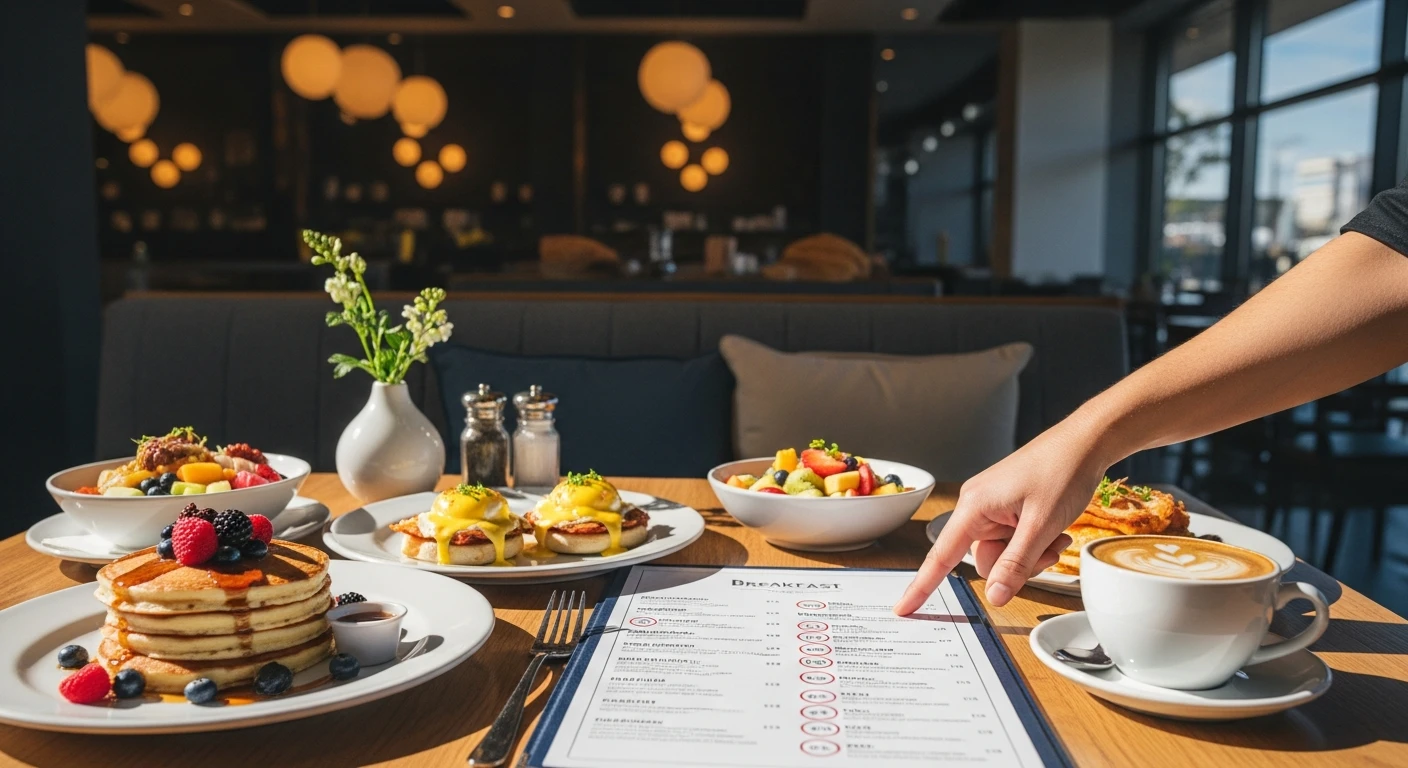
The best Make Your Breakfast Menu More Profitable handles everything from checkout to closing — without extra apps or workarounds. Your walk-in cooler is full of eggs. A case of 180 large eggs costs you about $38. That is roughly $0.21 per egg.
A three-egg omelet with cheese, peppers, and onions costs you $1.12 to plate. You sell it for $14.95.
That is a 92% gross margin. On a single menu item. Made with ingredients you probably already have in-house.
Now compare that to your dinner menu. That 12 oz. ribeye costs you $11.40 to plate and sells for $38. That is a 70% margin — still decent, but you are leaving 22 points of margin on the table every time a customer orders steak instead of eggs.
Here's the thing: this is not an argument against dinner service. It is an argument for breakfast service. Because if you are running a restaurant that opens at 11 AM, you are sitting on a kitchen, a dining room, and equipment that generates zero revenue for the first half of the day — while the most profitable meal of the day happens without you.
This guide will show you exactly how to build a breakfast menu that maximizes those margins, which items to feature and which to avoid, how to staff an AM shift without killing your labor budget, and how to use dayparting to track whether breakfast is actually making you money.
Why Breakfast Margins Are the Best in the Restaurant Business
Let's start with the numbers that matter. The average food cost for dinner service across all restaurant types is 28-35%. For lunch, it is 25-30%. For breakfast? It is 18-25%.
But it gets worse — for dinner, at least. Here is what makes breakfast fundamentally different from every other daypart:
- The core ingredients are cheap. Eggs, flour, butter, milk, potatoes, bread — these are commodity items with stable pricing and long shelf life. A 50 lb. bag of all-purpose flour costs $18 and makes roughly 200 pancake servings. That is $0.09 of flour per plate.
- Perceived value is high. Customers happily pay $13-$16 for a "Farmer's Breakfast" plate that costs you $2.30 to produce. They would never pay $13 for a dinner entree, but breakfast gets different mental accounting.
- Prep is simpler. Breakfast items require less technique, fewer specialized skills, and shorter cook times than dinner entrees. This means you can run the kitchen with fewer, less experienced (and less expensive) cooks.
- Table turns are faster. The average breakfast guest stays 35-45 minutes, compared to 60-90 minutes for dinner. That means your dining room generates more revenue per square foot per hour during breakfast than during dinner.
- Beverage margins are extreme. A cup of coffee costs you $0.15-$0.25 and sells for $2.50-$3.50. Fresh-squeezed OJ costs $0.60 and sells for $4.50. Most breakfast guests order at least one of each.
And that's not all: breakfast also fills a revenue gap that most restaurants simply accept as inevitable. Your rent, insurance, and equipment depreciation cost the same whether you open at 7 AM or 11 AM. Adding breakfast lets you amortize those fixed costs over more revenue-generating hours.
The Breakfast Menu Profitability Matrix
Not all breakfast items are created equal. Some are margin machines. Others are labor-intensive traps that look profitable on paper but eat into your bottom line when you factor in prep time and waste.
Here is how common breakfast items stack up:
| Menu Item | Plate Cost | Menu Price | Gross Margin | Prep Complexity |
|---|---|---|---|---|
| Pancakes (3-stack) | $0.68 | $11.95 | 94% | Low |
| Waffles | $0.82 | $12.95 | 94% | Low |
| 3-Egg Omelet (veggie) | $1.12 | $14.95 | 93% | Medium |
| Eggs Benedict | $2.85 | $16.95 | 83% | High |
| Breakfast Burrito | $2.10 | $13.95 | 85% | Medium |
| Avocado Toast | $2.40 | $14.95 | 84% | Low |
| French Toast | $0.95 | $12.95 | 93% | Low |
| Steak & Eggs | $6.20 | $19.95 | 69% | Medium |
| Drip Coffee | $0.18 | $2.95 | 94% | Minimal |
| Fresh OJ | $0.62 | $4.50 | 86% | Low |
The pattern is clear: flour-based and egg-based items dominate. They cost almost nothing to produce but command premium prices because of the labor and experience customers associate with dining out for breakfast.
Now here is the trick that separates profitable breakfast menus from unprofitable ones: menu engineering.
Menu Engineering for Breakfast: Stars, Plowhorses, Puzzles, and Dogs
If you have read our restaurant profit margins guide, you are already familiar with the stars/plowhorses/puzzles/dogs matrix. Here is how it applies specifically to breakfast:
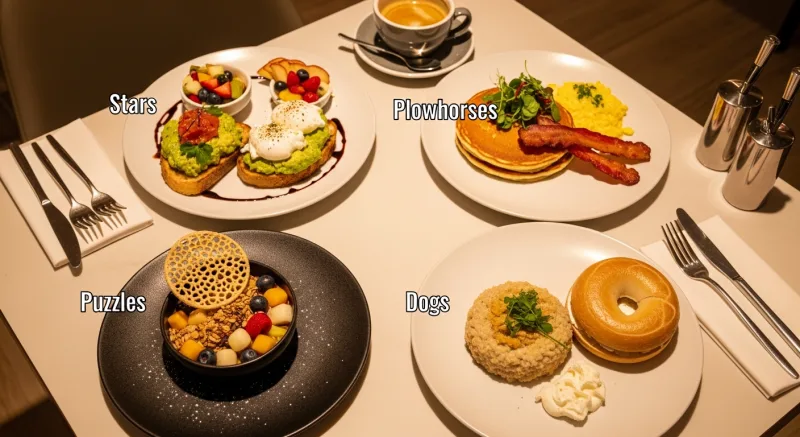
- Stars (high profit, high popularity): Omelets, pancake combos, breakfast burritos. These should be in the top-right of your menu with a visual call-out. Feature them prominently.
- Plowhorses (low profit, high popularity): Steak & eggs, smoked salmon plates. Customers love them but they compress your margins. Raise prices gradually, reduce portion sizes slightly, or pair them with high-margin add-ons.
- Puzzles (high profit, low popularity): Specialty waffles, stuffed French toast, chilaquiles. These make great money when they sell, but they need help. Use descriptive menu language, server recommendations, and LTO (limited time offer) framing to drive orders.
- Dogs (low profit, low popularity): Elaborate eggs Benedict variations, house-made granola bowls. Drop them. Every dog on your menu takes a customer's attention away from a star.
The single most profitable change you can make to a breakfast menu? Create a "combo" or "plate" structure that bundles a high-margin core (eggs or pancakes) with high-margin sides (toast, hash browns, fruit cup) and a beverage. A $16.95 "Rise & Shine Combo" that includes two eggs, bacon, toast, hash browns, and coffee costs you roughly $2.80 to produce. That is an 83% margin on a ticket that feels like a great deal to the customer.
Dayparting: How to Know If Your Breakfast Is Actually Making Money
Adding breakfast to your operation only makes sense if you can track whether it is profitable independently of your other dayparts. This is where most restaurants fail — they add breakfast, see total revenue go up, and assume it is working. But they never isolate the numbers.
Here's the thing: if your breakfast labor costs are eating all the food cost savings, you are running a charity, not a profit center.
Dayparting means splitting your financial reporting into distinct time blocks: breakfast (open to 11 AM), lunch (11 AM to 3 PM), and dinner (3 PM to close). For each daypart, you need to track:
- Revenue per labor hour — Total daypart revenue divided by total staff hours worked during that daypart. Target: $45-$65 for breakfast.
- Food cost percentage — Cost of goods for that daypart divided by daypart revenue. Target: 18-25% for breakfast.
- Covers per hour — Total guests served divided by hours open. This measures throughput efficiency.
- Average check — Total daypart revenue divided by number of tickets. Target: $12-$18 for breakfast.
A modern POS system makes daypart reporting automatic. With KwickOS, you set your daypart time windows once, and every sale is automatically tagged. You can pull a daypart profitability report in seconds — no spreadsheets, no manual calculations. Operators like T. Jin China Diner, running 15 locations with 75 terminals, use this exact approach to monitor morning performance across all stores from a single dashboard.
Without daypart tracking, you are flying blind. And flying blind with razor-thin restaurant margins is how you end up closing your doors.
Staffing the AM Shift Without Blowing Your Labor Budget
Labor is the second-largest expense in any restaurant, and adding a daypart means adding staff hours. But breakfast has a structural advantage that most owners underestimate: it requires dramatically less labor than dinner.
Here is a side-by-side comparison for an 80-seat restaurant:
| Role | Dinner Staff | Breakfast Staff |
|---|---|---|
| Line cooks | 3 | 2 |
| Prep cook | 1 | 0 (cooks handle prep) |
| Servers | 5 | 2-3 |
| Host | 1 | 0 |
| Bartender | 1 | 0 |
| Dishwasher | 1 | 1 |
| Total staff hours (4-hour shift) | 48 hours | 20-24 hours |
That is 50-58% fewer labor hours. At an average loaded cost of $18/hour (including taxes, insurance, and benefits), your breakfast labor runs $360-$432 per day compared to $864 for dinner. If breakfast generates $1,800-$2,500 in revenue during those 4 hours, your labor cost percentage lands at 17-24% — well within the profitable range.
But it gets worse if you get staffing wrong. The two mistakes that kill breakfast profitability:
- Overstaffing. Owners who are nervous about the new daypart schedule too many people "just in case." Track your covers per hour for the first two weeks and adjust. Use your POS hourly sales reports to find the sweet spot.
- Using dinner-rate cooks. Your $22/hour dinner saucier does not need to be cracking eggs at 7 AM. Hire a dedicated breakfast cook at $15-$17/hour. Breakfast cooking is less technically demanding, which means you can hire less experienced (and less expensive) talent.
Scheduling technology matters here. A POS that integrates scheduling — or at minimum provides employee management tools — lets you build shift templates specifically for the breakfast daypart and adjust based on actual sales data, not guesswork.
The Beverage Play: Where Breakfast Margins Get Ridiculous
If food margins at breakfast are impressive, beverage margins are obscene. And unlike dinner, where alcohol is the high-margin beverage play, breakfast runs on coffee — which is even cheaper to serve.
The math on coffee is almost unfair:
- A 12 oz. drip coffee uses about 14g of ground coffee. At $8/lb for quality beans, that is $0.25 per cup. You sell it for $2.95. That is a 91.5% margin.
- A latte uses $0.25 of coffee, $0.30 of milk, and sells for $5.50. 90% margin.
- Bottomless coffee at $4.95? The average customer drinks 2.3 cups. Your cost: $0.58. 88% margin, plus the customer feels like they are getting a deal, which increases satisfaction and tips.
Here is the pattern interrupt most owners miss: coffee is not just a menu item. It is a traffic driver. Customers will choose a restaurant for breakfast specifically because of the coffee. Invest $3,000-$5,000 in a quality espresso machine, source beans from a reputable local roaster, and train your staff to pull a proper shot. The ROI is measured in weeks, not months.
Fresh juice is the other breakfast beverage goldmine. A case of 40 oranges costs $28 and yields about 20 glasses of fresh-squeezed OJ. That is $1.40 per glass, sold for $4.50-$5.50. More importantly, "fresh-squeezed" is a premium signal that makes the entire breakfast experience feel upscale.
Real-World Breakfast Profitability: A Case Study
Let's walk through what adding breakfast looks like for a real mid-size restaurant.
The scenario: An 80-seat casual dining restaurant doing $65,000/month in lunch and dinner sales. Currently opens at 11 AM. Considering adding breakfast from 7 AM to 11 AM, seven days a week.
Startup Costs
| Item | Cost |
|---|---|
| Commercial waffle iron | $350 |
| Pancake batter dispenser | $75 |
| Espresso machine + grinder | $4,500 |
| Commercial juicer | $800 |
| Smallwares (egg rings, spatulas, etc.) | $300 |
| Menu printing/signage | $500 |
| Initial food inventory | $1,200 |
| Total | $7,725 |
Monthly Projections (After 90-Day Ramp-Up)
| Metric | Projection |
|---|---|
| Average covers per day (breakfast) | 45 |
| Average check | $14.50 |
| Monthly breakfast revenue | $19,575 |
| Food cost (22%) | $4,307 |
| Labor cost (20%) | $3,915 |
| Other variable costs (5%) | $979 |
| Monthly breakfast profit contribution | $10,374 |
| Annual breakfast profit contribution | $124,488 |
The $7,725 startup investment pays for itself in less than 23 days of breakfast service. After that, it is $10,000+ of additional profit every single month — from a kitchen that was sitting empty.
Multi-location operators see this effect multiplied. Crafty Crab Seafood, for example, runs 19 locations with 152 terminals on KwickOS. When a chain like that adds a daypart, the ability to sync menu changes across all locations with one click eliminates the operational nightmare of rolling out a new menu across dozens of stores.
7 Tactics to Maximize Breakfast Profitability
Once you have the basics in place, these tactics will push your breakfast margins even higher:
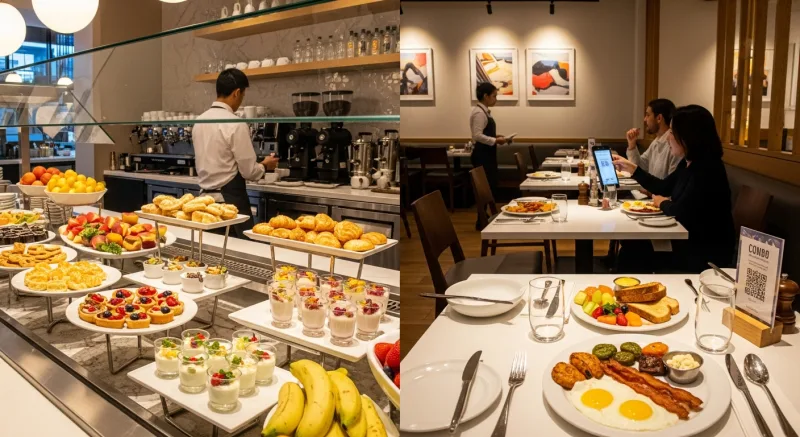
- Anchor with a premium item. Put a $22 "Grand Breakfast" at the top of the menu. Most people won't order it, but it makes the $14.95 omelet look like a deal. This is the decoy effect, and it works on breakfast menus better than anywhere else because the price range is compressed.
- Bundle aggressively. A la carte eggs ($8.95) + coffee ($2.95) + toast ($3.50) = $15.40. A "Morning Combo" with all three at $13.95 costs you the same $2.80 but feels irresistible. You lose $1.45 on paper but gain a guaranteed high-margin beverage sale and faster ordering.
- Upsell with add-ons. Bacon (+$3.50, costs you $0.85). Avocado (+$2.50, costs you $0.40). Extra eggs (+$2.00, costs you $0.42). These add-ons have 75-88% margins and require zero additional prep time. Train servers to suggest one add-on per table. If 40% of tables add bacon, that is an extra $420/week in pure profit.
- Use countdown language on LTOs. "Weekend Brunch Special — Stuffed French Toast — Available Until 11 AM." Scarcity drives orders. Rotate a new LTO every two weeks to keep regulars curious.
- Leverage your POS for menu intelligence. Track which items sell, which sit, and which get ordered together. Use food cost calculators to re-evaluate margins monthly. Swap out dogs for new puzzles. Promote stars relentlessly.
- Offer early-bird specials before 8 AM. A 10% discount before 8 AM fills seats during your slowest hour and spreads demand across the morning. The discount costs you $1.20 per check on average — less than the cost of an empty seat.
- Build a to-go breakfast program. Breakfast burritos, egg sandwiches, and coffee travel well. A to-go window or dedicated pickup shelf captures commuters who won't sit down but will spend $8-$12 on the way to work. Self-ordering kiosks — like the ones Rockin' Rolls runs at their 3 locations with 49 iPad stations — eliminate the labor cost of taking these quick orders, letting the customer order and pay in under 60 seconds.
The Technology Behind Profitable Breakfast Service
Running breakfast profitably requires more than good recipes. You need operational infrastructure that lets you track, adjust, and optimize in real time. Here is what your technology stack needs to support:
- Daypart reporting. Your POS must split financial data by time block so you can see breakfast profitability in isolation. If your current system lumps all sales together, you are guessing.
- Menu scheduling. Breakfast items should appear on terminals only during breakfast hours. This prevents ordering errors during lunch and dinner and keeps the interface clean for servers. KwickOS supports automatic menu switching by time of day — the breakfast menu appears at 7 AM and disappears at 11 AM without manual intervention.
- Inventory deductions by daypart. When a breakfast burrito sells, the system should deduct eggs, tortillas, cheese, and salsa from inventory in real time. This is how you catch waste early and know when to reorder. Read more about inventory management best practices.
- Kitchen display (KDS) configuration. Breakfast tickets need different routing than dinner tickets. Egg stations, griddle stations, and beverage stations each need their own display. Shogun Japanese Hibachi customized their KDS station displays to show exactly what each cook needs — and staff learned the system in under 5 minutes.
- Speed and reliability. Breakfast is fast-paced. When a server fires a ticket, the KDS needs to display it instantly. Cloud-only POS systems introduce 20-50ms of latency on every action. A hybrid system like KwickOS processes locally at 1ms and syncs to the cloud in the background — meaning your kitchen never waits for the internet to catch up. And if your internet goes down mid-rush? The system keeps running.
Common Breakfast Mistakes That Kill Profitability
Before you open those doors at 7 AM, avoid these traps that turn a high-margin daypart into a money pit:
- Too many menu items. A breakfast menu should have 12-18 items, not 35. Every additional item increases waste, complicates prep, and slows the kitchen. Look at the most profitable breakfast spots in your market — they keep it tight.
- Ignoring food waste. Breakfast ingredients like fresh fruit, dairy, and prepped potatoes spoil quickly. Prep only what you will sell based on cover projections. Use FIFO religiously. A 7-day waste audit during your first month of breakfast service will reveal where money is going into the trash.
- Not pricing beverages correctly. If your coffee is $1.99, you are leaving money on the table. Market rate for quality drip coffee in 2026 is $2.75-$3.50. Customers will not blink at $2.95 for a good cup of coffee, but that extra $0.96 per cup adds up to $8,600/year if you sell 30 cups per day.
- Skipping the ramp-up period. Breakfast traffic builds slowly. Expect 60% occupancy in month one, 75% in month two, and target levels by month three. Do not panic and add menu items or cut prices during the ramp. Let the regulars find you.
- Using your dinner POS configuration. Breakfast needs its own menu layout, its own KDS routing, and its own reporting category. Running breakfast through a dinner-configured POS is like wearing a suit to a beach — it technically works but everything is harder than it should be.
The Bottom Line: Breakfast Is the Highest-ROI Move Most Restaurants Are Not Making
The restaurant industry runs on tight margins. A typical full-service restaurant operates on 3-9% net profit. Every percentage point of margin improvement matters enormously.
Breakfast delivers those margin points more reliably than any other strategy. The food costs are lower. The labor requirements are smaller. The table turns are faster. The beverage margins are astronomical. And the startup investment is minimal compared to the return.
If your kitchen is sitting dark from 7 AM to 11 AM, you are paying rent, insurance, and depreciation on a space that is generating nothing. Adding breakfast changes that equation overnight.
You are not just adding a meal. You are adding $10,000+ in monthly profit contribution from an asset you already own.
The only question is whether your operational infrastructure — your POS, your kitchen displays, your scheduling, your reporting — can support a new daypart without creating chaos. If your current system cannot handle daypart-specific menus, real-time inventory tracking, and isolated profitability reporting, it is time to look at one that can.
Ready to Add Breakfast to Your Restaurant?
KwickOS gives you daypart reporting, automatic menu scheduling, real-time inventory tracking, and kitchen displays that configure in minutes — everything you need to run a profitable breakfast service. See how it works.
Get a Demo