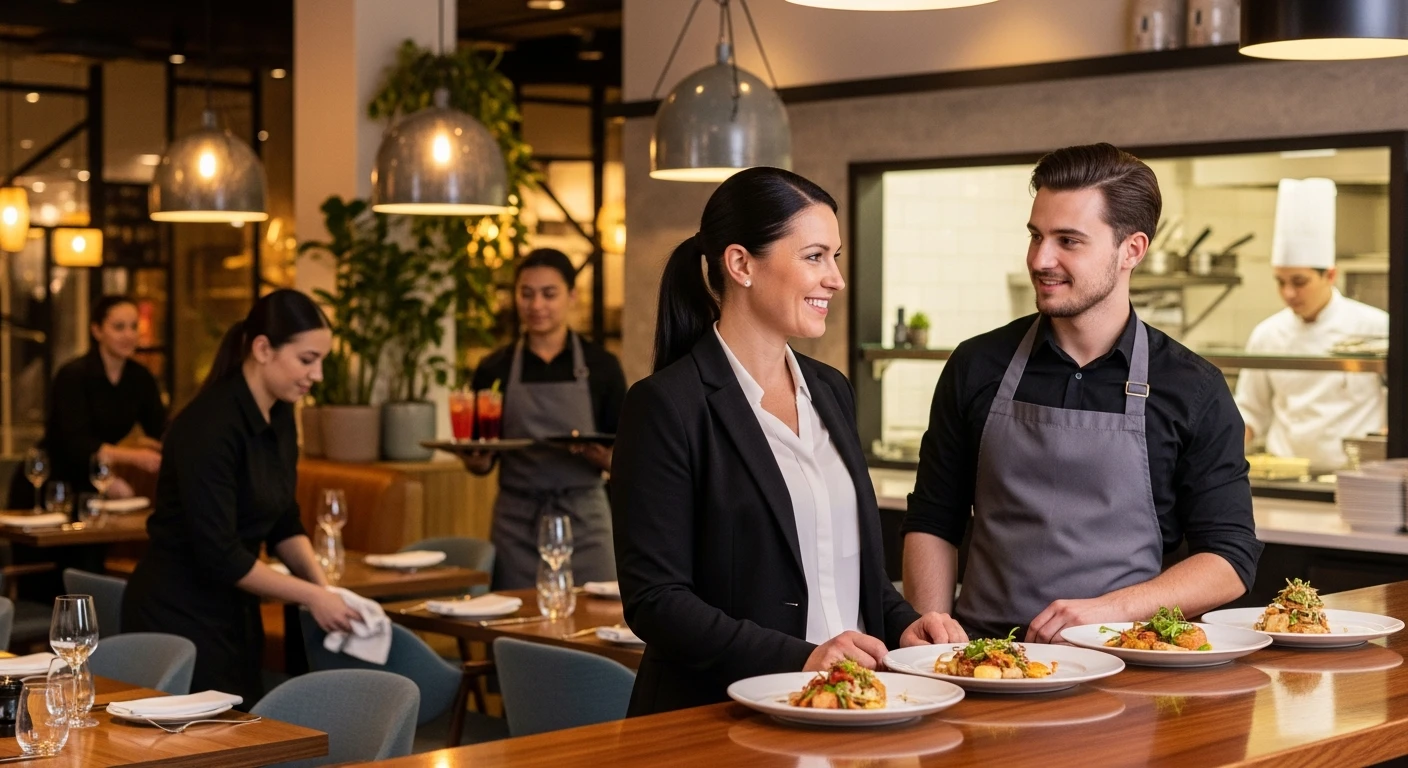
The best Restaurant Employee Management handles everything from checkout to closing — without extra apps or workarounds. You just lost another server. No two-week notice. No explanation. Just a no-show on a Friday night, with a full house and a 45-minute wait at the door.
Now you're scrambling. The host is running food. The manager is bussing tables. And the customers who came in expecting a good experience are getting something far less.
Here's the thing: this didn't have to happen. The server who ghosted you wasn't a bad hire — she was a predictable outcome of a system that pushes people out faster than it brings them in.
73% of restaurant operators say recruiting and retaining employees is their top challenge. The National Restaurant Association reports that the hospitality industry's turnover rate hovers near 75% annually — meaning three out of every four employees you hire this year will be gone before next January.
But it gets worse: each departure costs you an average of $5,864 in recruiting, hiring, training, and lost productivity. For a restaurant with 25 employees, that's $117,280 per year walking out the door. Not in food waste. Not in processing fees. In people.
This guide breaks down the five areas where restaurants lose the most money on labor — and the specific systems, tactics, and technology that fix each one.
The True Cost of Restaurant Turnover (It's Worse Than You Think)
Most owners calculate turnover cost as "the time it takes to train a replacement." That's about 10% of the actual number.
Here's what replacing a single employee actually costs:
| Cost Category | Estimated Cost |
|---|---|
| Job posting and recruiting | $350 - $600 |
| Manager time interviewing (8-12 hours) | $200 - $400 |
| Onboarding paperwork and setup | $100 - $200 |
| Training (40-60 hours at reduced productivity) | $800 - $1,500 |
| Mistakes during learning curve (food waste, comps) | $300 - $600 |
| Lost productivity from existing staff covering | $500 - $1,000 |
| Revenue loss from understaffing during transition | $1,000 - $2,500 |
| Total per employee | $3,250 - $6,800 |
The industry average lands at $5,864. Multiply that by your annual turnover count and you'll understand why labor — not food cost — is the number that determines whether your restaurant is profitable.
Problem #1: Scheduling That Drives People Away
Ask any restaurant employee what frustrates them most about the job. The answer isn't the pay. It's the schedule.
Schedules posted two days before the week starts. Clopens (closing at 11 PM, opening at 7 AM). Shifts that change without notice. Hours that fluctuate wildly from 38 hours one week to 22 the next — making it impossible to budget, plan childcare, or hold a second job.
And that's not all: a study by the Economic Policy Institute found that employees who receive their schedules less than one week in advance are 15% more likely to quit within 90 days compared to those who receive two weeks' notice.
The fix isn't "better managers." The fix is a system that makes good scheduling the default.
What Effective Scheduling Looks Like
- Demand-based templates. Your POS system already knows that Tuesday lunch does $1,800 and Saturday dinner does $7,200. Build schedule templates that match historical sales patterns — not gut feelings — to actual labor needs.
- Two-week advance publishing. Post schedules 14 days ahead. Lock them 7 days ahead. Changes after that require manager approval and employee consent.
- Shift swap self-service. Let employees trade shifts through the system without requiring manager involvement for every swap. This alone reduces no-shows by 20-30%.
- Overtime alerts. Flag any employee approaching 40 hours before the schedule is published — not after the overtime has already been worked.
Need a starting framework? Our scheduling template generator creates demand-based templates from your actual sales data.
Problem #2: Buddy Punching and Time Theft ($373 Billion Industry Problem)
Here's a number that should make every restaurant owner uncomfortable: the American Payroll Association estimates that buddy punching and time theft cost U.S. businesses $373 billion per year.
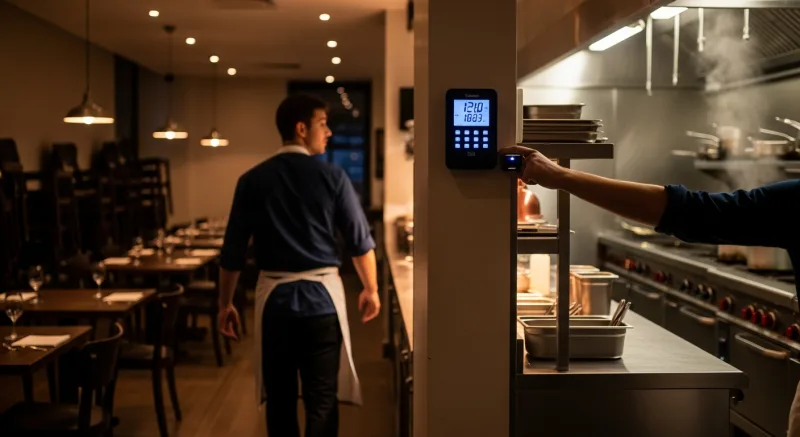
Buddy punching — when one employee clocks in for another who isn't there — is the most common form. In restaurants, it usually looks like this: a cook asks a coworker to punch him in at 10:00 AM while he strolls in at 10:20. Twenty minutes, five days a week, 50 weeks a year. That's 83 hours of paid time for work that never happened — roughly $1,250 at $15/hour, from a single employee.
PIN codes don't solve it. Employees share PINs like they share cigarettes. Swipe cards don't solve it either — cards get passed around just as easily.
Here's what does solve it: fingerprint identification.
How Fingerprint 1:N Eliminates Time Theft
KwickOS uses fingerprint 1:N matching — the "N" means the system identifies the employee from a single touch without requiring them to enter a number or select their name first. Place your finger on the reader. The system matches it against all enrolled employees in under one second. No buddy can replicate your fingerprint.
But the benefits go beyond just preventing buddy punching:
- Unauthorized access prevention. Cashier drawers, manager functions, void/discount permissions — all tied to fingerprint verification. No more "someone used my login" disputes.
- Break compliance tracking. The system logs exact break start and end times biometrically, keeping you compliant with state labor laws.
- Payroll accuracy. Time records based on biometric data are virtually dispute-proof, reducing payroll processing time and eliminating "I forgot to clock out" adjustments.
Toast doesn't offer fingerprint identification. Square doesn't either. Most cloud-only POS systems can't support biometric hardware because they run entirely in a browser. KwickOS runs natively on Linux with direct hardware integration — which is why fingerprint 1:N works seamlessly.
For a restaurant with 15 employees, eliminating buddy punching alone saves $1,500 to $4,000 per year in labor costs. Use our employee cost calculator to run the numbers for your team.
Problem #3: Commission Tracking That Destroys Trust
This problem hits hardest in service businesses — nail salons, spas, and hair salons — but it applies to any restaurant that uses tip pooling, performance bonuses, or commission-based pay.
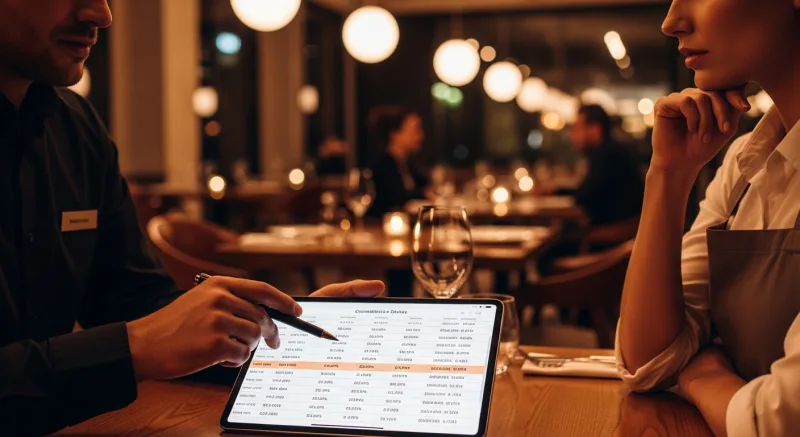
When employees can't see how their pay is calculated, they don't trust it. When they don't trust it, they leave.
Here's the thing: manual commission tracking is almost guaranteed to have errors. A manager calculating commissions for 15 stylists across 4 service tiers with different rates, factoring in product sales and tip splits — that's not a task humans do accurately under pressure at 9 PM on a Saturday.
Case Study: Diva Nail Beauty
Diva Nail Beauty operates 4 stores with 4 terminals running KwickOS. Before switching, their managers spent hours each week manually calculating technician commissions from paper records. Disputes were constant. Technicians would claim services were miscounted. Managers couldn't prove otherwise.
After implementing KwickOS with automated commission tracking:
- Commission calculations became automatic — tied directly to completed services logged in the POS.
- Technicians could see their running totals in real time, during their shift.
- Manager time spent on payroll calculations dropped by 90%.
- Commission disputes dropped to nearly zero.
- Employee satisfaction scores increased significantly, and two technicians who had given notice decided to stay.
The 90% efficiency increase wasn't a technology upgrade for its own sake. It was the elimination of a trust problem that was driving people out.
Problem #4: Language Barriers in Training
The Bureau of Labor Statistics reports that over 23% of restaurant workers are foreign-born, with significant populations of Spanish-speaking and Chinese-speaking employees. Yet most POS systems, training materials, and operational documents are English-only.

This creates a hidden cost: longer training times, more mistakes during the learning curve, and a sense of exclusion that accelerates turnover among your most loyal potential employees.
But it gets worse: when your POS interface is only in English, non-native speakers take 2-3 times longer to process orders, increasing table turn times and error rates. A server who struggles with the POS isn't slow — the POS is failing them.
Multi-Language as a Retention Tool
KwickOS supports English, Chinese, and Spanish natively across the entire platform — not just the customer-facing screens, but the employee-facing interface, training modules, and management reports.
The impact on training time is dramatic. Shogun Japanese Hibachi reported that new employees reached full operational proficiency in under 5 minutes on customized hibachi station displays — because the interface was intuitive and available in the language they think in.
When your team can read every screen, understand every prompt, and navigate every function in their native language, three things happen:
- Training time drops from days to hours.
- Error rates during the first 30 days drop by 40-60%.
- Employees feel respected and included — which matters more for retention than a $0.50/hour raise.
Problem #5: No Visibility Into Labor Cost Until It's Too Late
Most restaurant owners find out their labor cost percentage when their accountant closes the books — two to four weeks after the month ended. By then, the money is spent. The overstaffed Tuesday lunches and the overtime that accumulated during a short-staffed weekend are irreversible.
Here's the thing: labor cost isn't a monthly metric. It's a daily metric. Ideally, it's a real-time metric.
What Real-Time Labor Tracking Looks Like
| Metric | What It Tells You | When to Act |
|---|---|---|
| Labor cost % (real-time) | Current labor spend vs. current sales | If above 32% before the dinner rush |
| Sales per labor hour | Revenue generated per hour of paid labor | If below $35 during a shift |
| Overtime approaching | Employees nearing 40-hour threshold | By Wednesday of each week |
| Clock-in vs. scheduled time | Early arrivals inflating labor cost | Daily — restrict early clock-ins |
| Break compliance | Legal exposure from missed breaks | Every shift — automated alerts |
When your POS system feeds clock-in data, sales data, and schedule data into a single dashboard, you don't need to wait for month-end to know you have a labor problem. You can see it at 2 PM on a Tuesday and cut a server before the slow dinner shift starts.
5 Retention Tactics That Actually Work
Hiring is expensive. Retention is cheap. Here are five tactics backed by data and operator experience that keep restaurant employees from leaving.
1. Publish Schedules 14 Days in Advance
This single change reduces voluntary turnover by 15-20%. Employees who can plan their lives around a stable schedule are dramatically less likely to quit. The technology exists to generate demand-based schedules automatically — use it.
2. Make Pay Transparent and Real-Time
Let employees see their hours, tips, and commissions in real time through the POS system. Diva Nail Beauty saw commission disputes drop to zero after implementing this. When people trust their paycheck, they stay.
3. Eliminate Time Theft (And Tell Them You Did)
Implementing fingerprint clock-in isn't just about saving $1,500-4,000/year in buddy punching losses. It sends a message to honest employees: we don't tolerate people who steal time while you're working hard. That matters. Your best employees notice when coworkers get away with showing up late, and it demoralizes them.
4. Train in Their Language
If 30% of your kitchen staff speaks Spanish as their first language, your POS, your training materials, and your operational checklists should be in Spanish. This isn't about being nice — it's about reducing the 2-3x training time multiplier that language barriers create, and making your employees productive and confident faster.
5. Create Visible Advancement Paths
Document exactly what it takes to move from server to shift lead, from shift lead to assistant manager, from assistant manager to general manager. Include specific milestones — not vague criteria like "demonstrates leadership." Employees who can see a future at your restaurant are 3x more likely to stay through the difficult first 90 days.
The Technology Stack That Makes It All Work
None of these tactics work in isolation. They require a system that connects scheduling, time tracking, payroll data, sales data, and employee management in a single platform.
Here's what that stack looks like:
| Function | Separate Tools Approach | All-in-One (KwickOS) |
|---|---|---|
| POS and sales data | Toast / Square | Built-in |
| Scheduling | 7shifts ($35-150/mo) | Built-in |
| Time clock | Homebase ($25-100/mo) | Built-in (fingerprint) |
| Commission tracking | Manual / spreadsheets | Built-in (automatic) |
| Labor cost reporting | Manual export/import | Real-time dashboard |
| Multi-language support | Not available | EN / CN / ES native |
| Monthly cost (25 employees) | $200-450/mo in add-ons | $0 additional |
The separate tools approach has another hidden cost: data doesn't flow between systems automatically. Your scheduling tool doesn't know your real-time sales. Your time clock doesn't know your schedule. Your POS doesn't know your labor cost. Every manual bridge between systems is a place where errors happen and insights get lost.
The Bottom Line: Labor Is Your Biggest Lever
Food cost gets all the attention. Processing fees are the trendy topic. But labor — at 25-35% of revenue for most restaurants — is the single largest controllable expense in your business.
A 5% reduction in turnover at a 25-person restaurant saves $7,330 per year in replacement costs alone. Eliminating buddy punching saves another $1,500 to $4,000. Optimized scheduling reduces overstaffing by 10-15%, saving $6,000 to $15,000 per year depending on your volume.
Add it all up and you're looking at $15,000 to $26,000 in annual savings — not from cutting staff, but from managing them better.
That's the difference between a restaurant that's barely breaking even and one that's building real equity.
Your Team Deserves Better Tools
KwickOS gives you fingerprint clock-in, automated scheduling, real-time labor tracking, and commission management — all in one platform. No add-ons. No extra fees.
Get a Demo