The pizza business has a unique operational rhythm. At any given moment, a multi-location pizza operation is simultaneously taking phone orders, processing online orders, managing in-store dining, routing delivery drivers, tracking make times on the line, and running promotions that change weekly. Each of these workflows needs to function at every location with perfect consistency — because a customer who orders from "your pizza chain" expects the same experience regardless of which store fulfills the order.
I have deployed POS systems for pizza operations ranging from 3-location local chains to franchise groups with dozens of stores. The problems are universal: delivery zone overlap between locations, menu pricing inconsistencies, gift cards that only work at one store, loyalty programs that fragment customer data, and per-location processing fees that compound as you grow. The cost of these problems for a 12-location pizza chain exceeds $75,000/year. For a 5-location operation, it is $30,000-45,000.
Delivery Zone Management: The Invisible Revenue Leak
Multi-location pizza operations draw delivery zones around each store. The zones should be contiguous (covering the entire service area) without significant overlap (preventing two locations from competing for the same order) and with clear routing logic (an order from the boundary area routes to whichever store can deliver faster).
Here’s where it gets expensive.
On separate POS systems, each store's delivery zone is configured independently. Store A's zone was drawn when it was the only location. Store B opened a mile away, and its zone overlaps Store A's by 30 blocks. An online order from the overlap area might route to the wrong store — the farther one, increasing delivery time — or it might not route at all if the zones were not perfectly aligned.
The revenue leak from delivery zone mismanagement is substantial. Orders that route to the wrong location add 7–12 minutes to delivery time. Late deliveries generate 3.2x more complaints, 28% more refund requests, and 41% fewer reorders. Orders from addresses that fall in the gap between zones are simply lost — the customer's address is not in any store's delivery area, so the online ordering system rejects them. For a 12-location chain, even 5 lost orders per day across all locations at a $25 average ticket totals $45,625/year in missed revenue.
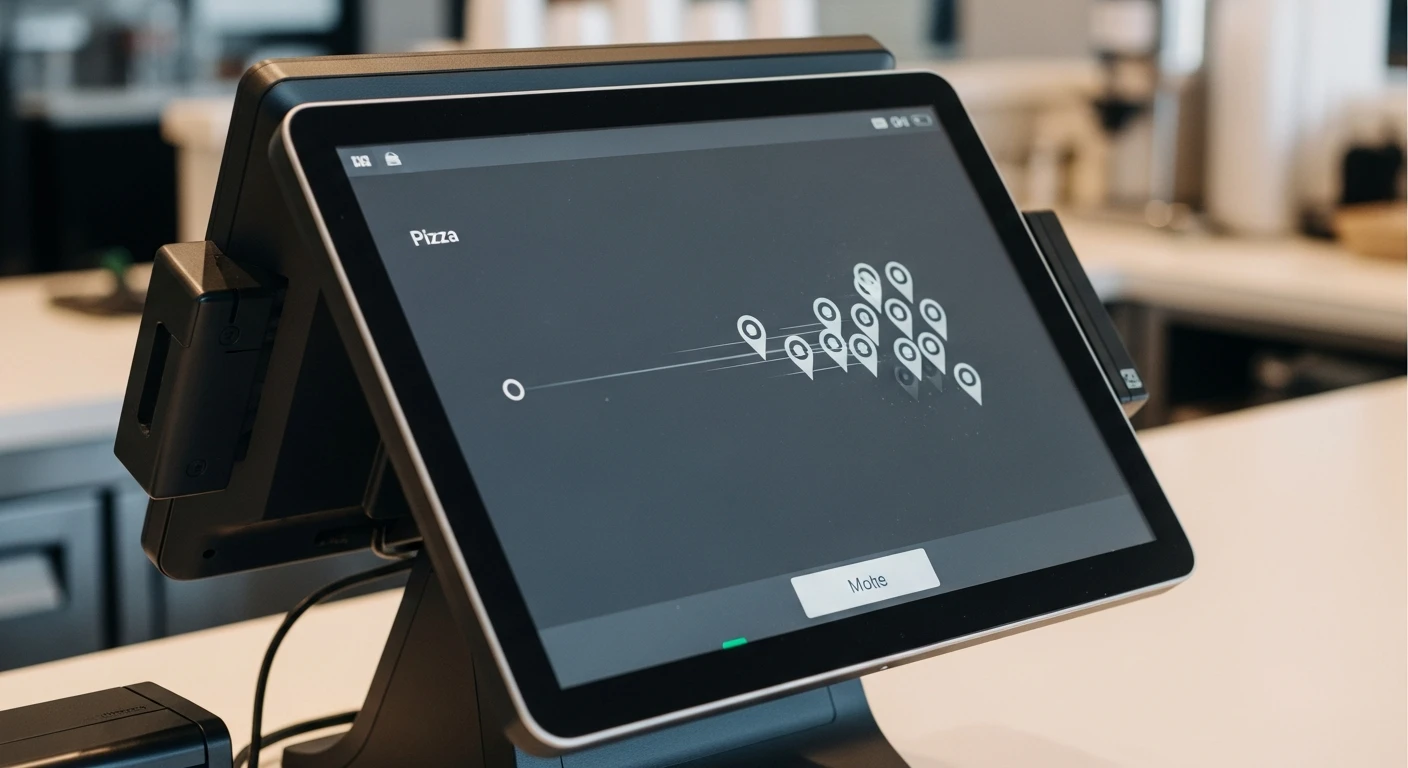
KwickOS manages delivery zones centrally with a map-based interface that shows all locations' zones simultaneously. You see the overlap, the gaps, and the boundary areas. When a customer orders online, the system routes to the optimal location based on distance, current kitchen load, and driver availability — not just which zone the address falls in. Centralized zone management ensures complete coverage with intelligent routing.
Menu Sync: Why 3 Seconds Matters
Pizza menus are modifier-heavy. A single pizza can have 4 sizes, 3 crust types, 30+ toppings (each with half/whole options), and multiple sauce options. A 12-location chain with this modifier complexity has over 1,000 possible price points that need to match across all stores.
But that’s just the beginning.
When cheese prices spike and you need to raise all pizza prices by $0.50, that change needs to happen at all 12 locations simultaneously. On separate POS systems, you are making 12 separate updates. On a Sunday night, when the change needs to take effect Monday morning. If you miss one store, Monday's orders at that location go out at the old price. If you enter $0.50 at 11 stores but accidentally enter $0.75 at the 12th, that store's pricing is wrong until someone catches it.
KwickOS pushes menu changes to all locations in seconds. Change the price at headquarters, click sync, and all 12 locations — every register, every online ordering page, every kiosk, every digital menu board — update simultaneously. The sync takes 3 seconds. The manual alternative takes 3 hours and introduces error risk at every step.
Crafty Crab Seafood uses this system across 19 locations and 152 terminals. Their menu complexity — seafood boils with dozens of sauce, spice, and add-on combinations — matches or exceeds pizza modifier complexity. If one-click sync handles 152 terminals at 19 locations, it handles your 12-location pizza operation with room to spare.
Online Ordering: One Brand, Multiple Fulfillment Points
The customer who orders online does not care which store makes their pizza. They order from "your brand." The website or app should determine the optimal fulfillment location automatically, based on the delivery address, and route the order accordingly. The customer sees one brand experience. Behind the scenes, the order is routed to the right kitchen.
And it gets worse.
On fragmented systems, online ordering is per-location. Each store has its own online ordering page (or its own profile on DoorDash/UberEats). A customer searching for your pizza chain might find Store A's listing, order delivery to an address closer to Store B, and receive their pizza 20 minutes later than necessary. Or worse, the customer discovers Store A does not deliver to their address and assumes you do not serve their area — when Store B is 8 minutes away.
KwickOS through KwickMenu provides a single branded online ordering page for the entire chain. The customer enters their address, the system identifies the closest store with delivery capability to that address, and routes the order accordingly. One URL, one brand experience, optimal fulfillment. No per-location ordering pages. No delivery zone confusion for the customer.
KwickDriver provides delivery at a flat $2 fee plus $6.99 per 5 miles — paid by the customer, not the restaurant. Compare that to DoorDash's 15-25% commission on every order. For a pizza chain doing $40,000/month in delivery across all locations, switching from DoorDash (at 20% commission) to KwickDriver saves $8,000/month or $96,000/year. The savings dwarf any POS subscription cost.
Gift Cards: The Cross-Location Pizza Essential
Pizza gift cards are purchased for specific occasions — kids' birthday parties, sports team celebrations, corporate lunch orders — and the purchaser often chooses the chain, not the specific location. A parent buying a $40 gift card for their kid's birthday party buys it at the location near their office. The party happens at the location near their house. If the card does not work at the second location, the party starts with an awkward payment conversation.
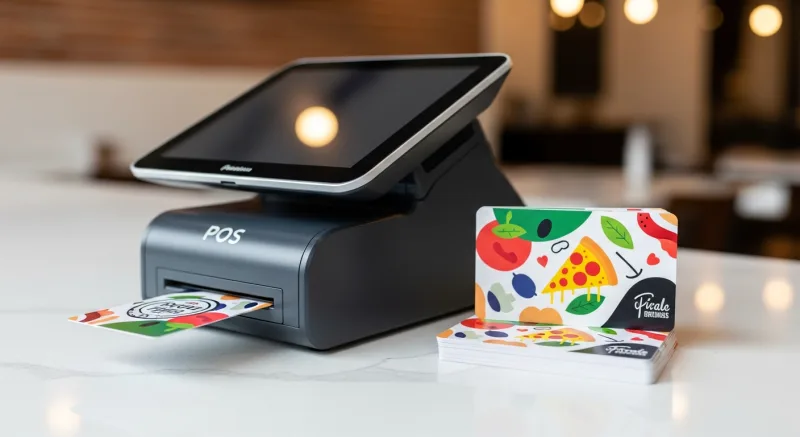
KwickOS gift cards work at every location from the moment of purchase. Physical cards, e-gift cards through the online ordering page, and promotional credits all sync in real time across all stores. The parent buys the card at Store A. The kid's party redeems it at Store C. Seamless.
For a 12-location pizza chain selling $150,000 in gift cards annually, the 10-15% breakage rate represents $15,000-22,500 in pure margin. That breakage only materializes if gift cards work everywhere — because frustrated gift card holders who cannot redeem at their preferred location push harder to fully spend the balance, which reduces breakage to zero.
Loyalty for Pizza: Frequency Meets Volume
Pizza customers order frequently — the average pizza consumer orders 1.7 times per week (88 orders per year). Loyalty programs in pizza have higher engagement than almost any other restaurant category because the ordering frequency means rewards are earned quickly. A "buy 8, get a free large pizza" program triggers a reward roughly every month for a regular customer.
When that loyalty is fragmented across locations, the frequency advantage disappears. A customer who orders from Store A one week and Store B the next (because they order from home and from work) earns half the points in each system. The "buy 8" program becomes "buy 16" in practice because neither system counts all their orders.
KwickOS loyalty unifies across all locations and all ordering channels — in-store, phone, online, and app. Every order from every store accumulates in one account. The customer who orders from two different stores reaches their reward in the same time as a customer who orders from one. Shared loyalty points mean your most geographically diverse customers — who are often your highest-value customers — receive the rewards their total patronage earns.
Kitchen Display Systems for Pizza Lines
Pizza kitchen display systems need to show make-line orders in sequence with clear topping callouts, differentiate between delivery and dine-in (delivery orders need to be ready before the driver returns), and track make times that determine how long a customer waits.
At multiple locations, KDS configuration needs consistency. A pizza maker transferring from Store A to Store B should see the same layout, the same workflow, the same priority system. On separate POS installations, each location's KDS might be configured differently — different display order, different priority rules, different timeout settings. This inconsistency slows down cross-trained employees and creates retraining costs at every transfer.
KwickOS KDS configuration is part of the centralized management. Configure the make-line display once, push it to all locations. When you add a new specialty pizza with specific topping placement instructions, the KDS update reaches every kitchen simultaneously. Shogun Japanese Hibachi's staff reached full proficiency on KwickOS KDS in under 5 minutes — the same intuitive design applies to pizza make-line displays.
The Processing Math for Multi-Location Pizza
Pizza chains process high volumes of moderate-value transactions. A 12-location chain averaging 200 orders/day per location at $28 average ticket processes $67,200/day or $2,016,000/month across all locations.
On Toast at 2.99% + $0.15 per transaction, monthly processing costs are approximately $63,878. At a negotiated rate through an independent processor (2.15% + $0.10), the same volume costs $45,744.
Annual savings from processor freedom: $217,608.
Let that number sink in. That is not a typo. At scale, the processing rate difference between a locked system (Toast, Square) and a negotiated rate compounds into six figures annually. This is why processor-agnostic POS systems are not a nice-to-have for multi-location pizza chains — they are a strategic financial imperative.
KwickOS is processor-agnostic. You negotiate one rate based on $2 million/month in aggregate volume. That volume gives you negotiating power that no single-location operator can match. If your processor tries to raise rates, you switch — because your POS works with any processor.
The Competitor Comparison for Pizza Chains
Now here’s how the competitors stack up.
Toast charges per-location subscription fees. At 12 locations on their Growth plan ($165+/month each), that is $1,980+/month in software fees — plus locked processing at the highest per-transaction cost of any major POS. Total annual cost (software + processing on $2M/month volume): approximately $790,000.
Square charges 2.6% + $0.10 per transaction with no monthly fee but no volume discount. On $2M/month, processing alone costs $628,800/year. And Square's multi-location management is limited — each location is a semi-independent instance.
Clover requires separate merchant accounts per location. Twelve separate accounts, twelve separate processor relationships, zero aggregate volume leverage. The administrative overhead alone costs more than the software subscription.
KwickOS: one platform fee, processor-agnostic, true multi-location unification. Use our free POS cost calculator to see the total cost comparison for your volume.
The Multi-Location Pizza Checklist
- Can you manage delivery zones centrally with intelligent order routing?
- Can you push menu and price changes to all locations in seconds?
- Does your online ordering route to the optimal fulfillment location automatically?
- Do gift cards work at every location in real time?
- Does the loyalty program count orders from all locations and channels?
- Can you use one payment processor at one rate for all locations?
- Does the KDS display maintain consistent configuration across all kitchens?
- If one location loses internet during Friday dinner rush, does it keep operating?
KwickOS answers yes to all eight. Hybrid local+cloud architecture processes transactions at 1ms locally while syncing to centralized management — keeping every location operational even during internet outages.
Scaling Your Pizza Chain?
Schedule a demo and we will show you centralized delivery zone management, one-click menu sync, unified online ordering, cross-location gift cards and loyalty, and processor savings calculated for your volume.
Get Your Free DemoOr call us directly: (888) 355-6996