The Pizza Math: How Your POS System Determines Whether You Profit $2.47 or $0.12 Per Pie
Updated March 2026
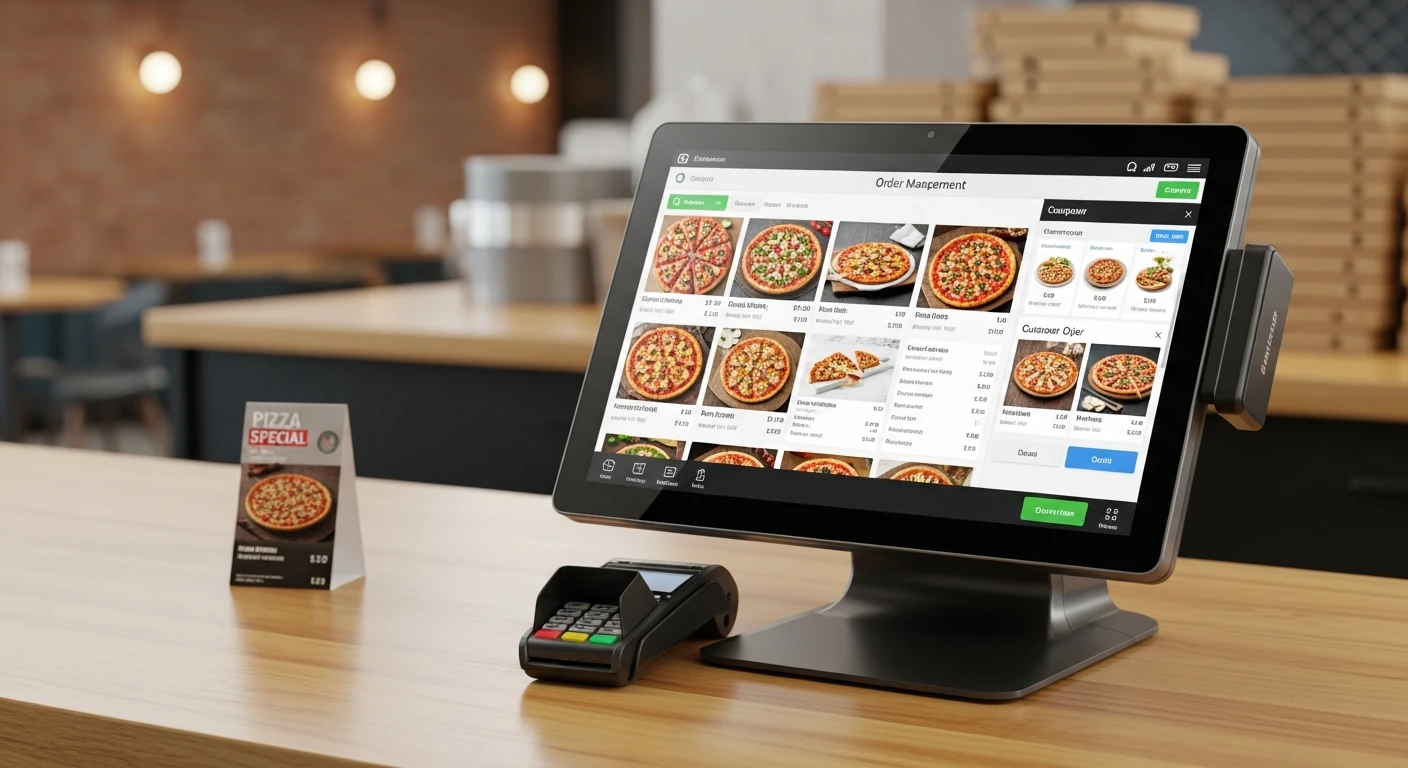
A large pepperoni pizza sells for $18.99 at most independent shops. After flour, cheese, sauce, pepperoni, the box, and a napkin, your food cost sits around $4.80. Rent, labor, insurance, and utilities eat another $11.72 on average. That leaves $2.47 in your pocket per pizza — before your POS system takes its cut.
Most pizza shop owners never run this calculation against their technology stack. They should. The difference between a processor-locked POS and a processor-agnostic platform can swing that $2.47 profit to nearly nothing, or push it past $3.00. Over 400 pizzas on a busy Friday, those pennies compound into thousands of dollars every month.
Breaking Down the Friday Night Rush
It is 6:14 PM on a Friday. The phone has not stopped ringing since 5:30. Three delivery drivers are loading bags in the back. The online ordering tablet is pinging every 90 seconds. Two walk-in customers are waiting at the counter while your cashier finishes a phone order. Your make line has nine tickets deep on the KDS screen.
This is the moment your POS system earns its keep — or falls apart.
Legacy systems handle this scenario with separate workflows: one screen for phone orders, a different tablet for online orders, a third interface for delivery dispatch. Your cashier toggles between windows. Mistakes multiply. A pepperoni gets rung as a sausage. A delivery address is keyed wrong. A customer who ordered online arrives for pickup and their order is not in the system because the tablet lost Wi-Fi for thirty seconds.
An integrated all-in-one system funnels every order — phone, walk-in, online, third-party delivery — into a single queue that feeds directly to the kitchen display. The make line sees one unified list sorted by promised time. No toggling. No duplicate entry. No lost orders when the router hiccups because the local system keeps running on its own hardware.
The Delivery Fee Equation Nobody Talks About
Delivery now represents 35-45% of revenue at the average pizza shop, up from 20% a decade ago. That shift has made delivery fees the single largest variable cost after food and labor.
Here is the math that keeps pizza shop owners awake at night:
| Delivery Method | Fee on $18.99 Pizza | Your Profit After Fee |
|---|---|---|
| DoorDash / UberEats (25% commission) | $4.75 | -$2.28 (loss) |
| Grubhub (20% commission) | $3.80 | -$1.33 (loss) |
| In-house driver (hourly + mileage) | ~$3.50 | -$1.03 (loss) |
| KwickDriver ($2 flat + $6.99/5mi) | $2.00 | +$0.47 (profit) |
Read that last row again. KwickDriver is the only delivery option in this table where the pizza shop actually makes money on a delivered large pepperoni. Every other method turns a $2.47 profit into a loss. This is why delivery integration is not a nice-to-have feature — it is the feature that determines whether your delivery business subsidizes your dine-in or bankrupts it.
Phone Orders: The Hidden Revenue Leak
Pizza shops take more phone orders than any other restaurant category. A busy shop fields 80-120 calls on a Friday night. Each call averages 2.5 minutes. That is 3.3 to 5 hours of labor just answering phones.
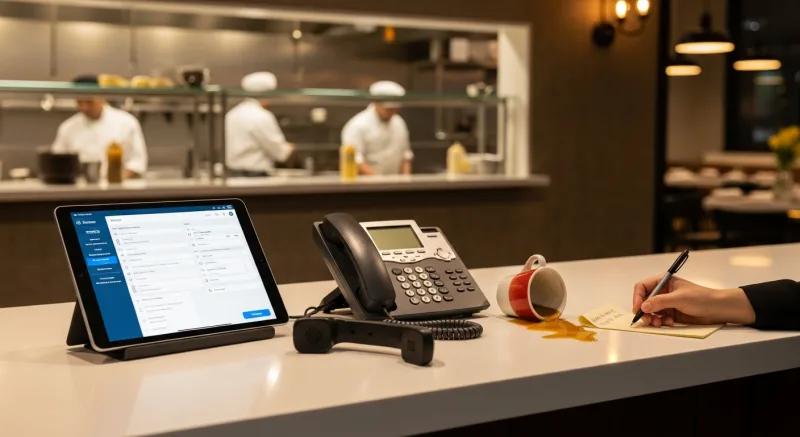
Every phone order also carries an error rate. Industry data puts it at 8-12% for phone-taken orders versus 1-2% for digital orders. On 100 Friday deliveries, that is 8 wrong orders that need to be remade, redelivered, or refunded. At $4.80 food cost plus driver time, each error costs $9-12. Eight errors cost $72-96 in a single night.
KwickOS approaches this from two angles. First, KwickPhone handles automated phone ordering with AI that understands "large pep, extra cheese, half mushroom" the way a veteran counter person does. Orders go straight into the POS queue. Second, KwickMenu provides branded online ordering that routes through Google Search and Maps, capturing customers who would otherwise land on DoorDash. Online orders have lower error rates, higher average tickets (customers add more when they browse visually), and zero labor cost to take.
Processing Fees: The Tax on Every Transaction
Toast charges 2.99% + $0.15 per transaction and requires you to use their processing. On a $25 average pizza order, that is $0.90 per transaction. Over 12,000 monthly transactions (a modest pizza shop), that is $10,800 per year in processing fees with no room to negotiate.
Square takes 2.6% + $0.10, slightly less but still locked in. You cannot shop rates. You cannot leverage your volume.
KwickOS does not process payments. It connects to whichever processor gives you the best rate. Pizza shops doing $40,000-60,000 per month in card volume can typically negotiate rates of 2.2-2.4% through independent processors. On $50,000 monthly volume, the difference between 2.99% and 2.3% is $345 per month — $4,140 per year. That is 1,676 additional large pepperoni pizzas worth of pure profit.
The Makeline Display Changes Everything
A pizza kitchen runs on visual flow. The person stretching dough needs to see what is coming. The person on toppings needs to see modifications. The oven person needs to know what is going out for delivery versus pickup so boxing and staging happen correctly.
KwickOS KDS stations can be configured per kitchen position. The dough station sees order type and size. The topping station sees the full modification list with allergen flags. The oven station sees the delivery queue with driver assignment and promised times, color-coded by urgency. When an order is 5 minutes past its promised time, it flashes red. When a driver is assigned, it turns green.
This kind of granular kitchen display configuration is what you find in enterprise pizza chains. The difference is that Papa John’s paid millions to develop their proprietary system. A three-location independent shop running KwickOS gets the same capability out of the box.
Inventory Tracking for Dough and Cheese
Pizza has a unique inventory challenge: your two highest-cost ingredients — dough and cheese — are also your two most variable. A 16-inch large uses roughly 18 ounces of dough and 10 ounces of mozzarella. But the person stretching dough at 5 PM is not the same person stretching at 10 PM. One runs heavy, one runs light. Over a week, that variance can swing cheese costs by 8-15%.
KwickOS inventory tracking ties every pizza sold to a theoretical ingredient depletion. At the end of the week, you compare theoretical usage to actual inventory. If you sold 2,400 large pizzas and should have used 1,500 pounds of mozzarella but actually used 1,680 pounds, you know exactly where to look: either portion control on a specific shift, waste during prep, or theft.
Most pizza POS systems do not track ingredient-level depletion against sales in real time. They track what you bought and what you have, but they do not tell you why the numbers do not match. The why is where money is saved.
Multi-Location Pizza Operations
The moment a pizza shop opens a second location, complexity multiplies. Menus need to stay in sync (mostly). Pricing might differ by neighborhood. Delivery zones overlap. A customer who orders online should be routed to the nearest location, not the one they happened to find first.
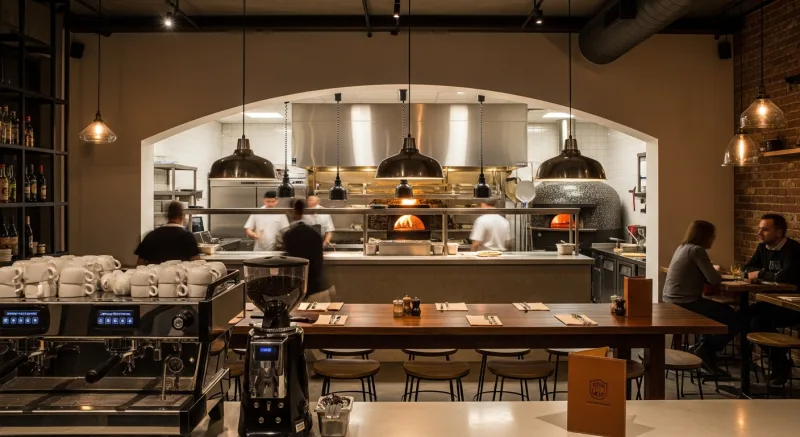
Crafty Crab Seafood operates 19 locations with 152 KwickOS terminals. While not a pizza chain, their operational challenge is identical: one-click menu synchronization across all stores, centralized reporting, and customized kitchen display workflows per location. When they add a seasonal special, it deploys to every store simultaneously. When one location modifies a dish for local preferences, that change stays local.
For a growing pizza brand, this means your flagship location’s Detroit-style special does not accidentally appear on the menu at your thin-crust-only location across town. Centralized control with local flexibility — the operational model that independent multi-unit pizza operators need but enterprise software rarely provides at an affordable price point.
Why Offline Mode Matters More for Pizza Than Any Other Category
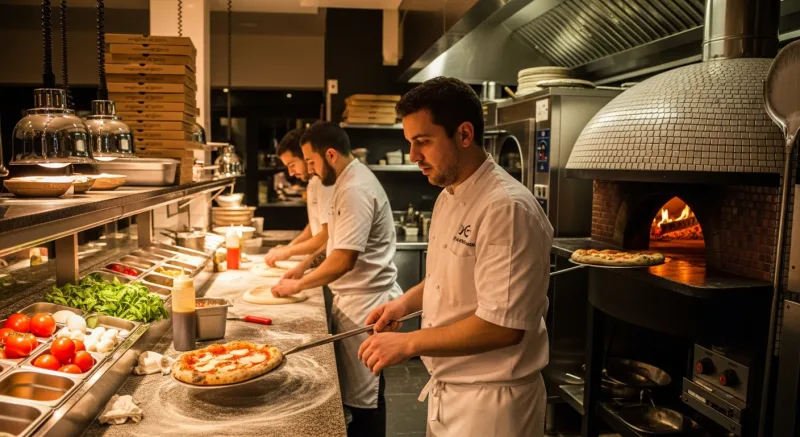
Pizza shops run later than most restaurants. Friday and Saturday shifts often extend past midnight. Internet outages are statistically more likely during evening peak hours when residential bandwidth is saturated. A pizza shop that goes offline at 8 PM on a Friday loses more revenue per minute than almost any other restaurant type because of the concentration of delivery and phone orders.
KwickOS runs on a hybrid local-plus-cloud architecture. The POS terminal processes transactions locally with 1-millisecond response times. If the internet drops, walk-in and phone orders continue processing without interruption. When connectivity returns, everything syncs to the cloud automatically. Toast, by contrast, is cloud-dependent — a connectivity disruption means the system slows to a crawl or stops entirely, with reported latency of 20 milliseconds or more even under normal conditions.
For a pizza shop doing $1,200-1,800 in revenue per hour on a Friday night, even a 15-minute outage represents $300-450 in potentially lost sales. Over a year, two or three outages during peak hours can cost more than the entire POS system subscription.
Putting the Numbers Together
Here is the annual financial impact for a single-location pizza shop doing $50,000 per month in revenue, comparing a processor-locked cloud POS to KwickOS:
| Category | Locked POS | KwickOS |
|---|---|---|
| Processing fees (annual) | $17,940 | $13,800 |
| Delivery commissions (annual) | $28,500 | $8,400 |
| Phone order errors (annual) | $4,800 | $960 |
| Outage losses (annual) | $1,350 | $0 |
| Total annual technology cost | $52,590 | $23,160 |
The difference is $29,430 per year. For a pizza shop netting 5-8% margins, that is the difference between a profitable year and a break-even one. It is the difference between opening a second location and wondering whether to close the first.
What to Look for in a Pizza Shop POS
Not every all-in-one system is built for pizza. Before signing a contract, confirm these capabilities:
- Half-and-half topping support — Can you ring a half-pepperoni, half-mushroom large without a workaround? KwickOS handles fractional toppings natively.
- Delivery zone mapping — Can you set variable delivery fees by distance? KwickDriver calculates fees by mileage automatically.
- Online ordering integration — Does the online menu feed directly into the kitchen display, or does it require manual re-entry?
- Phone order automation — Can AI answer basic calls during peak hours? KwickPhone takes the order, reads it back, and pushes it to the kitchen.
- Ingredient-level inventory — Does the system track cheese and dough depletion per pizza sold, or just count boxes?
- Processor choice — Can you switch processors if you find a better rate, or are you locked in for the life of the contract?
The pizza business operates on margins thinner than your crust. Every dollar your technology stack saves flows directly to the bottom line. When you are making $2.47 per pizza, the system that saves $0.30 per order is not a luxury — it is the only thing standing between profit and loss.
Ready to see the numbers for your shop? Call (888) 355-6996 or visit KwickOS.com for a free consultation.
The Revenue Features Most "All-in-One" Systems Charge Extra For
When POS companies say "all-in-one," they rarely mean gift cards and loyalty are included. Toast charges $75/month for their loyalty add-on. Square Loyalty starts at $45/month. Clover requires third-party apps. KwickOS includes all of these natively — zero extra cost.
Physical & Electronic Gift Cards
Sell branded physical cards at the register. Send e-gift cards via text or email. Track balances across every location in real time. Gift card holders spend 20-40% more than face value — this is not a nice-to-have, it is a revenue multiplier.
Points-Based Loyalty System
Every transaction earns points. Customers see their balance on receipts and can redeem at checkout. Configurable earn ratios, tiered VIP levels, and automatic birthday rewards. No separate app required — it runs inside the POS your cashier already knows.
Membership & Subscription Management
Run coffee clubs, wine memberships, or VIP dining programs. Recurring billing, exclusive member pricing, and member-only items — managed from the same dashboard as your daily operations. Your customers feel special. Your revenue becomes predictable.
Real impact: businesses using KwickOS loyalty features see repeat visit rates increase by up to 35%. Gift card programs generate an average of 15% additional revenue during holiday seasons.

Tom Jin
Founder & CIO of KwickOS · 30 Years IT · 20 Years Restaurant Industry
Tom built KwickOS after decades running restaurants and IT companies. Today KwickOS serves 5,000+ businesses across 50 states.