AI-Powered POS in 2026: How Machine Learning Is Replacing Gut Feelings in Restaurant Management
Updated March 2026 · 15 min read
For business owners evaluating AI-Powered POS in, the details matter more than the marketing. For thirty years, the point-of-sale terminal was a recording device. It documented what happened: what was sold, when, to whom, for how much. It was the business equivalent of a security camera — useful for looking backward, useless for looking forward. Every decision about tomorrow — how much to prep, how many people to schedule, what to promote, when to reorder, which customers are about to leave — was made by a human brain processing incomplete information under time pressure.
In 2026, that era is ending. Not because POS systems got fancier screens or faster processors, but because artificial intelligence transformed the terminal from a recording device into a prediction engine. The POS system no longer just tells you what happened yesterday. It tells you what will happen tomorrow — and what to do about it.
This is not a theoretical future. It is happening now, in the 5,000+ businesses running KwickOS across 50 states. Restaurants that know exactly how many chicken breasts to thaw on Tuesday morning. Coffee shops that predict which regulars will not show up this week. Nail salons where commission calculations that took two hours now take zero. Pizza shops where the AI orders the next cheese delivery before the kitchen runs low. The technology has arrived. The question is whether your business is using it or competing against businesses that are.
The Seven AI Capabilities That Define the 2026 POS
AI in POS systems is not a single feature. It is a collection of capabilities that work together to transform business operations from reactive to proactive. KwickOS integrates seven distinct AI functions that address the core challenges every small business faces.
1. Predictive Analytics: Knowing Tomorrow's Demand Today
Every business makes daily decisions based on expected demand: how much food to prep, how many staff to schedule, how much inventory to order. Historically, these decisions were made by the owner's gut feeling, informed by experience and adjusted by whatever she remembered about last week. This approach has a ceiling — even the most experienced operator cannot hold 200 variables in her head simultaneously.
KwickOS predictive analytics processes every transaction in the business's history and builds a demand model that accounts for day-of-week patterns, seasonal trends, weather correlations, local event impacts, and promotional effects. The system generates daily forecasts with confidence intervals: "Tuesday forecast: 245 covers with 90% probability between 220 and 270."
For a restaurant that preps based on a 245-cover forecast rather than a "probably around 250, maybe more" guess, the difference manifests in three places: food waste drops (you prepped for 245, not 300 just to be safe), stockouts drop (you prepped for 245, not the 200 that seemed safe), and labor matches demand (you scheduled for 245 covers worth of work, not yesterday's arbitrary schedule).
T. Jin China Diner, operating 15 stores with 75 terminals on KwickOS, uses predictive analytics to coordinate prep across all locations from a centralized dashboard. When you are managing 15 kitchens simultaneously, the ability to see demand forecasts for every location on one screen replaces the phone-call-to-each-manager approach that consumed two hours every morning.
2. KwickPhone: AI-Powered Phone Ordering
The restaurant industry loses an estimated $8 billion annually in missed phone orders. A ringing phone during the dinner rush goes unanswered because every employee is serving customers. The caller — who wanted to place a $45 takeout order — hangs up and calls the competitor. This happens dozens of times daily in busy restaurants, and the owner never knows because the loss is invisible.
KwickPhone is an AI phone ordering system that answers every call, understands natural language, and processes orders with precision that exceeds most human order-takers. A caller says: "I need two orders of kung pao chicken, one with extra spicy, a large fried rice, and four egg rolls for pickup in 30 minutes." KwickPhone parses the order, confirms it back, processes payment, and routes it to the kitchen production queue. No hold music. No human intervention. No missed orders.
The system handles the full range of phone interactions: orders, reservations, hours inquiries, directions, catering requests, and dietary questions. For interactions that require human judgment (complaints, complex event planning), it collects information and routes to the appropriate person.
3. Smart Inventory Management
Traditional POS inventory is a counter: you had 50, you sold 12, you have 38. Smart inventory connects the counter to the forecast and the supplier. KwickOS knows you have 38 units, forecasts selling 15 tomorrow, knows your supplier needs 48-hour notice, and triggers a reorder today to arrive before you run out on Thursday.
For restaurants, the AI maps recipes to ingredients, tracking consumption at the ingredient level. When you sell a pasta carbonara, the system deducts the pasta, bacon, eggs, parmesan, and cream from ingredient inventory simultaneously. It knows that four different menu items use parmesan, calculates total parmesan consumption from all four items' forecasts, and generates a single consolidated reorder.
Crafty Crab Seafood, running 19 stores with 152 terminals, leverages centralized inventory intelligence to coordinate purchasing across locations. When 19 locations order from the same supplier, the AI consolidates orders for volume discounts that individual locations could not negotiate independently.
4. Customer Churn Prediction
Acquiring a new customer costs 5-7 times more than retaining an existing one. Yet most businesses have no system for detecting when an existing customer is leaving. A regular who visited every week for two years and has not been in for three weeks is actively churning — but nobody noticed because the store was busy with today's customers.
KwickOS churn prediction monitors every loyalty customer's visit pattern and flags deviations. The system distinguishes between normal variation (a weekly regular who skipped one week because of vacation) and genuine churn signals (a weekly regular whose visits declined to biweekly, then monthly). For genuine churn signals, the system triggers automated retention offers calibrated to the customer's value and behavior.
The AI calculates the ROI of every retention intervention. A $5 reward to retain a customer worth $2,000 annually is an obvious investment. A $10 reward to retain a customer worth $150 annually might not be. The system makes these decisions at scale, managing retention for thousands of customers simultaneously with individualized strategies that no human could execute manually.
5. Labor Optimization
Labor is the largest controllable expense for most businesses — 25-35% of revenue. The difference between efficient scheduling and wasteful scheduling can be $20,000-50,000 annually for a single location. Yet most businesses schedule on templates: "same as last week, but add one person on Saturday."
KwickOS labor optimization generates schedules based on demand forecasts, historical productivity data, and regulatory compliance requirements. It matches staffing to the demand curve in quarter-hour increments, recommending staggered start times that eliminate the 2-hour gap between when staff arrive and when the rush begins.
The system also tracks revenue per labor hour by shift, by position, and by individual employee. This data identifies which employees generate the most revenue per hour, which positions have scheduling slack, and where adding a marginal employee would generate more revenue than their cost.
6. Menu and Pricing Intelligence
Every menu has items that make money and items that lose money, and most business owners cannot tell you which is which without sitting down with a spreadsheet for an hour. KwickOS continuously calculates profitability at the item level, accounting for ingredient costs, prep labor, and sales velocity.
The AI identifies pricing opportunities by analyzing demand elasticity. It detects which items can sustain a price increase without volume decline (inelastic demand) and which items are price-sensitive (elastic demand). It recommends bundle pricing, time-based pricing, and promotional pricing strategies based on actual customer behavior data rather than industry rules of thumb.
Menu positioning suggestions are generated based on profitability and popularity. High-profit, high-popularity items (stars) get prime menu positions. High-profit, low-popularity items (puzzles) get server recommendation prompts. Low-profit, high-popularity items (plowhorses) get reformulated or repriced. Low-profit, low-popularity items (dogs) get removed.
7. AI-Enhanced Gift Cards, Loyalty, and Membership
Traditional loyalty programs are one-dimensional: earn points, redeem points. AI transforms loyalty into a behavioral intelligence system that personalizes every customer's experience.
KwickOS tracks individual purchasing behavior and creates segmented loyalty strategies. A daily customer gets frequency reinforcement rewards. A lapsed customer gets re-engagement offers timed to their absence duration. A high-spending customer gets VIP recognition that deepens their emotional connection. A new customer gets rapid onboarding rewards that build habit before the novelty wears off.
Gift cards become a strategic acquisition tool when AI identifies purchase patterns. The system knows when gift card purchases peak for your specific business and recommends promotions timed to those windows. It tracks gift card redemption behavior and identifies that first-time redeemers who receive a follow-up offer within 72 hours convert to repeat customers at double the rate of those who do not.
Membership programs — monthly subscriptions for recurring value — create predictable revenue that stabilizes cash flow. KwickOS manages membership billing, usage tracking, and retention intelligence. A coffee shop's $15/month "daily drip" membership, a nail salon's $49/month "Style Club," or a restaurant's $25/month "lunch pass" all create revenue floors that smooth out daily volatility.
The Architecture Advantage: Why AI Needs Hybrid Local+Cloud
AI-powered features require data processing — and that processing needs to happen without disrupting the core transactional functions of the POS. Cloud-only systems (like Toast) send every transaction to a remote server, which means AI processing competes with basic transaction processing for bandwidth and latency. When the internet slows or drops, both functions degrade.
KwickOS uses a hybrid architecture where transactions process locally with 1-millisecond response times while AI analytics sync to the cloud asynchronously. Your register works instantly regardless of internet status. AI forecasts update in the background. If your internet drops for an hour during Friday dinner service, your POS runs perfectly while Toast's system degrades or fails entirely.
This architecture also means that AI processing does not add latency to transactions. The cashier tapping through a lunch rush does not experience slower response because the AI engine is simultaneously processing demand forecasts. The two functions run independently, with the local system prioritizing the transaction in front of the customer and the cloud system handling the intelligence that improves tomorrow's operations.
The Competitive Landscape: What Toast and Square Offer (and What They Do Not)
Toast markets AI-adjacent features: some sales reporting with trend lines, basic inventory tracking, and a loyalty program. But Toast's AI does not forecast demand at the item level, does not predict customer churn, does not optimize labor scheduling with 15-minute granularity, and does not offer AI phone ordering. Toast's core business model depends on payment processing lock-in (2.99% + $0.15), which means their incentive is transaction volume, not operational intelligence.
Square offers even less AI capability. Square's analytics are backward-looking summaries: what you sold yesterday, this week, this month. Square's inventory counts items but does not forecast consumption or generate reorder recommendations. Square's loyalty program is a digital punch card with no behavioral segmentation or churn prediction.
Clover's AI features are effectively nonexistent. Clover is a hardware platform with third-party app integrations, meaning any AI capability depends on which apps you purchase separately, at additional cost, with no data integration between them.
KwickOS integrates all seven AI capabilities into a single platform where data flows between functions. The demand forecast informs inventory ordering, which informs purchasing costs, which informs menu pricing, which informs promotional strategy, which informs loyalty offers. This integration multiplies the value of each individual AI function because they share data and inform each other.
Real Results from Real Businesses
The impact of AI-powered POS varies by business type and size, but patterns emerge across the KwickOS customer base:
- Food waste reduction: 25-40% — Predictive prep replaces over-prepping, saving $1,000-3,000 monthly for typical restaurants
- Labor cost reduction: 8-15% — Demand-matched scheduling eliminates overstaffing during slow periods
- Revenue recovery from missed orders: $500-2,000/month — KwickPhone captures phone orders that previously went to voicemail
- Customer retention improvement: 10-20% — Churn prediction and automated re-engagement preserve recurring revenue
- Processing cost savings: $5,000-15,000/year — Processor-agnostic model lets businesses negotiate competitive rates
Haidilao Hot Pot, with 600+ locations worldwide, represents the enterprise end of AI POS adoption. KwickOS scales from a single-terminal bubble tea shop (Tiger Sugar's 2-store, 2-kiosk operation) to multi-hundred-location chains, with AI intelligence that gets more powerful as the data set grows larger.
Implementation: 7 Days from Decision to AI-Powered Operations
KwickOS implementation follows a 7-10 day timeline from purchase to full operation. Day 1-3: hardware setup and data migration from your existing POS. Day 3-5: staff training (1-2 hours for counter staff, 2-3 hours for managers). Day 5-7: live operation with support standing by. AI features begin learning from day one and generate useful predictions within 60-90 days of consistent operation.
The system runs on standard hardware — any touchscreen tablet or terminal. No proprietary hardware lock-in. No Windows licenses. KwickOS runs on Linux, which means no operating system costs, no forced update restarts during service, and no malware vulnerability that targets Windows point-of-sale systems.
Shogun Japanese Hibachi went from purchase to operation with customized hibachi station displays in under a week, with staff achieving proficiency in under 5 minutes. The interface is designed for speed, not complexity — because a POS system that requires a training manual is a POS system that slows down your business.
The 2026 Decision: AI or Instinct
Every business owner makes hundreds of operational decisions daily. How much to prep. Who to schedule. What to promote. When to reorder. Which customers to reward. What to price. Whether to hire. These decisions have always been made by experience and instinct — and for decades, that was the best available approach.
In 2026, it is no longer the best approach. AI processes more data, identifies more patterns, and generates more accurate predictions than any human brain. Not because human experience is worthless — it is invaluable for the judgment calls that AI cannot make. But for the quantitative decisions that drive daily operations, the data-driven approach outperforms instinct consistently and measurably.
The businesses that thrive in 2026 and beyond will be the ones that let AI handle what AI does best (prediction, pattern recognition, optimization) while humans focus on what humans do best (customer relationships, creative problem-solving, team leadership). KwickOS is the platform that makes this division of labor possible — not someday, but today.
Ready to see what AI can do for your business? Call (888) 355-6996 or visit KwickOS.com for a personalized demo.
AI + Loyalty: Smarter Customer Retention
KwickOS combines AI insights with built-in loyalty tools to do something no other POS can: predict which customers are about to stop coming in and automatically re-engage them.
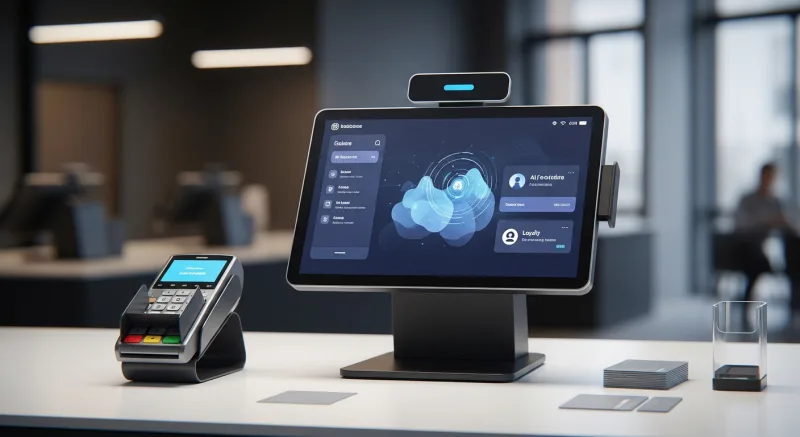
The gift card and loyalty system is not just a punch card — it is connected to AI-powered analytics that identify spending patterns, predict churn risk, and suggest targeted promotions. A customer who used to visit weekly but has not been in for 3 weeks? The system flags them and can trigger an automatic points bonus or e-gift card offer via SMS.
- Smart gift cards — AI suggests optimal gift card denominations based on your average ticket size
- Predictive loyalty — identifies at-risk customers before they leave, triggers re-engagement
- Points optimization — automatically adjusts earn rates during slow periods to drive traffic
- Membership insights — shows which VIP tiers generate the most lifetime value
All included. No add-on fees. Toast charges $75/month for basic loyalty without any AI component.
Founder & CIO of KwickOS · 30 Years IT · 20 Years Restaurant Industry
Tom built KwickOS after decades running restaurants and IT companies. Today KwickOS serves 5,000+ businesses across 50 states.
Related Articles
- Your Bakery's Oven Schedule Is Guessing. AI POS Knows Exactly What to Bake Tomorrow.
- The Full-Service Restaurant Where AI Runs the Floor Better Than Your Best Manager
- New York Nightlife Meets AI: How Manhattan Bars Are Cutting Pour Costs by 22%
- How Chicago Restaurants Are Using AI to Survive $15.80 Minimum Wage