The Full-Service Restaurant Where AI Runs the Floor Better Than Your Best Manager
Updated July 2026 · 13 min read
Every full-service restaurant lives or dies by the person running the floor — and most owners have exactly one of them. Your best floor manager has a gift. She can look at a 120-seat dining room on a Saturday night and know, instinctively, that Table 14 is about to ask for the check, Table 7 needs their appetizer plates cleared, and the party of six that just walked in should be seated in Section 3 because Maria is the server who handles large groups best. She processes dozens of variables simultaneously — table status, kitchen timing, server workload, guest mood, reservation queue — and makes decisions that keep the dining room flowing.
She is also a single point of failure. When she takes a vacation, service quality drops measurably. When she leaves for another restaurant, she takes her institutional knowledge with her. And even on her best night, she cannot see what she cannot see: the table in the corner that has been waiting 9 minutes for their entree, the server whose section is running 12% slower than the others, the trending pattern that shows Saturday 8 PM reservations take 22 minutes longer than 6 PM reservations because the kitchen is backed up.
AI does not replace your best manager. It gives every shift the intelligence of your best manager — plus the data processing capability that no human brain possesses.
Table Turn Optimization: The Revenue Multiplier Hidden in Your Floor Plan
A full-service restaurant with 30 tables that turns each table 2.2 times during dinner service generates revenue based on that 2.2 multiplier. Increasing to 2.4 turns — serving 6 more tables per night — adds $300-600 in nightly revenue without adding a single seat, a single employee, or a single menu item. Over a year, that is $110,000-220,000 in incremental revenue from improving a number that most restaurant owners do not measure.
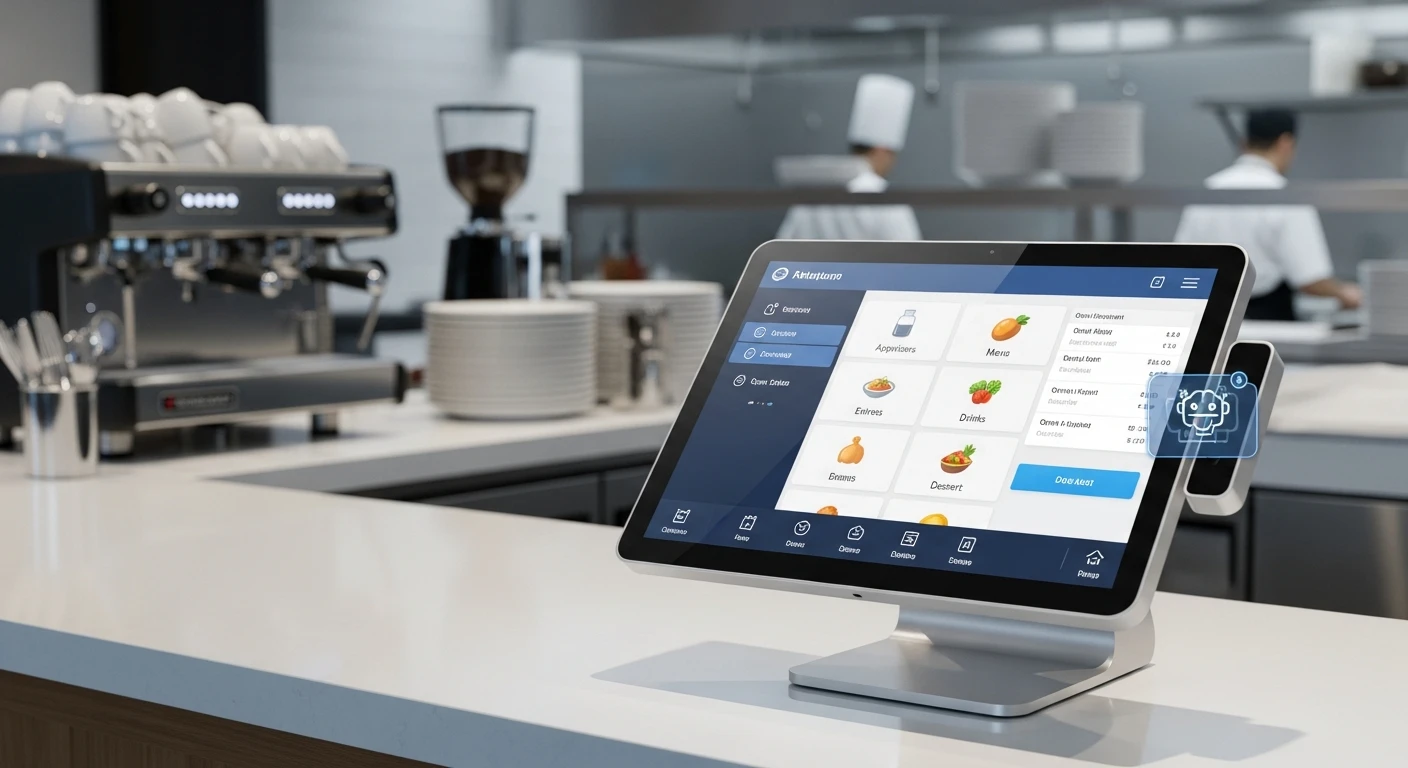
Here is what most owners never measure: KwickOS AI tracks table turn time at every table for every service period. It identifies which tables turn fastest (the two-tops near the bar that serve couples who eat quickly) and which turn slowest (the corner booth that attracts lingering groups). It tracks the gap between check presentation and payment — a metric most restaurants ignore — and finds that the average table sits unoccupied for 7 minutes between payment and the next seating because the host does not realize the table is available.
The system generates real-time alerts: "Table 14: check paid 3 minutes ago, not yet cleared" prompts the busser before the gap widens. "Table 22: estimated 8 minutes to completion, next reservation can be quoted 10 minutes" gives the host precise information instead of the "about 15-20 minutes" guess that frustrates waiting guests.
Crafty Crab Seafood, operating 19 stores with 152 terminals on KwickOS, uses this table-level intelligence to coordinate dining flow across their locations. When you are managing nearly 200 terminals across 19 restaurants, the ability to see table status and turn metrics in real time from a central dashboard transforms multi-location management from reactive firefighting to proactive optimization.
Course Timing: The Invisible Art That AI Makes Visible
Perfect course timing is the hallmark of excellent full-service dining. Appetizers arrive 8-12 minutes after ordering. Plates are cleared within 2 minutes of the last person finishing. Entrees arrive 5-8 minutes after appetizer plates are cleared. Dessert menus appear within 3 minutes of entree plate clearing. Every gap that is too long feels neglectful. Every course that arrives too quickly feels rushed.
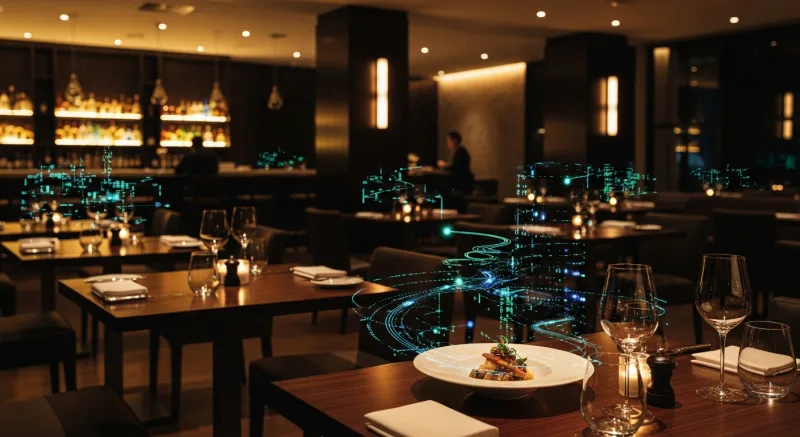
Human servers manage this by feel, and good servers do it well. But they manage it for their 4-5 tables. Nobody manages it across the entire dining room simultaneously. A manager might notice that Table 9's entrees are taking too long, but she cannot simultaneously notice that Table 3's appetizer came out 2 minutes before their drinks, that Table 15 has been waiting 4 minutes for their dessert order to be taken, and that the kitchen is running 3 minutes behind on all fired entrees.
But here is where it gets interesting. KwickOS tracks every course at every table against configurable timing targets. The kitchen display system shows not just what to cook but when it should fire relative to the table's dining progression. An alert on the KDS reads: "Table 9 entrees — fire now, appetizer plates cleared 6 min ago." Another reads: "Table 3 — hold drinks, appetizer 2 min from plating." The server's handheld terminal shows: "Table 15 — dessert order pending, 4 min since entree clear."
This orchestration transforms service quality from a function of individual server talent to a systematic capability of the restaurant. Your weakest server on a Saturday night delivers timing that approaches your strongest server's performance, because the system provides the intelligence that experience normally takes years to develop.
Reservation Intelligence: Predicting No-Shows Before They Happen
No-shows cost full-service restaurants an estimated $16 billion annually in the United States. A restaurant with 60 reservation covers per night and a 12% no-show rate loses 7 covers nightly. At an average check of $65, that is $455 per night or $166,000 per year in lost revenue from tables that sat empty because someone did not show up.
So how does the system stop it? KwickOS AI builds no-show probability profiles based on reservation behavior patterns. The system learns that reservations made more than 7 days in advance have a 15% no-show rate, while same-day reservations have a 4% rate. Friday 8 PM reservations no-show at 18%, while Tuesday 6 PM no-shows at 6%. Reservations made through third-party platforms no-show at 22%, while direct reservations through KwickOS no-show at 9%.
Armed with this data, the system recommends strategic overbooking. If Friday's 8 PM reservations historically no-show at 18%, the system suggests accepting 12% more reservations than your seating capacity for that time slot. The AI monitors confirmation responses and adjusts the overbooking percentage in real time as RSVPs come in.
The system also identifies individual high-risk reservations. A phone number that has no-showed twice in the past six months gets flagged. The host can require a credit card hold for that reservation or send a confirmation text that requires a response. This targeted approach reduces no-shows without creating friction for your reliable guests.
Server Performance Analytics: Fairness Through Data
Every restaurant has servers who generate higher checks, turn tables faster, and receive better tips. The question is whether those differences reflect skill, section assignment, or shift timing. A server consistently assigned the prime window tables during Saturday dinner will outperform a server assigned to the bar area during Tuesday lunch — but the difference is circumstantial, not performance-based.
KwickOS normalizes server performance across comparable conditions. The AI compares each server's metrics against others working the same shift, same section type, and same party size distribution. This reveals genuine performance differences: Server A generates 15% higher average checks than Server B when both work the same section on the same night, indicating superior upselling skills. Server C turns tables 10% faster than Server D under identical conditions, indicating more efficient service pacing.
These insights drive targeted coaching rather than blanket training. Server B needs upselling coaching. Server D needs table management coaching. Server A and Server C need to be recognized and possibly mentored into training roles. The AI replaces the subjective "I think Maria is our best server" assessment with quantified, comparable data.
AI-Enhanced Loyalty and Gift Cards for Fine Dining
Full-service restaurant loyalty programs must be sophisticated enough to match the dining experience. A punch card is inappropriate for a restaurant where the average check is $85. KwickOS creates tiered loyalty programs that align with the full-service customer's expectations.
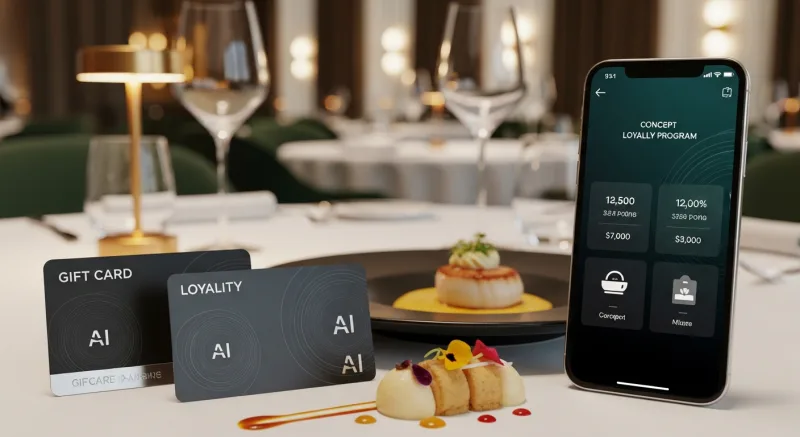
The AI segments diners by behavior: monthly regulars, quarterly visitors, special-occasion diners, and corporate entertainment hosts. Each segment receives different treatment. Monthly regulars earn recognition rewards — the bartender knows their preferred drink is ready when they sit down. Quarterly visitors receive re-engagement offers timed to their typical visit interval — a "we haven't seen you in a while" email with a complimentary appetizer. Special-occasion diners get personalized outreach before predictable occasions — an anniversary dinner reminder with a complimentary dessert offer.
Corporate entertainment hosts receive the highest-touch loyalty experience: invoicing capabilities, receipt customization for expense reports, and VIP priority seating. A corporate host who brings clients four times a year at $400 per visit is worth $1,600 annually. Losing them to a competitor because your POS cannot generate a proper expense receipt is an absurd failure.
Gift cards in full-service restaurants carry higher values ($75-200) and serve different purposes: corporate gifts, holiday presents, anniversary celebrations. KwickOS tracks gift card purchase occasions and triggers targeted promotions: "Last December you purchased three $100 gift cards. Early bird special: buy four this December and receive a complimentary $25 card." The AI identifies that corporate gift card buyers purchase 3.2 cards on average and respond to bulk incentives, while personal gift card buyers purchase 1.4 cards and respond to presentation upgrades (custom packaging, personal message cards).
KwickPhone: The AI Host That Never Puts You on Hold
Full-service restaurants receive an enormous volume of phone calls. Reservation requests, modification requests, cancellations, event inquiries, dietary restriction questions, hours confirmations, and directions account for 30-80 calls per day at a busy restaurant. During service, every call answered by the host takes them away from the guests physically standing at the host stand.
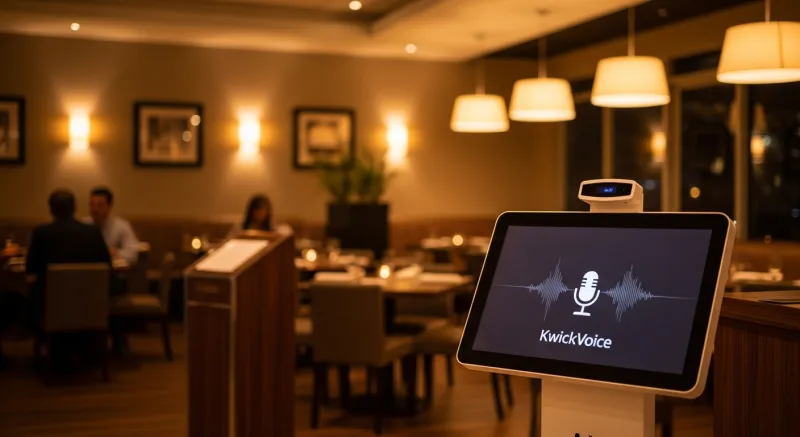
KwickPhone handles the full spectrum of restaurant phone interactions. It takes new reservations with party size, date, time, and special requests. It modifies existing reservations. It answers dietary questions by referencing the actual menu data in KwickOS. It provides directions and parking information. For complex inquiries — private dining events, custom menus, large party logistics — it collects details and schedules a callback from the manager.
Shogun Japanese Hibachi, operating with 4 terminals on KwickOS, benefits from AI phone handling that matches their high-touch dining experience. When a customer calls to book a hibachi table for a birthday party, KwickPhone captures the party size, date, any dietary restrictions, and whether they want the birthday announcement — routing a complete request to the manager rather than a scribbled note that misses critical details.
Menu Engineering with Real-Time Profitability Tracking
Full-service restaurant menus are the most complex in food service. A typical menu has 40-60 items across appetizers, salads, entrees, sides, and desserts, each with different food costs, prep times, and margin profiles. Traditional menu engineering requires a quarterly analysis with spreadsheets. KwickOS performs continuous menu intelligence.
The AI identifies that your $32 salmon entree has a 68% margin and sells 25 units per week (a star), while your $28 pasta primavera has an 82% margin but only sells 8 per week (a puzzle with untapped potential). It suggests repositioning the pasta on the menu — moving it to the top of the entree section, adding a "chef's recommendation" flag, or having servers verbally suggest it. Two weeks later, the AI measures the impact: pasta sales increased to 14 per week, adding $168 in weekly profit from a simple menu position change.
The system also identifies items that should be removed. A $24 appetizer that sells 3 per week, requires a unique ingredient that no other dish uses, and has a lower margin than comparable items is consuming menu real estate, kitchen prep time, and inventory complexity for negligible return. The AI calculates the full cost of maintaining the item — not just the food cost but the labor cost of prep, the inventory cost of stocking a unique ingredient, and the opportunity cost of the menu space it occupies.
Predictive Inventory for Full-Service Complexity
A full-service restaurant menu with 50 items might use 200+ unique ingredients. Managing cross-item ingredient dependencies manually is a daily exercise in mental gymnastics. The filet mignon and the beef carpaccio both use tenderloin. The salmon entree and the salmon appetizer draw from the same supply. The house salad dressing uses the same lemons as the lemon tart dessert.
KwickOS AI maps every menu item to its complete ingredient list and tracks consumption through sales. When the AI forecasts 30 salmon entrees and 12 salmon appetizers for Saturday, it calculates total salmon needed (accounting for portion sizes), checks current inventory, and generates orders with the appropriate lead time. If your fish supplier needs 48 hours notice, the order triggers Thursday morning.
The system prevents the most expensive inventory failure in full-service dining: 86ing a menu item during Saturday dinner service. Running out of your signature dish at 8 PM is a service failure that reservation guests do not forgive. The AI's real-time tracking and predictive ordering ensures that the kitchen has sufficient stock for forecasted demand with a safety buffer calibrated to your acceptable risk tolerance.
Labor Cost Intelligence for a 30% Line Item
Labor typically represents 28-35% of revenue in full-service restaurants, making it the largest controllable expense. The difference between 30% and 28% labor cost on $2 million in annual revenue is $40,000 — often the difference between a profitable year and a break-even one.
KwickOS AI optimizes labor across three dimensions: scheduling efficiency (right number of staff at the right times), productivity (sales generated per labor hour), and compliance (overtime avoidance, break scheduling, tip credit tracking). The system generates weekly schedules based on forecasted demand, historical labor performance, and local labor regulations.
It detects patterns that manual scheduling misses. Adding a third busser on Friday nights increases table turn speed by 8%, generating an additional $400 in revenue that more than covers the $120 busser cost. Reducing to one host on Tuesday instead of two saves $80 in labor with no measurable impact on guest satisfaction. These micro-optimizations, applied across every shift of every week, compound into significant annual savings.
Why Toast and Square Cannot Run a Full-Service Floor
Toast has full-service restaurant features, but its AI capabilities are rudimentary — our KwickOS vs Toast comparison breaks down the gap feature by feature. Toast cannot predict no-show probability for individual reservations. It cannot generate course-timing alerts across the entire dining room. It cannot normalize server performance across comparable conditions. Toast's table management shows you where guests are sitting. KwickOS tells you what is about to go wrong at each table and how to prevent it.
Square does not belong in a full-service restaurant. Its interface was designed for counter service. Square has no reservation system, no course-based firing, no floor plan management, and no server section assignment. Using Square in a full-service restaurant is like using a calculator to run a spreadsheet — it handles the arithmetic but misses the analysis entirely.
Neither platform offers the hybrid local+cloud architecture that full-service restaurants need. When your internet drops during a 200-cover Saturday dinner service, Toast goes down. Every table, every order, every payment is disrupted. KwickOS processes everything locally with 1ms response times. The internet outage that paralyzes a Toast restaurant is invisible to a KwickOS restaurant.
Full-service restaurant owners: Call (888) 355-6996 or visit KwickOS.com for a demo that shows how AI transforms your dining room floor.
AI + Loyalty: Smarter Customer Retention
KwickOS combines AI insights with built-in loyalty tools to do something no other POS can: predict which customers are about to stop coming in and automatically re-engage them.
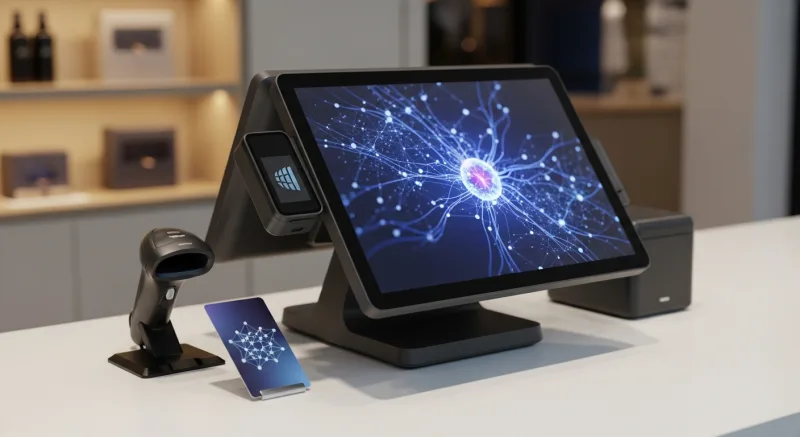
The gift card and loyalty system is not just a punch card — it is connected to AI-powered analytics that identify spending patterns, predict churn risk, and suggest targeted promotions. A customer who used to visit weekly but has not been in for 3 weeks? The system flags them and can trigger an automatic points bonus or e-gift card offer via SMS.
- Smart gift cards — AI suggests optimal gift card denominations based on your average ticket size
- Predictive loyalty — identifies at-risk customers before they leave, triggers re-engagement
- Points optimization — automatically adjusts earn rates during slow periods to drive traffic
- Membership insights — shows which VIP tiers generate the most lifetime value
All included. No add-on fees. Toast charges $75/month for basic loyalty without any AI component.
Frequently Asked Questions
How much revenue can better table turns add for a full-service restaurant?
Increasing turns from 2.2 to 2.4 on a 30-table floor serves roughly 6 more tables per night — about $300–$600 in added nightly revenue, or $110,000–$220,000 per year, without adding a single seat, server, or menu item.
Can AI POS actually reduce restaurant no-shows?
Yes. No-shows cost U.S. full-service restaurants an estimated $16 billion a year. KwickOS builds no-show probability profiles (for example 18% on Friday 8 PM reservations versus 6% on Tuesday 6 PM), recommends calibrated overbooking, and flags repeat no-show phone numbers for a card hold or confirmation text.
How is KwickOS different from Toast and Square for full-service dining?
Toast has full-service features but rudimentary AI — no per-reservation no-show prediction and no dining-room-wide course-timing alerts. Square was built for counter service and has no reservations, floor plan, or course firing. KwickOS also processes everything locally at 1ms response times, so an internet outage that takes Toast offline is invisible to a KwickOS restaurant. See the full KwickOS vs Toast breakdown.
Is loyalty and gift card management included or an add-on?
It is included with no add-on fee. AI-powered loyalty predicts churn, segments diners, and suggests promotions. Toast charges $75/month for basic loyalty without any AI component.
Founder & CIO of KwickOS · 30 Years IT · 20 Years Restaurant Industry
Tom built KwickOS after decades running restaurants and IT companies. Today KwickOS serves 5,000+ businesses across 50 states.