Your Bakery's Oven Schedule Is Guessing. AI POS Knows Exactly What to Bake Tomorrow.
Updated March 2026 · 12 min read
At 3:00 AM, a bakery owner in Houston stands in front of six sheet pans trying to decide how many croissants to laminate. She baked 80 yesterday and sold 74. The day before she made 60 and ran out by 10 AM. Last Tuesday she baked 90 and threw away 22 at closing. There is no pattern she can see. There is no formula written in any bakery textbook that accounts for the intersection of weather, local events, school schedules, and the unpredictable cravings of 400 daily customers.
She is not bad at her job. She is doing something that human cognition was never designed to do: predict granular daily demand across dozens of perishable SKUs with a 4-hour production lead time and zero tolerance for error in either direction. Overbake and you absorb the cost. Underbake and you lose the sale permanently — a customer who finds an empty croissant case at 9 AM does not come back at noon to check again.
This is the problem that artificial intelligence was built to solve. Not general intelligence. Not sentience. Pattern recognition across datasets too large and too variable for human processing. And in 2026, AI-powered POS systems are finally bringing that capability to bakeries that have been guessing since the day they opened.
Why Bakeries Are the Hardest Demand Forecasting Problem in Food Service
Restaurants have it comparatively easy. A dinner service that runs from 5 PM to 10 PM can adjust portions in real time. If you are running low on salmon, the server pushes the chicken. A coffee shop can brew another pot in four minutes. A bar restocks from a bottle that serves 20 drinks.
Bakeries operate on an entirely different timeline. Production happens hours before the first customer arrives. Croissant dough was laminated yesterday. Sourdough was started two days ago. The cinnamon rolls that sell out at 8:30 AM were shaped at 4:00 AM and proofed for two hours. By the time you know whether you made enough, it is too late to make more. The oven cycle for most artisan breads is 30-45 minutes, which means even a fast-response rebake cannot fill a gap before mid-morning traffic disappears.
This production lag makes bakeries uniquely suited to predictive analytics. The value of knowing tomorrow's demand today is exponentially higher in a bakery than in any other food service category. An AI system that can predict Tuesday's croissant demand within five units is not a convenience — it is the difference between a 4% waste rate and a 15% waste rate.
How KwickOS AI Builds a Demand Model for Your Bakery
KwickOS collects every transaction at the item level — what sold, when, in what combination, at what price, and through which channel (walk-in, online order, catering, delivery). Within 60 days of operation, the system has enough data to begin generating daily production forecasts for every item on your menu.
The AI engine does not simply average last week's sales. It builds layered models that incorporate day-of-week patterns (Saturday morning croissant demand is 40% higher than Wednesday), seasonal curves (pumpkin items spike 300% in October), weather correlation (rainy mornings increase coffee-and-pastry combo orders by 18%), and local event proximity (a farmers market two blocks away shifts your peak hour 45 minutes earlier on Sundays).
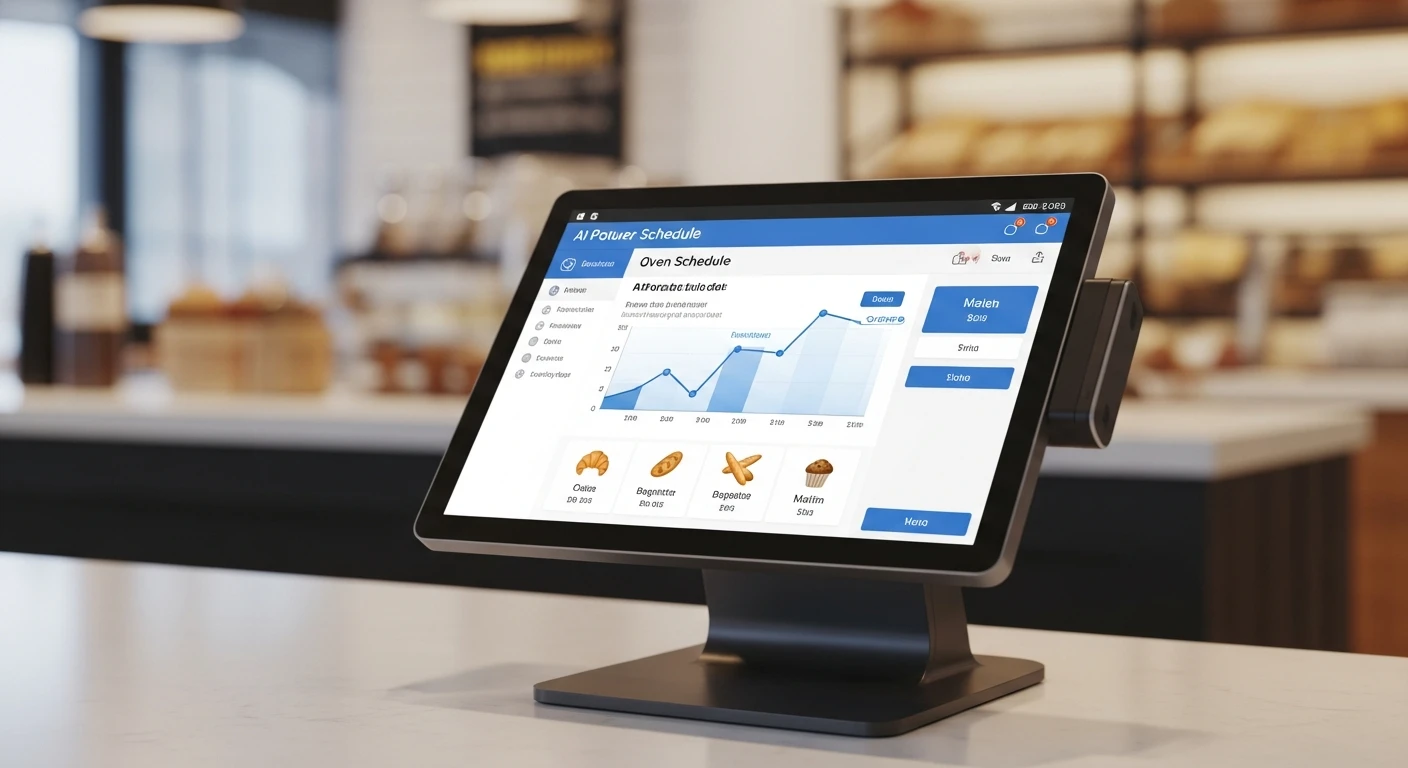
Each morning, the bakery owner receives a production forecast on her KwickOS dashboard: 76 croissants, 45 sourdough loaves, 30 cinnamon rolls, 24 baguettes. The system shows confidence intervals — "76 croissants with 90% probability of selling between 70 and 82." She adjusts if she has reason to (a private event she knows about that the system does not), but mostly she follows the numbers. Over three months, her waste drops from 14% to 5%. That is $1,800 per month in saved ingredients for a bakery doing $40,000 in monthly revenue.
Oven Scheduling: The Hidden Bottleneck AI Eliminates
Every bakery has a finite number of ovens with finite capacity. A deck oven holds six sheet pans. A convection oven holds twelve. When you are producing 15 different products with different bake temperatures, different bake times, and different loading sequences, oven scheduling becomes a combinatorial problem that most bakers solve by intuition and habit.
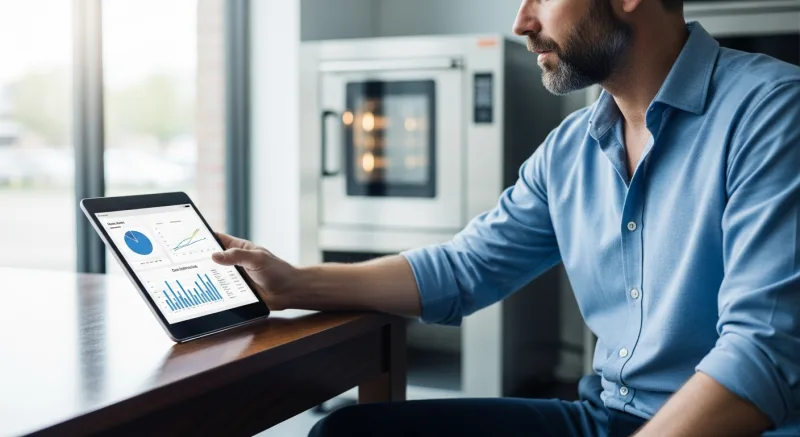
KwickOS AI generates oven schedules that sequence products by temperature compatibility and timing efficiency. Croissants at 400°F for 18 minutes, followed by danish at 375°F for 22 minutes, followed by cookies at 350°F for 12 minutes — the descending temperature sequence eliminates preheat waste between batches. The system knows that your sourdough needs steam injection during the first 10 minutes and schedules it when the deck oven is not occupied by items that suffer from humidity.
Baked Cravings, a KwickOS customer operating a self-serve kiosk at Lego Land, uses this kind of automated production logic to maintain fresh inventory across a 24-hour retail operation. When your bakery runs on a kiosk or self-ordering model, knowing exactly what to bake and when to bake it is the difference between a case full of stale pastries and one that looks freshly stocked at every hour.
Gift Cards and Loyalty Programs That AI Makes Smarter
Bakeries have historically underutilized gift cards and loyalty programs because the average transaction is small — $6 for a coffee and pastry — and the perceived ROI on a punch card seems minimal. AI changes the economics entirely.
KwickOS tracks individual customer behavior and identifies patterns that humans cannot see. The system notices that a customer who buys a loaf of sourdough every Saturday has not visited in two weeks. It triggers an automated loyalty reward — a $3 credit toward their next purchase — delivered via text or email. The cost of the $3 credit is trivial compared to the lifetime value of a weekly sourdough customer who spends $520 annually.
The AI also optimizes gift card promotions by identifying peak gift-giving periods specific to your customer base. For a bakery near an office park, the system notices a surge in gift card purchases during the first week of December (corporate gifting) and the week before Administrative Professionals Day. It recommends launching a "buy $25, get $5 bonus" promotion during those windows, timed to when your customers are already primed to buy.
Membership programs take this further. KwickOS supports tiered memberships — a $15/month "bread club" that guarantees a reserved loaf every Saturday, or a $25/month pastry subscription with rotating selections. The AI monitors member retention and flags members whose visit frequency is declining, triggering personalized re-engagement offers before they cancel.
KwickPhone: AI Phone Ordering for Bakeries That Cannot Afford to Miss a Call
Bakeries receive a disproportionate number of phone orders compared to other food service categories. Birthday cake orders, catering requests, wholesale inquiries, special dietary accommodations — these are complex orders that customers prefer to discuss by phone rather than navigate through an online form.
The problem is that bakery staff are elbow-deep in dough at 5 AM when a customer calls to order a custom cake for Saturday. KwickPhone, the AI-powered phone ordering system in KwickOS, handles incoming calls with natural language understanding. It can take a cake order ("I need a half-sheet chocolate cake with cream cheese frosting, nut-free, for 30 people, picked up Saturday at 2 PM"), confirm details, process payment, and route the order to the bakery's production queue — all without a human picking up the phone.
For bakeries that miss 15-20 calls per week during peak production hours, KwickPhone recovers revenue that was silently walking out the door. A custom cake order averages $45-80. Missing five of those per week is $12,000-$20,000 in annual lost revenue that the bakery owner never sees because the customer simply calls the next bakery in their search results.
Smart Inventory: From Flour Bags to Finished Pastries
Bakery inventory management operates on two levels that most POS systems handle poorly. There is ingredient-level inventory (50-pound bags of flour, cases of butter, blocks of chocolate) and finished-product inventory (the croissants in the case, the loaves on the shelf). The relationship between these two levels is a recipe matrix — 80 croissants requires 12 pounds of butter, 8 pounds of flour, and 2 quarts of milk.
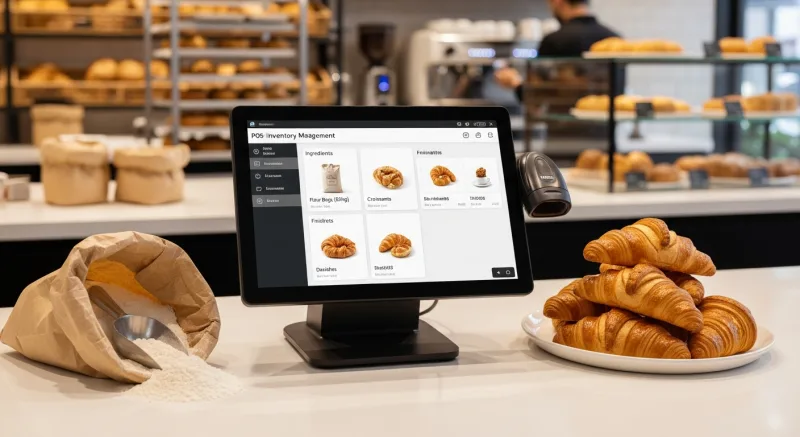
KwickOS AI manages both levels simultaneously. When the system forecasts 80 croissants for tomorrow, it automatically checks ingredient inventory. If butter stock is at 15 pounds — enough for tomorrow but not for Wednesday — the system generates a purchase order to your supplier. It learns your supplier's lead times and adjusts order timing accordingly. If your butter supplier needs 48-hour notice, the system orders two days before the projected stockout, not the morning you run out.
The AI also tracks ingredient price fluctuations and recommends bulk purchasing when prices dip below your trailing 90-day average. Butter prices fluctuated between $3.20 and $4.80 per pound in 2025. An AI that alerts you to buy two weeks of butter when the price hits $3.40 saves meaningful money over a year of production.
Customer Churn Prediction: Knowing Who You Are About to Lose
A bakery's most valuable asset is its regulars. The morning commuter who buys a coffee and muffin five days a week represents $2,600 in annual revenue. Losing that customer to a new competitor or a change in routine is a significant hit — and it happens silently. Nobody calls to say they are switching bakeries.
KwickOS churn prediction identifies at-risk regulars before they leave. The system recognizes that a five-day-a-week customer has dropped to three days, then two. It cross-references this decline with external factors (did they change jobs? Did a competing bakery open nearby?) and generates an alert. The bakery owner can then act — a personalized text with a free pastry offer, or a loyalty bonus that rewards their next five visits.
The mathematics of churn prevention are stark. Acquiring a new regular customer costs 5-7 times more than retaining an existing one. For a bakery with 200 regulars spending an average of $1,500 annually, reducing churn by 10% (keeping 20 customers who would have left) preserves $30,000 in revenue. The AI that enables this costs a fraction of what it saves.
Labor Optimization: Staffing a Bakery That Peaks at Dawn
Bakery labor patterns are unlike any other food service category. Peak production is 3 AM to 7 AM. Peak sales are 7 AM to 11 AM. By 2 PM, foot traffic drops 70%. This creates a staffing challenge: you need your most skilled (and expensive) bakers during production hours and your most personable staff during sales hours, with minimal overlap to control labor costs.
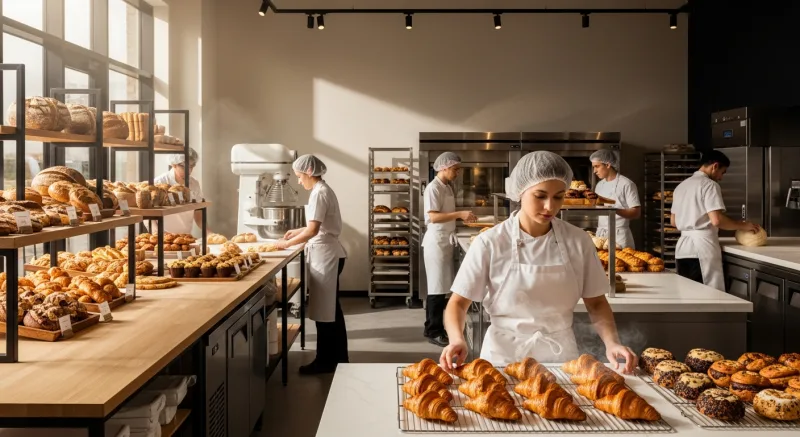
KwickOS labor optimization analyzes historical traffic patterns and forecasted demand to generate shift schedules that match staffing to need. The system accounts for bake times, production sequences, and anticipated customer volume to determine exactly when each position needs coverage. It might recommend a 3 AM start for two bakers, a 6 AM start for the front counter, and a 7 AM start for the second counter position — rather than the blanket 5 AM start that wastes two hours of counter labor.
The system also tracks individual employee productivity — which baker produces croissants fastest with the lowest defect rate, which counter staff generates the highest average transaction through upselling. Over time, the AI recommends shift assignments that pair your best production baker with your highest-demand mornings and your strongest upseller with weekend brunch crowds.
Menu Pricing Suggestions: What AI Sees That You Cannot
Most bakeries price by formula: ingredient cost times three, or ingredient cost times four for specialty items. This works as a starting point but ignores demand elasticity entirely. Your sourdough might sell the same volume at $7 as it does at $8, meaning you are leaving $1 per loaf on the table. Your chocolate chip cookies might sell 30% fewer units at $3.50 than at $2.75, meaning the price increase actually reduces total revenue.
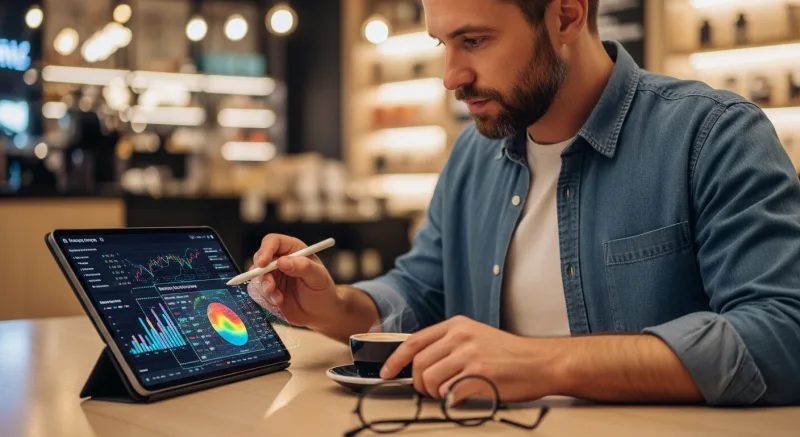
KwickOS AI tests pricing sensitivity by analyzing sales velocity at different price points. If you raised your latte price from $5.50 to $5.75 last month and volume did not change, the system notes inelastic demand and suggests the current price has room. If your scone price increase from $3.50 to $4.00 caused a 25% volume drop, the system recommends reverting or finding a midpoint.
The system also identifies profitable bundling opportunities. It notices that customers who buy a croissant almost always buy a coffee, but the reverse is not true. A "croissant + coffee" bundle at $7.50 (saving $0.75 versus individual pricing) converts coffee-only customers into croissant buyers, increasing pastry revenue without discounting to existing croissant buyers.
Why Toast and Square Cannot Match This for Bakeries
Toast was built for full-service restaurants. Its AI features — to the extent they exist — focus on table management, tip optimization, and menu engineering for dinner service. Toast does not understand production lead times, oven scheduling, or ingredient-level inventory that maps to finished products through recipes. It has no concept of a 4 AM production forecast.
Square is a payment processor with a POS interface attached. It tracks what you sold but cannot tell you what to make tomorrow. Square's inventory is a count of finished items. It does not understand that your croissant count is a function of butter inventory, lamination time, proof time, and oven availability.
Neither platform offers AI phone ordering for custom cake orders. Neither predicts customer churn for a bakery's unique regular-customer profile. Neither generates oven schedules based on temperature sequencing and production forecasts.
KwickOS was built as a complete operating system, not a payment terminal with extra features. For bakeries, that distinction means the difference between technology that records your day and technology that plans your day.
The Bakery AI Transition: What to Expect
Implementing AI in a bakery is not a switch you flip. KwickOS begins collecting data from day one, and useful predictions emerge within 60-90 days of consistent operation. During the first month, the system is learning your patterns. By month two, it begins generating forecasts that you compare against your own intuition. By month three, most bakery owners report that the AI's forecasts are more accurate than their own estimates 70-80% of the time.
The system gets smarter continuously. It incorporates new data daily, adjusts for trends (your neighborhood's growing interest in gluten-free options), and adapts to your bakery's evolution. When you add a new product, the AI uses sales data from similar items at comparable bakeries to generate initial forecasts, then refines based on your actual performance.
Installation takes 1-3 hours. Training takes 1-2 hours. Within a week, your staff is operating KwickOS as naturally as they operate your mixer. The AI layer works behind the scenes — your bakers see production sheets, not algorithms.
Bakery owners ready to stop guessing: Call (888) 355-6996 or visit KwickOS.com for a free demo tailored to bakery operations.
AI + Loyalty: Smarter Customer Retention
KwickOS combines AI insights with built-in loyalty tools to do something no other POS can: predict which customers are about to stop coming in and automatically re-engage them.
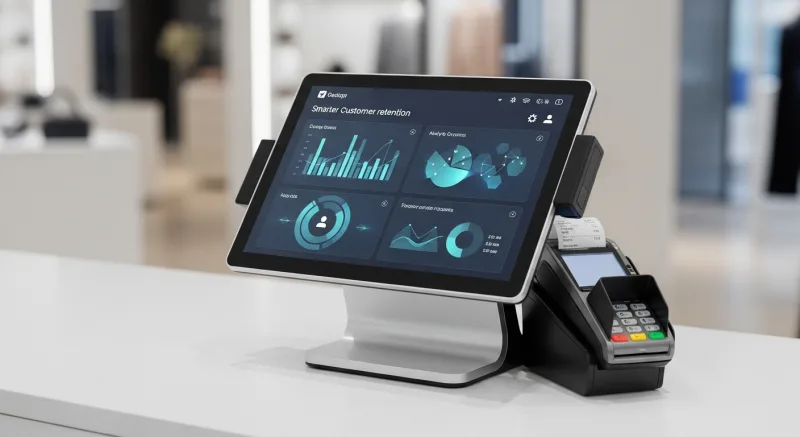
The gift card and loyalty system is not just a punch card — it is connected to AI-powered analytics that identify spending patterns, predict churn risk, and suggest targeted promotions. A customer who used to visit weekly but has not been in for 3 weeks? The system flags them and can trigger an automatic points bonus or e-gift card offer via SMS.
- Smart gift cards — AI suggests optimal gift card denominations based on your average ticket size
- Predictive loyalty — identifies at-risk customers before they leave, triggers re-engagement
- Points optimization — automatically adjusts earn rates during slow periods to drive traffic
- Membership insights — shows which VIP tiers generate the most lifetime value
All included. No add-on fees. Toast charges $75/month for basic loyalty without any AI component.

Founder & CIO of KwickOS · 30 Years IT · 20 Years Restaurant Industry
Tom built KwickOS after decades running restaurants and IT companies. Today KwickOS serves 5,000+ businesses across 50 states.