How Chicago Restaurants Are Using AI to Survive $15.80 Minimum Wage
Updated March 2026 · 12 min read
Chicago's minimum wage hit $15.80 in 2024, with annual increases indexed to CPI inflation pushing it toward $17 by 2027. For the city's 16,000+ restaurants, each dollar increase in minimum wage represents approximately $2,080 per full-time employee per year in additional labor costs. A restaurant with 15 hourly employees absorbed $31,200 in additional annual payroll between 2022 and 2024 alone. That money came from somewhere — thinner margins, higher menu prices, fewer staff, or some combination that slowly erodes the business.
The restaurants that are not just surviving but growing in Chicago's high-labor-cost environment share a common strategy: they are using artificial intelligence to extract maximum productivity from every labor dollar, every ingredient dollar, and every square foot of their operation. Not by working harder, but by making decisions that are measurably better than the decisions humans make unaided.
AI does not reduce Chicago's minimum wage. It makes each minimum-wage hour generate more revenue, produce less waste, and serve more customers. In a city where labor represents 33-38% of restaurant revenue — compared to the national average of 28-32% — that optimization is the difference between profitability and closure.
Labor Intelligence in a $15.80 Market
When labor costs $15.80 per hour before taxes, benefits, and overtime, every unproductive hour costs more than it did at $12. The Tuesday afternoon shift that used to waste $36 in idle labor now wastes $47.40. Multiply by 52 weeks and you have $2,465 in annual waste from a single overstaffed shift on a single day. Across an entire weekly schedule with multiple overstaffed periods, the waste reaches $15,000-25,000 annually.
KwickOS AI generates labor schedules that match staffing to forecasted demand in 15-minute increments. The system knows that Tuesday lunch in your Wicker Park location peaks between 12:15 and 1:30, but your Loop location peaks between 11:30 and 12:45 (earlier office lunch breaks). Each location gets a custom schedule optimized to its own demand curve, not a template applied across all stores.
The system tracks revenue per labor hour (RPLH) for every shift and alerts managers when the number drops below target. An RPLH target of $45 means every labor hour should generate $45 in revenue. When Tuesday afternoon's RPLH drops to $28, the data justifies sending one person home early — a decision that saves $47 in labor while losing zero revenue because the demand is not there.
KwickOS fingerprint authentication eliminates the buddy-punching problem that inflates payroll by 2-5% in restaurants without biometric controls. In Chicago, where even a 2% payroll inflation on a $400,000 annual labor budget means $8,000 in phantom costs, fingerprint time clocking pays for itself within months.
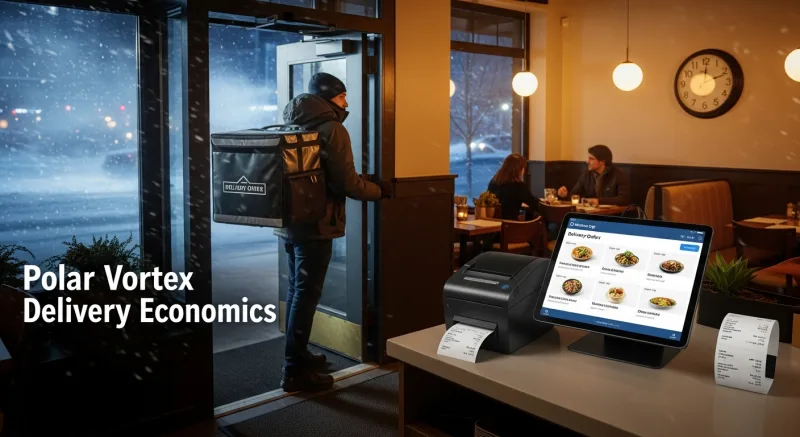
Polar Vortex Delivery Economics
Chicago's winters create a delivery demand pattern unique among American cities. When the wind chill drops below zero — which happens for an average of 25 days per winter — delivery orders surge 40-60% while dine-in traffic plummets. A restaurant that processes 30 deliveries on a normal winter evening might handle 50 on a sub-zero night. The economics of each delivery determine whether that surge is profitable or destructive.
Restaurants using DoorDash or Grubhub pay 20-30% commission on every order regardless of weather. On a $30 delivery during a polar vortex evening, DoorDash takes $6-9, leaving the restaurant with $21-24 before food costs. Factor in the 35% food cost and the restaurant nets $1.50-4.50 per delivery — barely worth the kitchen ticket.
KwickOS with KwickDriver charges a flat $2 per delivery plus $6.99 per 5 miles. The same $30 delivery costs $8.99 in delivery fees, but zero commission on the food. The restaurant keeps the full food revenue, netting $10-12 per delivery after food costs. Over a polar vortex winter with 25 high-delivery nights averaging 50 deliveries each, the difference is $10,625-18,750 in preserved margin.
The AI component predicts delivery volume based on weather forecasts and triggers staffing adjustments 48 hours in advance. When the forecast shows a polar vortex arriving Wednesday, the system recommends adding a kitchen position and two delivery drivers for Wednesday through Friday evenings. This advance planning prevents the 7 PM scramble of calling off-duty staff when orders start flooding in.
Multilingual AI for Chicago's Most Diverse Kitchens
Chicago's restaurant workforce operates in at least a dozen primary languages. Chinatown kitchens speak Mandarin and Cantonese. Pilsen and Little Village kitchens run on Spanish. Albany Park might have Urdu, Korean, and Arabic speakers on the same line. Devon Avenue adds Hindi and Gujarati. The front of house serves customers in English while the back of house communicates in whatever language gets food out fastest.
KwickOS supports English, Chinese, and Spanish natively, with each terminal and KDS station independently configurable. The AI extends this multilingual capability to KwickPhone, which processes phone orders in English, Mandarin, and Spanish. A Chinatown restaurant receives a phone order in Mandarin: "Wo yao liang fen gongbao jiding, yi fen chao fan" — the system processes the order and sends it to the kitchen in Chinese characters, eliminating the transliteration errors that occur when English-language POS systems force Chinese-speaking kitchens to read romanized item names.
For multi-concept restaurants in diverse neighborhoods, the language flexibility is operational, not cosmetic. A server at the register operates in English. The wok station KDS displays in Chinese. The prep station reads Spanish. Same data, same orders, three languages simultaneously. This is not a feature that Toast or Square offers at any price point.
Predictive Prep for Chicago's Seasonal Swings
Chicago's restaurant demand swings more dramatically between seasons than almost any other major U.S. market. Summer patio season can increase revenue 30-40% with outdoor seating. Winter can suppress dine-in traffic by the same margin while spiking delivery. The transition months — April and October — are unpredictable: one 70-degree April day brings patio traffic, and the next day's 38-degree rain sends everyone back inside.
KwickOS AI models these seasonal transitions at the item level. The system detects that your summer menu items (salads, cold appetizers, light entrees) spike 45% during the first warm week and recommends increasing prep quantities 48 hours before the forecast warm spell. It identifies that your hearty winter items (soups, stews, braised dishes) sustain demand through early April despite the calendar suggesting spring, and delays the menu transition recommendation until the data shows a genuine shift in ordering patterns.
For patio operations specifically, the AI forecasts patio versus indoor demand separately. A restaurant with 30 indoor seats and 20 patio seats needs to know not just "how many covers tonight" but "how many want to sit outside." The system learns that 8 PM June customers prefer outdoor seating at 70% while 6 PM October customers prefer indoor at 85%, enabling more accurate server section assignments and kitchen timing.
Gift Cards and Loyalty for Chicago's Neighborhood Economy
Chicago's neighborhood identity creates a loyalty dynamic unlike any other city. A Lincoln Park resident does not just eat at a restaurant — they eat at "their spot." They bring friends. They recommend it in the neighborhood Facebook group. They send their visiting parents. This word-of-mouth economy means that one loyal customer in a Chicago neighborhood can generate 5-10 referral visits per year on top of their own patronage.
KwickOS AI identifies these high-influence customers through their spending patterns and referral indicators (group visits, gift card purchases for others, multiple orders in a single week suggesting they are hosting). The system assigns them to a VIP loyalty tier with recognition-based rewards rather than discount-based rewards: first access to new menu items, chef's table invitations, birthday acknowledgments with a complimentary dessert.
For Chicago's strong corporate dining market, the AI identifies corporate entertainment patterns: the sales manager who brings clients quarterly, the startup founder who hosts team dinners monthly, the law firm partner who books private rooms for case celebrations. These corporate hosts receive invoicing capabilities, receipt customization for expense reports, and priority reservation access. A corporate host worth $2,400 annually who switches to a competitor because your POS could not generate a proper receipt is a preventable loss.
Gift card programs in Chicago benefit from the city's strong gifting culture. KwickOS triggers promotions before Chicago-specific gift-giving moments: Blackhawks and Bears game days (corporate entertaining), neighborhood holiday strolls (December), and Chicago Restaurant Week (January-February, when gift cards drive traffic during the slowest month). The AI identifies that gift cards purchased during Restaurant Week are redeemed at 92% rates because recipients are already restaurant-primed, versus 78% for holiday gift cards.
Health Inspection AI: Documentation That Saves Your Rating
Chicago's Department of Public Health inspections are published online, searchable by anyone, and flag directly on Google Maps and Yelp. A "conditional pass" or "fail" is visible to every potential customer who searches for your restaurant. The reputational damage from a failed inspection exceeds the fine by orders of magnitude.
KwickOS integrates food safety documentation into kitchen workflows. Temperature checks, FIFO rotation logs, equipment sanitization records, and holding-time alerts are embedded in the KDS workflow rather than existing as separate paper logs that get ignored during a rush. The system prompts: "Steam table check due. Log holding temperature for chicken." The response is recorded with a timestamp, creating an auditable digital trail that satisfies inspector documentation requirements.
The AI monitors compliance patterns and identifies risks before an inspector does. A pattern of late temperature checks during the Friday dinner rush suggests that staff are too busy to comply consistently — the system recommends redistributing the check schedule or adding a dedicated food safety monitor during high-volume periods. This proactive approach prevents the inspection failure rather than documenting the aftermath.
Processing Cost Optimization for High-Volume Chicago Restaurants
A mid-volume Chicago restaurant processing $80,000 monthly in card transactions pays $2,512 monthly at Toast's 2.99% + $0.15 rate (assuming $25 average ticket with 3,200 transactions). The same volume through an independent processor at 2.2% + $0.08 costs $2,016 monthly. Annual savings: $5,952.
For higher-volume operations — a River North steakhouse processing $200,000 monthly — the gap widens dramatically. Toast: $6,470/month. Independent processor at 1.9% + $0.07: $4,360/month. Annual savings: $25,320. KwickOS's processor-agnostic architecture lets both restaurants negotiate independently, and the AI provides transaction analytics that identify the most cost-effective processor for their specific volume and transaction-size profile.
Offline Resilience for Chicago's Infrastructure Challenges
Chicago's internet infrastructure is generally reliable in commercial districts, but the combination of century-old buildings, winter storms that damage infrastructure, and occasional Comcast outages creates real risk for cloud-dependent POS systems. A Friday night internet outage at a restaurant running Toast means degraded or non-functional operations during the highest-revenue service of the week.
KwickOS's hybrid local+cloud architecture processes every transaction locally with 1-millisecond response times. Internet connectivity handles cloud sync, online ordering integration, and remote management — functions that can pause during an outage without affecting in-restaurant operations. When connectivity returns, everything syncs automatically. The kitchen display keeps working. The registers keep processing. The fingerprint authentication keeps verifying. The business keeps running.
For Chicago restaurants in older neighborhoods — Bridgeport, Back of the Yards, parts of the South Side — where internet reliability is inconsistent, this is not a nice-to-have feature. It is the foundation that makes everything else possible.
Why Chicago Restaurants Are Leaving Toast and Square for AI-Powered Systems
Toast dominated the Chicago restaurant technology market through aggressive sales tactics: free hardware bundled with locked-in processing at 2.99%. Chicago restaurant owners discovered the real cost after signing: $6,000-25,000 annually in excess processing fees, cloud-dependent architecture that fails during winter storms, and an interface built for generic restaurants that does not understand Chinatown's multilingual needs or a deep-dish kitchen's 40-minute timing challenges.
Square gained traction among Chicago's smaller cafes and quick-service restaurants through simplicity. But simplicity becomes a limitation when your business needs labor optimization in a $15.80 minimum wage market, delivery management during polar vortex surges, or predictive inventory that accounts for Chicago's dramatic seasonal swings.
KwickOS offers what neither competitor can: AI intelligence calibrated to local operating conditions, multilingual operations for Chicago's diverse workforce, offline resilience for the city's infrastructure challenges, and processor freedom that saves real money at Chicago's transaction volumes.
Chicago restaurant owners ready for AI-powered operations: Call (888) 355-6996 or visit KwickOS.com for a demo tailored to Chicago's unique challenges.
AI + Loyalty: Smarter Customer Retention
KwickOS combines AI insights with built-in loyalty tools to do something no other POS can: predict which customers are about to stop coming in and automatically re-engage them.
The gift card and loyalty system is not just a punch card — it is connected to AI-powered analytics that identify spending patterns, predict churn risk, and suggest targeted promotions. A customer who used to visit weekly but has not been in for 3 weeks? The system flags them and can trigger an automatic points bonus or e-gift card offer via SMS.
- Smart gift cards — AI suggests optimal gift card denominations based on your average ticket size
- Predictive loyalty — identifies at-risk customers before they leave, triggers re-engagement
- Points optimization — automatically adjusts earn rates during slow periods to drive traffic
- Membership insights — shows which VIP tiers generate the most lifetime value
All included. No add-on fees. Toast charges $75/month for basic loyalty without any AI component.

Founder & CIO of KwickOS · 30 Years IT · 20 Years Restaurant Industry
Tom built KwickOS after decades running restaurants and IT companies. Today KwickOS serves 5,000+ businesses across 50 states.