
The best 17 Restaurant Tax Deductions Most Owners Miss handles everything from checkout to closing — without extra apps or workarounds. You survived another year in the restaurant business. The 14-hour days, the staffing headaches, the razor-thin margins. And now it is tax season.
You hand your books to your accountant. They file your return. You write a check to the IRS.
But here is the part nobody tells you: the average restaurant owner overpays their taxes by $8,000 to $15,000 every single year — not because they are bad at math, but because they miss deductions that are perfectly legal, perfectly available, and hiding in plain sight.
Here's the thing: your accountant handles dozens of businesses across multiple industries. They know the standard deductions. But restaurant-specific deductions? The ones buried in equipment depreciation schedules, meal benefit rules, and Section 179 elections? Those require someone who understands the daily reality of running a restaurant.
This guide covers 17 deductions that restaurant owners consistently miss. We are going to put actual dollar amounts on each one, because "potential savings" means nothing without numbers.
Let's start with the biggest one most owners get wrong.
1. Section 179 Equipment Deduction — Up to $1,160,000
When you buy a commercial oven, a walk-in cooler, or a POS system, you might assume you have to depreciate it over 5 to 7 years. That means a $15,000 oven only gives you a $2,143 deduction each year.
But it gets worse: by the time you have fully depreciated that oven, you have probably already replaced it.
Section 179 lets you deduct the entire cost in the year you bought it. That $15,000 oven? Full deduction, year one. The 2026 limit is $1,160,000 — more than enough for any restaurant equipment purchase.
What qualifies:
- Kitchen equipment (ovens, fryers, grills, refrigeration)
- POS systems and terminals
- Kitchen display systems (KDS)
- Self-ordering kiosks
- Digital signage
- Furniture and fixtures
- Security systems and cameras
- Delivery vehicles
A restaurant that spent $40,000 on new kitchen equipment and a modern POS system could deduct the entire amount in year one instead of spreading it across seven years. At a 25% effective tax rate, that is $10,000 back in your pocket this year instead of $1,428 per year over seven years.
And that's not all: Section 179 also applies to used equipment, not just new purchases. Bought a refurbished walk-in from a restaurant that closed? Deductible.
2. Bonus Depreciation — The Section 179 Backup
If your equipment purchases exceed the Section 179 limit (unlikely for most single-location restaurants, but common for multi-location groups), bonus depreciation picks up where Section 179 leaves off.
In 2026, bonus depreciation allows you to deduct 20% of qualifying assets in the first year (it has been phasing down from 100% in 2022). While less generous than it was during the pandemic years, 20% first-year depreciation on top of regular depreciation still accelerates your deductions significantly.
Typical savings: $500–$3,000 for equipment purchases above the Section 179 election.
3. Employee Meals — 50% Deductible
Every shift meal you provide to your staff is 50% deductible. This includes pre-shift family meals, meals consumed during breaks, and any food provided for the employer's convenience (keeping staff on-site during busy periods).
Here's the thing: most restaurant owners provide shift meals but never track the cost separately. If you are feeding 10 employees per shift at a food cost of $4 per meal, 300 days per year, that is $12,000 in employee meal costs — and a $6,000 deduction you are leaving on the table.
Your POS system should be tracking comp meals separately. If it is not, you are losing this deduction. Systems like KwickOS track comps automatically and export them for your accountant at year-end.
4. Business Meals with Clients and Vendors — 50% Deductible
When you take a food vendor to dinner to negotiate prices, that is deductible. When you meet a potential catering client over lunch, deductible. When you host a local business networking event at your restaurant, deductible.
The rules: the meal must have a clear business purpose, you or an employee must be present, and the expense cannot be "lavish or extravagant." Keep receipts and note the business purpose, attendees, and topics discussed.
Typical savings: $400–$1,200/year for owners who actively network with vendors and potential clients.
5. Vehicle Mileage — $0.70 Per Mile
Do you drive to the bank to make deposits? Visit suppliers? Drive between multiple locations? Pick up emergency supplies from the store when a vendor delivery falls short?
Every one of those miles is deductible at $0.70 per mile for 2026.
But it gets worse: most restaurant owners drive 6,000 to 12,000 business miles per year and deduct zero of them because they do not keep a mileage log.
The fix is simple: use a mileage tracking app on your phone. Record the date, destination, business purpose, and miles. An owner driving 8,000 business miles per year would deduct $5,600.
Multi-location operators drive even more. If you are managing 4 locations like Diva Nail Beauty does across their stores, your annual mileage deduction could easily exceed $8,000.
6. Home Office Deduction
If you do bookkeeping, payroll, scheduling, or vendor negotiations from a dedicated space in your home, you qualify for the home office deduction. The simplified method gives you $5 per square foot, up to 300 square feet — that is a $1,500 deduction with zero receipts required.
The key word is "dedicated." The space must be used regularly and exclusively for business. A corner of your kitchen table does not count. A spare bedroom with a desk where you do scheduling and review your restaurant analytics every night? That counts.
7. Software Subscriptions and Technology
Every software tool you use to run your restaurant is deductible as a business expense:
- POS software subscriptions
- Accounting software (QuickBooks, Xero)
- Scheduling software
- Online ordering platforms
- Reservation and waitlist systems
- Marketing and email tools
- Payroll services
- Inventory management software
An all-in-one platform like KwickOS — which bundles POS, KDS, online ordering, digital signage, kiosk, CRM, and delivery into one system — can actually simplify this deduction because it is one subscription instead of eight separate line items.
Typical savings: $1,200–$4,800/year depending on your tech stack.
8. Repairs and Maintenance
Repairs are immediately deductible. Improvements are capitalized and depreciated. The difference matters — a lot.
Fixing a broken oven burner? Repair — deduct it now. Replacing the entire oven? Improvement — depreciate it (or use Section 179). Repainting the dining room the same color? Repair. Remodeling the dining room with new layout and finishes? Improvement.
The IRS safe harbor rule lets you deduct any individual repair or maintenance item under $2,500 immediately, regardless of whether it could be classified as an improvement. This means that plumbing fix, the HVAC service call, and the new door handle are all immediate deductions.
Typical savings: $2,000–$6,000/year for restaurants that properly classify repairs vs. improvements.
9. Credit Card Processing Fees
Every dollar you pay in credit card processing fees is fully deductible. For a restaurant processing $40,000/month in card transactions, that is $11,000 to $16,000/year in deductible processing costs.
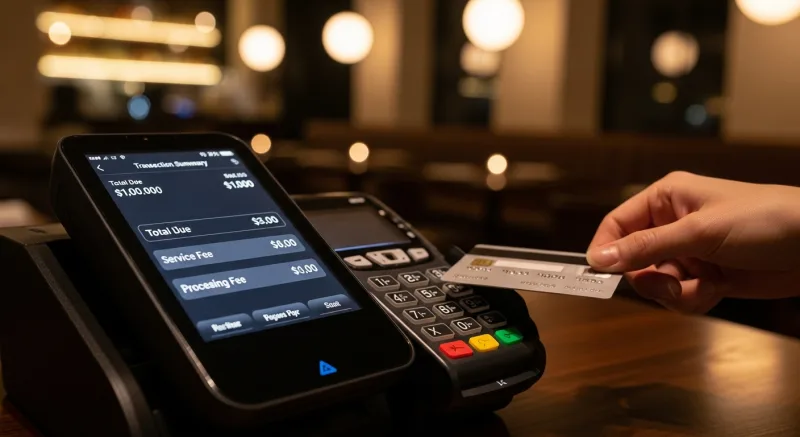
And that's not all: if you switch to a processor-agnostic POS and negotiate interchange-plus pricing, you reduce your processing costs by $3,000 to $5,000/year AND still deduct the full amount. You are saving money twice — once on the actual cost, and once on the tax deduction of the remaining cost.
10. Tip Credits (FICA Tip Credit)
This is the single most overlooked tax credit in the restaurant industry. As an employer, you pay the employer portion of FICA taxes (7.65%) on your employees' reported tip income. The FICA Tip Credit lets you claim a tax credit for the employer-share FICA taxes paid on tips that exceed the minimum wage.
For a restaurant with 15 tipped employees averaging $150/day in tips, this credit can be worth $15,000–$25,000 per year. It is a dollar-for-dollar tax credit, not just a deduction — meaning it directly reduces your tax bill.
Here's the thing: many accountants who do not specialize in restaurants either do not know about this credit or do not want to deal with the calculation. If your accountant has never mentioned the FICA Tip Credit, ask about it immediately.
11. Startup Costs
If you opened your restaurant within the last few years, you can deduct up to $5,000 in startup costs in your first year, with the remainder amortized over 15 years. Startup costs include market research, training employees before opening, travel to scout locations, and pre-opening advertising.
This deduction phases out if your total startup costs exceed $50,000, but most single-location restaurants fall within the threshold.
Typical first-year savings: $1,250–$5,000.
12. Insurance Premiums
All business insurance premiums are fully deductible:
- General liability insurance
- Property insurance
- Workers' compensation
- Liquor liability insurance
- Business interruption insurance
- Cyber liability insurance
- Umbrella policy
The average restaurant pays $5,000 to $12,000/year in insurance premiums. Every dollar is deductible. If you are not itemizing these on your return, you are overpaying.
13. Professional Services
Fees paid to accountants, attorneys, consultants, and other professionals for business purposes are fully deductible. This includes:
- Tax preparation fees
- Legal fees for lease review and negotiation
- HR consulting fees
- Menu consulting and food photography
- Marketing agency fees
- Business coaching
Typical savings: $800–$3,000/year.
14. Advertising and Marketing
All advertising and marketing expenses are fully deductible in the year they are incurred:

- Google Ads and social media advertising
- Print materials (menus, flyers, business cards)
- Website development and hosting
- Food photography sessions
- Local sponsorships and event marketing
- Loyalty program costs
- Email marketing platform fees
Restaurants that invest in marketing — especially digital marketing — often forget to track all the small expenses. A $50/month email tool, a $200 food photography session, $100/month in Google Ads — these add up to $4,200/year in deductions that slip through the cracks.
15. Uniforms and Laundry
Chef coats, aprons, branded t-shirts, non-slip shoes for kitchen staff — if the clothing is required for work and not suitable for everyday wear, the cost is deductible. The cost of laundering work uniforms is also deductible.
A restaurant buying uniforms for 20 employees at $150/person spends $3,000. Add $200/month for commercial laundry service, and you have a $5,400 annual deduction.
16. Delivery Platform Fees and Commissions
If you use DoorDash, UberEats, or Grubhub, the commissions they charge (typically 15–25% per order) are fully deductible as a cost of doing business. For a restaurant doing $8,000/month in delivery through third-party platforms at a 20% commission rate, that is $19,200/year in deductible fees.
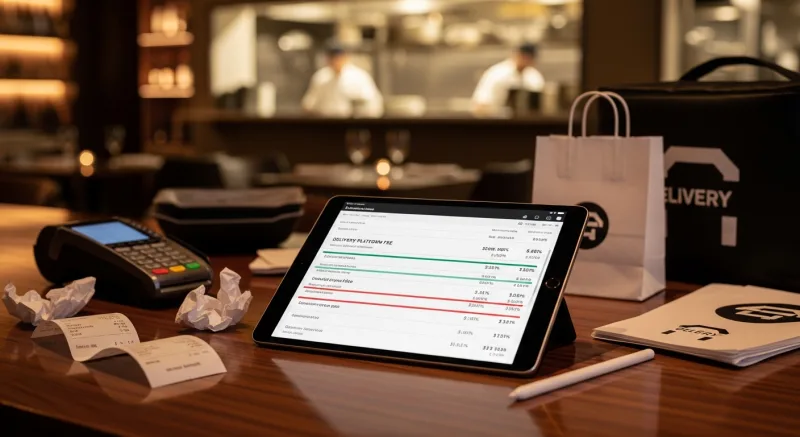
Of course, the smarter move is reducing those fees in the first place. Platforms like KwickDriver charge $2 flat + $6.99 per delivery instead of 15–25% commission — saving thousands while still generating a deductible expense.
17. Music Licensing and Entertainment
If you play music in your restaurant, you need licensing from ASCAP, BMI, or SESAC. Those licensing fees ($300–$1,500/year depending on venue size) are fully deductible. Streaming service subscriptions used for business (Spotify for Business, Rockbot, etc.) are also deductible.
If you host live music or entertainment, performer fees, sound equipment rental, and related costs are all deductible business expenses.
Typical savings: $300–$2,000/year.
Adding It All Up
Let's total the potential deductions for a typical single-location restaurant doing $1.2 million in annual revenue:
| Deduction | Estimated Annual Amount |
|---|---|
| Section 179 (equipment) | $5,000–$40,000 |
| Employee meals (50%) | $6,000 |
| Business meals | $800 |
| Vehicle mileage | $5,600 |
| Home office | $1,500 |
| Software/technology | $2,400 |
| Repairs and maintenance | $3,500 |
| FICA Tip Credit | $18,000 (credit) |
| Insurance premiums | $8,000 |
| Professional services | $1,500 |
| Advertising/marketing | $4,200 |
| Uniforms/laundry | $5,400 |
| Delivery commissions | $19,200 |
| Music licensing | $800 |
Even if you are already claiming half of these, the missed deductions alone could easily total $12,000 to $25,000. At a 25% effective tax rate, that is $3,000 to $6,250 in actual cash savings — every year.
For multi-location groups like T. Jin China Diner (15 stores) or Crafty Crab Seafood (19 stores), multiply those numbers accordingly. A 19-store operation missing just $5,000 in deductions per location is leaving $95,000 on the table.
How to Stop Missing Deductions
The reason restaurant owners miss deductions is not laziness — it is lack of tracking infrastructure. When your POS, accounting, and payroll systems do not talk to each other, expenses fall through the cracks.

Three things you can do right now:
- Use a POS system that tracks everything automatically. Comp meals, delivery fees, processing costs, employee hours — your POS should be generating the data your accountant needs without you manually pulling reports. KwickOS exports all of this in formats that integrate directly with QuickBooks and other accounting platforms.
- Keep a mileage log. This is the single easiest deduction to claim and the single most common one to miss. Download a free mileage app today. It takes 10 seconds per trip.
- Ask your accountant about the FICA Tip Credit. If they have never mentioned it, either they are not calculating it or they do not know about it. Either way, it is worth a conversation — or a new accountant.
The difference between a restaurant that survives and one that thrives is often not revenue — it is how much of that revenue you keep. Every deduction you miss is profit that disappears before it ever reaches your bank account.
Track Every Dollar Automatically
KwickOS tracks comps, labor, processing fees, and delivery costs in one system — so nothing falls through the cracks at tax time.
Get a Demo