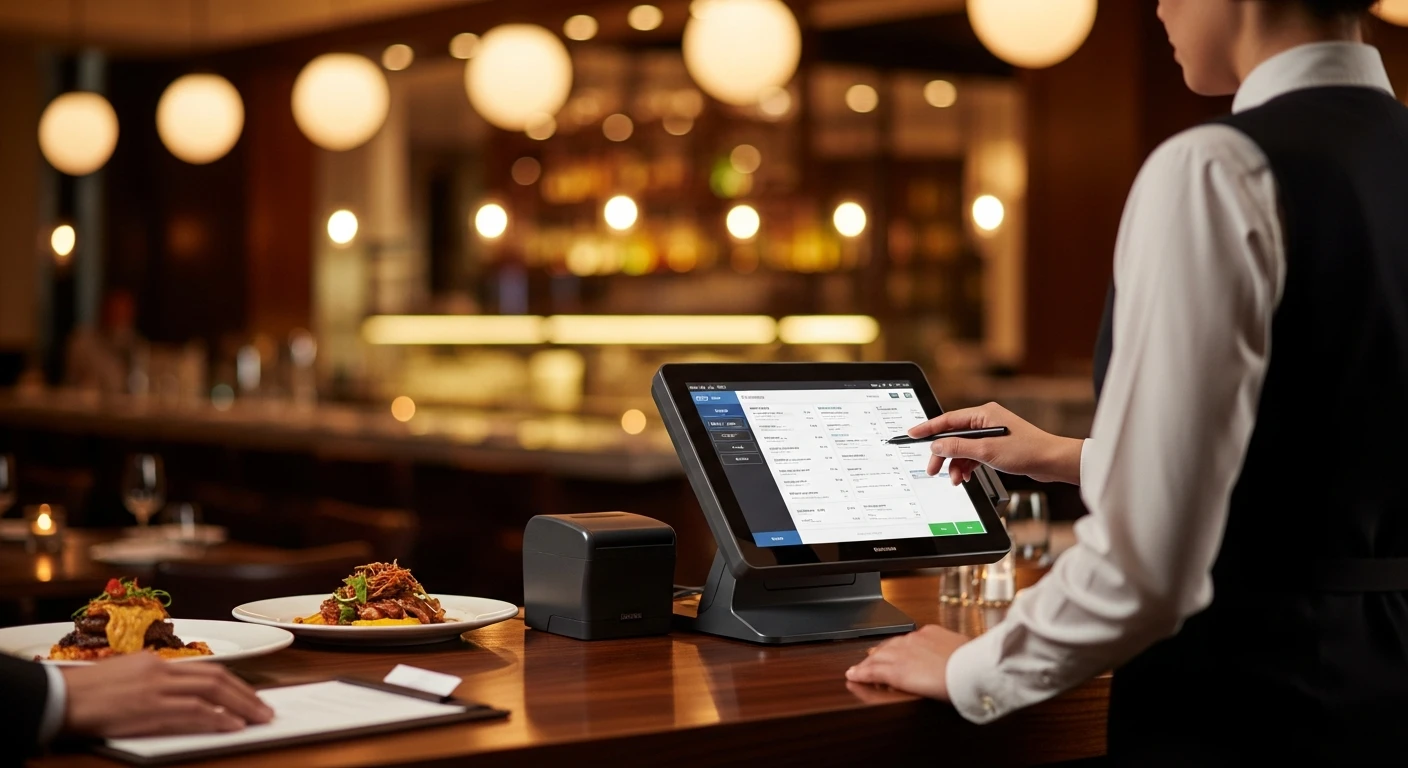
The typical Chicago restaurant pays $300-500/month for a fragmented technology stack: POS ($69-165/month), online ordering ($75-200/month), loyalty ($45-75/month), KDS ($30-50/month), scheduling ($30-80/month), and delivery commission (15-25% per order through DoorDash). That is $249-570/month before delivery commissions — which for a restaurant doing $6,000/month in delivery, add another $900-1,500. Total annual technology cost: $13,788-24,840. An operating system that includes all of these functions in a single platform costs dramatically less — and works dramatically better because the systems are integrated rather than connected.
The integration advantage matters most in Chicago's high-pressure restaurant environment. When a customer orders online during Friday dinner rush, the order must appear on the KDS instantly (not after a 5-second API delay), the inventory must update in real time (not batch-sync overnight), and the loyalty points must accrue automatically (not require a separate lookup). With 6 separate tools, each handoff is a potential failure point. With an operating system, there are no handoffs — it is all one system.
Why Chicago Restaurants Need an Operating System
Chicago's extreme seasonal swings — from 95-degree summers to subzero winters — create dramatic revenue fluctuations that loyalty programs help smooth. The city's 77 neighborhoods each have distinct culinary identities, from Polish sausage in Avondale to dim sum in Chinatown.
Chicago's Neighborhood Restaurant Dynamics
The city's key restaurant corridors — River North, Wicker Park, Logan Square, Chinatown, Pilsen, Lincoln Park, West Loop (Restaurant Row) — each have distinct competitive dynamics. River North skews toward higher-end dining where loyalty tiers and VIP treatment drive retention. Wicker Park has a higher density of casual and quick-service restaurants where speed and digital ordering are differentiators. An operating system serves both segments because the core functions (POS, KDS, loyalty, ordering, delivery) are needed everywhere — only the configuration differs.
Regulatory Environment
Chicago requires separate licenses for outdoor dining, BYOB establishments, and late-night food service. The 2026 minimum wage is $16.20/hour for businesses with 21+ employees, with a separate tipped minimum.
These regulations create cost pressures that make technology efficiency critical. Every dollar saved on fragmented software fees, every minute saved on manual processes, and every percentage point saved on payment processing goes directly to offsetting the regulatory cost burden.
What a Chicago Restaurant OS Includes
1. POS and Checkout
The foundation — connected to everything else. When a server enters an order, it fires to the KDS, updates inventory, earns loyalty points, and feeds the reporting dashboard simultaneously. No API delays, no sync failures, no manual reconciliation.
2. Kitchen Display System
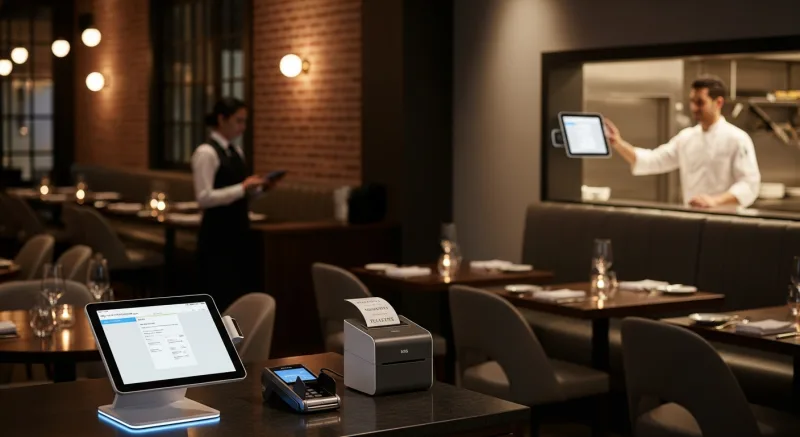
Multi-station routing for Chicago's diverse restaurant formats: hibachi stations (like Shogun Japanese Hibachi), seafood prep lines (like Crafty Crab), dim sum kitchens, pizza ovens, sushi bars, and standard hot/cold kitchen layouts. KwickOS's KDS is configurable for any kitchen layout and any station routing requirement.
3. Online Ordering
KwickMenu provides the ordering platform with 500K monthly users. Chicago restaurants benefit from being part of this existing traffic ecosystem rather than building their own ordering page from scratch. Orders flow directly to the KDS with zero re-entry.
4. Delivery at $2 Flat
KwickDriver at $2 flat + $6.99/5mi replaces DoorDash at 15-25% commission. For Chicago restaurants averaging 3-5 mile delivery radius, KwickDriver saves $800-1,500/month compared to DoorDash. The integrated dispatch means the driver gets the order the moment the kitchen marks it ready — no separate delivery tablet, no copy-paste of order details.
5. Loyalty and CRM
Built-in at $0 additional cost. Points, tiers, birthday rewards, gift cards, and customer profiles. See our detailed Chicago loyalty program guide for specific configuration recommendations.
6. Fingerprint Authentication
1:N fingerprint auth eliminates buddy punching ($4,800/year per restaurant), unauthorized voids, and cash drawer theft. In Chicago's competitive labor market, accountability tools reduce the internal shrinkage that silently erodes margins.
7. Digital Signage
KwickSign updates menu boards and promotional displays automatically from the POS database. When a dish sells out or a price changes, every screen updates instantly. For Chicago restaurants with high foot traffic and frequent menu changes, this eliminates the daily print-and-post cycle.
8. Hybrid Cloud Architecture
Chicago restaurants cannot afford downtime during peak service. KwickOS runs on hybrid local+cloud: all core functions operate at 1ms local latency, independent of internet connectivity. When the internet drops during Saturday dinner rush, the restaurant continues operating normally. Payments process, the KDS displays orders, loyalty points accrue, and everything syncs when connectivity returns.
Cost Comparison for Chicago Restaurants
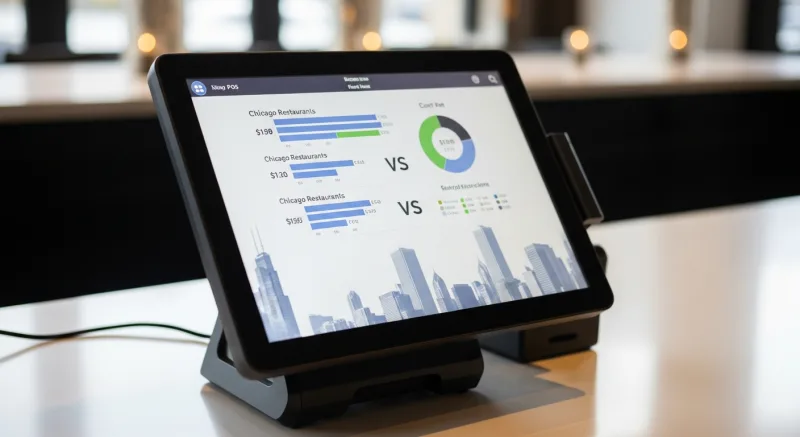
| System | Patchwork (per month) | KwickOS |
|---|---|---|
| POS | $69-165 | All included in one platform |
| Online Ordering | $75-200 | |
| Loyalty | $45-75 | |
| KDS | $30-50 | |
| Scheduling | $30-80 | |
| Delivery | 15-25% per order | |
| Total | $249-570/month + delivery % | One unified price + $2 flat delivery |
Add processor-agnostic payment processing (save $400-800/month on a $40,000/month volume) and the total annual savings from switching to KwickOS reach $10,000-25,000 for a typical Chicago restaurant.
KwickOS in Chicago: Real Deployments
KwickOS operates across 50 states with 5,000+ active businesses processing $2M+ in daily sales. Notable deployments include Crafty Crab Seafood (19 locations, 152 terminals with one-click menu sync), T. Jin China Diner (15 stores, 75 terminals with real-time remote monitoring), and Haidilao Hot Pot (600+ locations worldwide). These multi-location deployments demonstrate that the same OS that powers a single Chicago restaurant scales seamlessly to 5, 19, or 600+ locations.
Multi-Language Support
Chicago's diverse restaurant workforce benefits from KwickOS's native English, Chinese, and Spanish interface. Kitchen staff working in their preferred language see the KDS in that language. Front-of-house staff see English. The manager sees reports in whichever language they prefer. This is not a translation overlay — it is built into the OS.
Implementation in Chicago
KwickOS onboarding: 7-10 days from purchase to installation. Installation: 1-3 hours. Training: 1-2 hours. Shogun Japanese Hibachi reported operator proficiency in under 5 minutes.
Day 1-3: Installation, menu configuration, employee setup with fingerprint enrollment.
Day 4-7: Staff training, KDS station routing, and digital signage setup.
Day 8-10: Activate online ordering (KwickMenu), loyalty program, and delivery (KwickDriver).
By day 30: fully operational on a single platform, with all legacy tools decommissioned, and measurable cost savings visible in the first month's P&L.
Contact us at (888) 355-6996 or book a demo to see KwickOS in action for your Chicago restaurant.
Give Your Chicago Restaurant an Operating System
KwickOS includes POS, KDS, online ordering, delivery, loyalty, signage, and scheduling in one platform. Replace 6 tools with 1 and save $10,000-25,000/year.
Book Your Free Demo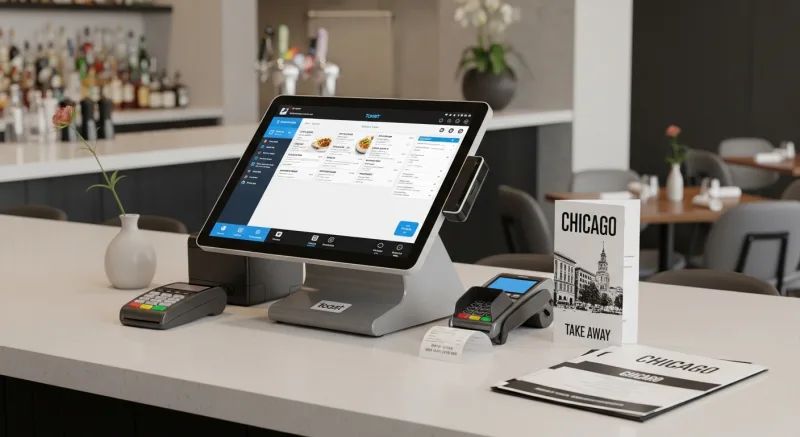
The OS Advantage: Gift Cards, Loyalty & Points Built Into the Core
When your POS is a full operating system, gift cards and loyalty are not bolted-on modules — they are woven into every transaction. A customer pays with a gift card, earns loyalty points, and gets asked about their membership status, all in one seamless checkout flow that takes your cashier zero extra steps.
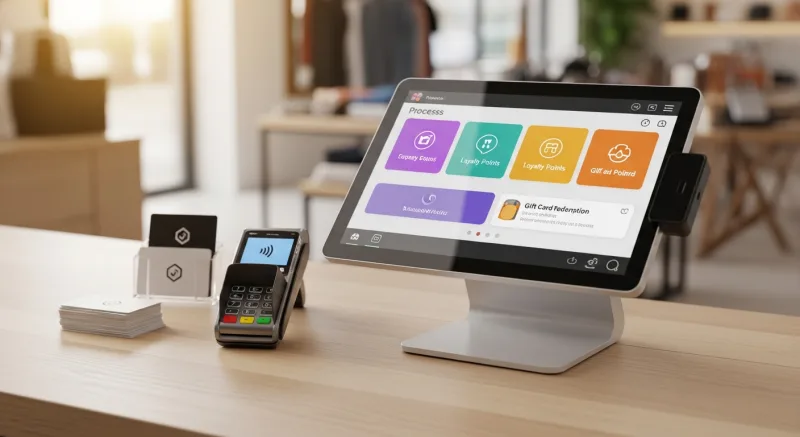
- Gift cards (physical + electronic) — issued, sold, tracked, and redeemed within the same interface as regular checkout
- Points system — points appear on every receipt, customers see their balance growing, redemption is one tap at payment
- Membership management — recurring billing, VIP pricing, member-only items, all controlled from the back office
- CRM connection — every gift card purchase, point earned, and membership interaction feeds into the customer profile for targeted marketing
This is what "operating system" means in practice. Not a POS with add-ons. A unified platform where every feature talks to every other feature. And none of it costs extra.