Beyond the Theme Parks: Why Orlando’s Real Restaurant Scene Needs Real POS Technology
Updated March 2026 · By Tom Jin
Orlando's competitive landscape demands Beyond the Theme Parks that delivers from day one. Orlando welcomed 75 million visitors in 2024. Seventy-five million. That is more tourists than the population of France, cycling through a single metropolitan area in a single year. The restaurant industry serving these visitors — alongside the 2.7 million permanent residents of metro Orlando — operates under conditions that are genuinely unique in American dining. The tourist economy creates a customer base that is overwhelmingly one-time: they visit, they eat, they leave, and they never return to your specific restaurant.
This one-visit reality shapes every technology decision an Orlando restaurant makes. Customer retention requires aggressive gift card and loyalty strategies because organic repeat visits are rare. Transaction volumes fluctuate wildly with school vacation schedules, convention calendars, and park ticket pricing. And the competition is not just other restaurants — it is the dining options inside Walt Disney World, Universal Studios, and SeaWorld, which collectively operate hundreds of food service locations.
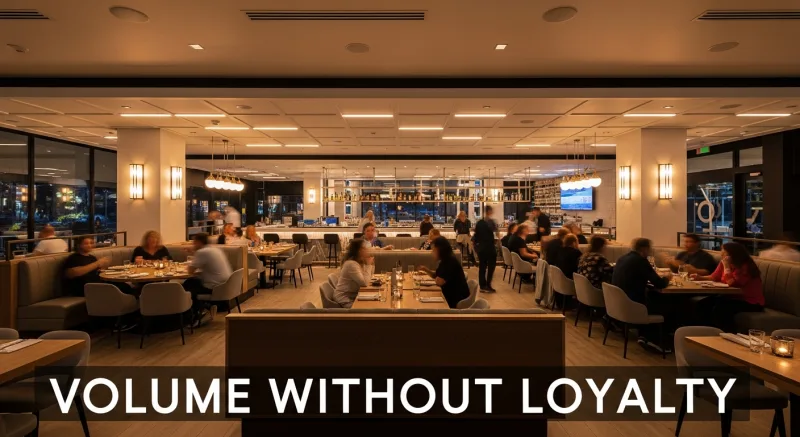
International Drive: Volume Without Loyalty
International Drive is Orlando’s restaurant ground zero — a 14-mile corridor of hotels, attractions, and restaurants serving an almost exclusively tourist clientele. The restaurants here process enormous volume: a well-positioned I-Drive restaurant might serve 400-600 covers on a peak day. But almost none of those customers are regulars. They are families on vacation who will eat at your restaurant exactly once.
For I-Drive restaurants, the POS must maximize revenue from each transaction because there is no next visit. KwickOS self-ordering kiosks increase average ticket size by 15-25% compared to server-taken orders because the visual menu with photos and upsell suggestions encourages add-ons that a rushed server does not have time to promote. A family of four at a kiosk adds an appetizer sampler and drink upgrades that the server-to-table interaction would not have surfaced. On 400 daily covers, a 20% ticket increase generates $2,000-$3,000 in additional daily revenue.
Gift card integration through KwickOS converts the one-time tourist into a future revenue commitment. A family that bought a $50 gift card at dinner sends their friends to the restaurant on their next Orlando trip. The gift card is the only repeatable marketing channel that works for a restaurant whose customer base lives in other states and countries.
Baked Cravings at LEGOLAND: The Self-Serve Revolution
Baked Cravings operates a self-serve kiosk at LEGOLAND Orlando using a PaxA35 terminal, demonstrating how KwickOS powers 24-hour retail and food service operations in theme park environments. The self-serve model eliminates staffing constraints in locations where foot traffic is enormous but unpredictable — a problem that every Orlando attraction-adjacent restaurant faces. A kiosk processes orders during the 3 PM surge and the 10 PM quiet with identical reliability and zero labor variance.
This model scales across Orlando’s attraction economy. Any restaurant near a major park can deploy self-ordering kiosks to handle the post-park dinner rush — the 5-7 PM window when exhausted families pour out of attractions and into the nearest food option. Kiosks process these families faster than server-assisted ordering, reducing wait times that cause walkouts and increasing throughput that captures revenue before families give up and order room service instead.
The Hurricane Window
Orlando sits in Central Florida’s hurricane corridor. While the city is 50 miles inland and less vulnerable to storm surge than coastal cities, the infrastructure disruption from hurricanes affects Orlando restaurants significantly. Hurricane Irma in 2017 closed theme parks for only the fourth time in Disney’s history, and the entire tourism economy paused for days. Power outages lasted a week in some Orlando neighborhoods.
KwickOS local processing keeps restaurants operational on generator power with zero internet dependency. In the days after a hurricane, when theme park tourists are stranded in hotels and local residents have no power at home, the restaurants that can operate become essential services. KwickOS ensures the POS is not the bottleneck that prevents operation during exactly the periods when demand is highest and alternatives are fewest.
The Mills 50 Vietnamese District
Orlando’s Mills 50 district along Colonial Drive and Mills Avenue has developed into one of the most significant Vietnamese restaurant corridors in the Southeast. Pho houses, banh mi shops, and Vietnamese coffee cafes serve both the local Vietnamese community and a growing fan base from across the metro area. These restaurants operate with kitchen staffs who work most efficiently in Vietnamese and customer-facing operations in English.
KwickOS’s visual KDS interface with icon-based modifiers communicates across the language gap. A pho order with modifications (rare beef, no cilantro, extra lime) displays on the KDS as a structured, scannable build using visual indicators alongside text. The cook processes the order through visual pattern recognition rather than reading English text, reducing errors and speeding production.
The Puerto Rican Community and Bilingual Operations
Orlando has one of the largest Puerto Rican communities on the mainland, concentrated in Kissimmee and throughout Osceola County. Puerto Rican restaurants, food trucks, and bakeries serve a community that operates bilingually. KwickOS Spanish-language support runs natively across terminals and KDS, allowing kitchen operations in Spanish while front-of-house serves in English. For a Kissimmee panaderia where the baker, the counter staff, and half the customers speak Spanish, this native language support eliminates the friction of operating in translation.
Convention Center Power: OCC and Beyond
The Orange County Convention Center is the second-largest in the United States, hosting over 200 events annually that bring millions of business travelers to Orlando. These visitors eat at local restaurants during multi-day conventions, creating predictable surges that savvy operators plan for. KwickOS analytics correlate sales data with convention schedules, enabling restaurants within the convention corridor to forecast staffing and inventory for each event.
Convention attendees purchase gift cards at higher rates than tourist families because they travel to Orlando repeatedly for annual industry events. A medical technology executive who attends the same convention every January becomes a loyal customer if the restaurant captures the relationship through a loyalty program. KwickOS loyalty enrollment during the convention visit creates a digital connection that generates a targeted offer before next year’s event.
Processing Costs at Orlando Volume
Orlando tourist-district restaurants operate at transaction volumes that amplify processing cost differences. An I-Drive restaurant processing $200,000 monthly at Toast’s 2.99% plus $0.15 pays $6,130 monthly — $73,560 annually. KwickOS with a negotiated processor at 2.1% plus $0.08 costs $4,280 monthly — $51,360 annually. Annual savings: $22,200 — enough to fund an entire seasonal marketing campaign targeting park visitors.
For neighborhood restaurants in Winter Park, Baldwin Park, and Thornton Park where volumes are lower but margins matter more, processor independence through KwickOS provides proportional savings that directly affect the owner’s livelihood. A Winter Park restaurant saving $500 monthly in processing — $6,000 annually — retains money that would otherwise subsidize a POS company’s revenue model.
KwickDriver and Orlando’s Hotel Delivery Market
Orlando’s 125,000+ hotel rooms create a massive food delivery market. Families exhausted from theme parks, convention attendees working late in their rooms, and business travelers who do not want to navigate I-Drive traffic all order delivery to their hotels. KwickDriver at $2 per delivery makes hotel delivery profitable for restaurants that would otherwise lose margin on third-party platform commissions.
KwickMenu online ordering captures hotel guests who search Google for “food delivery near [hotel name].” A well-optimized KwickMenu page for an I-Drive restaurant appears in these searches and converts the guest into a direct customer rather than routing them through DoorDash where they see twenty competing options.
Orlando POS Requirements
- Self-ordering kiosks — 75M tourists need automated ordering that increases ticket size and throughput
- Gift card integration — One-time tourist visitors become future revenue through gift cards
- Hurricane offline processing — Central Florida storms guarantee periodic infrastructure disruption
- Processor independence — Tourist-district volumes save five figures annually with negotiated rates
- Spanish-language support — Puerto Rican and Latin American communities operate bilingually
- Hotel delivery with flat fees — 125,000 hotel rooms create delivery demand; keep the margin
- Convention analytics — 200 annual events need data-driven forecasting
- Loyalty for repeat convention visitors — Annual event attendees are the closest thing to regulars
Seventy-five million visitors deserve great food. The restaurants serving them deserve technology that captures every possible dollar from every possible interaction.
Orlando restaurant owners: Call (888) 355-6996 or visit KwickOS.com to see technology built for the tourism economy.
Turn One-Time Diners into Regulars: Built-In Gift Cards & Loyalty
Most POS companies treat gift cards and loyalty as afterthoughts — expensive add-ons that cost $50-100/month extra. KwickOS includes them at no additional charge because we believe they are essential revenue tools, not luxury features.
Gift Cards That Actually Drive Revenue
Here is what most restaurant owners do not realize: gift card buyers spend an average of 20-40% more than the card's face value. A $50 gift card typically generates $60-70 in actual spending. KwickOS supports both physical gift cards and electronic gift cards that customers can purchase, send, and redeem through their phones.
- Physical gift cards — branded plastic cards that sit on your counter and sell themselves during holidays
- E-gift cards — customers buy and send digitally via text or email, perfect for last-minute gifts
- Balance tracking — real-time balance across all your locations, no manual reconciliation
- Reload capability — customers top up their balance, creating a built-in prepayment habit
Loyalty Points That Keep Them Coming Back
KwickOS loyalty is not a punch card from 2005. It is a digital points system that tracks every dollar spent and automatically rewards your best customers:
- Earn points on every purchase — configurable ratio (e.g., $1 = 1 point, or $1 = 10 points)
- Tiered rewards — silver, gold, platinum levels to incentivize higher spending
- Birthday rewards — automated birthday offers that bring customers back during their special month
- Points-for-payment — customers redeem points directly at checkout, seamless for your staff
Membership Programs
For restaurants running VIP programs or subscription models (like monthly coffee clubs), KwickOS membership management handles recurring billing, exclusive pricing tiers, and member-only menu items — all within the same system your cashier already uses.
The bottom line: Toast charges $75/month extra for loyalty. Square's loyalty starts at $45/month. KwickOS includes gift cards, e-gift cards, loyalty points, and membership management in every plan. That is $540-900/year you keep in your pocket.

Founder & CIO of KwickOS · 30 Years IT · 20 Years Restaurant Industry
Tom built KwickOS after running restaurants and IT companies for decades. He relocated the company to a 10,000 sq ft office in 2023 and now serves 5,000+ businesses across all 50 states, processing over $2M in daily sales.