Miami Speaks Spanish First. Shouldn’t Your POS System?
Updated March 2026 · By Tom Jin
In most American cities, Spanish is the second language of the restaurant industry. In Miami, it is the first. Over 70% of Miami-Dade County’s population speaks Spanish at home. Walk into the kitchen of virtually any restaurant in Hialeah, Little Havana, Doral, or Kendall, and Spanish is not just spoken — it is the language of operation. Ordering, prepping, cooking, plating, and managing all happen in Spanish. English appears at the front counter when an English-speaking customer orders, and sometimes not even then.
Despite this reality, the dominant POS systems in the Miami market — Toast, Square, Clover — are English-first platforms that treat Spanish as a secondary accommodation rather than a primary operating language. An English-only kitchen display in a Hialeah restaurant is not a minor inconvenience. It is a daily source of errors, slowdowns, and frustration for a kitchen crew that has been cooking professionally in Spanish for decades.
KwickOS Habla Español — Natively
KwickOS runs in Spanish across its entire interface: menus, modifiers, kitchen display orders, management reports, and employee-facing prompts. This is not a translation overlay on top of an English system. It is a fully functional Spanish-language operating environment where a restaurant owner who thinks, manages, and operates in Spanish never encounters an English interface unless they choose to.
For Little Havana’s Cuban restaurants, this means the kitchen display shows “Ropa Vieja — con arroz y frijoles negros” rather than “Shredded Beef — rice and black beans.” The cook reads the order in the language of the cuisine. For Doral’s Venezuelan arepas restaurants, the modifier tree displays “relleno: pollo mechado, queso de mano, aguacate” in the language the kitchen thinks in. This is not a translation convenience. It is operational accuracy.
Front-of-house terminals can simultaneously run in English for tourist-facing interactions while the kitchen runs in Spanish. Each terminal is independently configurable. A single restaurant operates bilingually without compromise — each person in the operation uses the POS in their dominant language.
Hurricane Infrastructure and Offline Survival
Miami-Dade County sits in the primary path of Atlantic hurricanes. Hurricane Irma in 2017, Hurricane Ian’s outer bands in 2022, and the constant threat of Category 4 and 5 storms during the June-November season create infrastructure disruption that mainland cities rarely experience. Multi-day power outages, weeks-long internet disruptions, and cellular network degradation are not hypothetical in Miami. They are seasonal expectations.
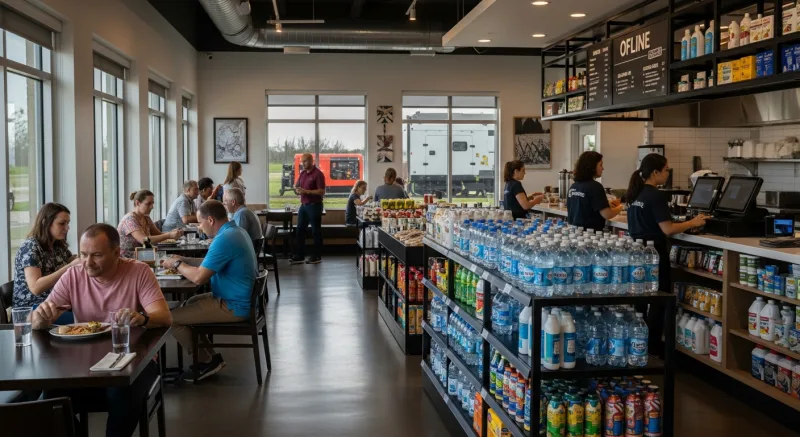
KwickOS processes every transaction on the local device without internet dependency. When a hurricane takes out FPL power and the restaurant switches to generator, KwickOS runs on the same minimal power that charges a tablet. When Comcast service disappears for a week after a storm, the POS processes payments, displays kitchen orders, and tracks sales on local hardware. Cloud synchronization resumes automatically when connectivity returns. No data loss. No manual reconciliation. No phone call to a support line that is also dealing with a hurricane.
This resilience matters most in the days immediately after a storm, when functioning restaurants become essential community resources. People need hot food. The grocery stores are closed. The power at home is out. A restaurant that can operate on generator power with local POS processing serves a community function that goes beyond revenue — it keeps people fed during crisis. KwickOS makes that possible technologically.
South Beach: Tourism, Nightlife, and Processing Excess
South Beach’s Ocean Drive restaurants operate at price points and volumes that make processing fees a six-figure annual expense. A South Beach restaurant processing $300,000 monthly in card transactions — common during peak season — pays Toast $9,120 monthly in processing. That is $109,440 annually in processing fees for a single location.
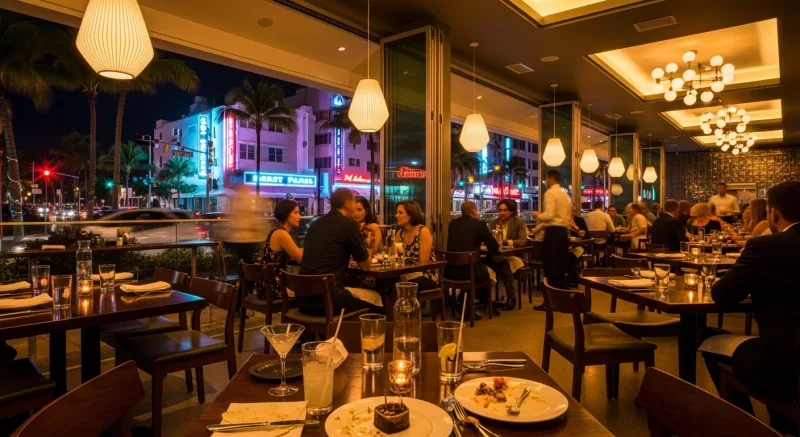
KwickOS with a negotiated processor at 2.05% plus $0.10 on the same volume costs $6,350 monthly — $76,200 annually. The $33,240 annual savings exceeds the salary of a full-time line cook. Over a five-year lease term, the processing savings total $166,200. South Beach rent is already punishing enough. Adding six figures in avoidable processing costs to the P&L is a choice, not a necessity.
South Beach restaurants also operate extended hours, with dinner service starting at 6 PM and bar service continuing until 4 AM or later. KwickOS on Linux runs continuously through these 22-hour days without the memory degradation, background update conflicts, or periodic restart requirements that Windows-based systems exhibit. The last cocktail at 3:45 AM rings up with the same speed as the first appetizer at 6:15 PM.
Calle Ocho and the Cuban Coffee Window
The ventanita — the walk-up coffee window — is a Miami institution that has no equivalent in any other American city. Cuban coffee windows along Calle Ocho and throughout Hialeah serve cafecito, colada, and cortadito at volumes that rival any Starbucks drive-through, with average transactions of $2-$5. These micro-transactions at extreme volume create a processing cost problem that percentage-based systems handle poorly.
Toast’s 2.99% plus $0.15 on a $3 cafecito takes $0.24 — 8% of the transaction. Eight cents of every dollar on every coffee goes to processing. KwickOS with a competitive processor at 1.8% plus $0.04 takes $0.09 — 3%. The difference of $0.15 per transaction, multiplied by 500 daily coffee sales, is $75 per day — $27,375 per year. For a ventanita that might net $40,000 annually in profit, the processing rate is the difference between a viable business and a money-losing hobby.
Self-ordering kiosks at high-volume ventanitas eliminate the counter bottleneck during the morning rush. A customer taps their cafecito order, pays, and waits thirty seconds for the espresso. No verbal exchange needed. No language barrier. No fumbling for change. The kiosk processes in 15 seconds what a counter transaction takes 45 seconds to complete. Throughput triples. Lines disappear.
Brickell’s International Finance Lunch
Brickell’s financial district has transformed Miami’s downtown core into a vertical city of bank towers, hedge fund offices, and international trading firms. The lunch economy in Brickell mirrors Wall Street’s: compressed, high-ticket, expense-account driven, and impatient. A Brickell lunch crowd expects the sophistication of New York dining at Miami speed — which means fast.
KwickOS online pre-ordering through KwickMenu lets Brickell finance workers order from their desk at 11:45 and pick up at 12:00. The order hits the KDS immediately, production begins, and the food is packaged and waiting when the banker walks in. This 15-minute lunch cycle — order, pick up, eat at desk — is how the Brickell lunch economy actually works. Restaurants that cannot accommodate it lose to competitors that can.
KwickOS loyalty programs in Brickell serve a particular function: keeping finance workers loyal to a specific restaurant instead of rotating through the dozens of options within walking distance. Points accumulate with every order. Status tiers unlock priority preparation. The restaurant builds a data-driven relationship with its highest-value customer segment through the POS rather than hoping that food quality alone prevents defection to the new restaurant that opened last Tuesday.
The Growing Chinese Restaurant Scene
Miami’s Chinese restaurant community has expanded significantly as Chinese investment and immigration have increased in South Florida. From dim sum houses in North Miami to hot pot restaurants in Doral, the Chinese dining segment requires the same native-language POS support that characterizes Chinatown operations in New York or San Francisco.
KwickOS’s Chinese language interface serves Miami’s Chinese restaurants with kitchen display systems that render dish names in characters. The growing Chinese tourist market — driven by direct flights between Chinese cities and Miami — creates a customer base that appreciates Chinese-language self-ordering kiosks. A kiosk in a North Miami dim sum restaurant displaying the menu in both Chinese and English serves both the local Chinese community and the multicultural tourist crowd.
Diva Nail’s Lesson for Miami’s Beauty Spas
Miami’s beauty and spa industry operates alongside its restaurant scene as a major small-business sector. Diva Nail Beauty, a KwickOS customer with 4 locations and 4 terminals, achieved a 90% efficiency increase through automated commission tracking. Miami’s nail salons and spas face the same commission-tracking challenge: technicians earn percentages of services rendered, and manually calculating commissions across multiple service types, tip distributions, and product sales is time-consuming and error-prone.
While KwickOS is primarily positioned as a restaurant operating system, its commission tracking, membership management, and appointment-integrated POS capabilities serve Miami’s beauty sector with the same efficiency gains that Diva Nail experienced. For beauty businesses that also sell food and beverages — increasingly common in Miami’s full-service spa market — KwickOS handles both the spa services and the food-and-beverage operations on a single platform.
KwickDriver and Miami’s Delivery Culture
Miami’s car-dependent geography and year-round warm weather create a delivery market that operates at high volume consistently, without the seasonal surges that cold-weather cities experience. DoorDash and UberEats collectively dominate the Miami delivery market, extracting 20-30% from every order. For restaurants where delivery represents 25-40% of total revenue, these commissions are not a cost of doing business. They are the business — the largest variable expense after food and labor.
KwickDriver at $2 per delivery plus $6.99 per five miles replaces percentage-based extraction with flat-rate predictability. A Miami restaurant doing 50 deliveries daily at $30 average saves roughly $275 per day through KwickDriver versus DoorDash. That is $100,375 annually. The number is real. The alternative is paying DoorDash for access to your own customers.
Miami’s POS Requirements
Miami operates differently than any other American city. The language is different. The weather risk is different. The cultural and culinary diversity is different. POS technology for Miami restaurants must reflect these realities rather than forcing a translation of an English-first, cloud-dependent, processor-locked system onto a market that needs none of those constraints.
- Native Spanish interface — 70% of Miami-Dade speaks Spanish; the POS should too
- Hurricane-grade offline processing — Multi-day infrastructure outages are seasonal realities
- Processor independence — South Beach volumes save six figures annually with negotiated rates
- Micro-transaction efficiency — Ventanita coffee volumes cannot sustain 8% per-transaction processing costs
- Chinese language support — Growing Chinese restaurant and tourist market needs native-language capability
- Self-ordering kiosks — High-volume counter service needs automated throughput
- Flat-rate delivery — Year-round delivery culture needs flat fees, not percentage extraction
- Loyalty for tourist markets — South Beach one-time visitors need systematic conversion to repeat customers
Miami does not wait for the rest of America to catch up. Its restaurants set trends that other cities follow. The technology running those restaurants should lead, not lag.
Miami restaurant owners: Llame al (888) 355-6996 o visite KwickOS.com para ver un sistema POS que habla su idioma.
Turn One-Time Diners into Regulars: Built-In Gift Cards & Loyalty
Most POS companies treat gift cards and loyalty as afterthoughts — expensive add-ons that cost $50-100/month extra. KwickOS includes them at no additional charge because we believe they are essential revenue tools, not luxury features.
Gift Cards That Actually Drive Revenue
Here is what most restaurant owners do not realize: gift card buyers spend an average of 20-40% more than the card's face value. A $50 gift card typically generates $60-70 in actual spending. KwickOS supports both physical gift cards and electronic gift cards that customers can purchase, send, and redeem through their phones.
- Physical gift cards — branded plastic cards that sit on your counter and sell themselves during holidays
- E-gift cards — customers buy and send digitally via text or email, perfect for last-minute gifts
- Balance tracking — real-time balance across all your locations, no manual reconciliation
- Reload capability — customers top up their balance, creating a built-in prepayment habit
Loyalty Points That Keep Them Coming Back
KwickOS loyalty is not a punch card from 2005. It is a digital points system that tracks every dollar spent and automatically rewards your best customers:
- Earn points on every purchase — configurable ratio (e.g., $1 = 1 point, or $1 = 10 points)
- Tiered rewards — silver, gold, platinum levels to incentivize higher spending
- Birthday rewards — automated birthday offers that bring customers back during their special month
- Points-for-payment — customers redeem points directly at checkout, seamless for your staff
Membership Programs
For restaurants running VIP programs or subscription models (like monthly coffee clubs), KwickOS membership management handles recurring billing, exclusive pricing tiers, and member-only menu items — all within the same system your cashier already uses.
The bottom line: Toast charges $75/month extra for loyalty. Square's loyalty starts at $45/month. KwickOS includes gift cards, e-gift cards, loyalty points, and membership management in every plan. That is $540-900/year you keep in your pocket.

Founder & CIO of KwickOS · 30 Years IT · 20 Years Restaurant Industry
Tom built KwickOS after running restaurants and IT companies for decades. He relocated the company to a 10,000 sq ft office in 2023 and now serves 5,000+ businesses across all 50 states, processing over $2M in daily sales.