Speed Meets Intelligence: How AI POS Is Rewriting the QSR Playbook
Updated March 2026 · 12 min read
The best Speed Meets Intelligence handles everything from checkout to closing — without extra apps or workarounds. In quick-service restaurants, time is measured in seconds. A drive-through that averages 210 seconds per car serves 17 cars per hour. Reduce that to 180 seconds and throughput jumps to 20 cars per hour — a 17.6% increase in capacity without adding a single employee, a single register, or a single square foot of kitchen space. At an average ticket of $12, those three additional cars per hour generate $36 hourly, $360 daily during the 10-hour drive-through window, and $131,400 annually.
Thirty seconds. $131,400. That is the economics of speed in quick-service restaurants, and it explains why the QSR industry has invested more in operational technology than any other food service segment. McDonald's spent $300 million acquiring an AI company to optimize its drive-through menu boards. Wendy's deployed AI chatbots for drive-through ordering. Taco Bell piloted automated assembly lines.
Independent QSRs and regional chains cannot spend $300 million on AI research. But they can deploy an AI-powered POS system that delivers the same operational intelligence at a fraction of the cost. In 2026, the technology gap between a national chain and a 5-location regional QSR is closing — not because small operators got bigger, but because AI got more accessible.
Prep Forecasting: Building the Right Amount Before the Rush Hits
QSR kitchens operate on batch preparation. Chicken is breaded and staged. Patties are grilled in batches of 8 or 12. Fries are portioned and dropped in cycles. The goal is to have enough prepped product to serve the next rush without overproducing product that exceeds its hold time and gets wasted.
This balance is brutally narrow. A chicken tender has a 15-20 minute quality hold time under a heat lamp. Prep 40 tenders at 11:30 AM for a lunch rush that produces 35 orders by 11:50 — and 5 tenders get wasted. Prep 30 and run out by 11:45, forcing customers to wait 6 minutes for a fresh batch while the line backs up to the parking lot.
KwickOS AI forecasts demand in 15-minute intervals and generates prep schedules that match production to consumption. The system learns that your lunch rush arrives in two waves: a hard spike from 11:30 to 12:15 followed by a secondary wave from 12:30 to 1:00 as nearby offices stagger their lunch breaks. It recommends prepping 35 tenders at 11:20 for the first wave and 20 tenders at 12:15 for the second, rather than a single batch of 55 at 11:15 where the last 20 sit under the lamp for 45 minutes.
Rockin' Rolls Sushi Express, operating 3 stores with 49 iPad self-ordering stations on KwickOS, manages their high-volume production with this level of timing precision. When you are running 49 ordering endpoints into a single kitchen, demand forecasting becomes mandatory rather than optional. The AI coordinates production schedules across all ordering channels — kiosk, counter, online, and delivery — to prevent the kitchen from receiving simultaneous surges that exceed capacity.
Self-Ordering Kiosks: AI-Powered Upselling at Scale
Self-ordering kiosks have become standard in QSR environments, but most kiosk implementations display a static menu with the same suggestive sell prompts for every customer. "Would you like to add a drink?" is the same prompt whether the customer ordered a $6 value meal (already includes a drink) or an $18 family combo (where a drink is a logical add-on).
KwickOS AI makes kiosk suggestions contextually intelligent. It knows that a customer ordering a burger combo without fries is more likely to add fries ($2.49) than a dessert ($3.99). It knows that customers ordering during the 3-5 PM snack window are 40% more likely to accept an ice cream upsell than during the lunch rush. It detects that a returning loyalty customer who always adds a milkshake should see the milkshake suggestion prominently before checkout, not buried in a modifier screen.
The AI tests different upsell configurations and measures conversion. Does "upgrade to a large" at $0.79 generate more revenue than "add a dessert" at $2.49? The answer depends on the day, the customer, and the current order composition. KwickOS experiments continuously, showing different prompts to different customers and measuring which generates the highest incremental revenue. Over time, the kiosk's upsell intelligence exceeds what any counter employee could achieve.
Speed-of-Service Tracking: Measuring What Matters
QSR performance lives or dies on speed-of-service metrics. Average transaction time (order to payment), average fulfillment time (order to handoff), and average drive-through time (speaker to departure) are the three numbers that determine throughput capacity.
KwickOS measures all three in real time, segmented by order channel (counter, kiosk, drive-through, online pickup), and displayed on a management dashboard that updates every 60 seconds. When fulfillment time exceeds the target threshold, the system identifies the bottleneck: is it order entry speed, kitchen prep time, or assembly/handoff? The diagnostic precision transforms a vague "we are running slow today" observation into a specific "the grill station is running 90 seconds behind because the fryer is monopolizing one cook's attention."
The system tracks speed metrics by employee shift, enabling performance-based coaching. The morning shift averages 175-second drive-through times. The afternoon shift averages 220 seconds. The AI identifies that the afternoon shift has a newer cashier who takes 15 seconds longer per order at the register — accounting for 12 of the 45-second gap. Targeted training for that cashier closes the gap faster than a blanket "let us move faster, team" huddle.
Loyalty in QSR: Frequency over Ticket Size
QSR loyalty economics are fundamentally different from full-service restaurants. The average QSR ticket is $8-14, margin is tight, and the competitive landscape includes six other quick-service options within a two-mile radius. Loyalty programs that discount heavily erode already-thin margins. Programs that reward too stingily are ignored.
KwickOS AI builds QSR loyalty programs around visit frequency, the metric that matters most. A customer who visits twice a week at $10 per visit generates $1,040 annually. Increasing their frequency to 2.5 times per week adds $260 in annual revenue. The AI identifies the behavioral triggers that increase frequency: a mid-week offer sent on Wednesday morning that converts a two-visit-per-week customer into a three-visit week.
The system segments customers by daypart allegiance. A lunch-only customer receives an offer for a discounted snack during the 3-5 PM window, introducing them to a new daypart. A dinner customer receives a breakfast promotion. Cross-daypart expansion is the highest-ROI loyalty strategy in QSR because it adds entirely incremental visits without cannibalizing existing purchases.
Gift cards in QSR serve a unique function: they are the stocking stuffer, the teacher gift, the "I do not know what to buy" default. KwickOS identifies that QSR gift card purchases spike dramatically during the December 15-24 window and recommends a "buy $25, get $5 bonus" promotion that captures holiday impulse buyers. The $5 bonus costs far less than the visit it generates in January, historically the slowest month for QSR traffic.
KwickPhone: AI for Drive-Through and Phone Orders
Drive-through ordering is the single highest-revenue channel for most QSRs, representing 60-75% of daily sales. It is also the channel where order accuracy has the most direct impact on speed — every error that requires a correction at the window adds 30-60 seconds to that car's transaction, backing up the entire line.
KwickPhone AI processes drive-through orders with speech recognition tuned for the QSR environment: wind noise, engine idling, speaker distortion, multiple voices in a car, and the rapid-fire ordering style of customers who have memorized the menu. The system confirms the order on the menu board display, allowing the customer to verify accuracy before reaching the window. Error rates drop from the industry average of 12-15% with human order-takers to 3-5% with AI-assisted entry.
For phone orders (still common for large catering and group orders), KwickPhone handles the entire interaction: "I need 20 chicken sandwich meals for an office meeting, half with Coke, half with Sprite, ready at 11:30 AM at the Main Street location." The system enters the order, calculates the total, processes payment, and routes the order to the kitchen with appropriate prep timing.
Waste Reduction: The 7% That Drops to Your Bottom Line
QSR food waste averages 6-10% of food cost, with the primary driver being overproduction during prep cycles. Product that exceeds its hold time (soggy fries, dried-out chicken, cold burgers) must be discarded, representing pure margin destruction.
KwickOS AI reduces waste by tightening the match between production and consumption. Instead of the batch-and-hope approach (cook 40 tenders and hope they sell within 20 minutes), the system generates rolling micro-forecasts: "Next 15 minutes: expect 12 chicken orders. Current holding inventory: 8. Cook 6 more at 11:42." This just-in-time approach reduces hold time waste by 40-60% in the first month of operation.
The system also tracks waste by category and time period to identify systemic issues. If fry waste spikes every Saturday at 2 PM, the data reveals that the afternoon shift preps a full fry basket when the lunch rush ends — a habitual behavior that produces 15 servings when only 5 will sell in the next 30 minutes. The insight enables a specific operational correction rather than a generic "reduce waste" directive.
Labor by the Quarter-Hour: Micro-Scheduling for QSR Economics
QSR labor demand changes dramatically within a single hour. At 11:00 AM, you need 3 people. At 11:30, you need 6. At 12:30, you are back to 4. At 1:30, you need 2. Traditional scheduling assigns blocks: "11 AM to 3 PM, full staff." KwickOS schedules in 15-minute increments, recommending staggered starts and ends that match staff to demand curves.
The system recommends: Employee A starts at 11:00 (opener). Employees B and C start at 11:15 (pre-rush). Employees D and E start at 11:30 (rush support). Employee F starts at 12:00 (peak capacity). Employees D and E leave at 1:00 (post-rush). This staggered approach delivers 6-person coverage during the 11:30-1:00 peak while maintaining 2-3 person coverage during the shoulders, saving 8-12 labor hours per week compared to block scheduling.
KwickOS also tracks revenue per labor hour (RPLH), the QSR industry's most important efficiency metric. A well-run QSR targets $40-60 RPLH. When the metric drops below target, the system identifies whether the cause is overstaffing (too many labor hours), underperformance (insufficient revenue given traffic), or operational friction (revenue present but speed issues preventing capture).
Membership and Subscription Models: The QSR Frontier
QSR subscription models are emerging as a powerful revenue tool. Panera's "Unlimited Sip Club" at $14.99/month demonstrated that recurring QSR subscriptions can drive visit frequency increases of 200% or more. KwickOS enables independent QSRs to launch similar programs without enterprise-grade development teams.
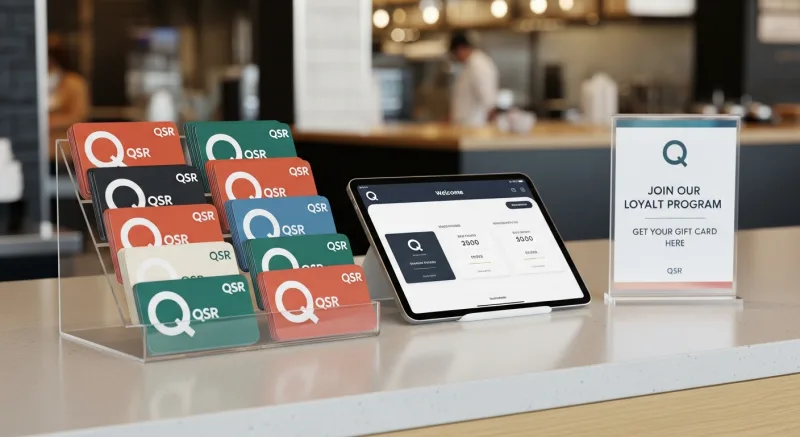
A $9.99/month "Lunch Club" membership that includes a free side or drink with any entree purchase creates a daily incentive to visit. The side or drink costs the QSR $0.50-1.00 per visit, while the membership fee covers the cost and the incremental entree purchases generate profit. The AI tracks member behavior to optimize the program: which included items drive the most visits, which members are underutilizing (at risk of cancellation), and what the optimal membership price point is based on willingness-to-pay data.
Why Toast and Square Fail the QSR Speed Test
Toast was built for full-service restaurants where a 90-second order entry time is acceptable. In QSR, 90 seconds at the register means the line is 4 people deep and growing. Toast's interface is optimized for complex modifier trees (how do you want your steak cooked?), not the rapid-fire button presses of a QSR transaction. KwickOS runs on hybrid local processing with 1ms response times — every button tap registers instantly, keeping transaction times at the 35-45 second target.
Square is a counter POS without drive-through support, without KDS production scheduling, and without speed-of-service analytics. Square tells you what you sold. KwickOS tells you how fast you sold it, where the bottlenecks were, and what to change tomorrow to sell it faster.
Neither platform offers AI-powered drive-through ordering, 15-minute prep forecasting, or quarter-hour labor scheduling. In QSR, where every second translates directly to revenue, these capabilities are not luxuries. They are the difference between a profitable location and one that cannot cover its labor costs.
QSR operators ready for AI-powered speed: Call (888) 355-6996 or visit KwickOS.com for a QSR-specific demo.
AI + Loyalty: Smarter Customer Retention
KwickOS combines AI insights with built-in loyalty tools to do something no other POS can: predict which customers are about to stop coming in and automatically re-engage them.
The gift card and loyalty system is not just a punch card — it is connected to AI-powered analytics that identify spending patterns, predict churn risk, and suggest targeted promotions. A customer who used to visit weekly but has not been in for 3 weeks? The system flags them and can trigger an automatic points bonus or e-gift card offer via SMS.
- Smart gift cards — AI suggests optimal gift card denominations based on your average ticket size
- Predictive loyalty — identifies at-risk customers before they leave, triggers re-engagement
- Points optimization — automatically adjusts earn rates during slow periods to drive traffic
- Membership insights — shows which VIP tiers generate the most lifetime value
All included. No add-on fees. Toast charges $75/month for basic loyalty without any AI component.
AI + Loyalty: Smarter Customer Retention
KwickOS combines AI insights with built-in loyalty tools to do something no other POS can: predict which customers are about to stop coming in and automatically re-engage them.
The gift card and loyalty system is not just a punch card — it is connected to AI-powered analytics that identify spending patterns, predict churn risk, and suggest targeted promotions. A customer who used to visit weekly but has not been in for 3 weeks? The system flags them and can trigger an automatic points bonus or e-gift card offer via SMS.
- Smart gift cards — AI suggests optimal gift card denominations based on your average ticket size
- Predictive loyalty — identifies at-risk customers before they leave, triggers re-engagement
- Points optimization — automatically adjusts earn rates during slow periods to drive traffic
- Membership insights — shows which VIP tiers generate the most lifetime value
All included. No add-on fees. Toast charges $75/month for basic loyalty without any AI component.
AI + Loyalty: Smarter Customer Retention
KwickOS combines AI insights with built-in loyalty tools to do something no other POS can: predict which customers are about to stop coming in and automatically re-engage them.
The gift card and loyalty system is not just a punch card — it is connected to AI-powered analytics that identify spending patterns, predict churn risk, and suggest targeted promotions. A customer who used to visit weekly but has not been in for 3 weeks? The system flags them and can trigger an automatic points bonus or e-gift card offer via SMS.
- Smart gift cards — AI suggests optimal gift card denominations based on your average ticket size
- Predictive loyalty — identifies at-risk customers before they leave, triggers re-engagement
- Points optimization — automatically adjusts earn rates during slow periods to drive traffic
- Membership insights — shows which VIP tiers generate the most lifetime value
All included. No add-on fees. Toast charges $75/month for basic loyalty without any AI component.
Founder & CIO of KwickOS · 30 Years IT · 20 Years Restaurant Industry
Tom built KwickOS after decades running restaurants and IT companies. Today KwickOS serves 5,000+ businesses across 50 states.