Friday Night Pizza Orders Spike 340%. Your Kitchen Found Out at 6 PM. AI Knew Monday.
Updated March 2026 · 12 min read
Every independent pizza shop owner has a version of the same nightmare. It is Friday at 6:15 PM. The phone is ringing off the hook. Online orders are stacking up. The make line is three tickets deep and growing. Your dough prep from this afternoon — which seemed like plenty at 3 PM — is going to run out by 8:30. Your two delivery drivers are both out on runs and six delivery orders are cooling in the warming rack. A customer just walked in, saw the chaos, and walked right back out.
This is not a bad night. This is a predictable night that happened because the prediction happened too late. Friday night volume spikes are not surprises. They are mathematical certainties that vary by magnitude, not by existence. The question was never "will Friday be busy?" but "exactly how busy will this specific Friday be, and what do I need to prep?" Human estimation gets this right about 60% of the time. AI gets it right 90% of the time. That 30-point accuracy gap is the difference between a kitchen that flows and a kitchen that drowns.
Dough Prep Forecasting: The 24-Hour Planning Horizon
Pizza dough requires 18-24 hours of cold fermentation for optimal texture and flavor in most recipes. This means that every pizza you sell on Friday was decided on Thursday. The dough you make today is tomorrow's revenue ceiling. Make too little and you cap your Friday revenue at whatever the dough allows. Make too much and you throw away $2-4 per unused dough ball on Saturday morning.
KwickOS AI builds dough forecasts based on layered historical analysis. It does not simply average last Friday's volume. It identifies that the first Friday of the month is 12% busier than mid-month Fridays (payday effect). It detects that Fridays during football season run 20% higher than off-season Fridays. It factors in weather: rainy Fridays increase delivery orders by 30% while reducing dine-in by 15%, with a net positive effect on total volume. Local events — a high school football game, a concert at the nearby venue — are flagged for manual adjustment.
Each Thursday morning, the system displays a dough prep target: "Friday forecast: 285 pizza equivalents. Prep 310 dough balls (8% safety margin)." The safety margin itself is AI-calibrated: higher for high-variance days (Super Bowl Sunday, Halloween) and lower for predictable days (typical Tuesday).
Delivery Dispatch Optimization: Getting Hot Pizza There Fast
For independent pizza shops, delivery is both the highest-demand service and the highest-cost operation. A delivery driver costs $12-18 per hour in wages plus vehicle wear, insurance, and tip pool management. A third-party delivery service charges 20-30% of the order value. Neither option is cheap, and both require optimization to be profitable.
KwickOS with KwickDriver provides delivery at a flat $2 per order plus $6.99 per 5 miles — dramatically cheaper than third-party platforms. But cost per delivery is only half the equation. The other half is delivery efficiency: how many deliveries per driver per hour.
KwickOS AI optimizes driver dispatch by batching orders geographically. Instead of sending Driver A to 123 Oak Street and then back to the shop, then out to 127 Oak Street five minutes later, the system holds both orders for simultaneous dispatch. The AI calculates the optimal batch window: holding an order 4 minutes to batch it with a nearby delivery saves 15 minutes of total drive time, getting both customers their pizza faster than sequential dispatching.
The system also predicts delivery demand by time window and recommends driver scheduling. Friday 6-9 PM needs 4 drivers. Tuesday 5-8 PM needs 2. The AI adjusts based on weather (add a driver when rain is forecast), local events (add a driver when the home team plays), and seasonal patterns (longer evenings in summer shift delivery peaks 30 minutes later).
KwickPhone: The AI That Takes Pizza Orders Better Than Your Staff
Pizza shops are one of the last industries where a significant percentage of orders arrive by phone. An estimated 35-45% of independent pizza shop orders are phone-based, and each phone order consumes 2-3 minutes of staff time: greeting, taking the order, reading it back, processing payment, providing a time estimate.
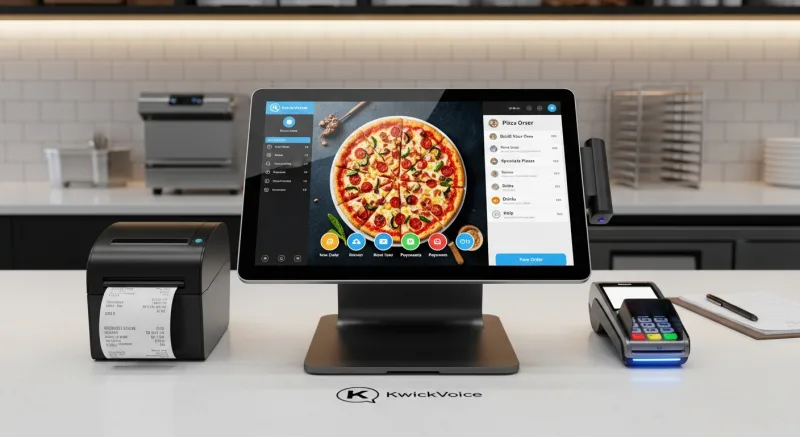
During the Friday rush, phone orders compete with walk-in customers and online order fulfillment for staff attention. A ringing phone that goes unanswered is a $25-40 order that goes to Domino's. A phone order taken hastily with errors results in a remake that costs $5-8 in ingredients and labor.
KwickPhone handles pizza phone orders with precision that exceeds most human order-takers. It understands natural language: "I want a large pepperoni with extra cheese, a medium veggie with light sauce, and a side of garlic knots" is parsed into three line items with modifications, confirmed back to the caller, and entered into the production queue. Payment is processed by phone (card on file or new card entry). The caller receives a text confirmation with their order details and estimated delivery or pickup time.
KwickPhone does not get flustered during the rush. It does not mishear "mushrooms" as "much rooms." It does not forget the extra cheese. It handles 20 simultaneous calls without putting anyone on hold. For a pizza shop that processes 60 phone orders on a Friday night, KwickPhone recovers the 15-20 orders that would have been lost to busy signals and transforms the 40 minutes of staff phone time into make-line production time.
Topping Inventory: Predicting the Pepperoni Consumption Curve
Pizza topping inventory follows consumption patterns that mirror pizza sales but with per-topping variability. Pepperoni accounts for 65% of all topped pizzas. Sausage appears on 30%. Mushrooms on 25%. Anchovies on 2%. These percentages shift based on promotions, seasonal menus, and local preferences.
KwickOS AI tracks topping consumption at the pizza level and generates procurement forecasts. If Friday's forecast is 285 pizzas, the system calculates: 185 will include pepperoni (65% attachment), requiring 37 pounds at 3.2 ounces per pizza. Current inventory is 42 pounds. Sufficient for Friday but insufficient for the weekend without a reorder. The system triggers a supplier order for Monday delivery (supplier lead time: 48 hours) to cover next week's forecast.
The AI also tracks waste at the topping level. If your vegetable prep waste rate is 18% (peels, stems, unusable portions), the system factors that into ordering calculations. You need 25 pounds of usable green peppers, which requires ordering 30.5 pounds. This precision prevents both the "we ran out of mushrooms at 8 PM" crisis and the "we threw away 10 pounds of peppers on Monday" waste problem.
Loyalty Programs That Fight Domino's and Papa John's
National pizza chains spend hundreds of millions on loyalty programs. Domino's "Piece of the Pie Rewards" has 30+ million members. Papa John's "Papa Rewards" offers a free pizza after $75 in spending. Independent pizza shops cannot match these marketing budgets, but they can match — and exceed — the intelligence behind the loyalty program.
KwickOS builds pizza loyalty programs with behavioral intelligence that national chains cannot replicate at the local level. The AI identifies that Customer A orders every Friday night (habitual) and needs a reward structure that reinforces their habit: "Every 6th Friday pizza is free." Customer B orders sporadically — twice in January, once in February, nothing in March. Customer B needs a re-engagement offer: "We haven't seen you in a while. $5 off your next order this week."
The system creates family-oriented promotions based on order patterns. A household that consistently orders 2 large and 1 medium every Friday gets a "family deal" bundle priced to increase their loyalty while increasing the shop's margin through strategic bundling. The bundle price appears to save the customer $4 while actually maintaining the same per-pizza margin through smaller portion costs on sides included in the bundle.
Gift cards for pizza shops peak during the holidays and sports seasons. KwickOS triggers promotions timed to these peaks: "Give the gift of pizza: $25 gift card + free large cheese pizza" during December. The free pizza costs $3.50 in ingredients and drives $25 in guaranteed revenue plus the overspend that 72% of gift card users generate above the card value.
Menu Pricing: What to Charge for a Large Pepperoni in Your Zip Code
Pizza pricing is hyperlocal. A large pepperoni at $14.99 is competitive in a suburban market but below-market in an urban core where the same pizza sells for $18-22. Most pizza shop owners set prices based on competitor scanning — driving past three other shops and checking their posted prices. This reactive pricing ignores demand data entirely.
KwickOS AI analyzes price sensitivity from your own transaction data. It detects that raising your large specialty pizza from $19.99 to $21.99 resulted in only a 4% volume decrease, generating a net revenue increase of 8%. Conversely, raising your medium cheese from $10.99 to $12.99 caused a 15% volume drop — customers have a ceiling on what they will pay for a basic cheese pizza that does not extend to specialty pizzas.
The system identifies optimal combo pricing. A "dinner deal" that bundles a large pizza, breadsticks, and a 2-liter for $24.99 (versus $30 separately) increases order frequency by 22% while maintaining margin because the breadsticks and soda have 85%+ margins that subsidize the pizza discount. The AI monitors combo performance weekly and recommends adjustments when attachment rates shift.
Kitchen Display Intelligence for Pizza Production Lines
A pizza kitchen's make line has a specific sequence: dough stretching, sauce, cheese, toppings, oven loading. During peak volume, the bottleneck shifts between stations. At moderate volume, the oven is the constraint (12-15 minute bake times). At high volume, the make line itself becomes the constraint (a complex specialty pizza takes 90 seconds to build).
KwickOS KDS presents orders to the make line in an optimized sequence. It batches similar pizzas (three large pepperonis in a row is faster than alternating between pepperoni, veggie, and specialty) while respecting time-based priority (a delivery order placed 20 minutes ago takes priority over a dine-in order placed 5 minutes ago). The system calculates oven capacity and staggers make-line output to match — preventing the 8-pizza pileup that happens when the make line works faster than the oven can absorb.
For shops with conveyor ovens, the AI optimizes the oven loading pattern. A conveyor oven running at 7 minutes per pizza can process 8 pizzas per cycle with proper spacing. The KDS displays the next 8 pizzas in oven-loading order with a countdown timer, creating a rhythm that maximizes throughput without the guesswork that leads to uneven baking.
Labor Scheduling for the Pizza Demand Curve
Pizza shop labor demand follows a curve that is dramatically different from other restaurants. A typical pizza shop does 15% of daily revenue between 11 AM and 2 PM (lunch), 10% between 2 PM and 5 PM (dead zone), and 60% between 5 PM and 9 PM (dinner). The remaining 15% is scattered. Staffing a pizza shop flat across all hours wastes 30% of labor budget on low-productivity periods.
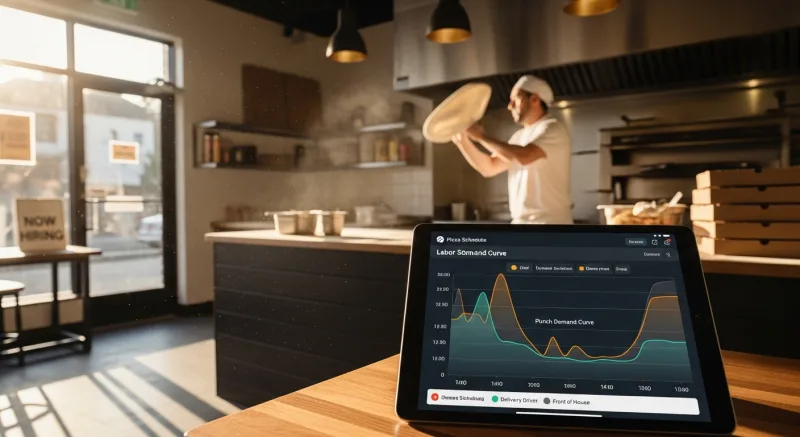
KwickOS AI generates labor schedules that match this curve precisely. Two employees from 11 AM to 2 PM. One from 2 PM to 4 PM (prep work, inventory). Three from 4 PM to 5 PM (pre-dinner prep). Five from 5 PM to 9 PM (full production). Two from 9 PM to close (cleaning, closing prep). Delivery drivers arrive at 4:30 PM and stagger departure based on order volume decline.
The system learns that adding a sixth person from 6 PM to 8 PM on Fridays generates an additional $400 in revenue (faster throughput, fewer lost phone orders) at a labor cost of $36. That is an 11:1 return on the marginal labor investment — a decision that data makes obvious and intuition often misses.
Why Toast and Square Cannot Compete for Pizza Shops
Toast does not understand pizza. Its kitchen display was built for a multi-station restaurant kitchen with appetizer, grill, saute, and dessert stations. A pizza kitchen has one production line with a make station and an oven. Toast's multi-station routing adds unnecessary complexity to a linear production process.
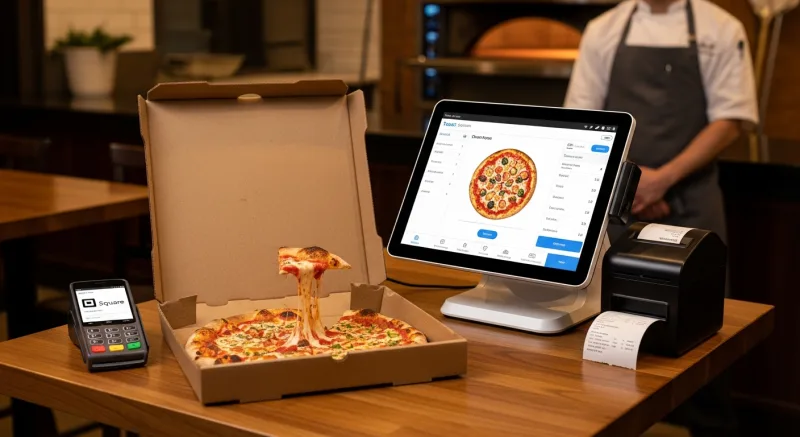
Toast's delivery capabilities rely on third-party integration (DoorDash Drive) with percentage-based pricing that destroys pizza delivery margins. A $20 pizza delivery through Toast's integrated DoorDash costs $4-6 in delivery fees. The same delivery through KwickDriver costs $2 flat. On 50 deliveries per day, the annual difference exceeds $50,000.
Square has no delivery management, no dough production forecasting, no driver dispatch optimization, and no pizza-specific KDS workflow. Square is a cash register. A pizza shop needs an operating system.
Pizza shop owners tired of Friday night chaos: Call (888) 355-6996 or visit KwickOS.com to see AI-powered pizza operations in action.
AI + Loyalty: Smarter Customer Retention
KwickOS combines AI insights with built-in loyalty tools to do something no other POS can: predict which customers are about to stop coming in and automatically re-engage them.
The gift card and loyalty system is not just a punch card — it is connected to AI-powered analytics that identify spending patterns, predict churn risk, and suggest targeted promotions. A customer who used to visit weekly but has not been in for 3 weeks? The system flags them and can trigger an automatic points bonus or e-gift card offer via SMS.
- Smart gift cards — AI suggests optimal gift card denominations based on your average ticket size
- Predictive loyalty — identifies at-risk customers before they leave, triggers re-engagement
- Points optimization — automatically adjusts earn rates during slow periods to drive traffic
- Membership insights — shows which VIP tiers generate the most lifetime value
All included. No add-on fees. Toast charges $75/month for basic loyalty without any AI component.
AI + Loyalty: Smarter Customer Retention
KwickOS combines AI insights with built-in loyalty tools to do something no other POS can: predict which customers are about to stop coming in and automatically re-engage them.
The gift card and loyalty system is not just a punch card — it is connected to AI-powered analytics that identify spending patterns, predict churn risk, and suggest targeted promotions. A customer who used to visit weekly but has not been in for 3 weeks? The system flags them and can trigger an automatic points bonus or e-gift card offer via SMS.
- Smart gift cards — AI suggests optimal gift card denominations based on your average ticket size
- Predictive loyalty — identifies at-risk customers before they leave, triggers re-engagement
- Points optimization — automatically adjusts earn rates during slow periods to drive traffic
- Membership insights — shows which VIP tiers generate the most lifetime value
All included. No add-on fees. Toast charges $75/month for basic loyalty without any AI component.
AI + Loyalty: Smarter Customer Retention
KwickOS combines AI insights with built-in loyalty tools to do something no other POS can: predict which customers are about to stop coming in and automatically re-engage them.
The gift card and loyalty system is not just a punch card — it is connected to AI-powered analytics that identify spending patterns, predict churn risk, and suggest targeted promotions. A customer who used to visit weekly but has not been in for 3 weeks? The system flags them and can trigger an automatic points bonus or e-gift card offer via SMS.
- Smart gift cards — AI suggests optimal gift card denominations based on your average ticket size
- Predictive loyalty — identifies at-risk customers before they leave, triggers re-engagement
- Points optimization — automatically adjusts earn rates during slow periods to drive traffic
- Membership insights — shows which VIP tiers generate the most lifetime value
All included. No add-on fees. Toast charges $75/month for basic loyalty without any AI component.
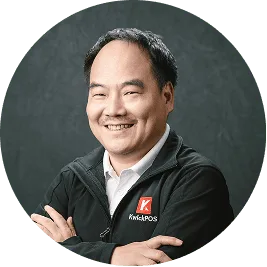
Founder & CIO of KwickOS · 30 Years IT · 20 Years Restaurant Industry
Tom built KwickOS after decades running restaurants and IT companies. Today KwickOS serves 5,000+ businesses across 50 states.