The Coffee Shop That Knows Your Order Before You Walk In
Updated March 2026 · 12 min read
Sarah walks into her neighborhood coffee shop at 7:22 AM every weekday. She orders a large oat milk latte with an extra shot. The barista who has been there for two years knows this. The new barista who started Monday does not. On Monday, Sarah waited 90 seconds longer while the new hire asked questions, checked the screen, and fumbled with the milk steamer. On Tuesday, Sarah went to the Starbucks drive-through instead. She has not been back.
And she is not alone. Industry data shows that 68% of independent coffee shop customers who experience a single service disruption try a chain competitor within 48 hours. One in three never returns. Your best barista's two-week vacation could cost you $4,200 in lost regulars.
This is the independent coffee shop's existential crisis in a single anecdote. Your competitive advantage over Starbucks is personal connection — knowing your customers, remembering their names, anticipating their orders. But that knowledge lives in individual employees' heads. When those employees call in sick, quit, or get replaced, the knowledge walks out with them. Starbucks does not have this problem because Starbucks stores its customer knowledge in software. Every Starbucks app user's order history, preferences, and payment method are in the system, accessible to any employee at any register.
In 2026, AI-powered POS systems give independent coffee shops the same capability — and then go far beyond it. Because while Starbucks knows what you ordered last time, an AI system knows what you are going to order next.
Predictive Ordering: Beyond Order History
KwickOS does not simply record that Sarah orders an oat milk latte. The AI builds a behavioral model of Sarah as a customer. It knows she orders hot lattes September through April and switches to iced in May. It knows she adds an extra shot on Mondays and Fridays (suggesting higher caffeine need at the start and end of the work week). It knows she occasionally adds a blueberry muffin on days she arrives before 7:15 AM (suggesting she skipped breakfast at home).
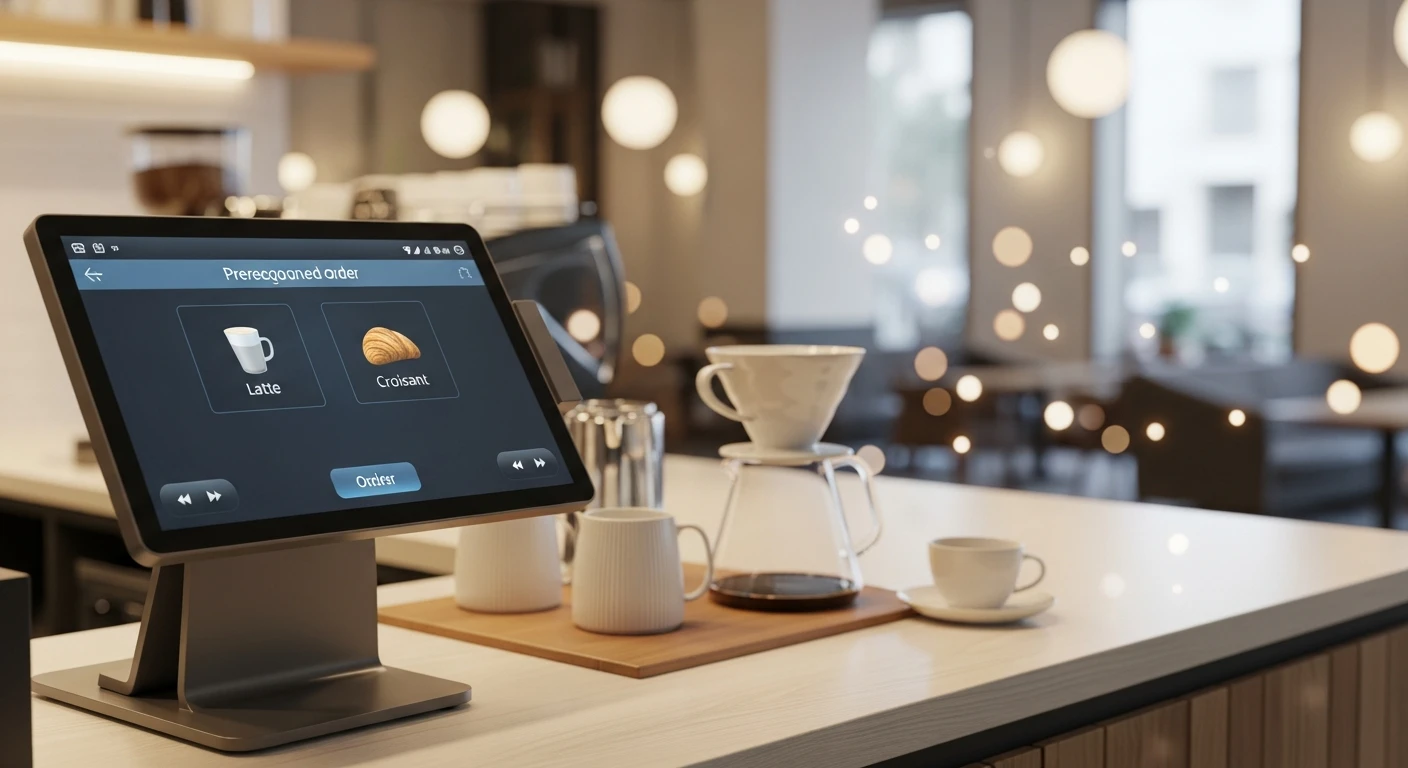
When Sarah walks up to the counter — or scans her loyalty QR code at the kiosk — the system displays her predicted order. In March, that is a large hot oat milk latte with an extra shot. In June, it switches to iced without her asking. On a Monday when she arrives at 7:08 AM, the system suggests adding a blueberry muffin. The new barista does not need to know Sarah personally. The system knows Sarah and communicates that knowledge to whoever is at the register.
This is not science fiction. It is pattern recognition applied to transaction data, and KwickOS performs it for every loyalty customer in your database. A coffee shop with 400 regulars has 400 predictive profiles, each updated with every transaction.
Morning Rush Forecasting: Staffing the 90-Minute Window That Pays Your Rent
For most coffee shops, 65-75% of daily revenue occurs between 6:30 AM and 9:00 AM. This 150-minute window is not just busy — it is the financial foundation of the entire business. Here's the brutal math. Understaffing by one barista during the morning rush does not just create longer lines. It drives customers to competitors who will serve them faster, and those customers may never return.
KwickOS AI forecasts morning rush volume with hourly granularity. It learns that Monday mornings are 15% busier than Thursday mornings. It detects that the first rainy morning after a dry week increases drive-through volume by 25% (people who normally walk are now driving). It recognizes that the morning after a local holiday has suppressed volume because commuters are not going to work.
The system translates these forecasts into staffing recommendations. Tomorrow is a rainy Monday: recommend three baristas from 6:30-9:00 instead of the usual two. Thursday looks normal: two baristas will handle the volume. Friday before a long weekend will see a 20% drop in commuter traffic but a 15% increase in late-morning leisure customers: stagger shifts so two baristas cover the early morning and a third arrives at 9 AM for the brunch crowd.
Milk and Supply Intelligence: Stop Running Out of Oat Milk at 8 AM
The most embarrassing operational failure in a coffee shop is running out of a core ingredient during peak hours. "We are out of oat milk" at 8 AM on a Tuesday is not a minor inconvenience — it is a betrayal of every customer who chose your shop specifically because you carry oat milk. In the specialty coffee market, 34% of lattes now use alternative milks, and those customers are the least forgiving when their preference is unavailable.
KwickOS tracks milk consumption at the drink level. Every latte, cappuccino, and flat white deducts the appropriate quantity from the specific milk type used. The AI knows your shop uses 6 gallons of oat milk on a typical Monday, 4 gallons on Wednesday, and 8 gallons on Saturday. It tracks current inventory against projected consumption and generates alerts when supply will not cover the next business day.
But it gets better. The system goes further by learning your supplier's delivery patterns and reliability. If your oat milk supplier delivers every Tuesday and Friday, and you need 10 gallons for the Tuesday-through-Thursday window, the system ensures your Tuesday order accounts for three days of consumption. If your supplier has a pattern of short-shipping (delivering 8 gallons when you ordered 10), the AI adjusts the order quantity upward to compensate.
Loyalty Programs That Compete with Starbucks Rewards
Starbucks Rewards has 34 million active members in the U.S., and it is the primary reason many coffee drinkers never try an independent shop. The program works because it is frictionless (order and pay from the app), personalized (customized offers), and rewarding (free drinks and food). Independent coffee shops cannot match Starbucks' technology budget, but KwickOS AI creates a loyalty experience that matches or exceeds it in personal touch.
KwickOS loyalty operates through QR codes, phone numbers, or the KwickMenu online ordering platform — no app download required. Customers earn points on every purchase, but the AI personalizes the reward structure for each customer instead of applying uniform thresholds.
A daily customer who spends $5.50 per visit earns a free drink after 8 visits (approximately every two weeks). A weekly customer who spends $12 per visit (latte plus food) earns a free pastry after 4 visits (monthly). The AI calibrates reward frequency to maximize the dopamine hit of earning something while maintaining profitable economics for the shop.
The system also creates urgency-based promotions that Starbucks cannot replicate at scale. "Your favorite oat milk latte is 20% off today only" — sent at 6:45 AM to a regular who has not visited in five days. The hyper-personal timing and offer relevance generates a 35% redemption rate compared to Starbucks' 15-20% on generic promotions.
Gift cards become a weapon in the loyalty arsenal. KwickOS identifies that coffee shop gift card purchases spike during Teacher Appreciation Week, graduations, and the December holidays. The system recommends targeted promotions for each window: "Buy a $25 gift card, get a free bag of our house blend" for the holidays. Gift card recipients who visit your shop for the first time are automatically enrolled in the loyalty program, and the AI begins building their predictive profile from day one.
KwickPhone: Handling the Calls Your Baristas Cannot
Coffee shops receive phone calls about catering orders (office coffee service for meetings), event inquiries (can we host a book club?), wholesale inquiries (do you sell beans by the pound?), and the perpetual "are you open?" question. Every call answered by a barista during the morning rush adds 60-90 seconds of distraction that delays 3-4 drink orders.
KwickPhone answers these calls with AI. Catering orders for office coffee deliveries are taken with full customization: "12 drip coffees, 4 lattes, cream and sugar on the side, delivered to 450 Main Street at 8:30 AM." The order enters the production queue automatically. Wholesale bean orders are processed with size, roast, and grind specifications. Basic inquiries about hours, location, and menu are handled without human involvement.
For a coffee shop that receives 15 calls during the morning rush, KwickPhone saves 15-20 minutes of barista time during the most revenue-critical window of the day. More importantly, it ensures that a catering order for 30 drinks — worth $150-200 — does not go to a competitor because your staff could not answer the phone.
Pricing Intelligence: The $0.50 That Changes Everything
Coffee shop pricing is psychologically complex. A latte at $5.50 feels reasonable. The same latte at $6.00 triggers price resistance. The difference is $0.50, but the psychological gap is far wider. Most coffee shop owners set prices once and adjust annually based on cost increases, never knowing whether they left money on the table or priced themselves above the comfort zone.
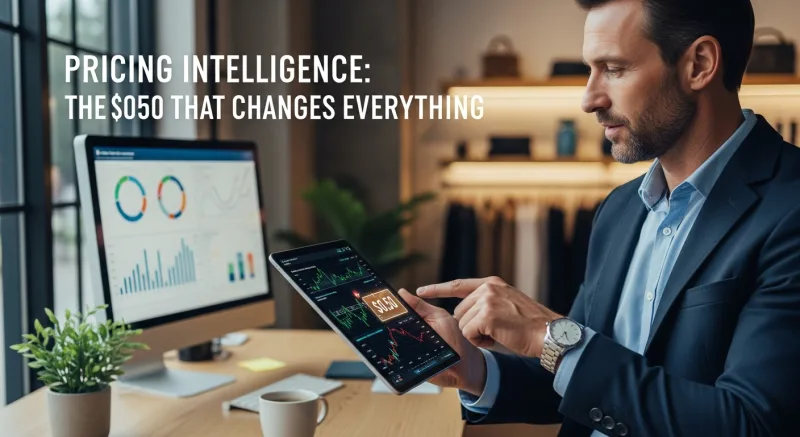
KwickOS AI monitors demand elasticity at the item level. It detects that your cold brew sells identically at $4.75 and $5.00 (inelastic demand — raise the price). It notices that your avocado toast dropped 20% in orders when you raised it from $9.50 to $10.50 (elastic demand — find a middle ground or revert). It identifies that seasonal drinks have significantly lower price sensitivity than staple drinks (customers expect to pay more for a limited-time pumpkin latte).
Now here's where it gets really interesting. The system recommends time-based pricing that most shops never consider. A latte costs you the same at 7 AM and 2 PM, but demand at 7 AM is 5x higher. A modest price increase during peak hours ($5.75 instead of $5.50) generates $0.25 per drink during the period when customers are least price-sensitive and most time-constrained. Over 200 peak-hour drinks per day, that is $50 daily or $18,250 annually in incremental revenue from a quarter per drink.
Waste Reduction: AI for the Most Perishable Menu in Food Service
Coffee shops waste 15-20% of their pastry inventory daily. The muffins baked or delivered in the morning that do not sell by 3 PM become stale. The sandwiches prepped for the lunch rush that sit unsold go in the trash at closing. This waste directly erodes a category (food) that many coffee shops depend on for 25-35% of revenue.
KwickOS AI forecasts food demand by item and day, enabling precise ordering from bakery suppliers or internal production. The system learns that chocolate croissants sell out on weekdays but banana bread underperforms on Mondays. It recommends ordering 20% fewer banana bread loaves on Mondays and reallocating that spend to additional croissants.
And here's the part that pays for itself. The system also triggers dynamic promotions to move aging inventory. At 2 PM, when pastries have 3 hours of saleable life remaining and current stock exceeds projected demand, the AI generates a "happy hour" food promotion: "50% off all pastries after 2 PM." This recovers partial revenue from items that would otherwise be thrown away, and it brings in afternoon customers who might also buy a drink at full price.
Multi-Location Intelligence for Growing Coffee Brands
Independent coffee shops that expand to 2-5 locations face an immediate management scaling problem. The owner who personally managed one shop — adjusting orders, monitoring quality, coaching staff — cannot be in three places simultaneously. Each additional location doubles the decision-making load without doubling the owner's capacity.
KwickOS provides real-time dashboards across all locations from a single screen. The AI identifies cross-location patterns that no manager would spot: Location 2's oat milk consumption is 40% higher per capita than Location 1, suggesting a different customer demographic that should influence menu offerings. Location 3's morning rush peaks 20 minutes later than Location 1, meaning the same staff schedule applied to both locations wastes labor at Location 3.
Think about what this means for growth. The system standardizes what should be standardized (drink recipes, quality metrics, loyalty programs) while allowing location-specific optimization (staffing schedules, inventory levels, promotional timing). This balance between consistency and local adaptation is what separates successful multi-location coffee brands from chains that feel generic.
Why Toast and Square Lose the Coffee Shop Battle
Toast charges coffee shops the same processing rate (see our full KwickOS vs Toast comparison) it charges full-service restaurants: 2.99% + $0.15 per transaction. On a $5 coffee, that is $0.30 — 6% of the sale price. For a coffee shop processing 300 transactions per day, that is $90 daily in processing fees, or $32,850 annually. An independent processor at 2.2% + $0.08 charges $0.19 per $5 transaction — $57 daily, saving $12,045 per year. KwickOS lets you use any processor, making those savings real.
Beyond pricing, Toast's features are calibrated for restaurants with tables, servers, and multi-course meals. Its menu engineering tools assume a dinner menu with appetizers, entrees, and desserts. A coffee shop with 30 drinks and 12 food items does not benefit from restaurant-centric analytics.
Square is simpler but shallower (see the full KwickOS vs Square breakdown). Square's loyalty program is a basic digital punch card with no predictive personalization. Its inventory tracks items but not ingredients — it knows you sold 50 lattes but cannot tell you how much oat milk remains. Square has no concept of morning rush forecasting, dynamic food pricing, or customer churn prediction.
KwickOS understands that a coffee shop is not a small restaurant. It is a high-velocity, low-ticket, relationship-dependent business where the difference between thriving and failing is measured in seconds per transaction, cents per drink, and the 400 regulars who either come back tomorrow or do not.
Coffee shop owners competing against Starbucks: Call (888) 355-6996 or visit KwickOS.com for a demo built around coffee shop operations.
AI + Loyalty: Smarter Customer Retention
KwickOS combines AI insights with built-in loyalty tools to do something no other POS can: predict which customers are about to stop coming in and automatically re-engage them.
The gift card and loyalty system is not just a punch card — it is connected to AI-powered analytics that identify spending patterns, predict churn risk, and suggest targeted promotions. A customer who used to visit weekly but has not been in for 3 weeks? The system flags them and can trigger an automatic points bonus or e-gift card offer via SMS.
- Smart gift cards — AI suggests optimal gift card denominations based on your average ticket size
- Predictive loyalty — identifies at-risk customers before they leave, triggers re-engagement
- Points optimization — automatically adjusts earn rates during slow periods to drive traffic
- Membership insights — shows which VIP tiers generate the most lifetime value
All included. No add-on fees. Toast charges $75/month for basic loyalty without any AI component.

Founder & CIO of KwickOS · 30 Years IT · 20 Years Restaurant Industry
Tom built KwickOS after decades running restaurants and IT companies. Today KwickOS serves 5,000+ businesses across 50 states.