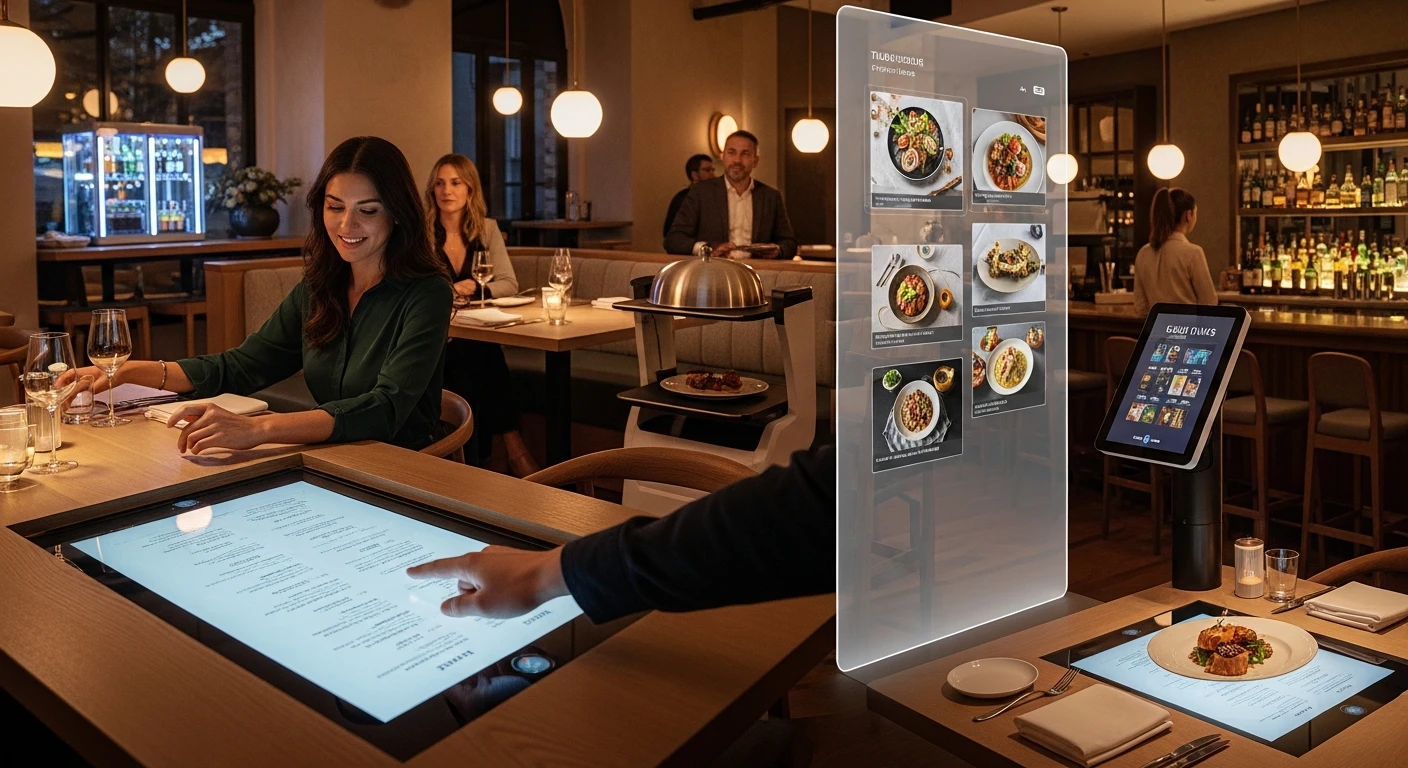
The restaurant industry has always been a business of thin margins and relentless execution. What has changed in the past few years is the role technology plays in determining who thrives and who struggles. The gap between tech-forward restaurants and those still running on manual processes is now measurable in dollars — thousands of dollars per month in labor savings, reduced waste, and captured revenue that would otherwise walk out the door.
We are not talking about gimmicks or Silicon Valley fantasies. The seven trends in this article are being implemented right now by real restaurants, from single-location family operations to chains with hundreds of units. Each one addresses a specific operational problem and delivers a measurable return. Let us look at what is actually working.
1. AI-Powered Ordering and Customer Interaction
Artificial intelligence has moved beyond the hype phase in restaurants and into practical, revenue-generating applications. The most impactful use case right now is AI-assisted ordering — systems that use natural language processing to take phone orders, manage drive-through interactions, and personalize online ordering experiences.
KwickPhone, for example, handles inbound phone orders using conversational AI that understands menu items, modifiers, and common customer requests. For restaurants that receive a high volume of phone orders — Chinese restaurants, pizza shops, and catering-heavy operations — this eliminates the labor cost of having a dedicated phone person during peak hours while actually improving order accuracy. A human taking phone orders in a noisy kitchen makes mistakes. An AI system does not get distracted.
On the online ordering side, AI-driven recommendation engines are proving their value. When a customer orders a main course, intelligent suggestions for appetizers, drinks, and desserts increase average ticket size by 12 to 18 percent in real-world deployments. This is not a theoretical number — it is what restaurants using smart upselling on their online ordering platforms are actually seeing.
The key insight is that AI in restaurants is not about replacing human hospitality. It is about handling the repetitive, error-prone tasks — phone orders, data entry, inventory counting — so that your staff can focus on the parts of the job that require human judgment and warmth.
2. Self-Service Kiosks Going Mainstream
Self-service kiosks used to be associated exclusively with fast food chains that could afford six-figure technology investments. In 2026, the economics have shifted dramatically. Tablet-based kiosks running on standard iPads or Android devices can be deployed for a fraction of the cost of purpose-built hardware, making them accessible to any restaurant.
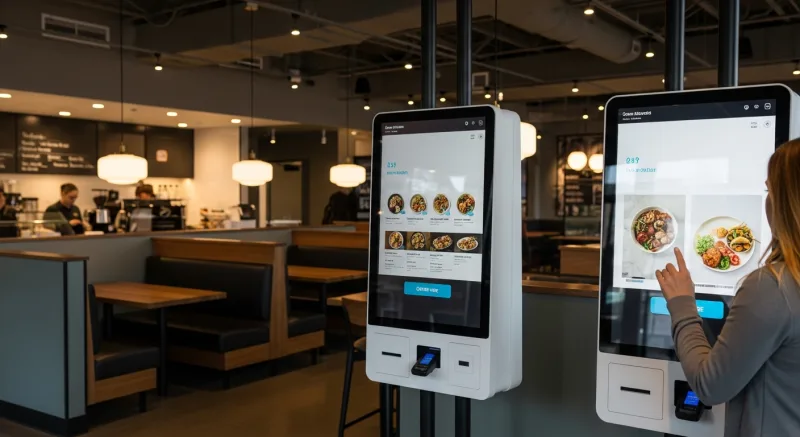
The results speak for themselves. Rockin' Rolls Sushi Express deployed 49 iPad self-ordering stations across their three locations and saw a measurable reduction in serving time through seamless KDS (kitchen display system) integration. Customers place their own orders at the table, the order goes directly to the kitchen display, and food arrives faster because there is no lag waiting for a server to enter the order manually.
Baked Cravings took the concept further by deploying a self-serve kiosk at Lego Land for their 24-hour retail operation using a PaxA35 terminal. For their business model — high traffic, simple menu, need for speed — a kiosk eliminates the constraint of staffing and allows them to serve customers around the clock.
Tiger Sugar International Dessert uses kiosks with minimal-step personalization, allowing customers to customize their drink orders through an intuitive touchscreen interface. The kiosks also generate electronic receipts with integrated loyalty tracking, turning every transaction into a data point for their customer relationship management.
The trend is clear: kiosks are no longer a luxury for enterprise chains. They are a practical tool for any restaurant that wants to reduce labor costs, increase order accuracy, and speed up service. The key is choosing a kiosk solution that integrates directly with your POS and kitchen systems rather than operating as a separate silo.
3. Contactless and Tap-to-Pay Becoming the Default
The shift toward contactless payments that accelerated during the pandemic has now reached a tipping point. In 2026, tap-to-pay is no longer an alternative payment method — it is the primary payment method for a majority of consumers under 45. Restaurants that do not support NFC payments, mobile wallets (Apple Pay, Google Pay, Samsung Pay), and QR code-based payments are actively losing customers.
But the more interesting development is what is happening behind the scenes with payment processing. The most forward-thinking restaurant operators are realizing that who processes their payments matters as much as how. POS platforms that lock merchants into proprietary payment processing — charging 2.99% plus a per-transaction fee — are costing restaurants thousands of dollars annually compared to processor-agnostic systems where the merchant can negotiate competitive interchange-plus rates.
For a restaurant processing $500,000 in annual card transactions, the difference between a locked 2.99% rate and a negotiated 2.2% interchange-plus rate is approximately $3,950 per year. Over five years, that is nearly $20,000. You can calculate your own potential savings using our processing fee calculator.
The trend is dual: contactless payments are the customer-facing change, but processor freedom is the operator-facing opportunity that smart restaurants are not ignoring.
4. Hybrid Cloud-and-Local Architecture
The debate between "cloud POS" and "local POS" has been resolved by a third option: hybrid systems that combine the best of both worlds. A hybrid architecture runs the POS application locally on your network — processing orders, sending kitchen tickets, and handling payments at local network speed — while syncing all data to the cloud for remote access, backup, and multi-location management.
The practical benefits are significant. Local processing means sub-millisecond response times at the terminal. When a server taps "send to kitchen," the ticket appears on the KDS screen instantly — not after a round trip to a cloud server that might take 20 to 100 milliseconds depending on your internet connection and the vendor's server load. During a dinner rush, those milliseconds add up across hundreds of orders.
More importantly, a hybrid system keeps working when your internet goes down. This is not an edge case. A 2025 survey by Uptime Institute found that 60% of businesses experienced at least one significant internet outage in the past year. For a restaurant doing $5,000 in revenue on a busy night, even 30 minutes of downtime on a cloud-only POS can mean $500 to $1,000 in lost sales and frustrated customers who leave.
T. Jin China Diner, which operates 15 locations with 75 terminals, relies on hybrid architecture for real-time remote monitoring across all stores. The owner can view live sales data, check inventory levels, and monitor employee activity from anywhere — but each location continues to function independently if the internet connection drops. That combination of central visibility and local resilience is what makes hybrid the winning architecture.
Cloud-only POS vendors often downplay this issue, claiming their "offline mode" handles outages. In most cases, offline mode means you can accept cash payments and queue credit card transactions — a far cry from full operational continuity. If your restaurant accepts 70 to 80 percent of payments by card (the national average), a cloud-only offline mode leaves most of your transactions in limbo.
5. First-Party Delivery Technology
The economics of third-party delivery are forcing a reckoning. DoorDash, Uber Eats, and Grubhub charge restaurants 15 to 30 percent commission on every order. For a restaurant with 30% food costs and 30% labor costs, paying another 20% in delivery commission means the restaurant is losing money on every delivery order. The math simply does not work for most operators.
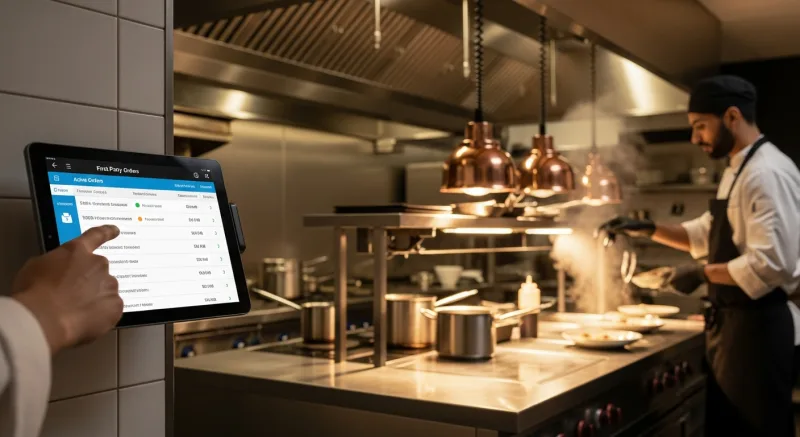
The solution is first-party delivery — technology that lets restaurants manage their own delivery operations through their own website and app, keeping the customer relationship and the revenue. The challenge has always been logistics: routing, driver management, and the sheer operational complexity of running a delivery fleet.
New delivery management tools are solving this. KwickDriver, for example, offers a flat-fee delivery model at $2 per order plus $6.99 per five miles — a fraction of the 15 to 25 percent commission that third-party platforms charge. For a $30 delivery order, the restaurant pays roughly $9 through a third-party platform but only about $9 through first-party delivery with built-in logistics. The economics flip dramatically at higher order values: a $50 order costs $10-$12.50 through DoorDash but still under $10 through first-party delivery.
KwickMenu, which powers online ordering for thousands of restaurants, processes over 500,000 clicks per month — demonstrating the massive consumer demand for direct ordering from restaurants. Customers increasingly prefer ordering directly from a restaurant's website when given the option, especially when the experience is seamless and they know more of their money goes to the business they are supporting.
The trend is unmistakable: restaurants that build first-party ordering and delivery capability in 2026 will own their customer relationships and their margins. Those that remain dependent on third-party platforms will continue to subsidize someone else's business model. Use our delivery fee calculator to see the difference for your specific situation.
6. Digital Signage as a Revenue Driver
Digital signage in restaurants used to mean a TV behind the counter showing a static menu. In 2026, it has evolved into a dynamic, data-driven communication channel that directly impacts revenue.
Modern digital signage systems integrated with POS data can automatically promote high-margin items during slow periods, display real-time wait times, showcase daily specials, and even adjust displayed pricing for happy hour or late-night menus — all without any manual intervention. The signage updates itself based on time of day, inventory levels, and sales data.
The most compelling use case is in quick-service and fast-casual restaurants where the menu board is the primary sales tool. A digital menu board that highlights high-margin combos, features appetizing photography, and dynamically promotes items based on inventory can increase average ticket size by 8 to 15 percent compared to static boards.
For multi-location operations, centrally managed digital signage eliminates the cost and delay of printing and shipping physical menu boards every time there is a price change or menu update. Crafty Crab Seafood, with 19 locations, uses centralized menu management to push updates to all stores simultaneously — and digital signage is a natural extension of that capability.
What makes this trend particularly interesting is that most POS platforms — Toast, Square, Clover — do not offer built-in digital signage. It is typically a separate system from a separate vendor with separate management. An integrated platform that includes signage natively, like KwickOS with KwickSign, eliminates the complexity and cost of a third-party signage solution.
7. Biometric Authentication for Staff
The seventh trend is less visible to customers but has significant financial impact: biometric authentication for employee clock-in, POS access, and security-sensitive operations like voids and discounts.
Traditional employee authentication uses PINs or swipe cards. The problem is well-documented: employees share PINs, buddy-punch for each other, and use unauthorized discounts. The National Restaurant Association estimates that employee theft accounts for 4 to 5 percent of restaurant revenue. For a restaurant doing $1 million in annual revenue, that is $40,000 to $50,000 per year.
Fingerprint-based authentication solves this in two ways. First, it eliminates buddy punching because you cannot fake a fingerprint. Second, it creates an auditable trail for every sensitive action — every void, every discount, every drawer open — tied to a specific individual's biometric identity rather than a shareable PIN.
The most advanced implementations use 1:N fingerprint matching, where the employee simply touches the sensor without entering an employee number first. The system identifies the employee from its database in under a second. This is faster than typing a PIN and far more secure. Contrast this with 1:1 matching, where the employee enters their ID first and then scans their finger — functional but slower.
Diva Nail Beauty, with four locations and four terminals, implemented fingerprint-based authentication with automated commission tracking and saw a 90% increase in operational efficiency. The system eliminated disputes over commissions by creating an irrefutable record of which technician performed each service.
The adoption barrier for biometric authentication has historically been cost and complexity. Purpose-built biometric terminals were expensive and required specialized IT to deploy. Today, fingerprint scanners that connect via USB to standard POS terminals cost under $100 and integrate directly with platforms that support them. The ROI is measured in weeks, not years.
It is worth noting that major POS platforms like Toast do not support fingerprint authentication at all. This is one of those features that separates enterprise-grade business operating systems from consumer-oriented POS terminals.
How to Act on These Trends
Understanding trends is useful. Acting on them is what matters. Here is a practical prioritization framework for restaurant operators:
- Immediate (this quarter): Evaluate your payment processing arrangement. If you are locked into a proprietary processor, calculate what you are overpaying and explore processor-agnostic alternatives. This is the fastest path to measurable savings.
- Near-term (next 6 months): If you do not have first-party online ordering, implement it. The revenue you are losing to third-party commission is likely your single largest controllable expense after labor and food costs.
- Medium-term (next 12 months): Evaluate self-service kiosks for your operation. Start with one or two units in a single location, measure the impact on labor costs and order accuracy, and expand from there.
- Ongoing: Ensure your POS platform supports hybrid architecture, biometric authentication, and integrated digital signage. If it does not, you will need to switch platforms eventually — and the sooner you do, the less painful the migration.
The restaurants that will thrive in the next five years are not necessarily the ones with the biggest budgets. They are the ones that adopt the right technology at the right time and integrate it into a unified operational platform rather than stitching together a patchwork of disconnected tools.
Future-Proof Your Restaurant
KwickOS is the all-in-one platform that brings all seven of these trends together — AI ordering, kiosks, contactless payments, hybrid cloud, first-party delivery, digital signage, and biometric security. See it in action.
Get Your Free Demo