You are placing merchants, closing deals, grinding through objections — and yet every month your income resets to zero. Commission checks come and go, but nothing compounds. You watch colleagues earning less per deal somehow build $15K, $20K, even $30K/month in recurring income while you start from scratch every single quarter.
It gets worse. The POS platform you are selling — Toast, Square, Clover — is quietly siphoning the one income stream that could change everything: your payment processing residuals. Every merchant you place on a processing-locked POS is a merchant generating $0 in residual for you. Permanently.
But here is the good news: there is a proven, mathematical path to $20,000/month in passive residual income within 30 months. It requires the right POS platform (one that does not steal your processing), consistent merchant placements, and an understanding of how interchange economics actually work. This guide breaks down the exact model — with real numbers, real timelines, and real portfolio valuations.
The Foundation: How Interchange Creates Your Income
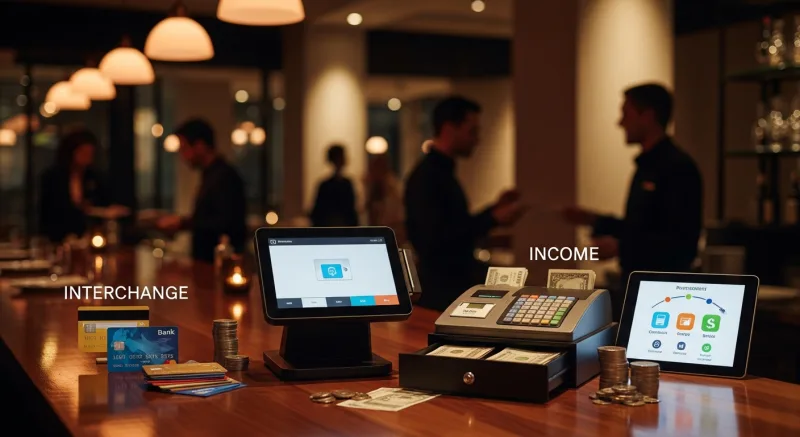
Every time a consumer swipes, dips, or taps a credit or debit card at a merchant's terminal, a series of fees flow between four parties: the cardholder's bank (issuer), the merchant's bank (acquirer), the card network (Visa/Mastercard/Amex/Discover), and the payment processor. Understanding this flow is essential because your residual income is a fraction of these fees. (For a complete breakdown, see our credit card processing fees guide.)
The Fee Stack
On a typical $50 restaurant transaction paid with a Visa Signature credit card:
| Fee Component | Who Sets It | Approximate Amount | Who Receives It |
|---|---|---|---|
| Interchange Fee | Visa/Mastercard | 1.65% + $0.10 = $0.925 | Issuing Bank |
| Assessment Fee | Visa/Mastercard | 0.14% = $0.070 | Card Network |
| Processor Markup | Your Processor | 0.10% + $0.05 = $0.100 | Processor |
| Agent Markup | You (the Agent) | 0.10% + $0.03 = $0.080 | You |
| Total Merchant Cost | 1.99% + $0.18 = $1.175 |
In this example, the merchant pays $1.175 on a $50 transaction. Of that, $0.08 — your markup — is your residual. It does not sound like much on a single transaction. But a restaurant processing $40,000/month runs approximately 1,600 transactions. Your 10 basis points + $0.03 per transaction yields roughly $70/month from that single merchant. Now multiply by 100 merchants. Then by 200. (Use our free POS calculators to model your specific territory.)
Interchange-Plus vs. Flat-Rate: Why It Matters for Your Income
The pricing model you use with merchants directly determines how much you earn.
Interchange-Plus (IC+): The merchant pays actual interchange (set by card networks) plus your markup. Your markup is transparent and consistent. A merchant on IC + 20 basis points pays interchange + 0.20% on every transaction. You earn the 20 bps minus your processor's cost (typically 5-10 bps), leaving you 10-15 bps of net residual. This is the gold standard for agent income because your margin is predictable and defensible.
Flat-Rate: The merchant pays a single rate (e.g., 2.49%) on all transactions. The actual interchange varies by card type (debit is cheaper, rewards cards are more expensive, corporate cards are most expensive), so the agent's margin fluctuates. On a month with lots of debit transactions, margins are fat. On a month with lots of corporate cards, margins are thin. Flat-rate is simpler to sell but harder to predict for income purposes.
The POS connection: Toast and Square use flat-rate pricing that the merchant cannot negotiate, and the agent cannot participate in. The processing revenue flows to the POS company, not to you. On a processor-agnostic platform like KwickOS, you set the pricing model. (See our detailed KwickOS vs Toast comparison for the full breakdown.) Most sophisticated agents use interchange-plus because it maximizes their controllable margin and provides the most transparent value to the merchant.
The Portfolio Compounding Model: From 0 to $20K/Month
Residual income from payment processing follows a mathematical compounding curve. Each new merchant adds to your monthly income permanently (or until they close or switch processors). Unlike commission income, which resets to zero each month, residual income is cumulative. Every month starts with the income from last month, plus whatever new merchants you added, minus whatever merchants you lost to attrition.
Here is the 24-month model for an agent starting from zero and placing 5 new merchants per month:
Assumptions
- New merchants per month: 5
- Average monthly card volume per merchant: $45,000
- Agent net residual: 0.20% (20 basis points) of card volume
- Monthly attrition: 1.5% (lower than industry average, achievable with quality POS and service)
- Volume growth: 0% (conservative — in reality, merchant volumes tend to grow 3-5%/year)
The 24-Month Trajectory
| Month | Active Merchants | Total Monthly Volume | Monthly Residual Income |
|---|---|---|---|
| 1 | 5 | $225,000 | $450 |
| 3 | 15 | $668,000 | $1,336 |
| 6 | 29 | $1,282,000 | $2,564 |
| 9 | 42 | $1,872,000 | $3,744 |
| 12 | 54 | $2,430,000 | $4,860 |
| 15 | 66 | $2,961,000 | $5,922 |
| 18 | 77 | $3,460,000 | $6,920 |
| 21 | 87 | $3,928,000 | $7,856 |
| 24 | 97 | $4,365,000 | $8,730 |
At 5 placements per month — a part-time pace for many agents — you reach $8,730/month in passive residual income within 24 months. That is $104,760 annualized. Not bad for what many agents treat as a supplemental activity.
Now let us look at the same model at 10 placements per month — a full-time reseller's pace:
| Month | Active Merchants | Monthly Residual Income |
|---|---|---|
| 6 | 57 | $5,130 |
| 12 | 108 | $9,720 |
| 18 | 153 | $13,770 |
| 24 | 193 | $17,370 |
| 30 | 228 | $20,520 |
At 10 placements per month, you cross the $20,000/month threshold at Month 30. That is $240,000+ per year in passive residual income. And "passive" is the operative word — these are merchants you placed months or years ago. They are processing cards every day. Your residual arrives every month. You do not need to re-sell them, re-service them, or re-negotiate. The income persists as long as the merchant is active.
At 10 new merchant placements per month with $45K average volume and 20 basis points net residual, an agent crosses the $20K/month passive income threshold by Month 30. The income continues growing with each additional placement.
The POS Lever: Why Your POS Choice Determines Your Residual Ceiling
Now here is where it gets really interesting.
Here is the insight that separates $5K/month agents from $20K/month agents: your POS platform is the primary determinant of your residual income ceiling. Not your sales skill. Not your territory. Your POS choice.
The logic is straightforward:
- To earn processing residuals, you need a processing relationship with the merchant.
- To have a processing relationship, the merchant's POS must allow external processing.
- If the POS requires proprietary processing (Toast, Square), you have no residual.
- If the POS is processor-agnostic (KwickOS), you keep your full residual.
This is not a marginal difference. It is binary. On Toast, your processing residual from each merchant is $0. On KwickOS, your processing residual from each merchant is $90/month (at 20 bps on $45K volume). Over 200 merchants, that is $0/month vs. $18,000/month. Same merchants. Same sales effort. Different POS.
The Dual-Income Architecture
Smart agents build what I call a dual-income architecture: POS revenue (from hardware and software placement) PLUS processing residual (from card volume). These are two independent income streams generated by a single sales activity — placing a merchant on your POS platform with your processing.
Let us quantify the dual-income model for a single merchant:
| Income Component | Amount | Frequency | 36-Month Total |
|---|---|---|---|
| POS Hardware Margin | $300-$800 | One-time | $300-$800 |
| POS Software Revenue Share | $20-$50/mo | Monthly | $720-$1,800 |
| Processing Residual (20 bps on $45K) | $90/mo | Monthly | $3,240 |
| Total Per Merchant (36 Months) | $4,260-$5,840 |
A single merchant generates $4,260-$5,840 in total income over 36 months. The processing residual ($3,240) accounts for 55-76% of the total — and it is the only component that is truly passive after the initial placement. It is also the only component that a processing-capture POS like Toast eliminates.
Merchant Selection: Where the Highest Residuals Live
Not all merchants generate equal residual income. The key variables are card volume and card mix (debit vs. credit vs. corporate). Here is where to focus for maximum residual per placement:
High-Volume Merchants (>$80K/month card volume)
Full-service restaurants, high-end beauty salons, specialty retail. A merchant processing $100,000/month at 20 basis points generates $200/month in residual — more than double the average. These accounts are harder to close but disproportionately valuable. A portfolio of 50 high-volume merchants generates the same residual as 100+ average merchants.
KwickOS reference: Crafty Crab Seafood operates 19 locations with 152 terminals. A chain of this size likely processes $1.5-$2.5 million per month in total card volume. At 20 basis points, a single chain account of this scale generates $3,000-$5,000/month in residual income.
Multi-Location Operators
Chain restaurants with 3-20 locations are the highest-value targets in POS sales. One sales effort, one relationship, multiple locations of card volume. A 10-store chain doing $40K/month per location generates $400K in total monthly volume = $800/month residual from a single client relationship.
KwickOS's multi-location management capabilities — one-click menu sync, real-time multi-store monitoring, centralized reporting — make these accounts sticky. T. Jin China Diner has been on KwickOS across all 15 locations for years. That kind of retention is what makes chain accounts the backbone of a high-value residual portfolio.
Business-to-Business Merchants
Merchants who accept corporate purchasing cards and business credit cards generate the highest interchange per transaction. B2B interchange rates can exceed 2.5% (compared to 1.5-1.8% for consumer cards), which means the spread between interchange and your all-in rate is larger. More spread = more residual per dollar of volume.
Cash-Heavy Businesses Converting to Card
The most overlooked opportunity: businesses that are currently cash-heavy but transitioning to card acceptance. Asian restaurants, in particular, have historically been more cash-intensive. As consumer payment preferences shift to card and contactless, these merchants' card volumes grow 10-20% year over year. Your residual from these merchants grows automatically as their card volume increases — without any additional effort from you.
The Retention Imperative: Protecting Your Residual Stream
The mathematical models above assume a 1.5-2% monthly attrition rate. Improve retention by even half a percent, and the cumulative impact on your portfolio is enormous. At 200 merchants:

- 2% monthly attrition: You lose 4 merchants/month. You must place 4 new merchants just to stay even.
- 1.5% monthly attrition: You lose 3 merchants/month. One fewer replacement needed per month.
- 1% monthly attrition: You lose 2 merchants/month. Half the replacement burden.
Over 12 months, the difference between 2% and 1% attrition on a 200-merchant portfolio is 24 merchants — representing approximately $2,160/month in residual income. That is $25,920/year from retention improvement alone, without placing a single new merchant.
This is where your POS choice directly impacts your income. A reliable, feature-rich POS that merchants love reduces churn. Our 2026 POS buying guide covers which features matter most for retention. An unreliable POS with hidden fees and poor support increases churn. Every percentage point of retention translates directly to your bank account.
How KwickOS Drives Retention
- Hybrid architecture: 1ms local processing, continues during internet outages. Merchants never experience a dead terminal during service. Zero downtime = zero reason to switch.
- All-in-one platform: POS, KDS, online ordering, kiosks, digital signage, CRM, loyalty, gift cards, delivery — all integrated. No feature gaps that competitors can exploit. No add-on fees that create resentment.
- Processor freedom: Merchants never feel trapped. They stay because the system works, not because they cannot leave. Voluntary retention is the strongest retention.
- 24/7 multilingual support: English, Chinese, Spanish from U.S.-based teams. Problems get solved quickly in the merchant's language. A merchant who gets fast, native-language support at 11 PM on a Saturday does not switch POS systems.
- Deep integration: Merchants using KwickOS for POS + KDS + online ordering + kiosks + signage have high switching costs. Replacing one component means replacing everything. This natural stickiness protects your residual.
Portfolio Valuation: Building a Sellable Asset
A processing residual portfolio is not just income — it is an asset. In the payments industry, residual portfolios are bought and sold regularly. Current market multiples:
| Portfolio Quality | Multiple (Monthly Residual) | Example: $15K/mo Portfolio |
|---|---|---|
| Low quality (high attrition, flat-rate, no POS stickiness) | 18-22x | $270,000 - $330,000 |
| Average quality (moderate attrition, mixed pricing) | 24-28x | $360,000 - $420,000 |
| High quality (low attrition, IC+, POS-integrated, sticky merchants) | 30-36x | $450,000 - $540,000 |
| Premium (low attrition, chain accounts, multi-year POS contracts) | 36-42x | $540,000 - $630,000 |
A $15,000/month residual portfolio — achievable within 18-24 months at the pace we have modeled — is worth between $270,000 and $630,000 depending on quality. The factors that push toward premium valuation are exactly the factors that KwickOS provides: low attrition (hybrid reliability, all-in-one features), POS stickiness (deep integration reduces switching), and interchange-plus pricing (clean, transparent margins that buyers can underwrite).
For agents thinking about building toward an exit — or simply building long-term wealth — the portfolio valuation is often more valuable than the cumulative income. An agent who earns $300,000 in residual income over 3 years AND builds a portfolio worth $500,000 has created $800,000 in total wealth. The portfolio sale is a liquidity event that commissions and bonuses can never provide.
The $500K Merchant: A Case Study in Residual Economics
Let us trace the full residual economics of a single high-value merchant to illustrate the compounding effect at the individual account level.
Merchant profile: A Japanese hibachi restaurant doing $500,000/year in card volume ($41,667/month). Placed on KwickOS with interchange-plus processing at IC + 25 basis points. Agent cost basis is IC + 5 bps. Net agent residual: 20 basis points.
| Metric | Value |
|---|---|
| Monthly card volume | $41,667 |
| Agent residual (20 bps) | $83.33/month |
| Annual residual | $1,000 |
| 3-year residual (assuming 3% annual volume growth) | $3,184 |
| 5-year residual | $5,637 |
| Portfolio value of this one merchant (at 30x monthly) | $2,500 |
One merchant. $1,000/year in passive income. $2,500 in portfolio value. Now imagine this merchant is Shogun Japanese Hibachi — a KwickOS reference account that reported operator proficiency in under 5 minutes. A merchant that happy is a merchant that stays for years, generating residual income throughout.
Now scale that across a portfolio. One hundred merchants at $1,000/year each = $100,000/year in passive residual income from a portfolio worth $250,000 at 30x valuation. The math is not complicated. The challenge is placing 100 merchants and keeping them. That is where your POS platform — and your commitment to the process — determines the outcome.
The POS-Processing Flywheel
But wait — it gets even better.
The most successful agents in the industry have discovered something that creates exponential growth: the POS-processing flywheel. Here is how it works:
- Place a merchant on KwickOS + your processing. You earn POS revenue and processing residual.
- The merchant is happy. KwickOS works reliably, includes all features, and the processing rate is fair.
- The merchant refers other merchants. Restaurant owners know other restaurant owners. Nail salon owners know other salon owners. One happy merchant generates 1-3 referrals per year.
- You place the referred merchants. Lower acquisition cost (no cold calling), higher close rate (warm referral), same residual income.
- Your growing portfolio demonstrates credibility. When you can say "I service 50 restaurants in this area," prospects trust you more than when you say "I'm new to this."
- Higher credibility leads to more placements, which leads to more referrals.
This flywheel effect is why agents with established portfolios accelerate rather than plateau. The first 50 merchants are the hardest. The next 50 come from referrals, reputation, and momentum. By the time you reach 100+ merchants, your pipeline is partially self-generating.
KwickOS's merchant base provides a particularly strong foundation for this flywheel in specific communities. In Asian restaurant markets, where KwickOS has deep penetration (T. Jin China Diner, Crafty Crab, Tiger Sugar, Haidilao), a single successful installation can generate cascading referrals through tightly networked community connections. Agents who target this segment report referral rates 2-3x higher than the restaurant market average.
Getting to $20K/Month: The Action Plan
Phase 1: Foundation (Months 1-6)
- Complete KwickOS reseller onboarding and product training
- Establish or confirm your processing agreement (ISO or sub-agent)
- Target 5 placements/month, focusing on single-location restaurants and beauty/spa
- Build your first 25-30 active merchants
- Expected residual by Month 6: $2,500-$3,000/month
Phase 2: Acceleration (Months 7-18)
- Increase pace to 8-10 placements/month as your product knowledge and pipeline develop
- Begin targeting multi-location operators (higher value per deal)
- Leverage early merchant success for referrals — ask every satisfied merchant for 2 introductions
- Expected residual by Month 18: $10,000-$14,000/month
- Portfolio asset value: $300,000-$420,000
Phase 3: Compounding (Months 19-30)
- Maintain 10 placements/month — your pipeline is now partially self-generating from referrals
- Focus on portfolio quality: replace any underperforming processors, upgrade merchants to interchange-plus if they are on flat-rate
- Consider adding a sub-agent or sales associate to expand coverage while you manage the portfolio
- Expected residual by Month 30: $20,000+/month
- Portfolio asset value: $600,000+
The Bottom Line
So what does all this mean for you?
Building $20,000/month in passive residual income from payment processing is not a fantasy and not a marketing pitch. It is a mathematical outcome of placing merchants at a consistent pace on a platform that does not steal your processing revenue, and maintaining those merchants through superior POS technology and service.
The variables are within your control: placement pace, merchant quality, processing markup, and POS platform choice. Of these, the POS platform choice is the most consequential, because it determines whether you earn processing residuals at all. On Toast or Square, you earn zero residuals regardless of how many merchants you place. On KwickOS, you earn your full residual on every merchant, every month, compounding into a portfolio that generates passive income and appreciates as a sellable asset.
KwickOS does not process payments. KwickOS does not want your processing revenue. KwickOS wants to be the best POS platform for your merchants — because happy merchants stay, and merchants who stay keep generating the residual income that makes your business work. That alignment of incentives is the foundation of the entire model.
If you are ready to explore the KwickOS reseller opportunity and start building your residual portfolio, contact our partner team at kwickos.com/partners or call (888) 355-6996.
Turn One-Time Diners into Regulars: Built-In Gift Cards & Loyalty
Most POS companies treat gift cards and loyalty as afterthoughts — expensive add-ons that cost $50-100/month extra. KwickOS includes them at no additional charge because we believe they are essential revenue tools, not luxury features.
Gift Cards That Actually Drive Revenue
Here is what most restaurant owners do not realize: gift card buyers spend an average of 20-40% more than the card's face value. A $50 gift card typically generates $60-70 in actual spending. KwickOS supports both physical gift cards and electronic gift cards that customers can purchase, send, and redeem through their phones.
- Physical gift cards — branded plastic cards that sit on your counter and sell themselves during holidays
- E-gift cards — customers buy and send digitally via text or email, perfect for last-minute gifts
- Balance tracking — real-time balance across all your locations, no manual reconciliation
- Reload capability — customers top up their balance, creating a built-in prepayment habit
Loyalty Points That Keep Them Coming Back
KwickOS loyalty is not a punch card from 2005. It is a digital points system that tracks every dollar spent and automatically rewards your best customers:
- Earn points on every purchase — configurable ratio (e.g., $1 = 1 point, or $1 = 10 points)
- Tiered rewards — silver, gold, platinum levels to incentivize higher spending
- Birthday rewards — automated birthday offers that bring customers back during their special month
- Points-for-payment — customers redeem points directly at checkout, seamless for your staff
Membership Programs
For restaurants running VIP programs or subscription models (like monthly coffee clubs), KwickOS membership management handles recurring billing, exclusive pricing tiers, and member-only menu items — all within the same system your cashier already uses.
The bottom line: Toast charges $75/month extra for loyalty. Square's loyalty starts at $45/month. KwickOS includes gift cards, e-gift cards, loyalty points, and membership management in every plan. That is $540-900/year you keep in your pocket.