30,000 Restaurants, 88 Cities, One County: LA’s POS Problem Is Bigger Than You Think
Updated March 2026 · By Tom Jin
Los Angeles County contains 88 incorporated cities, over 30,000 restaurants, and a dining culture so vast and varied that no single article, guide, or review can capture it. The San Gabriel Valley alone has more Chinese restaurants than most American states have restaurants total. Koreatown operates the largest Korean dining district outside Seoul. East LA’s taco culture predates the taco truck trend by five decades. And Hollywood’s celebrity chef restaurants set national culinary trends that other cities copy a year later.
The POS technology serving this ecosystem should match its complexity. It does not. Most LA restaurants run one of three systems — Toast, Square, or Clover — none of which were designed for the linguistic diversity, geographic scale, or culinary breadth that defines dining in LA County. The Chinese restaurant in Alhambra running an English-only POS. The taqueria in Boyle Heights paying 2.99% processing on $8 burritos. The multi-location Korean BBQ chain locked into hardware that cannot scale. These are not edge cases. They are the norm across 30,000 restaurants making technology choices that will cost them hundreds of thousands of dollars over the next five years.
The San Gabriel Valley: America’s Real Chinatown
Forget Manhattan’s Chinatown or San Francisco’s Grant Avenue. The San Gabriel Valley — Alhambra, Monterey Park, San Gabriel, Arcadia, Temple City, Rowland Heights — is the largest concentration of Chinese restaurants in the Western Hemisphere. Over 500 Chinese restaurants operate in a 15-mile corridor, representing every regional Chinese cuisine: Cantonese seafood, Sichuan hot pot, Shanghainese soup dumplings, Hunanese chili cuisine, Taiwanese bubble tea, and Northern Chinese hand-pulled noodles.
The operational reality of these restaurants is Chinese-language dominant. Kitchen staff read Chinese. Owners manage in Chinese. The menu items have names that are meaningful in Chinese and approximate in English. A POS system that renders dim sum tickets in romanized English creates daily production errors because the romanizations are ambiguous. “Shu mai” on a ticket could refer to three different preparations depending on the regional cuisine. The Chinese characters eliminate ambiguity instantly.
KwickOS renders Chinese natively on every screen — KDS, terminals, kiosks, and reports. The dim sum cart workflow processes through KwickOS with open checks that accumulate items as carts circulate through a 300-seat dining room. Each item stamps to the table check with Chinese characters and English descriptions simultaneously, producing a bill that both Chinese-speaking staff and English-speaking customers can verify. This dual-language workflow is not a feature added for the SGV. It is how KwickOS operates by design.
Koreatown After Midnight
LA’s Koreatown is the densest restaurant district in the city, with over 400 Korean restaurants, bars, and cafes concentrated in a three-square-mile area centered on Wilshire and Western. The defining characteristic of K-Town dining is its hours: Korean BBQ restaurants that open at 5 PM and close at 2 AM, soju bars that do not fill up until 11 PM, and after-hours fried chicken joints that peak between midnight and 3 AM.
This late-night operating model demands POS reliability beyond what standard restaurant-hour systems are designed for. KwickOS on Linux runs continuously without the memory leaks, background update interruptions, and periodic restart requirements that Windows-based systems exhibit during extended uptime. A K-Town BBQ restaurant that opens at 5 PM and closes at 2:30 AM runs KwickOS for 9.5 hours straight without a single hiccup, every night, 365 nights per year.
Korean BBQ’s tableside cooking model also creates unique POS requirements. Orders are placed incrementally as diners cook and consume, with additional proteins, sides, and beverages added throughout a two-hour dining experience. KwickOS handles open-ended, incrementally building checks natively — the server adds items to an active check throughout the meal, the KDS shows each addition to the kitchen for prep, and the final bill calculates when the table requests it. This is not the order-submit-close workflow that fast-casual POS systems assume. It is the continuous-service model that Korean BBQ requires.
The Taco Economy and Micro-Transaction Processing
East LA, Boyle Heights, Lincoln Heights, and South LA operate a taco economy where average transactions are $6-$12 — among the lowest of any restaurant segment. At these ticket levels, processing rates are not percentages on a spreadsheet. They are the difference between a viable business and a break-even operation that cannot afford to replace the fryer when it dies.
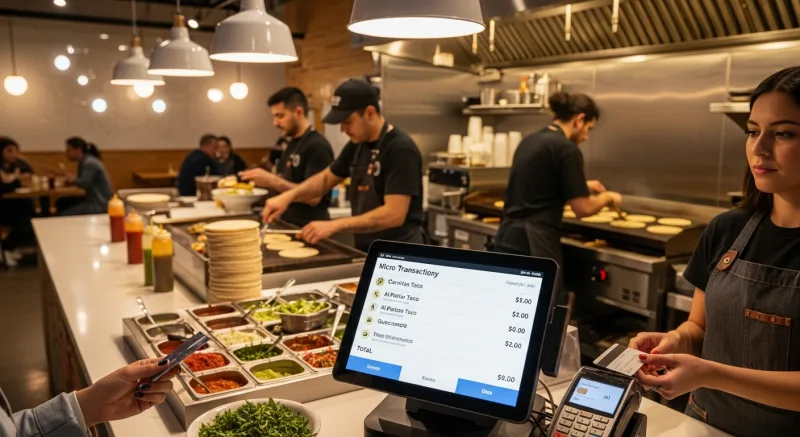
Toast’s 2.99% plus $0.15 on a $10 taco order takes $0.45 — 4.5% of the transaction. Square’s 2.6% plus $0.10 takes $0.36 — 3.6%. KwickOS with a competitive processor at 1.9% plus $0.05 takes $0.24 — 2.4%. The difference between 4.5% and 2.4% on 400 daily transactions at $10 average is $84 per day — $30,660 annually. For a taqueria where the owner works the grill fourteen hours a day, that $30,000 represents their entire annual personal income above expenses.
KwickOS also runs on hardware the restaurant already owns. A used iPad running KwickOS replaces a $799 Toast terminal with a $200 device. For taco shops operating on capital budgets measured in thousands rather than tens of thousands, this hardware flexibility eliminates a barrier to entry that locked-hardware systems create.
Earthquake Country and Local Processing
Southern California’s seismic activity creates infrastructure disruption risks that affect restaurant technology in ways that most POS companies ignore. A significant earthquake disrupts cell towers, internet trunk lines, and power distribution for hours to days. The Ridgecrest earthquakes in 2019 disrupted cellular service across portions of LA County. The Northridge earthquake in 1994 left large areas without power for weeks.
KwickOS processes every transaction locally on the device itself. No internet, no cell service, no cloud server required for the payment at your register. When the next significant quake hits and cellular infrastructure degrades, KwickOS restaurants keep processing while cloud-dependent systems wait for a connection to a server that may itself be affected. The local data storage means all sales records, employee data, and menu configurations survive the event on hardware at the restaurant rather than depending on a cloud service that may be inaccessible during the recovery period.
Hollywood and the Celebrity Restaurant Processing Tax
Hollywood, Beverly Hills, and West Hollywood host LA’s highest-ticket restaurants, where average dinner checks of $150-$400 per person make processing rates an enormous absolute cost. A restaurant in Beverly Hills processing $500,000 monthly in card transactions pays Toast $15,100 per month in processing. Through KwickOS with a negotiated rate of 2.0% plus $0.10, the cost drops to $10,500. Annual savings: $55,200. That is a full-time sous chef salary freed from processing fees.
At these elite volumes, the ability to negotiate processor rates — which only a processor-agnostic system like KwickOS permits — is worth more than any POS feature. The processing savings alone can fund the entire POS software subscription many times over. Toast, Square, and Clover lock high-volume restaurants into rates that those restaurants’ volumes give them the leverage to negotiate below — if they used a system that allowed negotiation.
The Food Truck Permit Labyrinth
LA County operates one of the most complex food truck regulatory environments in America. Different cities within the county have different permitting requirements, different operating hour restrictions, and different health inspection standards. A food truck that operates in Santa Monica, Hollywood, and Pasadena navigates three different regulatory frameworks. The POS system running this mobile operation must work in all three environments on the same hardware with the same reliability.
KwickOS runs on any touchscreen device, requiring no proprietary hardware that ties the operation to a specific terminal format. A food truck’s tablet-based KwickOS system works whether the truck is parked on Abbot Kinney in Venice or at a corporate catering event in Glendale. The same system processes street-vendor transactions, catering invoices, and online pre-orders through KwickMenu — all on a device that fits in a truck cabinet when the operation is mobile and on a counter when it is not.
Crafty Crab’s Multi-Location LA Model
Crafty Crab Seafood’s expansion to 19 locations with 152 terminals includes presence in Southern California, demonstrating multi-location management at scale within LA’s geographic enormity. Managing locations spread across a county where a drive from Long Beach to Pasadena takes 90 minutes requires technology that provides real-time visibility without physical presence.
KwickOS’s centralized dashboard shows every location’s real-time performance from any internet-connected device. When the owner checks Saturday night sales at 10 PM, all locations display simultaneously — revenue, covers, average tickets, labor percentages, and variance from projections. One-click menu synchronization ensures consistency across locations while allowing per-location modifications for local market preferences. This management infrastructure is what makes multi-location growth across LA County operationally feasible rather than a management nightmare.
Loyalty in the Most Competitive Market in America
With 30,000 restaurants in the county, LA presents the most intense customer acquisition and retention challenge in the country. A restaurant in Silver Lake competes with 50 alternatives within walking distance. A lunch spot in DTLA competes with food halls, ghost kitchens, and celebrity chef restaurants all within a three-block radius. Without systematic loyalty capture, even excellent restaurants lose customers to the sheer volume of alternatives.
KwickOS integrates loyalty points, gift cards, and membership tiers into every transaction without add-on fees. A customer who accumulates 500 points at your Silver Lake restaurant has an economic reason to return rather than exploring the new opening two doors down. Gift cards purchased by Hollywood entertainment companies for client gifts create guaranteed future visits. Membership programs for regulars generate predictable monthly revenue in a market where consistency is the rarest commodity.
LA’s POS Requirements at Scale
Los Angeles is the most demanding restaurant market in America. Its diversity, scale, and competitive intensity expose every limitation of every POS system. The technology that serves 30,000 restaurants across 88 cities must be as adaptable as the market it serves.
- Native Chinese language — The San Gabriel Valley’s 500+ Chinese restaurants need character-level accuracy
- Native Spanish language — East LA’s kitchen workforce operates in Spanish
- Processor independence — From $10 taco shops to $500K/month fine dining, every volume tier benefits from negotiated rates
- Earthquake-grade offline processing — Seismic events disrupt infrastructure; local processing keeps you running
- 24-hour Linux reliability — Koreatown’s late-night operations need systems that do not degrade during extended uptime
- Hardware flexibility — Food trucks and taco shops need affordable, replaceable devices
- Multi-location management — LA County’s geography demands remote oversight at scale
- Integrated loyalty — 30,000 competitors make systematic retention essential, not optional
LA invented the food truck. It invented the celebrity chef restaurant. It hosts the most diverse dining scene on earth. Its POS technology should be equally original.
Los Angeles restaurant owners: Call (888) 355-6996 or visit KwickOS.com to see what POS technology designed for LA’s reality delivers.
Turn One-Time Diners into Regulars: Built-In Gift Cards & Loyalty
Most POS companies treat gift cards and loyalty as afterthoughts — expensive add-ons that cost $50-100/month extra. KwickOS includes them at no additional charge because we believe they are essential revenue tools, not luxury features.
Gift Cards That Actually Drive Revenue
Here is what most restaurant owners do not realize: gift card buyers spend an average of 20-40% more than the card's face value. A $50 gift card typically generates $60-70 in actual spending. KwickOS supports both physical gift cards and electronic gift cards that customers can purchase, send, and redeem through their phones.
- Physical gift cards — branded plastic cards that sit on your counter and sell themselves during holidays
- E-gift cards — customers buy and send digitally via text or email, perfect for last-minute gifts
- Balance tracking — real-time balance across all your locations, no manual reconciliation
- Reload capability — customers top up their balance, creating a built-in prepayment habit
Loyalty Points That Keep Them Coming Back
KwickOS loyalty is not a punch card from 2005. It is a digital points system that tracks every dollar spent and automatically rewards your best customers:
- Earn points on every purchase — configurable ratio (e.g., $1 = 1 point, or $1 = 10 points)
- Tiered rewards — silver, gold, platinum levels to incentivize higher spending
- Birthday rewards — automated birthday offers that bring customers back during their special month
- Points-for-payment — customers redeem points directly at checkout, seamless for your staff
Membership Programs
For restaurants running VIP programs or subscription models (like monthly coffee clubs), KwickOS membership management handles recurring billing, exclusive pricing tiers, and member-only menu items — all within the same system your cashier already uses.
The bottom line: Toast charges $75/month extra for loyalty. Square's loyalty starts at $45/month. KwickOS includes gift cards, e-gift cards, loyalty points, and membership management in every plan. That is $540-900/year you keep in your pocket.

Founder & CIO of KwickOS · 30 Years IT · 20 Years Restaurant Industry
Tom built KwickOS after running restaurants and IT companies for decades. He relocated the company to a 10,000 sq ft office in 2023 and now serves 5,000+ businesses across all 50 states, processing over $2M in daily sales.