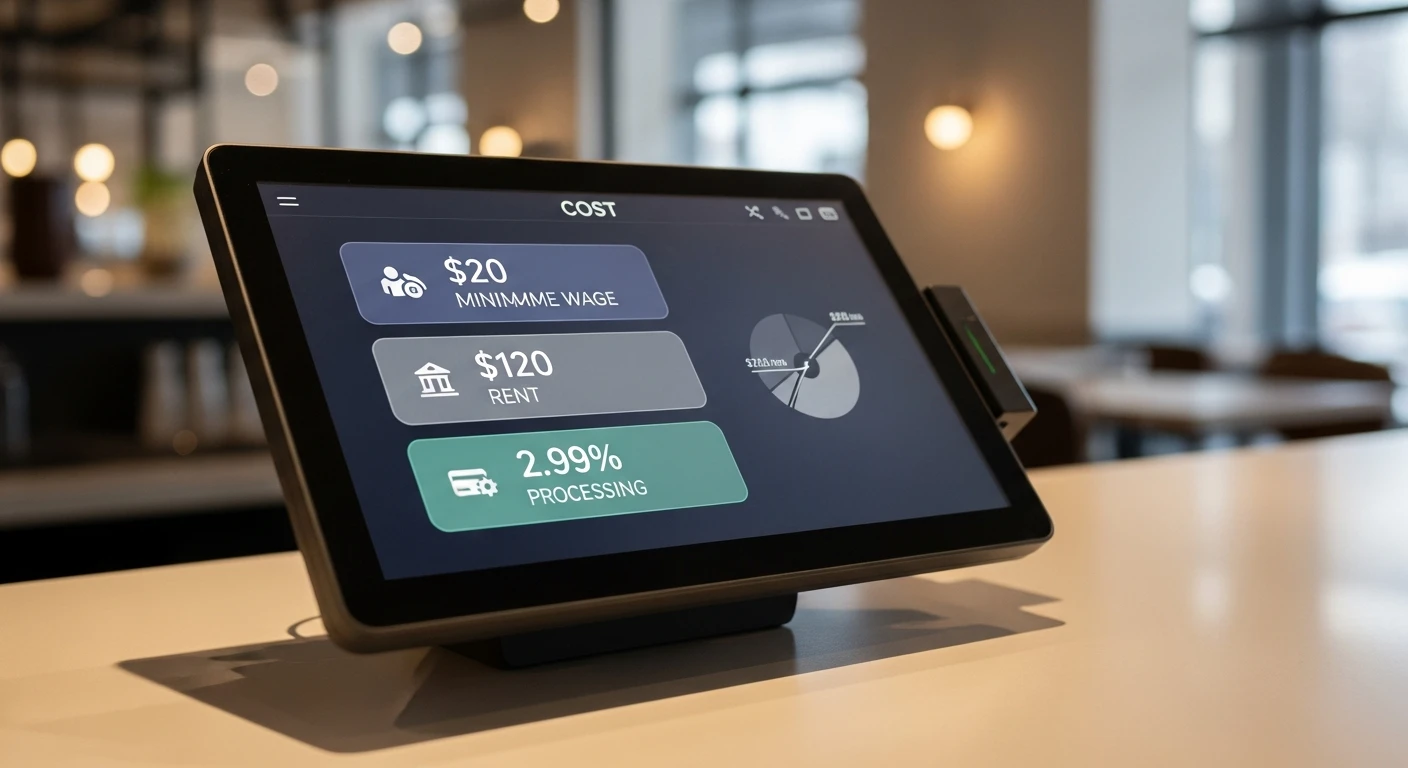
$20 Minimum Wage, $120 Rent, and 2.99% Processing: The Three Costs Killing San Francisco Restaurants
Updated March 2026 · By Tom Jin
San Francisco may be the hardest place in America to run a profitable restaurant. The city’s minimum wage — $18.67 and climbing — applies to all employees with no tip credit, meaning your dishwasher costs the same per hour as your server before tips. Commercial rent in desirable neighborhoods ranges from $80 to $120 per square foot annually. Ingredient costs are among the highest in the country. And the margin compression from these fixed costs leaves zero room for the variable cost of locked-in POS processing that extracts an additional 3% from every transaction.
San Francisco has lost over 4,000 restaurants since 2019. The survivors are operators who control every controllable cost with ruthless precision. For these survivors, the POS processing rate is not a back-office detail. It is a line item that determines whether the restaurant generates a 2% profit margin or a 2% loss. At San Francisco cost structures, the difference between 2.99% and 2.0% processing is literally the difference between viability and closure.
The Processing Math That Should Keep SF Operators Up at Night
A moderately successful San Francisco restaurant processes $180,000 monthly in card transactions. Toast at 2.99% plus $0.15 costs $5,547 monthly — $66,564 annually. KwickOS with a negotiated processor at 2.0% plus $0.10 costs $3,800 monthly — $45,600 annually. The $20,964 annual savings at San Francisco cost structures is not discretionary income. It is survival money. It is the quarterly tax payment that otherwise forces the owner to take a personal loan. It is three months of a line cook’s salary.
At the higher end — a Union Square restaurant doing $400,000 monthly — Toast processing costs $12,110 monthly ($145,320 annually). KwickOS with a negotiated rate at 1.95% plus $0.10 costs $8,000 monthly ($96,000 annually). The $49,320 annual savings exceeds the salary of a full-time sous chef. Over a five-year lease, that is $246,600 in processing savings alone — from a single expense line that most operators never negotiate because their POS system does not allow it.
Chinatown: The Oldest in North America
San Francisco’s Chinatown is the oldest in North America and remains one of the densest Chinese restaurant concentrations outside of Asia. Grant Avenue, Stockton Street, and the surrounding blocks support over 100 Chinese restaurants ranging from dim sum palaces to tiny noodle shops. The kitchens operate in Cantonese, Mandarin, and Toishanese. The customers are both the local Chinese community and the tourists who flock to Chinatown daily.
KwickOS Chinese-language support is not a feature for SF Chinatown. It is a requirement. Kitchen display systems must render dish names in characters that the wok cook, the dim sum chef, and the noodle maker read as naturally as they read a handwritten ticket from the previous generation’s paper system. KwickOS provides this natively — characters on the KDS, characters on the terminal, characters in the reports. Not a translation layer. Native rendering.
For dim sum operations, the open-check workflow is essential: items added from carts to table checks throughout the meal, with the running total calculated at the end. KwickOS tracks this incrementally building check with dual-language display — Chinese for staff, English for tourists — producing a final bill that both parties can verify.
The Mission District: Taqueria Economics at Scale
The Mission District’s taqueria culture operates on volume and speed with average transactions of $12-$16. At these ticket levels and San Francisco’s cost structure, the 4%+ effective processing rate from Toast (after the per-transaction fixed fee) turns every burrito into a money-losing proposition on thin margins. KwickOS processor independence lets Mission taquerias negotiate rates appropriate for their transaction profile — high volume, moderate tickets, speed-critical service.
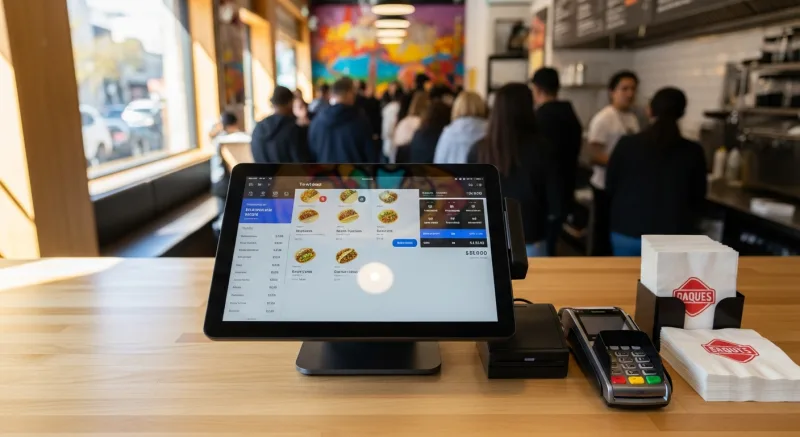
KwickOS Spanish-language interface serves the Mission’s kitchen workforce, which operates predominantly in Spanish. KDS displays, modifiers, and management tools run natively in the language the business operates in. For a Mission taqueria where the owner, the cooks, and half the customers communicate in Spanish, this native support is not a feature. It is respect for the operational reality.
Earthquake Resilience: The Bay Area’s Permanent Risk
San Francisco sits on the San Andreas Fault. The question is not whether the next significant earthquake will hit but when. When it does, the infrastructure disruption will include power outages, internet failure, cellular congestion from millions of simultaneous calls, and structural damage to buildings that house restaurants. Cloud-dependent POS systems will fail comprehensively.
KwickOS processes locally on the device itself. No internet required. No cloud dependency. No cellular connection needed for the transaction at your counter. When the next earthquake disrupts everything that cloud systems depend on, KwickOS processes transactions on generator-powered tablets at 1-millisecond speed. All data resides locally in addition to cloud backup. The restaurant recovers operationally the moment power returns, without waiting for internet infrastructure repair that may take days or weeks.
The Fog and the Hills: SF’s Micro-Climate Delivery Challenge
San Francisco’s geography and micro-climates create delivery logistics unlike any other city. Hills with 20-30% grades, fog that reduces visibility to 50 feet in the Richmond and Sunset districts, and neighborhoods separated by elevation changes that add significant time to delivery routes all affect delivery economics. DoorDash charges the same 25% regardless of whether the delivery is a flat two blocks in SoMa or a hill-climbing three miles from the Marina to Twin Peaks.
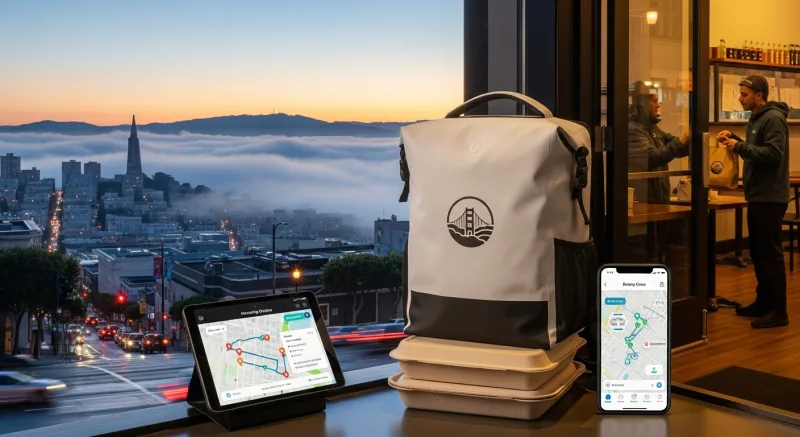
KwickDriver’s distance-based pricing ($2 per delivery plus $6.99 per five miles) creates transparent delivery economics that respect SF’s geography. A restaurant can define its profitable delivery zone based on actual topographic distance rather than accepting every DoorDash order regardless of whether the delivery is profitable after accounting for SF’s unique logistics.
North Beach and the Historic Restaurant
North Beach’s Italian restaurants operate in buildings dating to the post-earthquake rebuilding of 1906. These structures have limited electrical capacity, brick walls that attenuate Wi-Fi, and kitchen spaces designed for a previous century’s restaurant operations. KwickOS compact tablets and wall-mounted KDS screens fit these historic spaces. Local processing eliminates the Wi-Fi dependency that thick walls create. The technology adapts to the building rather than requiring the building to adapt to the technology.
Tech Worker Lunch and the $22 Average Ticket
Despite the tech downturn, San Francisco’s remaining tech workforce drives a lunch economy centered on SoMa, the Financial District, and Mission Bay. These workers expect mobile-first ordering, fast pickup, and digital receipts. KwickMenu online ordering provides the seamless digital experience that tech workers evaluate against consumer app standards. KwickOS loyalty programs capture the tech lunch regular who has fifteen options within a three-block radius and needs a reason beyond food quality to pick yours.
San Francisco POS Survival Guide
- Processor independence — SF costs leave zero margin; negotiated rates save $20-50K annually
- Native Chinese language — North America’s oldest Chinatown needs character-level KDS accuracy
- Native Spanish language — Mission District kitchens operate in Spanish
- Earthquake offline processing — Seismic events will disrupt everything cloud systems depend on
- Distance-based delivery — SF hills and fog create delivery logistics that flat-percentage pricing ignores
- Historic building hardware — North Beach and Chinatown need compact, Wi-Fi-independent systems
- Labor productivity — $18.67+ minimum wage demands technology that maximizes every labor hour
- Loyalty in hyper-competition — The densest restaurant market in America needs systematic retention
San Francisco restaurants cannot control the rent, the minimum wage, or the earthquake risk. They can control their processing costs. That control starts with a POS system that does not lock them into someone else’s revenue model.
San Francisco restaurant owners: Call (888) 355-6996 or visit KwickOS.com to see how processor freedom changes the survival math.
Turn One-Time Diners into Regulars: Built-In Gift Cards & Loyalty
Most POS companies treat gift cards and loyalty as afterthoughts — expensive add-ons that cost $50-100/month extra. KwickOS includes them at no additional charge because we believe they are essential revenue tools, not luxury features.
Gift Cards That Actually Drive Revenue
Here is what most restaurant owners do not realize: gift card buyers spend an average of 20-40% more than the card's face value. A $50 gift card typically generates $60-70 in actual spending. KwickOS supports both physical gift cards and electronic gift cards that customers can purchase, send, and redeem through their phones.
- Physical gift cards — branded plastic cards that sit on your counter and sell themselves during holidays
- E-gift cards — customers buy and send digitally via text or email, perfect for last-minute gifts
- Balance tracking — real-time balance across all your locations, no manual reconciliation
- Reload capability — customers top up their balance, creating a built-in prepayment habit
Loyalty Points That Keep Them Coming Back
KwickOS loyalty is not a punch card from 2005. It is a digital points system that tracks every dollar spent and automatically rewards your best customers:
- Earn points on every purchase — configurable ratio (e.g., $1 = 1 point, or $1 = 10 points)
- Tiered rewards — silver, gold, platinum levels to incentivize higher spending
- Birthday rewards — automated birthday offers that bring customers back during their special month
- Points-for-payment — customers redeem points directly at checkout, seamless for your staff
Membership Programs
For restaurants running VIP programs or subscription models (like monthly coffee clubs), KwickOS membership management handles recurring billing, exclusive pricing tiers, and member-only menu items — all within the same system your cashier already uses.
The bottom line: Toast charges $75/month extra for loyalty. Square's loyalty starts at $45/month. KwickOS includes gift cards, e-gift cards, loyalty points, and membership management in every plan. That is $540-900/year you keep in your pocket.

Founder & CIO of KwickOS · 30 Years IT · 20 Years Restaurant Industry
Tom built KwickOS after running restaurants and IT companies for decades. He relocated the company to a 10,000 sq ft office in 2023 and now serves 5,000+ businesses across all 50 states, processing over $2M in daily sales.