March 13, 2026 · 13 min read
Your Pizza Shop Runs 3 Revenue Channels. Your POS Vendor Charges Lock-In Fees on All of Them.
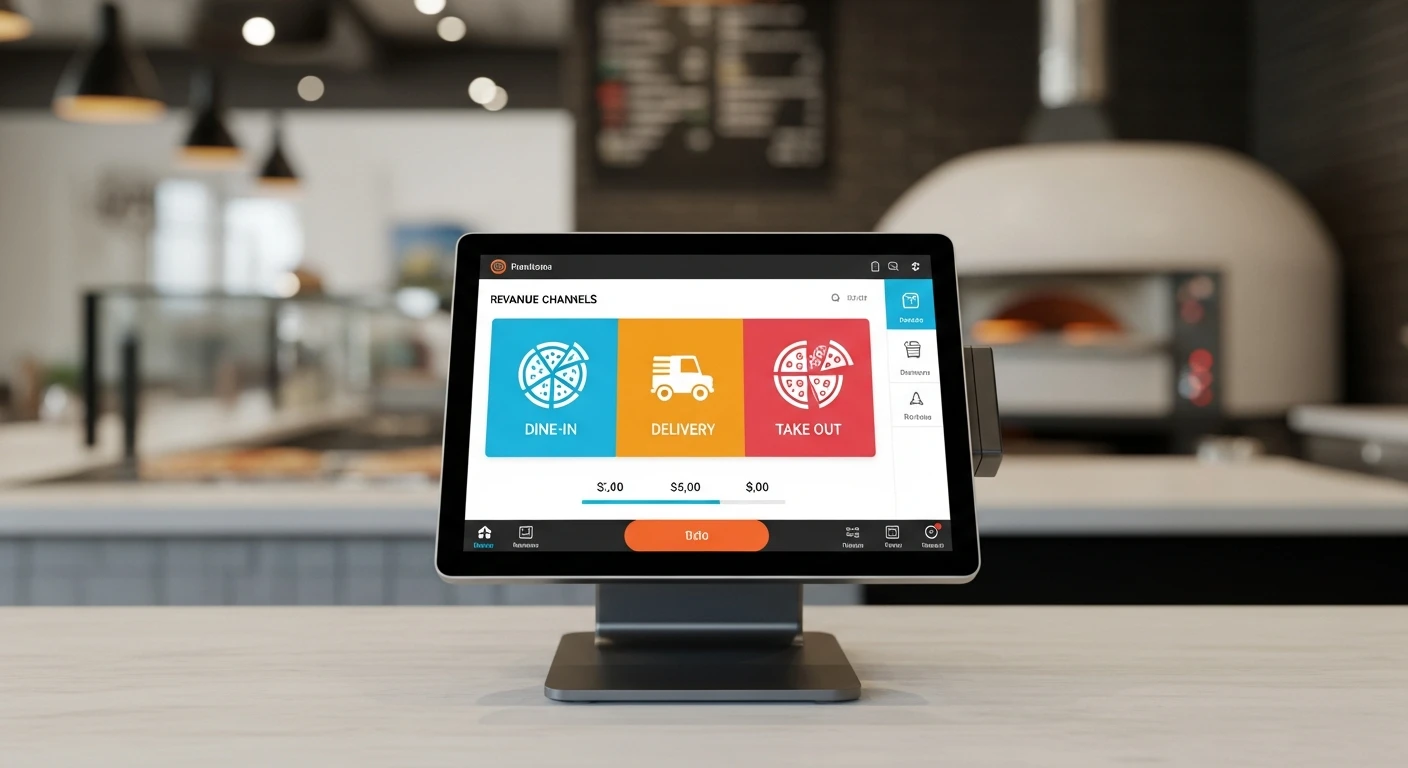
For pizza shop operators, Your Pizza Shop Runs 3 Revenue Channels. Your POS Vendor Charges Lo... isn't optional — it's the backbone of daily operations. Pizza is a delivery-first business. Over 60% of pizza revenue comes from delivery and takeout orders — each one prepaid by credit card through an online system or over the phone. That means your payment processor touches more of your revenue than in any other restaurant category. And if your POS locked you into their processor, every one of those transactions carries an inflated fee.
The pizza math: A pizza shop doing $750,000/year in card sales through a locked processor at 2.99% + $0.15 pays approximately $24,075/year. A negotiated interchange-plus rate of 2.49% + $0.10 costs $20,175/year. Annual savings: $3,900. Over three years: $11,700 — enough to buy a new conveyor oven.
Delivery Revenue: The Processing Fee Multiplier
A pizza delivery order follows this payment path: customer places order online, card is authorized at order time, order is prepared and delivered, tip is added at the door (or pre-set online), and the final amount settles. That is two processing events per delivery — the initial authorization and the final settlement with tip adjustment.
Some locked processors charge for both events. On 80 deliveries per day, that could mean 160 processing events instead of 80. At $0.15 per event, the extra 80 charges cost $12/day or $4,380/year — invisible to most pizza owners because they never see the event-level detail on their processing statements.
A processor-agnostic POS lets you choose a processor that consolidates authorization and settlement into a single fee event. This distinction alone can save a busy delivery operation thousands annually.
The Third-Party Delivery Tax Stack
Many pizza shops use DoorDash, UberEats, or Grubhub for delivery. These platforms charge 15-25% commission. On a $30 pizza order, DoorDash takes $4.50-7.50. But here is what most pizza owners miss: you still pay credit card processing fees on your share of the transaction.
The commission reduces your revenue to $22.50-25.50, but you paid processing fees on the full $30 when the customer's card was initially charged. The processing fee on the commission portion — the money you never received — costs you an additional $0.13-0.22 per order. On 50 third-party delivery orders per day, that is $2,372-4,015/year in processing fees on revenue you did not keep.
KwickOS offers KwickDriver at a flat $2 + $6.99/5mi, replacing the 15-25% commission entirely. And because orders process through your own system with your own processor, there is no fee stacking. You pay one processing fee on the customer's total. Your delivery fee goes to your driver. The rest goes to your business.
Phone Orders: The Card-Not-Present Premium
Despite the shift to online ordering, 30-40% of pizza orders still come by phone. Phone orders where the customer reads their card number are classified as "card-not-present" transactions, which carry higher interchange rates than in-person chip or tap payments.
The card-not-present premium is typically 0.15-0.30% above the standard rate. On $200,000/year in phone orders, that premium costs $300-600/year. With a locked processor, you accept whatever card-not-present rate they set. With processor choice, you can negotiate CNP-specific pricing or choose a processor that offers favorable rates for high-CNP businesses like pizza shops.
KwickOS's integrated online ordering through KwickMenu shifts phone orders to digital orders, which process as card-on-file transactions at lower rates. The customer enters their card once, and future orders use the stored token. This channel shift alone can reduce your effective processing rate on delivery orders by 0.10-0.20%.
Friday Night Volume: When Every Second Counts
A busy pizza shop on Friday and Saturday nights processes 150-250 orders between 5 PM and 10 PM. The kitchen runs at maximum capacity. The phone rings nonstop. Online orders queue on the KDS. And every order requires a card authorization that your cloud-based POS sends to a remote server.
During peak hours, cloud latency spikes because every restaurant in America is processing simultaneously. A 4-second authorization delay per order × 200 orders = 13 minutes of cumulative processing time. That does not sound like much until you realize it pushes three to five orders past your delivery time guarantee, generating complaints and lost repeat business.
KwickOS processes locally at 1ms. Card authorizations happen on-site. The KDS receives orders instantly. Your make line never waits for the cloud. On a Friday night where speed determines customer satisfaction, local processing is not a feature — it is a survival requirement.
Gift Cards: Pizza's Built-In Marketing Tool
Pizza gift cards are among the most redeemed gift cards in food service because pizza is universally popular and the gift card value aligns perfectly with order sizes. A $25 pizza gift card covers a large pizza with a topping. A $50 card covers a family meal deal. Redemption rates on pizza gift cards exceed 90%, and recipients typically overspend by 15-25%.
A pizza shop selling $3,000/month in gift cards generates $36,000/year in immediate cash flow. At 20% average overspend, total redemption value is $43,200. That $7,200 in overspend is pure incremental revenue driven by the gift card program.
Toast and Square gift cards only work within their closed ecosystem. Leave their platform, and your outstanding gift cards become liabilities without a clear resolution path. KwickOS gift cards work with any processor, any time. Your $50 family pizza night gift card redeems whether you are using Heartland, TSYS, or a local ISO.
Loyalty Programs: The Repeat Order Engine
Pizza is a repeat-purchase business. The average American orders pizza 40 times per year. A loyalty program that rewards every eighth order with a free pizza or $10 off can increase order frequency by 20-30% among enrolled customers.
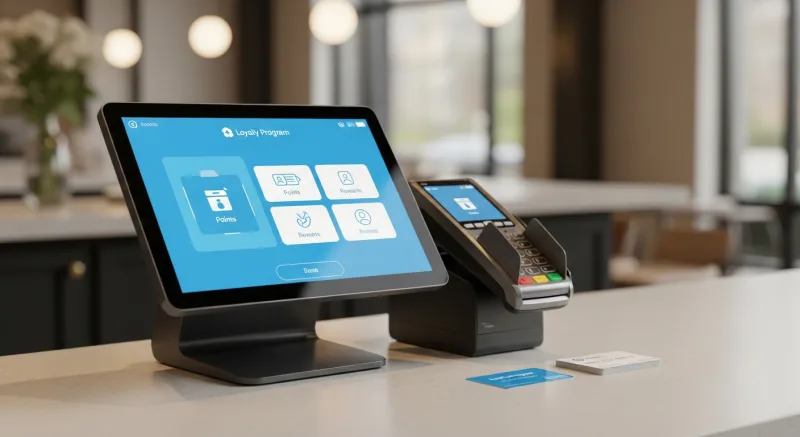
The most effective pizza loyalty programs combine simple point accumulation with surprise rewards: "You've ordered 5 times this month — here's a free order of breadsticks." These programs require a POS that tracks customer behavior across all channels (dine-in, delivery, online, phone) and applies rewards seamlessly.
KwickOS loyalty operates independently of payment processing. Your points, rewards, and customer data belong to your business. When Toast changes their loyalty tier pricing — which they have done multiple times — your program is unaffected because it is not built on their infrastructure.
The Multi-Unit Pizza Operator's Nightmare
Pizza chains operate on thin margins with high volume. A three-store pizza operation doing $2.25M/year in combined card sales pays $9,000/year more than necessary through a locked processor. Over a five-year franchise agreement, that is $45,000 in excess fees — the equivalent of a full kitchen remodel at one location.
KwickOS serves multi-location operations with per-store processor flexibility and centralized menu management. Crafty Crab Seafood runs 19 stores with one-click menu sync. A pizza chain using KwickOS can deploy a new limited-time pizza to all locations simultaneously while each location maintains its own optimized processing rate.
Online Ordering: Own It or Pay for It
Online ordering now drives 45-55% of pizza revenue. If your online orders flow through a third-party platform, you pay the platform's commission (15-25%) plus your locked processor's fee on whatever revenue remains. The fee stack on a $30 online pizza order through DoorDash with Toast processing can consume 20-28% of the order value before you buy a single ingredient.
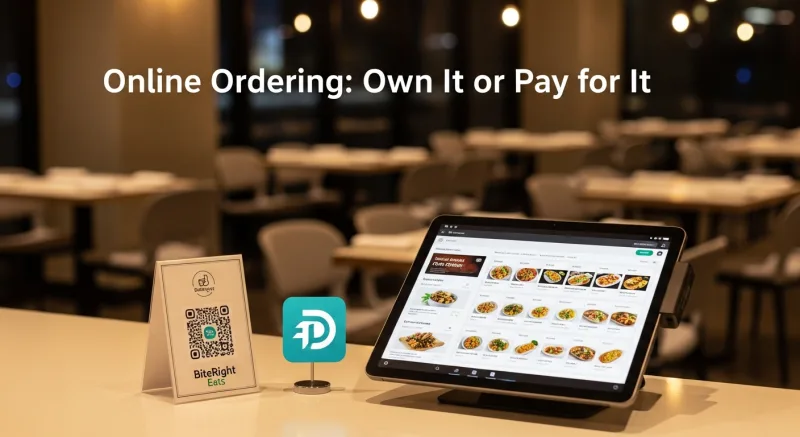
KwickOS includes KwickMenu for direct online ordering. Your customers order from your branded page. No commission. Your processor handles the card at your negotiated rate. The order flows directly to your KDS. KwickMenu processes 500,000 clicks per month across its network, proving the platform's reliability at scale.
The Catering Opportunity: Large Orders, Large Fee Savings
Pizza catering for offices, school events, and parties generates $200-1,000 per order. These large transactions are where the percentage fee creates the biggest absolute dollar difference. On a $500 office catering order, the difference between 2.99% ($14.95) and 2.49% ($12.45) is $2.50 per order. A pizza shop handling 10 catering orders per week saves $1,300/year from processor choice on catering alone.
The Three-Year Cost for a Pizza Shop
Pizza shop: $750K/year in card sales across all channels:
Locked processor (2.99% + $0.15): ~$24,075/year
Negotiated processor via KwickOS: ~$20,175/year
Annual savings: $3,900
Three-year savings: $11,700
$11,700 over three years. Add KwickDriver savings (replacing DoorDash commission at $15,000-25,000/year) and the total cost reduction from switching to KwickOS can exceed $50,000 over three years for a single location.
Your pizza shop thrives on speed, consistency, and value. Your payment processing should reflect those same principles — not exploit them.
Stop paying lock-in fees on every slice. Call (888) 355-6996 or visit kwickos.com for a pizza shop POS demo.
KwickOS · 6405 Cypresswood Dr #250, Spring TX 77379
Turn One-Time Diners into Regulars: Built-In Gift Cards & Loyalty
Most POS companies treat gift cards and loyalty as afterthoughts — expensive add-ons that cost $50-100/month extra. KwickOS includes them at no additional charge because we believe they are essential revenue tools, not luxury features.
Gift Cards That Actually Drive Revenue
Here is what most restaurant owners do not realize: gift card buyers spend an average of 20-40% more than the card's face value. A $50 gift card typically generates $60-70 in actual spending. KwickOS supports both physical gift cards and electronic gift cards that customers can purchase, send, and redeem through their phones.
- Physical gift cards — branded plastic cards that sit on your counter and sell themselves during holidays
- E-gift cards — customers buy and send digitally via text or email, perfect for last-minute gifts
- Balance tracking — real-time balance across all your locations, no manual reconciliation
- Reload capability — customers top up their balance, creating a built-in prepayment habit
Loyalty Points That Keep Them Coming Back
KwickOS loyalty is not a punch card from 2005. It is a digital points system that tracks every dollar spent and automatically rewards your best customers:
- Earn points on every purchase — configurable ratio (e.g., $1 = 1 point, or $1 = 10 points)
- Tiered rewards — silver, gold, platinum levels to incentivize higher spending
- Birthday rewards — automated birthday offers that bring customers back during their special month
- Points-for-payment — customers redeem points directly at checkout, seamless for your staff
Membership Programs
For restaurants running VIP programs or subscription models (like monthly coffee clubs), KwickOS membership management handles recurring billing, exclusive pricing tiers, and member-only menu items — all within the same system your cashier already uses.
The bottom line: Toast charges $75/month extra for loyalty. Square's loyalty starts at $45/month. KwickOS includes gift cards, e-gift cards, loyalty points, and membership management in every plan. That is $540-900/year you keep in your pocket.

Tom Jin
Founder & CIO of KwickOS · 30 Years IT · 20 Years Restaurant Industry
After 20 years in restaurant operations, Tom built KwickOS to solve the inefficiencies he experienced daily — including the payment processing markups that quietly erode pizza shop profits.
Related Articles
QSR: Quick-Service Processing Fee Squeeze
High-volume QSR operations and the compounding cost of locked processing.

Small Business Delivery Guide
How to build a delivery operation without surrendering 25% to DoorDash.
Online Ordering: Increase Revenue, Cut Commission
Direct online ordering versus third-party platforms. The revenue math.