March 13, 2026 · 14 min read
Nail Salon Owners: You Are Paying Processing Fees on Your Technicians' Tips. Here Is How Much.
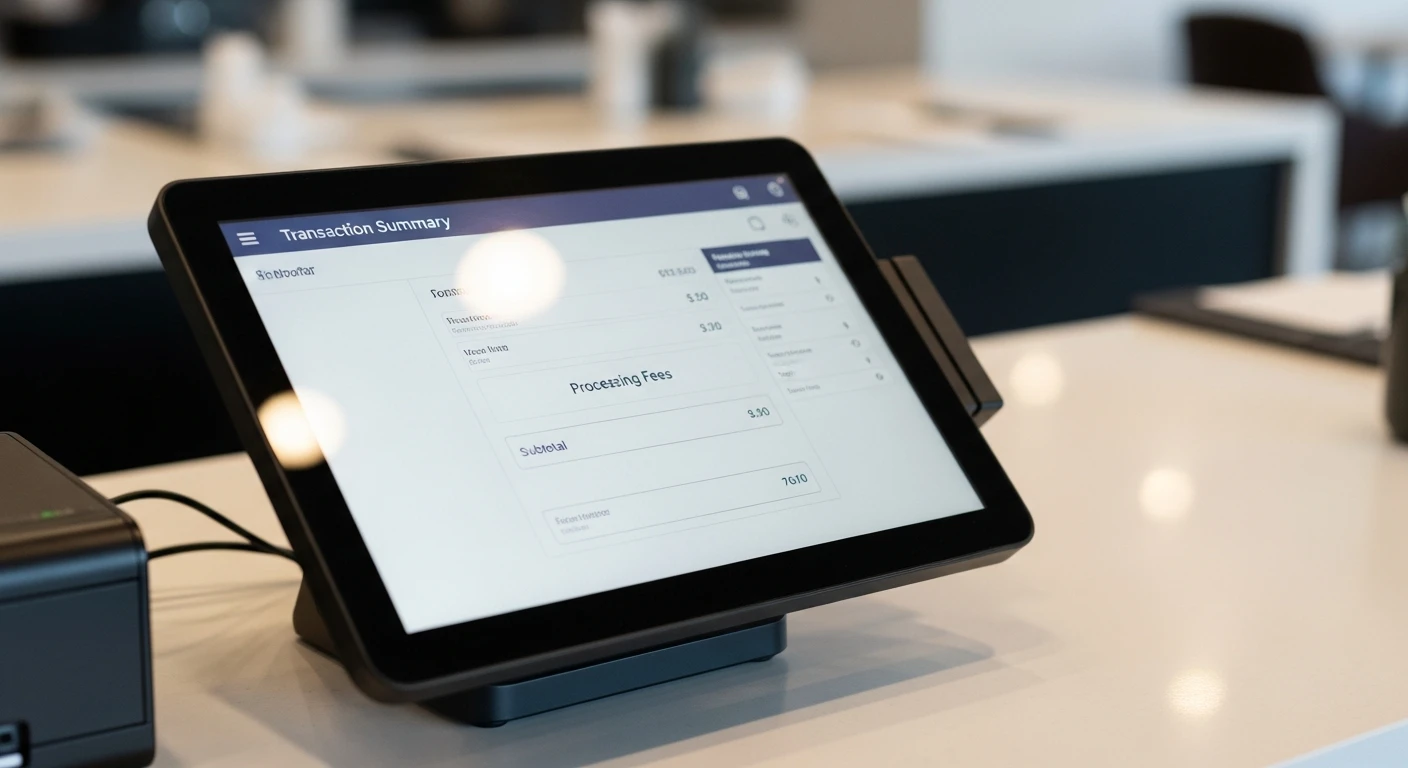
A gel manicure costs $45. The client tips $10. Your processor charges 2.99% on the full $55 — including the $10 that goes directly to your nail technician. You are paying $0.30 to process someone else's income. Multiply that across 50 appointments per day, 360 days per year, and you are hemorrhaging money that never needed to leave your business.
The nail salon math: A salon doing $420,000/year in card sales (including $84,000 in tips) through a locked processor pays $2,100/year more than a negotiated rate. The tip processing penalty alone costs $620/year. Over three years: $6,300 lost to lock-in. That is 140 bottles of OPI gel polish or two new pedicure thrones.
The Tip Processing Problem: Paying Fees on Money That Is Not Yours
Nail salons have the highest tip-to-service ratio of any beauty business. Clients tip 20-25% on services that range from $25 basic manicures to $85 deluxe pedicures. In a salon doing $350,000/year in service revenue, tip volume is $70,000-87,500.
Your locked processor does not distinguish between your revenue and your technicians' tips. The 2.99% fee applies to the entire transaction. On $80,000 in annual tips, the processing fee is $2,392. That money comes out of either your pocket or your technicians' earnings — either way, it is a cost that processor freedom can reduce.
Some independent processors offer tip-excluded processing where the percentage fee applies only to the service amount, with a flat micro-fee on the tip portion. This can reduce tip processing costs by 40-60%. But you will never see this pricing option while Square or Clover dictates your processor.
With KwickOS, you choose a processor that handles tips intelligently. The POS separates service revenue from tips for processing purposes, and your chosen processor applies the appropriate fee structure to each. Your technicians keep more. Your business keeps more. Only the locked POS vendor loses.
Commission Tracking: The Calculation That Determines Your Payroll
Nail salon payroll is commission-based for technicians and hourly for support staff. A typical commission structure pays 40-60% of service revenue to the performing technician, with the salon retaining the remainder for overhead, supplies, and profit.
Accurate commission calculation requires precise transaction tracking. Which technician performed which service? Was the pedicure upgraded to deluxe? Did the client add nail art? Each upsell changes the commission amount.
Diva Nail Beauty, operating 4 stores with 4 terminals on KwickOS, automated their commission tracking and achieved a 90% efficiency increase. Before KwickOS, commission calculations required manual review of every transaction at month end — hours of spreadsheet work that was error-prone and created disputes with technicians. After switching, commissions calculate automatically based on service assignments, and technicians can see their running totals in real time.
When your POS is locked to a processor, the commission calculation and the processing fee extraction happen in the same black box. You cannot independently verify that the fees deducted match the rates quoted. With KwickOS and a separate processor, you have two independent records that cross-check each other.
The Walk-In Versus Appointment Dynamic
Nail salons operate on a hybrid model: 60-70% appointments, 30-40% walk-ins. Walk-in revenue is unpredictable and tends to concentrate on weekends and evenings. The POS must handle both workflows — checking in a booked client and processing a spontaneous walk-in — without creating a bottleneck at the front desk.
The payment processing speed matters most during walk-in surges. A Saturday afternoon with eight walk-ins waiting and three checkout stations processing cards simultaneously requires a system that handles concurrent transactions without cloud latency delays.
KwickOS processes locally at 1ms. Three simultaneous card taps at three stations process independently on local hardware. No cloud queue. No server contention. No "card processing, please wait" messages that make clients anxious about whether their payment went through while six people are waiting behind them.
Gift Cards: The Nail Salon's Secret Weapon
Nail salon gift cards are the go-to gift for birthdays, bridal showers, Mother's Day, and "just because." The average nail salon gift card value is $50-75, and recipients typically add services beyond the card amount: "I came for the manicure but I'll add a pedicure too" is the most common gift card upsell in the beauty industry.
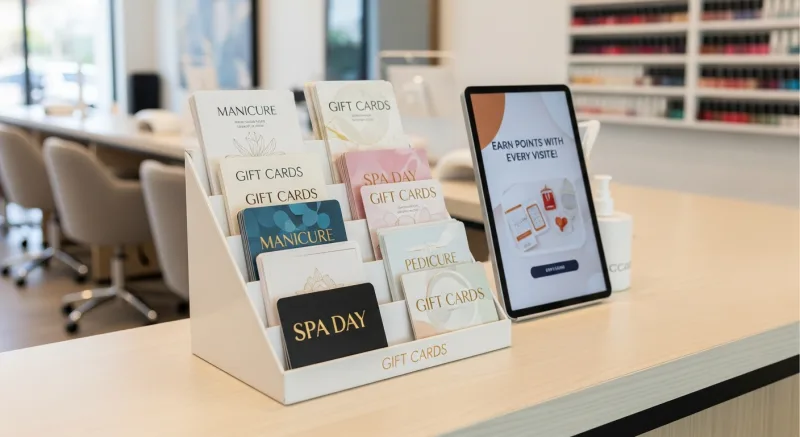
A salon selling 30 gift cards per week at $60 average generates $93,600/year in gift card revenue. The overspend rate averages 25-35% — turning that $93,600 into $117,000-126,360 in total transaction value when cards are redeemed.
With Toast or Square, your gift card program dies when you leave their ecosystem. Outstanding balances become orphaned. A bride who received a $200 spa day gift card from her bridesmaids discovers it no longer scans at checkout. That moment destroys more customer goodwill than any service mistake ever could.
KwickOS gift cards are processor-independent. They work today, next year, and five years from now regardless of which company processes the underlying card payment. Your gift card liabilities are your own to manage, not held hostage by a POS vendor's contract terms.
Membership Plans: Monthly Revenue That Survives Processor Changes
The nail salon membership model is booming: $49/month for a basic manicure, $79/month for a mani-pedi, $129/month for a monthly deluxe service with product discounts. These programs convert occasional visitors into predictable monthly revenue and increase average client lifetime value by 4-6x.
A salon with 100 members at $70/month average generates $84,000/year in recurring revenue. That is rent, utilities, and insurance covered by predictable monthly income regardless of walk-in volume or seasonal fluctuations.
Locked processors hold your membership billing hostage. Switch POS systems and every member's card token becomes invalid. Re-enrollment emails have a 15-25% dropout rate. On 100 members, losing 20 members means losing $16,800/year in recurring revenue — not because members wanted to leave, but because your POS vendor made the transition deliberately painful.
KwickOS manages memberships with tokenization that is independent of any specific processor. Switch processors, and the recurring charges continue without interruption. Your members never see a billing hiccup. Your revenue never dips.
Multi-Service Transactions: The Upsell That Costs You Extra
A typical nail salon visit involves multiple services: manicure + pedicure, or gel polish + nail art + paraffin treatment. When these are processed as a single transaction, you pay one per-swipe fee. But some POS systems with locked processors split multi-service transactions into separate line items that each incur individual processing events.
Even when processed correctly as a single transaction, the combined service total of $75-150 generates a larger percentage fee than you would pay with a competitive processor. The difference of 0.40% on a $120 multi-service appointment is $0.48. That is 50 appointments per day × 360 days = $8,640/year in total processing, of which approximately $2,100 is the excess from lock-in.
Product Retail: The Margin Booster That Processing Erodes
Nail polish, cuticle oil, hand cream, gel lamp kits, dipping powder sets — retail products generate 15-20% of nail salon revenue at 40-50% margins. A salon doing $60,000-80,000/year in product sales earns $24,000-40,000 in gross margin from retail.
Processing fees on product sales: $60,000 × 2.99% + $0.15/transaction = approximately $2,094/year through a locked processor. With a negotiated rate: approximately $1,614/year. Savings: $480/year on product retail alone.
The product margin is your cleanest profit center — no labor cost per unit, no tip processing, no commission split. Protecting that margin from inflated processing fees is the simplest optimization available.
The Language Barrier and Technology Adoption
A significant portion of nail salon owners in the U.S. are Vietnamese-American, and many prefer systems with multilingual support. Payment processing contracts written in dense English legalese can obscure the actual costs being charged.
KwickOS supports English, Chinese, and Spanish natively, with an interface designed for clarity across language backgrounds. More importantly, processor choice means you can work with a processor or ISO (Independent Sales Organization) that communicates in your preferred language and explains rates transparently. You are not stuck with a single vendor's customer service team and their English-only contract terms.
Fingerprint Security: Preventing Unauthorized Discounts
Nail salons face a specific theft pattern: unauthorized discounts. A technician gives a friend a 50% discount, or a front desk employee voids a service and pockets the cash equivalent. These losses accumulate to 2-4% of revenue for salons without proper access controls.
KwickOS uses 1:N fingerprint authentication. Every discount, every void, every cash drawer open requires a biometric scan. There are no shared PINs, no manager codes written on sticky notes. The system knows exactly who authorized every financial action, with a timestamp and fingerprint record.
Toast and Square rely on PIN-based access that is trivially shareable. In a salon where five technicians work at adjacent stations, PINs get shared within the first week. Fingerprint authentication eliminates this vulnerability entirely.
The Three-Year Cost for a Nail Salon
Nail salon: $420K/year in card sales (including $84K tips):
Locked processor (2.99% + $0.15): ~$15,258/year
Negotiated processor via KwickOS: ~$13,158/year
Annual savings: $2,100
Three-year savings: $6,300
$6,300 over three years. That is a new UV gel station, three months of product inventory, or the down payment on a second location's build-out. The money exists. It is currently flowing to a POS company that adds zero value to your nail services.
Switching: Built for Beauty Businesses
- Service menu: Every service, add-on, and upgrade imports with pricing and duration. Commission structures configure per technician.
- Client records: Preferences (favorite color, gel vs. regular, allergies) and visit history migrate seamlessly.
- Hardware: KwickOS runs on any device — no proprietary terminals. Runs on Linux with no Windows license.
- Training: Diva Nail Beauty's team was operational quickly. Most front desk staff learn the system in 1-2 hours.
- Timeline: 7-10 days from purchase. Installation: 1-3 hours.
Your technicians create art at every station. Your front desk manages a complex schedule flawlessly. Your POS should match that standard — without charging you extra for the privilege of processing your own customers' payments.
Ready to stop overpaying on every appointment? Call (888) 355-6996 or visit kwickos.com for a nail salon POS demo.
KwickOS · 6405 Cypresswood Dr #250, Spring TX 77379
Turn One-Time Diners into Regulars: Built-In Gift Cards & Loyalty
Most POS companies treat gift cards and loyalty as afterthoughts — expensive add-ons that cost $50-100/month extra. KwickOS includes them at no additional charge because we believe they are essential revenue tools, not luxury features.
Gift Cards That Actually Drive Revenue
Here is what most restaurant owners do not realize: gift card buyers spend an average of 20-40% more than the card's face value. A $50 gift card typically generates $60-70 in actual spending. KwickOS supports both physical gift cards and electronic gift cards that customers can purchase, send, and redeem through their phones.
- Physical gift cards — branded plastic cards that sit on your counter and sell themselves during holidays
- E-gift cards — customers buy and send digitally via text or email, perfect for last-minute gifts
- Balance tracking — real-time balance across all your locations, no manual reconciliation
- Reload capability — customers top up their balance, creating a built-in prepayment habit
Loyalty Points That Keep Them Coming Back
KwickOS loyalty is not a punch card from 2005. It is a digital points system that tracks every dollar spent and automatically rewards your best customers:
- Earn points on every purchase — configurable ratio (e.g., $1 = 1 point, or $1 = 10 points)
- Tiered rewards — silver, gold, platinum levels to incentivize higher spending
- Birthday rewards — automated birthday offers that bring customers back during their special month
- Points-for-payment — customers redeem points directly at checkout, seamless for your staff
Membership Programs
For restaurants running VIP programs or subscription models (like monthly coffee clubs), KwickOS membership management handles recurring billing, exclusive pricing tiers, and member-only menu items — all within the same system your cashier already uses.
The bottom line: Toast charges $75/month extra for loyalty. Square's loyalty starts at $45/month. KwickOS includes gift cards, e-gift cards, loyalty points, and membership management in every plan. That is $540-900/year you keep in your pocket.

Tom Jin
Founder & CIO of KwickOS · 30 Years IT · 20 Years Restaurant Industry
Tom built KwickOS for every small business, including the beauty and spa industry. Diva Nail Beauty's 90% efficiency improvement is just one example of what processor freedom and smart technology deliver.
Related Articles
Hair Salons: $2,800/Year in Processing Lock-In Costs
Commission tracking, tip processing, and product retail fees for hair salons.
The Complete Nail Salon POS Guide
Everything about POS systems designed for nail and beauty businesses.
Retail Shops: The Lock-In Tax on Every Sale
Retail-specific processing lock-in analysis with inventory and product margin math.