March 13, 2026 · 14 min read
Your Bakery Is Paying Toast $2,400/Year Just for the Privilege of Using Their Credit Card Processor
The best Your Bakery Is Paying Toast $2,400/Year Just for the Privilege of U... handles everything from checkout to closing — without extra apps or workarounds. Bakery net margins sit between 5% and 9%. After flour, butter, labor, and rent, there is almost nothing left. So why are thousands of bakery owners handing over $200 every month to a POS company that forces them into overpriced payment processing?
The math that should make you angry: A bakery processing $600,000/year in credit cards through Toast pays roughly 2.99% + $0.15 per transaction. Switch to a competitive processor at 2.49% + $0.10, and you save $3,300/year. Over a three-year Toast contract, that is $9,900 you never had to lose.
The Quiet Extraction: How Payment Lock-In Works in Bakeries
When you signed up for Toast, Square, or Clover, the sales pitch focused on the hardware, the software, the pretty interface. Nobody lingered on the payment processing clause buried in the contract. But that clause is where the real money flows.
Here is what it says, in plain language: you must use their payment processor. You cannot shop rates. You cannot negotiate with competing processors. You cannot switch without abandoning your entire POS system.
For a bakery doing $50,000 per month in card transactions, the difference between a locked-in rate and a negotiated rate looks like this:
Toast locked rate: 2.99% + $0.15 = $1,510/month on $50K volume
Negotiated rate (interchange-plus): ~2.39% + $0.10 = $1,210/month
Monthly difference: $300
Annual loss from lock-in: $3,600
That $3,600 disappears every year. It does not buy you better features. It does not improve your frosting. It goes directly to Toast's bottom line because they bundled payment processing into a system you thought was about running your bakery.
Why Bakeries Get Hit Harder Than Restaurants
The average bakery transaction is small. A $6 croissant. A $4.50 coffee. An $8 slice of cake. When your average ticket is $9 compared to a restaurant's $35, the per-transaction fee component becomes proportionally devastating.
Consider two businesses each processing $600,000/year in cards:
A full-service restaurant at $35 average ticket processes roughly 17,142 transactions. At $0.15 per transaction, the fixed component is $2,571.
A bakery at $9 average ticket processes roughly 66,667 transactions. At $0.15 per transaction, the fixed component is $10,000.
Same volume, same percentage rate, but the bakery pays almost $7,500 more in per-transaction fees. This is not an accident. Flat-fee POS processors designed their pricing around restaurant ticket sizes. Bakeries, coffee shops, and other low-ticket businesses subsidize the system.
A processor-agnostic POS like KwickOS lets you negotiate transaction-level pricing that actually fits your business model. Some bakery-friendly processors offer tiered structures where transactions under $10 carry a reduced per-swipe fee. You cannot access those structures when your POS vendor dictates your processor.
The Gift Card Trap Nobody Mentions
Bakery gift cards are a goldmine. The National Retail Federation reports that gift card recipients spend 20-40% above the card value per visit. For a bakery, that turns a $25 gift card into a $31-35 transaction. Multiply that across your holiday gift card sales, Mother's Day, Valentine's Day, and teacher appreciation season, and gift cards can represent 8-15% of annual revenue.
Here is the problem: Toast's gift card system only works with Toast's payment processing. If you ever leave Toast, your outstanding gift card balances become a nightmare. Customers holding $3,000 in unredeemed gift cards expect those cards to work. Toast has no obligation to make that transition smooth.
KwickOS gift cards are processor-independent. They work with whichever payment processor you choose, today or five years from now. Switch processors next month? Your gift cards still work. Every balance, every transaction history, every loyalty point tied to that card transfers seamlessly because the gift card system is not shackled to a specific payment pipeline.
For a bakery that sells 400 gift cards during the holiday season at an average of $30 each, that is $12,000 in gift card liability. Losing portability on that amount because your POS vendor holds it hostage is a risk no bakery owner should accept.
The Loyalty Point Devaluation Problem
Your bakery loyalty program might offer a free pastry after ten purchases, or $5 off after accumulating 100 points. These programs drive repeat visits. Regular customers visit 67% more frequently when enrolled in a loyalty program, according to Bond Brand Loyalty research.
But when your loyalty system is bolted to a locked payment processor, you face a hidden vulnerability: the POS company can change their loyalty terms, add fees for loyalty redemptions, or deprecate features. In 2025, Toast added a fee for advanced loyalty features that had previously been included. Bakeries that had built their customer retention strategy around those features had two choices: pay more or lose their loyalty data.
KwickOS runs loyalty and membership programs independently of payment processing. Your points, tiers, birthday rewards, and customer purchase histories belong to your business, stored in a system that does not care which company processes the underlying card transactions.
Real Bakery Numbers: What $2,400/Year Actually Buys
Let me frame $2,400 in bakery terms, because percentages are abstract but ingredients are real:
- 4,800 pounds of all-purpose flour at $0.50/lb — enough to produce roughly 19,200 standard loaves of bread
- 600 pounds of European-style butter at $4/lb — the butter for 7,200 croissants
- 48 cases of cage-free eggs at $50/case — enough for your custard and pastry cream production for four months
- 80 hours of part-time labor at $15/hr plus tax — two months of weekend counter help
- A commercial stand mixer — the Hobart equivalent that makes your production line possible
Every year you stay locked into overpriced processing, you are choosing to give away the ingredients for 7,200 croissants. Not because you must. Because nobody showed you the alternative.
Flour Costs Are Rising. Your Processing Fees Should Be Falling.
Wheat prices increased 23% between 2023 and 2025. Sugar is up 18%. Butter hit its highest wholesale price in a decade. Bakery owners are already squeezing every efficiency out of their production line. You are buying in bulk, negotiating with suppliers, reducing waste with better forecasting.
Why would you not apply that same discipline to your second-largest cost after labor? Credit card processing fees now exceed rent for many small bakeries. The average bakery pays $18,000-30,000/year in processing fees. Reducing that by even 15% through competitive processor shopping saves $2,700-4,500 annually.
But you cannot shop processors when Toast, Square, or Clover locks you in. You accept whatever rate they set, and they raise it whenever they want. Toast increased processing fees twice in 2024 without offering merchants any new features in return. Bakery owners on Reddit forums described the fee increases as "getting a rent hike from a landlord who hasn't fixed the plumbing."
How KwickOS Processor Freedom Works for Bakeries
KwickOS connects to any payment processor through standard integration protocols. The setup process works like this:
- Choose your processor. Get quotes from three or four processors. Heartland, Worldpay, TSYS, a local ISO — anyone. Tell them your monthly volume, average ticket size, and transaction count. Watch them compete for your business.
- Connect to KwickOS. Your chosen processor provides terminal credentials. KwickOS integrates in minutes, not weeks. No proprietary hardware required.
- Renegotiate annually. When your processing contract comes up, shop again. Your POS does not change. Only the processor behind it does. This leverage alone typically saves 0.15-0.30% on your effective rate.
One bakery owner in Austin switched from Square to a local processor through KwickOS and dropped her effective rate from 2.75% to 2.19%. On her $42,000/month card volume, that saves $2,352/year. She used the savings to lease a second proofer that increased her morning production capacity by 40%.
The Membership Model: Bakeries' Untapped Revenue Stream
Subscription bakery memberships are growing fast. A "bread club" that delivers a fresh loaf weekly for $15/month. A "pastry box" subscription for $35/month. A corporate breakfast program at $200/month. These recurring revenue streams smooth out the feast-or-famine cash flow that plagues bakeries.
Membership billing requires a POS that can handle recurring charges without processor dependency. If your membership system runs through Toast's payment stack and you leave Toast, every subscriber's billing breaks. You have to re-collect payment information from every member. Some will not bother re-entering their card. You lose subscribers not because they wanted to leave, but because your POS transition created friction.
KwickOS manages memberships through tokenized card storage that works with any processor. Switch processors, and the tokens migrate. Your subscribers never see a disruption. Their $15/month bread club charge continues on schedule regardless of which company actually processes the transaction.
The Offline Advantage: When Saturday Morning Rush Meets Internet Outage
Your busiest hour is Saturday from 8 to 9 AM. The line stretches to the door. Every second counts. Now imagine your internet drops — which happens more often than your ISP admits, especially in strip mall locations with shared infrastructure.
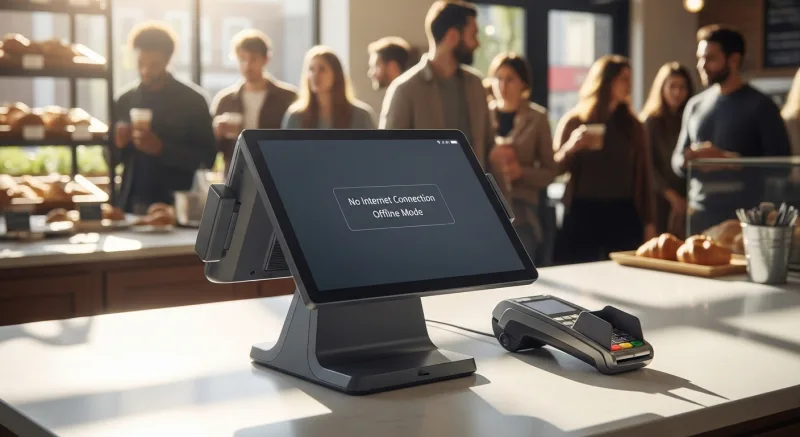
Cloud-dependent POS systems like Toast go into "offline mode," which is a polite way of saying they stop working properly. Card transactions queue. Loyalty lookups fail. Online orders disappear. Your Saturday morning revenue takes a direct hit.
KwickOS processes everything locally with 1-millisecond response times. The internet could be down all morning and your staff would never know the difference. Cards process through local hardware. The display case inventory updates. The KDS in back keeps routing orders. When internet returns, everything syncs. No lost sales. No frustrated customers walking out because your cloud POS is buffering.
Baked Cravings: A KwickOS Bakery in Action
Baked Cravings runs a self-serve kiosk operation at Lego Land, which is about as high-pressure as bakery retail gets. Families with impatient children, 24-hour retail hours, and a PaxA35 terminal that needs to process transactions without hesitation.
The kiosk handles orders autonomously. No cashier. No line confusion. Customers tap their selections, pay with any card or digital wallet, and pick up their order. KwickOS manages the entire flow: menu display, order processing, payment, and kitchen routing. The processor behind the terminal is invisible to the customer — and replaceable by the owner at any time.
What Switching Actually Looks Like
The fear that keeps bakery owners locked in is the switching cost. "I'll lose my data." "My staff will need retraining." "I can't afford downtime."
Here is the reality of switching to KwickOS:
- Data migration: Menu items, customer records, and transaction histories import from your existing system. KwickOS supports data imports from Toast, Square, and Clover.
- Training time: The web-based interface runs on any browser. Staff training takes 1-2 hours. The Shogun Japanese Hibachi team reached full operator proficiency in under 5 minutes because the interface follows standard touch patterns.
- Installation: 1-3 hours for hardware setup. KwickOS runs on Linux, so there is no Windows license, no bloated operating system, no mandatory updates that brick your terminal during morning rush.
- Timeline: From purchase to fully operational: 7-10 days.
Compare that to the $7,200 you will lose over the next two years staying on a locked processor. The switching cost is a fraction of the lock-in cost.
The Three-Year Calculation Every Bakery Owner Needs to See
Three-year processing cost comparison for a bakery doing $600K/year in cards:
Locked processor (Toast/Square): ~$17,940/year × 3 = $53,820
Negotiated processor (via KwickOS): ~$14,340/year × 3 = $43,020
Three-year savings: $10,800
$10,800 over three years. That is a deck oven. That is a full kitchen renovation. That is the difference between expanding into wholesale accounts and staying stuck at your current capacity.
Your bakery's margins are thin enough already. Stop paying a technology company for the privilege of processing your own customers' credit cards.
Ready to stop overpaying for payment processing? Call (888) 355-6996 or visit kwickos.com for a free bakery POS demo.
KwickOS · 6405 Cypresswood Dr #250, Spring TX 77379
Turn One-Time Diners into Regulars: Built-In Gift Cards & Loyalty
Most POS companies treat gift cards and loyalty as afterthoughts — expensive add-ons that cost $50-100/month extra. KwickOS includes them at no additional charge because we believe they are essential revenue tools, not luxury features.
Gift Cards That Actually Drive Revenue
Here is what most restaurant owners do not realize: gift card buyers spend an average of 20-40% more than the card's face value. A $50 gift card typically generates $60-70 in actual spending. KwickOS supports both physical gift cards and electronic gift cards that customers can purchase, send, and redeem through their phones.
- Physical gift cards — branded plastic cards that sit on your counter and sell themselves during holidays
- E-gift cards — customers buy and send digitally via text or email, perfect for last-minute gifts
- Balance tracking — real-time balance across all your locations, no manual reconciliation
- Reload capability — customers top up their balance, creating a built-in prepayment habit
Loyalty Points That Keep Them Coming Back
KwickOS loyalty is not a punch card from 2005. It is a digital points system that tracks every dollar spent and automatically rewards your best customers:
- Earn points on every purchase — configurable ratio (e.g., $1 = 1 point, or $1 = 10 points)
- Tiered rewards — silver, gold, platinum levels to incentivize higher spending
- Birthday rewards — automated birthday offers that bring customers back during their special month
- Points-for-payment — customers redeem points directly at checkout, seamless for your staff
Membership Programs
For restaurants running VIP programs or subscription models (like monthly coffee clubs), KwickOS membership management handles recurring billing, exclusive pricing tiers, and member-only menu items — all within the same system your cashier already uses.
The bottom line: Toast charges $75/month extra for loyalty. Square's loyalty starts at $45/month. KwickOS includes gift cards, e-gift cards, loyalty points, and membership management in every plan. That is $540-900/year you keep in your pocket.

Tom Jin
Founder & CIO of KwickOS · 30 Years IT · 20 Years Restaurant Industry
Tom built KwickOS after running restaurants and IT companies for decades. With 5,000+ businesses on the platform across 50 states, he has seen firsthand how payment processing lock-in drains small business profits.
Related Articles
Coffee Shops: The $1,800/Year Processing Tax
Low-ticket coffee transactions get crushed by per-swipe fees. How to fight back.
Payment Lock-In: The $6,000/Year Tax Nobody Talks About
The definitive 2026 guide to processor-agnostic POS and why it matters.
Processor-Agnostic POS: The Complete Guide
What processor freedom means and how it saves businesses thousands annually.