For Houston business owners searching for Galleria to Chinatown to Katy, here's what the top operators already know. Houston's restaurant scene is defined by two forces: extraordinary diversity and extraordinary sprawl. The metro area covers over 10,000 square miles, making it larger than several states. Within that expanse lies arguably America's most diverse food scene — Vietnamese in Midtown, Chinese along Bellaire Boulevard, Tex-Mex everywhere, BBQ traditions, Nigerian cuisine in Alief, Indian food in the Mahatma Gandhi District, and every fusion concept imaginable.
For restaurant groups operating across this metro, the challenge is not just managing multiple locations — it is managing multiple locations that might be 30 miles apart in traffic that turns a 30-mile drive into a 75-minute ordeal during rush hour. Physical presence-based management does not scale in Houston. Technology-based management is the only option.
Hurricane Season: Why Offline Operation is Not Optional in Houston
Houston experiences tropical weather events that can knock out power and internet for hours or days. Hurricane Harvey in 2017 demonstrated what multi-day infrastructure failure looks like. Even without a direct hurricane hit, tropical storms bring flooding that disrupts internet service, and summer thunderstorms cause regular power fluctuations.
For a restaurant group running cloud-dependent POS systems (Toast, Square), a multi-hour internet outage during dinner service is a revenue disaster. The registers go into degraded offline mode (limited functionality, no loyalty, no gift cards, no real-time reporting) or stop working entirely. Multiply that across 4 locations and you are looking at $5,000-15,000 in lost revenue from a single weather event.
KwickOS processes every transaction locally at 1ms speed. Internet is used for cloud sync, not core operations. When a tropical storm knocks out internet at your Katy location, every register, every KDS screen, and every payment terminal continues operating at full capability. When connectivity returns — hours or days later — data syncs automatically. Your Galleria location, which has power and internet, continues operating normally. Each location is independent. No single point of failure.
In Houston, this is not a nice-to-have feature. It is an insurance policy that pays for itself the first time a summer storm hits during Friday night service.
Houston's Diversity: Multilingual POS as a Baseline Requirement
Houston is the most ethnically diverse large city in America. A restaurant group operating in Chinatown (Bellaire corridor) needs Chinese-language POS capability. A location in the East End needs Spanish interface options. A location in Midtown might need English, Chinese, and Spanish depending on staff composition.
KwickOS supports English, Chinese, and Spanish natively across the POS interface — not as a third-party add-on but as built-in capability. Staff at the Bellaire location toggle to Chinese. Staff at the East End location use Spanish. The Galleria location runs in English. All three locations feed into the same centralized English-language dashboard for ownership review.
This multilingual capability extends to customer-facing systems as well. Self-ordering kiosks, online ordering through KwickMenu, and digital signage can display in multiple languages. In a city where 145 languages are spoken, technology that operates in only one language is a competitive disadvantage.
The Sprawl Dashboard: Managing Across 35 Miles
A Houston restaurant owner with locations in the Galleria area, Bellaire, Midtown, and Katy cannot visit all four stores in a single day during operational hours — the driving time alone would consume 3-4 hours. The alternative is a dashboard that brings every location to the owner's phone.
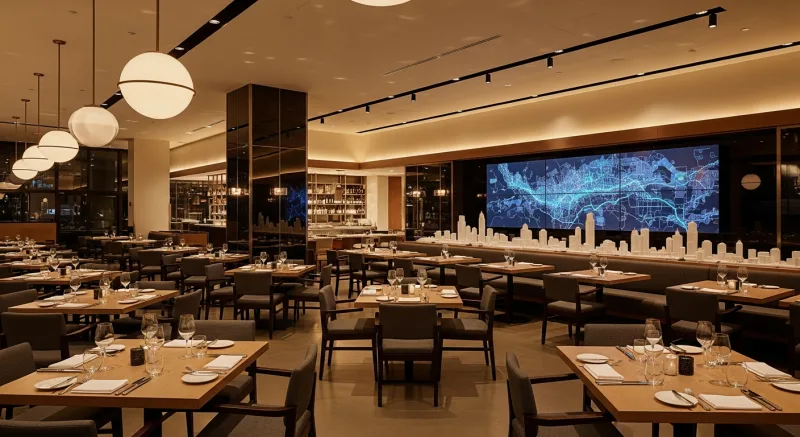
KwickOS shows all locations in real time. At 6 PM, the owner sees that Midtown is filling up fast (the Astros game nearby is driving pre-game traffic — staffing looks adequate), Bellaire is running normally, the Galleria location has an unusual void pattern on Station 2 (flag for the manager to investigate), and Katy had a slow lunch but is trending upward for dinner (the new billboard campaign might be working).
T. Jin China Diner monitors 15 locations and 75 terminals through this dashboard. For Houston restaurant groups, where the physical distance between locations makes in-person oversight impractical, the dashboard is the primary management interface — not a supplement to physical visits.
Gift Cards Across Houston's Micro-Markets
Houston's sprawl creates distinct micro-markets. The customer base in Katy (suburban families) is entirely different from Midtown (young professionals) or Bellaire (Asian community). Gift cards purchased in one micro-market are frequently given to people in another. A Galleria-area executive buys a gift card for an employee who lives in Katy. A Bellaire regular gives a gift card to a friend in Midtown.
KwickOS gift cards work at every location from the moment of purchase. No metro-area restrictions. No "this card was purchased at our Bellaire location" friction. Physical and digital gift cards sync in real time across all locations. Houston's geographic spread makes cross-location gift card functionality particularly important because the probability of cross-location redemption is higher than in denser cities.
Unified Loyalty in a Commuter City
Houston is a car city. Customers drive across the metro for work, shopping, entertainment, and dining. A loyal customer might visit your Midtown location after work, your Katy location for weekend family dinners, and your Galleria location for business lunches. On fragmented loyalty, this customer appears as three infrequent visitors. On unified loyalty, they are one of your most valuable customers.
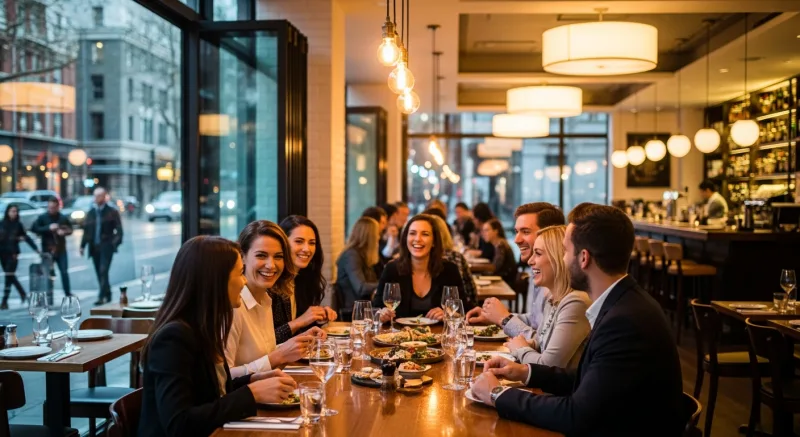
KwickOS loyalty pools all visits across all locations. Points, membership tiers, and customer preferences travel with the customer regardless of which Houston location they visit. Membership management from headquarters identifies cross-location regulars for VIP treatment everywhere.
Processing Savings at Houston Volume
Houston restaurant groups benefit from Texas's lower operating costs in most categories — no state income tax, reasonable rents compared to coastal cities — but payment processing rates are the same everywhere. A 4-location Houston group processing $450,000/month on Toast (2.99% + $0.15) pays approximately $14,070/month. At a negotiated rate of 2.2% + $0.10, the same volume costs $10,350/month.
Annual savings: $44,640. In Houston, where restaurant rents average $25-45/sq ft, that savings covers several months of rent at a suburban location.
KwickOS is processor-agnostic. Negotiate one rate based on aggregate volume. Houston's competitive restaurant market rewards operators who minimize every controllable cost — and processing is among the largest controllable expenses.
One-Click Menu Sync for Houston's Food Scene
Houston restaurant groups frequently run location-specific specials alongside a core menu. Crawfish season brings temporary menu additions across multiple locations. Game day specials run at locations near NRG Stadium or Minute Maid Park. Cultural holidays drive menu events at specific locations.
KwickOS one-click sync pushes core menu changes to all locations simultaneously, while location-specific items stay local. Add a crawfish boil special to all 4 locations for spring — one click. Add a Korean New Year menu only to the Bellaire location — local configuration. The system handles both scenarios without forcing a choice between central control and local flexibility.
Employee Management Across Houston Metro
Houston restaurant employees sometimes commute between locations, especially for shift coverage. KwickOS fingerprint authentication works at every store. One employee, one record, one timecard — regardless of which location they clock in at. Cross-location hours are tracked automatically for overtime compliance under Texas law.
The Houston Multi-Location Checklist
- Can each location operate at full capability during internet/power disruption?
- Does the POS support English, Chinese, and Spanish natively?
- Can you see all Houston locations on one real-time dashboard?
- Do gift cards work across all locations in the metro instantly?
- Does loyalty unify across all stores?
- Can you push menu changes to all locations with one click?
- Can you use one processor at one rate for all locations?
- Do employees use fingerprint authentication that works everywhere?
KwickOS handles all eight. With hybrid local+cloud architecture, each Houston location operates independently while connecting to centralized management — exactly the resilience that Houston's weather and geography demand.
Running Restaurants Across Houston?
Schedule a demo and we will show you hurricane-resilient local processing, multilingual POS, cross-metro gift cards and loyalty, and processing savings for your Houston restaurant group.
Get Your Free DemoOr call us directly: (888) 355-6996