Houston’s Restaurant Technology Playbook: Hurricanes, Humidity, and the Most Diverse Food City in America
Updated March 2026
Houston is the most underrated restaurant city in the United States. No other metro area matches its culinary diversity per capita: Nigerian suya next to Vietnamese pho next to Salvadoran pupusas next to Cajun crawfish next to Texas barbecue, all within a two-mile stretch of Hillcroft Avenue. The city’s 14,000 restaurants serve a population that is 45% Hispanic, 23% Black, 8% Asian, and everything in between — creating a food landscape so varied that national restaurant technology companies do not even attempt to design for it specifically.
That oversight creates an opportunity. Houston restaurants that choose technology built for their actual conditions — not generic conditions assumed by Silicon Valley — gain an operational advantage that compounds over months and years. And those conditions are unlike any other American city.
Hurricane Season: The Six-Month Offline Requirement
Hurricane season runs June through November. Houston has been hit by four major hurricanes since 2005: Rita (2005), Ike (2008), Harvey (2017), and Beryl (2024). Harvey alone shut down the city for two weeks and caused $125 billion in damage. Power outages lasted days to weeks in affected areas. Internet service was unreliable for a month across large portions of the metro.
For six months of every year, a Houston restaurant must be prepared for the possibility that internet connectivity will disappear for an extended period. A POS system that requires cloud connectivity to process transactions is not just inconvenient during a hurricane — it is useless during the exact period when the community most needs functioning restaurants.
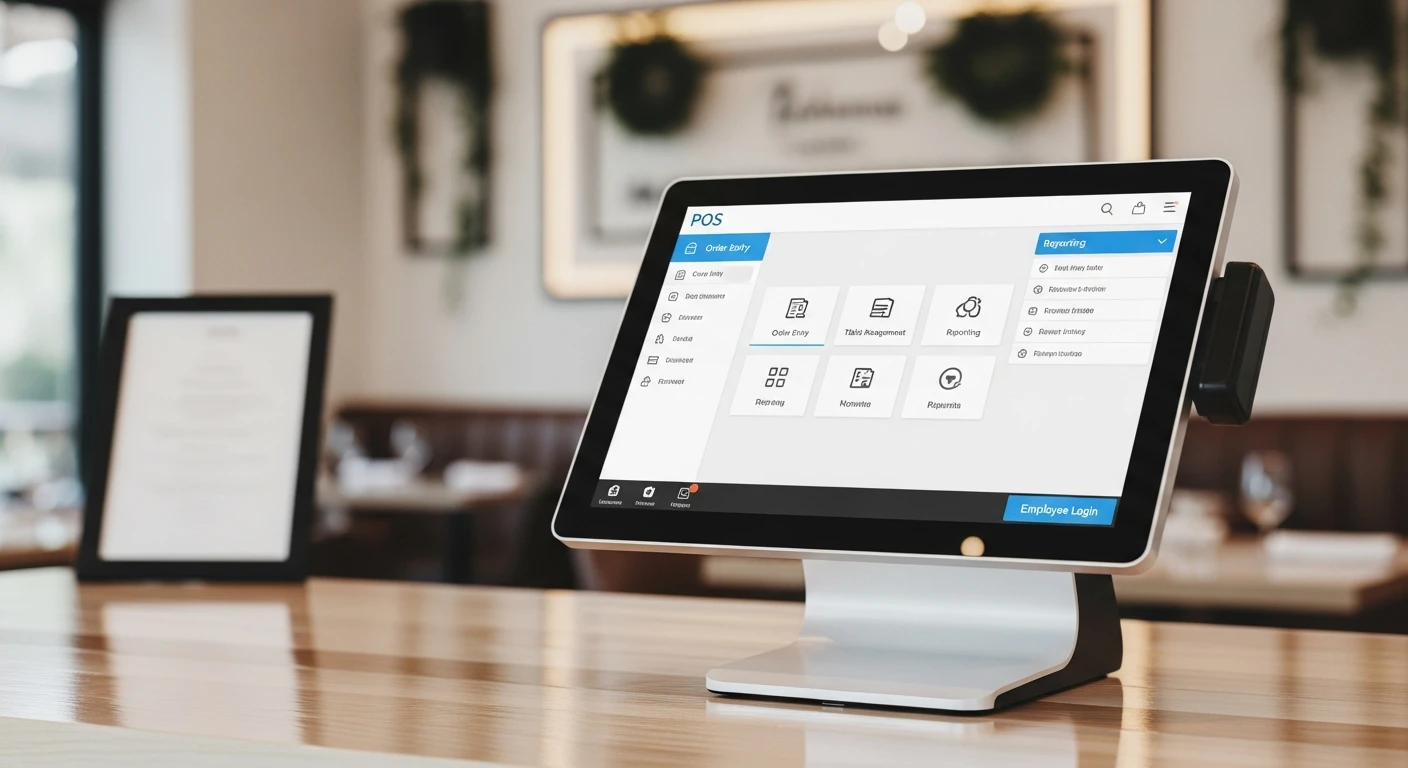
KwickOS processes every transaction locally on the terminal hardware. No internet required for order entry, payment processing (stored-and-forward), kitchen display, inventory tracking, or employee management. When Hurricane Harvey flooded Houston and cell towers went down across the south side, a restaurant running KwickOS could have continued operating on generator power alone. Every transaction would sync to the cloud once connectivity restored — whether that was two hours later or two weeks later.
Toast is cloud-dependent. Square requires internet for payment processing. In a hurricane-prone city, choosing a cloud-dependent POS is choosing to close your business every time a storm knocks out your ISP. Houston restaurants have learned this lesson the hard way, repeatedly.
The Energy Industry Lunch Crowd
Houston’s Energy Corridor — stretching along the Katy Freeway from Dairy Ashford to Barker Cypress — contains office complexes housing over 300,000 workers. ExxonMobil, BP, Shell, ConocoPhillips, and Halliburton all maintain major presences. The lunch crowd from these offices hits nearby restaurants in a compressed 75-minute wave from 11:30 AM to 12:45 PM.
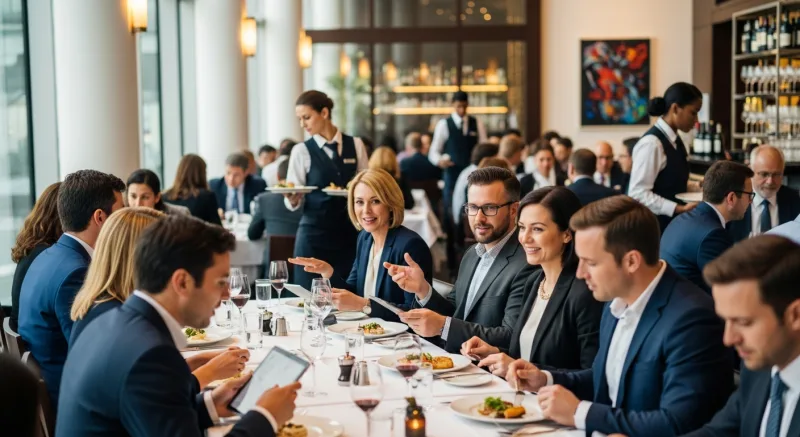
Restaurants serving the Energy Corridor lunch rush need to process 150-250 transactions in that 75-minute window. Speed is everything. A corporate worker with a 45-minute lunch break will not wait 12 minutes in line. They will walk to the next restaurant or order ahead on their phone.
KwickOS addresses this with a combination of self-ordering kiosks and mobile pre-ordering. Kiosk stations allow 4-6 simultaneous orders with no staff involvement. KwickMenu mobile ordering lets office workers order from their desk at 11:15 and pick up at 11:45 — no line, no wait. The kitchen display receives all orders — kiosk, mobile, and counter — in a single prioritized queue sorted by promised time.
The math works: three kiosks and one counter position handle the same volume as four counter positions during peak, at lower labor cost and with higher average tickets (kiosk upselling consistently increases ticket size by 15-25%). For a restaurant that does 60% of daily revenue in a 75-minute window, the throughput capacity of your POS directly determines your revenue ceiling.
Culinary Diversity Creates Technology Complexity
Houston’s food diversity is not just a cultural talking point. It creates specific technology requirements that homogeneous markets do not face. Consider the restaurant types clustered along Bellaire Boulevard in Houston’s Chinatown corridor:
- Dim sum halls with 200-300 menu items, cart service requiring tableside ordering, and kitchen workflows that fire items continuously rather than per-order
- Vietnamese pho shops with modifier-heavy ordering (rare steak, well-done brisket, tendon, tripe, with or without bean sprouts) where each bowl is a custom build
- Chinese hot pot restaurants with per-item pricing, long dwell times (90-120 minutes per table), and inventory depletion that tracks individual sliced meats and vegetables
- Korean BBQ with all-you-can-eat pricing, table timer tracking, and waste monitoring to control cost on unlimited offerings
- Taiwanese boba shops with sweetness levels, ice levels, and topping combinations that create hundreds of product variants from 30 base drinks
A generic POS handles none of these operations well. KwickOS handles all of them because the system was built in this exact environment. The Bellaire corridor is 20 minutes from KwickOS headquarters in Spring, TX. These are not theoretical use cases — they are real restaurants running real operations on KwickOS, with configurations built by engineers who eat at these restaurants weekly and understand the operational nuances firsthand.
Spring, Texas: Where KwickOS Lives
KwickOS headquarters is in Spring, TX — a northern Houston suburb. This is not a footnote. For Houston restaurant owners, it means your POS vendor is local. When you need on-site support, a technician drives to your restaurant. When you need hardware, it ships from a warehouse 30 minutes away, not from a fulfillment center in Ohio. When you have a configuration question about your specific dim sum cart workflow, you talk to an engineer who has eaten dim sum at your restaurant.
Toast is headquartered in Boston. Square is in San Francisco. Clover is in Sunnyvale. None of them have meaningful local presence in Houston. When your Toast terminal fails on a Saturday night, you call a national support line staffed by someone who has never seen your restaurant and may never have been to Texas.
KwickOS provides 24/7 multilingual support from US-based staff. For Houston, "multilingual" is not marketing language — it is operational reality. Support in English, Chinese, and Spanish covers the majority of Houston’s restaurant operator population. Tom Jin, the founder, has 30 years of IT experience and 20 years of restaurant industry experience. He built KwickOS because he ran restaurants in this market and could not find technology that solved his problems.
Tex-Mex and the Modifier Explosion
Houston is the Tex-Mex capital of the world. From Ninfa’s on Navigation to the 47 locations of El Tiempo across the metro, Tex-Mex represents the single largest restaurant category in the city. Tex-Mex ordering is inherently modifier-heavy: enchilada plates with choice of sauce (red, green, sour cream, ranchera), choice of protein, choice of two sides, choice of rice type (Mexican, Spanish, cilantro lime), choice of beans (refried, black, charro, borracho).
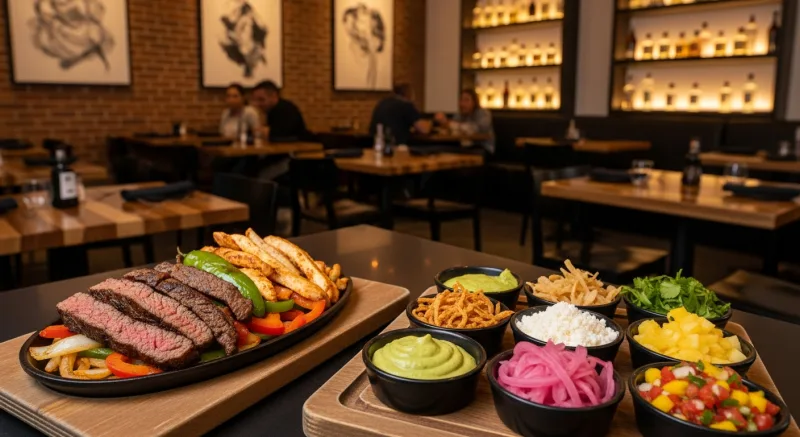
A single enchilada plate with all modifier permutations generates over 200 possible combinations. Multiply by a menu of 40 entrees, and the modifier tree becomes enormous. POS systems that handle modifiers as flat text lists become unwieldy. Kitchen staff reading long modifier strings make errors.
KwickOS structures modifiers in hierarchical groups. The KDS display shows the enchilada plate with sauce, protein, and sides displayed as structured tags rather than a paragraph of text. The line cook sees "Red / Chicken / Rice-Mex / Bean-Black" in a scannable format rather than "chicken enchilada with red sauce substitute cilantro lime rice for Spanish rice no sour cream add extra cheese black beans instead of refried." Structured display reduces read time and error rate, which matters when the kitchen is pushing 300 enchilada plates on a Saturday night.
Houston’s Sprawling Geography and Delivery Economics
Houston is the most spread-out major city in America. The metro area covers 10,000 square miles — larger than the state of New Jersey. A "local" delivery can be 8-12 miles through traffic that ranks as the 8th worst in the country. This sprawl makes delivery economics fundamentally different from dense cities like New York or San Francisco.
Third-party delivery platforms charge percentage-based commissions regardless of distance. A $30 order delivered 2 miles costs the restaurant the same 25% ($7.50) as a $30 order delivered 10 miles. But the 10-mile delivery takes three times as long for the driver, creating service quality problems and longer delivery times that generate complaints attributed to the restaurant, not the platform.
KwickDriver’s distance-based pricing aligns with Houston’s reality. The $2 flat fee plus $6.99 per 5 miles means a 2-mile delivery costs $2 (versus $7.50 on DoorDash) and a 10-mile delivery costs approximately $16 (transparent to the customer, who can decide if the distance is worth it). This model works in Houston where customers understand that distance matters — they drive 20 miles for their favorite restaurant and expect delivery fees to reflect geography.
Humidity, Hardware, and the Case for Web-Based Systems
Houston’s humidity averages 75-90% year-round. Kitchen environments compound this with steam from cooking. Hardware in Houston restaurant kitchens faces moisture exposure that would be unusual in drier climates. Touch screens fog. Connections corrode. Paper receipt printers jam when paper absorbs moisture.
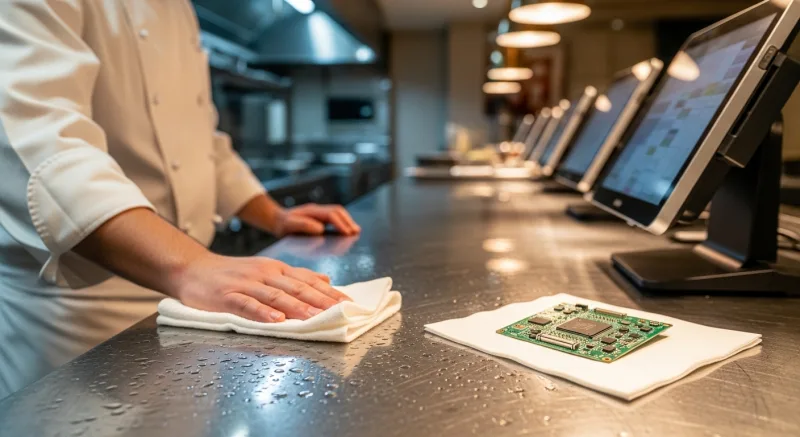
KwickOS eliminates paper printing through digital KDS displays and electronic receipts. Fewer mechanical components mean fewer humidity-related failures. The web-based interface means the POS function runs in a browser — if a terminal develops hardware issues from moisture exposure, you swap the hardware and reconnect in minutes. No software reinstallation, no license transfer, no waiting for a proprietary replacement.
Linux-based terminals are also more resistant to the malware and virus issues that Windows terminals face. In an environment where kitchen staff might plug a personal phone into a USB port to charge, Linux’s inherent security model prevents the malware vectors that regularly compromise Windows POS systems in food service environments.
The Vietnamese Pho Shop Case Study
Houston has the largest Vietnamese population outside of Vietnam, concentrated in the Midtown and Bellaire areas. Pho restaurants operate with a specific workflow: large menu of soup variations, aggressive modifier system (protein combinations, noodle type, broth strength), high-volume lunch service (150-200 bowls per hour at peak), and tight margins on a $12-15 average ticket.
The POS challenge for pho shops is speed and accuracy on modifier-heavy items. A customer orders a large pho with rare steak, well-done brisket, and tendon — three proteins that the kitchen assembles differently from two proteins or one. The bowl needs extra bean sprouts on the side, no cilantro (allergy), and extra hoisin at the table. That is one order with six modifiers, and there are 200 more behind it during lunch.
KwickOS handles this through pre-configured modifier buttons organized by category. The cashier taps "Large," taps "Rare Steak + WD Brisket + Tendon" (protein combo button), taps "Extra Sprouts," taps "No Cilantro" (allergen-flagged), taps "Extra Hoisin." Five taps, done. The KDS shows the order with allergen flag prominent. Total ring time: under 8 seconds. A POS that requires typing modifier notes or navigating nested menus takes 20-30 seconds for the same order — which means serving 30-40% fewer customers during the lunch window.
Processing Freedom for High-Volume Houston Operations
Houston restaurant volumes are substantial. A popular restaurant on Westheimer might process $120,000-180,000 per month in card transactions. At Toast’s mandatory 2.99% + $0.15 rate, monthly processing on $150,000 runs $4,635. An independent processor offering 2.2% + $0.08 charges $3,380. Annual savings: $15,060.
For a Houston restaurant operating on 4-6% net margins, $15,000 per year in processing savings represents a meaningful percentage of total profit. KwickOS never touches your processing revenue. You choose the processor, negotiate the rate, and keep the savings. When volume grows and you qualify for better interchange tiers, you renegotiate without changing anything else about your system.
This matters especially for Houston’s multi-unit operators. A group with five locations processing $500,000 monthly has enormous negotiating leverage with processors. Being locked into Toast’s fixed rate at that volume costs $75,000+ annually more than an aggressively negotiated independent rate. KwickOS lets you leverage your volume. Toast profits from it.
Why Houston Restaurants Choose Local
Houston is a city that values local businesses and local relationships. The restaurant community here is tight — operators know each other, refer vendors, and share experiences. A POS company headquartered 25 miles away in Spring, staffed by people who eat at Houston restaurants and understand the market’s specific demands, earns trust differently than a national brand with a local sales rep and a faraway support center.
KwickOS serves 5,000+ businesses across 50 states, but its roots are in Houston. The engineering team that builds the software walks into Houston restaurants, sees how the system performs in real conditions, and makes adjustments based on direct observation. When a Bellaire hot pot restaurant needs a specific table-timer configuration, the engineer who builds it has eaten hot pot at that restaurant. That proximity between builder and user produces better software than any amount of market research from 2,000 miles away.
Houston deserves restaurant technology that understands Houston. The hurricanes, the humidity, the sprawl, the diversity, the energy corridor lunch rush, the Bellaire dim sum halls, the Tex-Mex modifier explosions — these are not edge cases. They are Houston. And the POS system that serves Houston needs to be built for exactly these conditions.
Houston restaurant owners: Visit us in Spring or call (888) 355-6996. Check out KwickOS.com to see what local POS support actually looks like.
The Revenue Features Most "All-in-One" Systems Charge Extra For
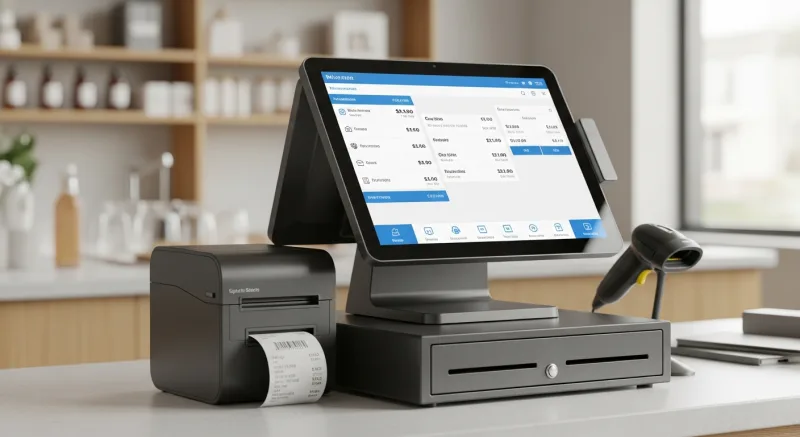
When POS companies say "all-in-one," they rarely mean gift cards and loyalty are included. Toast charges $75/month for their loyalty add-on. Square Loyalty starts at $45/month. Clover requires third-party apps. KwickOS includes all of these natively — zero extra cost.
Physical & Electronic Gift Cards
Sell branded physical cards at the register. Send e-gift cards via text or email. Track balances across every location in real time. Gift card holders spend 20-40% more than face value — this is not a nice-to-have, it is a revenue multiplier.
Points-Based Loyalty System
Every transaction earns points. Customers see their balance on receipts and can redeem at checkout. Configurable earn ratios, tiered VIP levels, and automatic birthday rewards. No separate app required — it runs inside the POS your cashier already knows.
Membership & Subscription Management
Run coffee clubs, wine memberships, or VIP dining programs. Recurring billing, exclusive member pricing, and member-only items — managed from the same dashboard as your daily operations. Your customers feel special. Your revenue becomes predictable.
Real impact: businesses using KwickOS loyalty features see repeat visit rates increase by up to 35%. Gift card programs generate an average of 15% additional revenue during holiday seasons.

Tom Jin
Founder & CIO of KwickOS · 30 Years IT · 20 Years Restaurant Industry
Tom built KwickOS after decades running restaurants and IT companies. Today KwickOS serves 5,000+ businesses across 50 states.