The DFW metroplex stretches 70 miles from Fort Worth to the eastern suburbs of Dallas. With 8 million residents and a population growing by 150,000+ per year, it is the fourth-largest metro area in the country and the fastest-growing large metro in the United States. New master-planned communities in Frisco, McKinney, Celina, and Prosper are creating restaurant demand in areas that were farmland five years ago.
For restaurant groups, DFW offers an expansion opportunity that exists nowhere else: a massive, growing market with relatively affordable real estate (compared to coastal cities), no state income tax, and a customer base with disposable income. The groups that capitalize on this opportunity are the ones with technology infrastructure that scales as fast as the market does.
The DFW Growth Machine: Why Scalability Matters
In DFW, a successful restaurant group does not stay at 3 locations for long. The market pulls you toward expansion because the demand is there, the economics work, and competitors are expanding into the new suburbs weekly. If you do not open in the new Frisco development, three national chains will.
This growth pace demands a POS system that makes opening a new location trivial, not traumatic. On KwickOS, opening a new location follows a simple process: clone the master menu, configure the hardware (1-3 hours installation), train the staff (1-2 hours — Shogun Japanese Hibachi reached full proficiency in under 5 minutes), and go live. The new location appears on your unified dashboard immediately. Gift cards work there from day one. Loyalty program is active. Processing runs through your existing aggregate-rate processor.
Contrast this with Toast or Clover, where each new location means a new subscription ($69-165/month per location on Toast), potentially a new processor relationship (Clover requires separate merchant accounts), and a new instance that needs manual configuration and testing. The per-location cost of expansion on locked systems grows linearly. On KwickOS, it grows marginally.
Managing Across the Metroplex
The drive from Uptown Dallas to Fort Worth is 35 miles — 45 minutes with no traffic, 90 minutes during rush hour. Plano to Arlington is 40 miles. A restaurant owner with locations in both cities cannot manage by physical presence. The dashboard is the management method.
KwickOS shows every location on one screen in real time. Saturday evening: the Uptown Dallas location is at capacity with a 30-minute wait. The Plano location is running at 70% of target — the new marketing campaign has not reached the North Dallas suburbs yet. The Fort Worth location just had an unusual $200 void that needs investigation. All three data points visible simultaneously from the owner's phone, whether they are at home in Highland Park or on vacation in Cancun.
T. Jin China Diner monitors 15 locations and 75 terminals through this same dashboard architecture. For DFW groups where the metro's size makes in-person oversight of all locations impossible on a daily basis, centralized real-time visibility is what makes multi-location operation manageable.
Gift Cards in a Cross-City Metro
DFW residents frequently cross between Dallas and Fort Worth for dining, entertainment, and shopping. A customer who discovers your restaurant at the Uptown location during a night out in Dallas might live in Southlake (equidistant between Dallas and Fort Worth). They buy a gift card at Uptown, but their friend who receives it lives in Fort Worth. The card needs to work at the Fort Worth location.
KwickOS gift cards work at every location instantly. No metro-boundary restrictions. No "that card was purchased in Dallas" frustration. Physical and digital gift cards sync in real time across all locations throughout the metroplex.
Unified Loyalty for DFW Commuters
DFW commuters routinely travel 20-30 miles between home and work. A customer who lives in Plano and works in Uptown Dallas might visit your Plano location for weekend family dinners and your Uptown location for weekday business lunches. Unified loyalty ensures their total patronage is recognized. Fragmented loyalty treats them as two different occasional customers.
KwickOS loyalty pools all visits, all spend, all points into one account. Membership tiers managed from headquarters recognize your best customers regardless of which DFW location they frequent. When a customer's cross-metro patronage pushes them into Gold tier, every location in the group sees and respects that status.
Processing Savings at DFW Scale
DFW restaurant groups benefit from Texas's business-friendly environment — no state income tax, reasonable rents, strong consumer spending. Processing rates, however, are universal. A 4-location DFW group processing $400,000/month on Toast (2.99% + $0.15) pays approximately $12,535/month. At a negotiated rate of 2.2% + $0.10, the cost drops to $9,200/month.
Annual savings: $40,020. That funds the build-out of your fifth location in the next high-growth DFW suburb.
KwickOS is processor-agnostic. In a market where expansion opportunity exists but capital is always a constraint, saving $40,000/year on processing by simply choosing your own processor is one of the highest-ROI decisions a DFW restaurant group can make.
Texas Weather and Offline Operation
DFW experiences severe weather — spring tornado season, summer heat waves that strain the power grid (remember the February 2021 freeze that knocked out power for days), and thunderstorms that disrupt internet service. A cloud-dependent POS in a DFW restaurant during a grid event is an expensive risk.
KwickOS processes every transaction locally at 1ms. Internet outages do not affect POS operations. Power outages are mitigated with standard UPS backup. Each location operates independently — if the Fort Worth location loses internet, the Dallas and Plano locations are unaffected. When connectivity returns, data syncs automatically.
Menu Sync for Rapid Expansion
When your DFW group opens a new location in McKinney, the menu needs to be identical to your existing stores from day one. On KwickOS, you clone the master menu and push it. The new location launches with perfect menu consistency. When you run a seasonal promotion across all locations — fall Tex-Mex specials, holiday catering menus — one click pushes it everywhere.
Crafty Crab Seafood uses one-click sync across 19 locations and 152 terminals. For a DFW group growing from 4 to 8 locations over the next two years, the ability to launch new stores with a cloned menu and push updates to all locations simultaneously is what makes rapid expansion operationally feasible.
The DFW Multi-Location Checklist
- Can you open new locations by cloning the master menu and going live in days?
- Can you see all DFW locations on one real-time dashboard?
- Do gift cards work across Dallas, Fort Worth, and suburbs instantly?
- Does loyalty accumulate across all metro locations?
- Can each location operate during power/internet disruptions?
- Can you push menu changes to all locations with one click?
- Can you use one processor at one aggregate rate?
- Do employees use the same fingerprint authentication at every location?
KwickOS handles all eight — the architecture scales from 3 locations to 30, matching the pace of DFW's growth.
Growing Across the DFW Metroplex?
Schedule a demo and we will show you rapid-deployment menu cloning, cross-metro gift cards and loyalty, real-time multi-location dashboard, and processing savings for your DFW restaurant group.
Get Your Free Demo
Or call us directly: (888) 355-6996
Turn One-Time Diners into Regulars: Built-In Gift Cards & Loyalty
Most POS companies treat gift cards and loyalty as afterthoughts — expensive add-ons that cost $50-100/month extra. KwickOS includes them at no additional charge because we believe they are essential revenue tools, not luxury features.
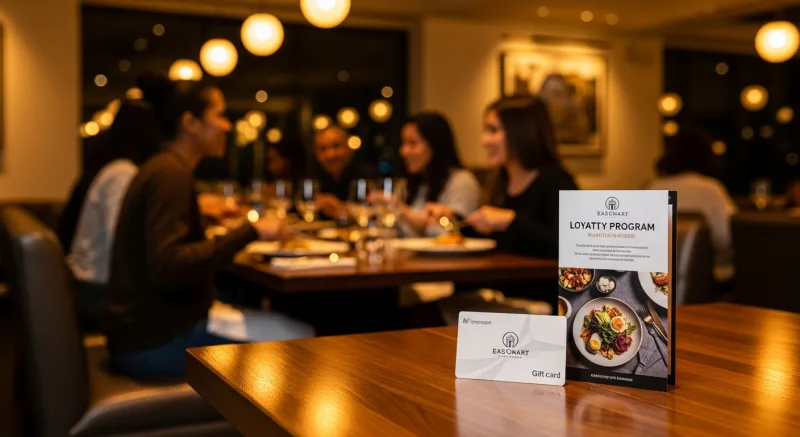
Gift Cards That Actually Drive Revenue
Here is what most restaurant owners do not realize: gift card buyers spend an average of 20-40% more than the card's face value. A $50 gift card typically generates $60-70 in actual spending. KwickOS supports both physical gift cards and electronic gift cards that customers can purchase, send, and redeem through their phones.
- Physical gift cards — branded plastic cards that sit on your counter and sell themselves during holidays
- E-gift cards — customers buy and send digitally via text or email, perfect for last-minute gifts
- Balance tracking — real-time balance across all your locations, no manual reconciliation
- Reload capability — customers top up their balance, creating a built-in prepayment habit
Loyalty Points That Keep Them Coming Back
KwickOS loyalty is not a punch card from 2005. It is a digital points system that tracks every dollar spent and automatically rewards your best customers:
- Earn points on every purchase — configurable ratio (e.g., $1 = 1 point, or $1 = 10 points)
- Tiered rewards — silver, gold, platinum levels to incentivize higher spending
- Birthday rewards — automated birthday offers that bring customers back during their special month
- Points-for-payment — customers redeem points directly at checkout, seamless for your staff
Membership Programs
For restaurants running VIP programs or subscription models (like monthly coffee clubs), KwickOS membership management handles recurring billing, exclusive pricing tiers, and member-only menu items — all within the same system your cashier already uses.
The bottom line: Toast charges $75/month extra for loyalty. Square's loyalty starts at $45/month. KwickOS includes gift cards, e-gift cards, loyalty points, and membership management in every plan. That is $540-900/year you keep in your pocket.