Best All-in-One POS System for Dallas Restaurants
Published March 2026 · 10 min read
Dallas doesn't do anything small. The metro area spans 13 counties, feeds 8 million people, and generated $18.7 billion in restaurant sales in 2025 according to the Texas Restaurant Association. From Pecan Lodge's legendary brisket line that wraps around the Deep Ellum block before the doors open, to the $400 omakase experiences popping up in Uptown high-rises, the DFW food scene demands technology that can handle both extremes without breaking a sweat.
Running a restaurant in Dallas presents a unique set of challenges that generic POS buying guides completely ignore. This analysis examines what DFW operators actually need from their technology based on the realities of operating in this specific market.
The BBQ and Steakhouse Factor
Texas BBQ isn't just food. It's an identity, and it comes with operational complexity that most POS systems weren't designed to handle. A typical Dallas BBQ joint sells by weight rather than fixed portions, requiring a POS that can price items per quarter-pound rather than per plate. The kitchen workflow is nothing like a standard restaurant because the pit runs 14-18 hours ahead of service. When the brisket sells out, it's gone, and the POS needs to communicate that across the counter, online ordering, and kiosk channels simultaneously, not 15 minutes later when the cloud finally syncs.
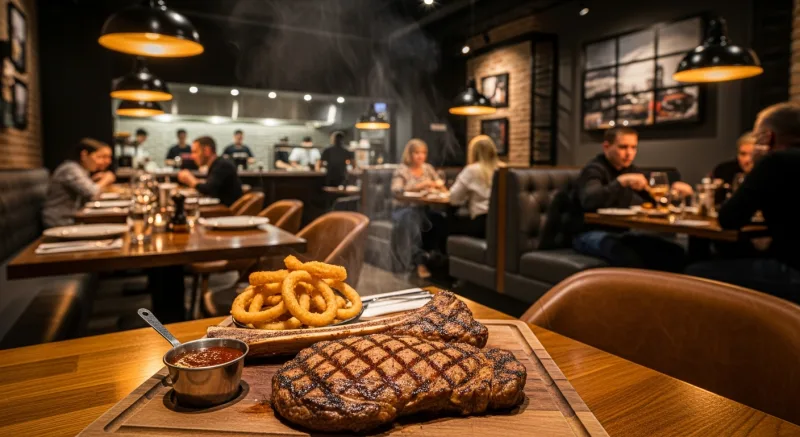
Steakhouses face their own POS demands. A single table at Pappas Bros on Lovers Lane might generate a $600 ticket with specific temperature requests, wine pairings, and side modifications. The POS needs to transmit that to the kitchen display with absolute clarity because remaking a $85 tomahawk ribeye kills your margins. Meanwhile, the bar is running a separate rhythm with happy hour pricing that transitions automatically at 7pm without a manager manually switching menus.
Weight-based pricing, timed menu transitions, and instant out-of-stock syncing across all channels are not niche features in Dallas. They are daily necessities. KwickOS handles all three natively because the system was built for exactly these multi-format operations.
DFW Airport and the Hospitality Surge
DFW International Airport served 73 million passengers in 2025, making it the third busiest in the world. The airport's 140-plus restaurants and bars operate under conditions that would destroy most POS setups: transactions per minute during connection rushes exceed typical restaurant peak by three to four times, every customer is in a hurry, and the WiFi infrastructure in a sprawling airport terminal is notoriously inconsistent.
Airport restaurant operators need a POS that processes transactions locally rather than routing every order through a cloud server in Virginia. A one-second delay feels like ten seconds to a passenger watching their boarding time approach. KwickOS's hybrid architecture processes each transaction in approximately one millisecond on the local terminal while background-syncing to the cloud, which means an airport WiFi hiccup doesn't turn into a line of angry travelers.
Beyond the airport, the surrounding hospitality corridor along International Parkway includes hundreds of hotel restaurants, conference dining facilities, and catering operations that serve the convention traffic flowing through the Kay Bailey Hutchison Center downtown. These operations scale up and down rapidly, sometimes doubling capacity for a single event and returning to normal the next day. A POS that charges per-terminal fees punishes this flexibility. A system that allows adding temporary stations during peak events without long-term cost commitments aligns with how hospitality actually works in DFW.
Tex-Mex: High Volume, Tight Margins, Complex Menus
Dallas has more than 4,000 Mexican and Tex-Mex restaurants, from the $6.99 lunch special counters on Harry Hines Boulevard to the upscale modern Mexican concepts opening along Henderson Avenue. The common thread is menu complexity. A single enchilada plate might involve selecting from three proteins, five sauces, cheese type, rice and bean preferences, and spice level. Multiply that by a 200-item menu, and the modifier tree in your POS becomes the single biggest factor in order accuracy and speed.
KwickOS structures modifiers in a nested hierarchy that cashiers navigate with two to three taps rather than scrolling through flat lists. For operations like Crafty Crab, which runs 19 locations with 152 terminals and uses one-click menu sync to push updates across every store simultaneously, this kind of modifier architecture isn't theoretical. It's handling thousands of orders per day across multiple states.
The bilingual dimension matters enormously in Dallas. Kitchen staff in many DFW Tex-Mex restaurants are more comfortable reading Spanish tickets, while front-of-house interacts with customers in English. A POS that only supports English on kitchen displays creates a translation bottleneck that slows every ticket. KwickOS supports English, Spanish, and Chinese natively across all display types, matching the actual linguistic reality of Dallas restaurant kitchens.
Game Day Economics at AT&T Stadium
When the Cowboys play at home, the area within a five-mile radius of AT&T Stadium in Arlington transforms economically. The 80,000-seat venue generates $10-15 million in local restaurant spending per game day according to Arlington Convention and Visitors Bureau estimates. Restaurants in the Entertainment District experience 300-400% volume increases that last approximately six hours, from pre-game arrivals through post-game celebrations.
This surge pattern requires specific POS capabilities. Line-busting through mobile terminals or tablets that servers carry through crowds waiting for tables. Automatic happy hour and surge pricing that switches on and off at predetermined times without manual intervention. Kitchen display systems that intelligently route orders to balance stations rather than overwhelming a single cook because the POS sent 40 appetizer orders to one screen in two minutes.
KwickOS kitchen display routing distributes orders based on station workload and estimated preparation time. Shogun Japanese Hibachi uses customized station displays to manage its hibachi-specific workflow, demonstrating that the platform adapts to unique kitchen configurations rather than forcing restaurants into a one-size-fits-all ticket flow.
The North Dallas Korean BBQ Corridor
The stretch of Royal Lane and Harry Hines between Koreatown and Carrollton has become one of the densest Korean BBQ corridors in the United States outside Los Angeles. These restaurants face a POS challenge that few platforms handle well: table-side cooking where the order isn't a static list of dishes but an evolving session. Guests order meat cuts progressively over 90-minute sittings, add banchan sides, switch between individual and shared ordering, and often split checks in complex ways at the end.
The POS needs to keep a running tab that remains open and editable for extended periods, handle per-gram pricing for premium cuts like wagyu, and support split-by-item check division where one person's A5 ribeye doesn't get averaged across the whole table. Time-based pricing for all-you-can-eat sessions adds another layer, requiring the POS to start a timer when the table is seated and automatically apply the correct rate when they close out.
Most cloud POS systems were designed for quick-service and fast-casual workflows where tickets open and close in under 15 minutes. Korean BBQ in Dallas needs a system comfortable with two-hour open tickets, and that's a fundamental architectural choice, not a feature toggle.
Property Taxes and the Margin Squeeze
Dallas County property taxes for commercial spaces average 2.2% of assessed value, among the highest in the country for a state with no income tax. A restaurant leasing a 3,000-square-foot space in Uptown where the property is assessed at $1.5 million sees roughly $33,000 in annual property taxes passed through the lease as triple-net charges. That cost goes up every year as DFW property values continue climbing.
When your fixed overhead is this aggressive, every fraction of a percentage point on credit card processing matters. Dallas restaurants processing $700,000 annually in card sales through a locked processor at 3.1% pay $21,700 in fees. Switching to a competitive processor available through a processor-agnostic POS like KwickOS at 2.4% drops that to $16,800. The $4,900 annual savings offsets a significant chunk of the property tax pain.
For multi-location Dallas operators, the savings multiply. A five-location group doing $3.5 million combined in card sales saves approximately $24,500 annually by having the freedom to negotiate processing rates. That's a full kitchen equipment refresh every other year funded entirely by processing savings.
Summer Heat and the Digital Pivot
From June through September, Dallas temperatures regularly exceed 100 degrees Fahrenheit. Foot traffic at restaurants without strong patio misters or covered patios drops 25-35% during afternoon hours according to Dallas Restaurant Association surveys. The operators who maintain revenue during these months are those with robust delivery and online ordering channels that capture the customers choosing to eat at home rather than walk across a 140-degree parking lot.
KwickMenu, the online ordering platform integrated with KwickOS, handles this seasonal shift by routing delivery orders directly into the kitchen display queue without requiring staff to manually transfer orders from a third-party tablet. During summer months, delivery might represent 40-50% of a Dallas restaurant's revenue, and if that channel operates on a separate system from dine-in, the kitchen becomes a chaos of competing tickets from different sources.
The delivery economics matter here too. Third-party platforms charge 15-25% commission, which on a $30 order means $4.50 to $7.50 goes to DoorDash or UberEats. KwickDriver offers a flat $2 base fee plus $6.99 per five miles, keeping dramatically more revenue with the restaurant. For a Dallas restaurant doing 60 deliveries per day during summer, the difference between third-party commissions and KwickDriver fees can exceed $200 per day, or $6,000 over the three hottest months.
What Dallas Restaurants Should Prioritize
Based on the specific market dynamics in DFW, here's what matters most when selecting an all-in-one POS:
Weight-based and time-based pricing: Essential for BBQ, Korean BBQ, and buffet concepts that dominate the Dallas dining landscape. If the POS can't handle per-ounce pricing natively, it's not built for this market.
Multi-language kitchen displays: The DFW restaurant workforce is bilingual at minimum. English-only kitchen tickets create errors and slow service. Spanish and Chinese language support is a practical requirement, not a diversity checkbox.
Processor freedom for margin protection: With Dallas property taxes eating into margins from one side and rising food costs from the other, processing savings are the most controllable cost lever available.
Offline reliability for venue and airport operations: WiFi in AT&T Stadium, DFW Airport, and many older Dallas building interiors is unreliable. Cloud-only POS systems turn connectivity problems into revenue problems.
Delivery integration that preserves margins: Summer heat makes delivery essential, not optional. The delivery fee structure your POS offers or integrates with directly impacts whether those orders are profitable.
Dallas restaurants operate in one of the most competitive and cost-intensive markets in the country. The technology platform you choose either gives you an edge or adds to the drag. To see how KwickOS addresses each of these Dallas-specific challenges, call (888) 355-6996 or visit KwickOS.com.
The Revenue Features Most "All-in-One" Systems Charge Extra For
When POS companies say "all-in-one," they rarely mean gift cards and loyalty are included. Toast charges $75/month for their loyalty add-on. Square Loyalty starts at $45/month. Clover requires third-party apps. KwickOS includes all of these natively — zero extra cost.
Physical & Electronic Gift Cards
Sell branded physical cards at the register. Send e-gift cards via text or email. Track balances across every location in real time. Gift card holders spend 20-40% more than face value — this is not a nice-to-have, it is a revenue multiplier.
Points-Based Loyalty System
Every transaction earns points. Customers see their balance on receipts and can redeem at checkout. Configurable earn ratios, tiered VIP levels, and automatic birthday rewards. No separate app required — it runs inside the POS your cashier already knows.
Membership & Subscription Management
Run coffee clubs, wine memberships, or VIP dining programs. Recurring billing, exclusive member pricing, and member-only items — managed from the same dashboard as your daily operations. Your customers feel special. Your revenue becomes predictable.
Real impact: businesses using KwickOS loyalty features see repeat visit rates increase by up to 35%. Gift card programs generate an average of 15% additional revenue during holiday seasons.

Tom Jin
Founder & CIO of KwickOS · 30 Years IT · 20 Years Restaurant Industry
Tom built KwickOS after decades running restaurants and IT companies. Today KwickOS serves 5,000+ businesses across 50 states.