For Chicago business owners searching for Loop to Lincoln Park, here's what the top operators already know. Chicago is America's third-largest restaurant market, with over 7,300 restaurants serving 2.7 million city residents and millions of suburban commuters. The market is defined by extreme seasonality — January foot traffic can drop 40-60% compared to July — and by neighborhood identity that dictates everything from menu composition to price points to operating hours.
For multi-location restaurant groups, Chicago presents a specific challenge: the city's geography creates natural market segmentation. Your Loop location depends on weekday lunch traffic from office workers who disappear at 5 PM and do not exist on weekends. Your Lincoln Park location thrives on weekend brunch and evening dining from young professionals. Your suburban Schaumburg location serves families who arrive by car and order larger quantities per table.
Each location needs a POS that handles its specific operational rhythm while feeding data into a centralized management layer that gives ownership visibility across the entire group.
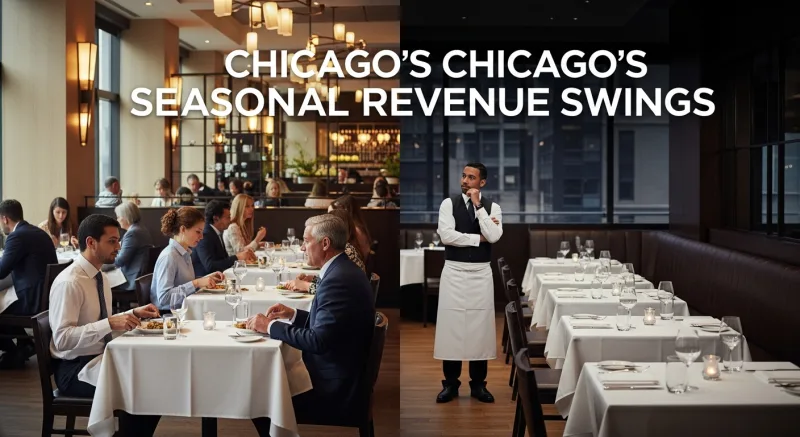
Chicago's Seasonal Revenue Swings
No major American city has more extreme seasonal variation in restaurant revenue than Chicago. A polar vortex in January can reduce walk-in traffic by 70%. A beautiful June weekend can push revenue 50% above average. Restaurant groups need real-time visibility into how each location is performing relative to weather-adjusted expectations — not just compared to last month.
KwickOS's multi-location dashboard shows all locations in real time. On a January Monday when the wind chill is -15F, the owner sees that the Loop location is at 30% of normal lunch volume (expected — office workers are working from home), Lincoln Park is at 45% (better than expected — the neighborhood residents are ordering delivery), and Schaumburg is at 60% (suburban customers still drive to restaurants in bad weather). The data enables in-the-moment decisions: reduce staffing at the Loop for the rest of the week, increase delivery capacity at Lincoln Park, and maintain normal operations in Schaumburg.
Without a unified dashboard, these decisions wait until end-of-week when the owner manually compiles reports from each location. By then, the overstaffing at the Loop has cost $2,000 in unnecessary labor and the delivery surge at Lincoln Park has been handled by frustrated, understaffed employees who turned orders away.
T. Jin China Diner monitors 15 locations through this same dashboard. For Chicago restaurant groups, where weather-driven variability is the dominant factor in daily revenue, real-time multi-location visibility is the most valuable technology capability you can have.
Neighborhood-Specific Menus with Central Control
Your Loop lunch menu needs speed: quick combos, grab-and-go items, 10-minute ticket times. Your Lincoln Park dinner menu needs depth: shareable plates, seasonal cocktails, dessert options that encourage lingering. Your Chinatown location might need a completely different menu composition with authentic dishes, multilingual labeling, and family-style portions.
KwickOS supports master menu management with location-specific overrides. The core brand items — your signature dishes, standard sides, beverage program — sync across all locations with one click. Neighborhood-specific items, pricing adjustments, and menu layouts are configured as location overrides that persist through master menu syncs.
When headquarters adds a new seasonal item that all locations should carry, one click pushes it everywhere. When the Chinatown location needs a dim sum menu that only exists at that store, it is configured locally and does not affect other locations. Central consistency for the brand. Local customization for the neighborhood.
Crafty Crab Seafood manages this across 19 locations in multiple markets. Their core seafood boil menu syncs chain-wide while location-specific specials stay local. The same architecture works for a Chicago group operating across neighborhoods with dramatically different dining cultures.
Cross-Neighborhood Gift Cards
Chicago gift card dynamics follow the city's commuter patterns. A Loop office worker buys a gift card at your downtown restaurant as a birthday gift for a friend who lives in Lincoln Park. That friend needs to be able to use it at the Lincoln Park location. A suburban customer receives a gift card from their kids who bought it at the location near their college campus in the city. The card needs to work everywhere.
KwickOS gift cards sync across all locations in real time. No per-location restrictions. No "sorry, this card was purchased at our other location." The balance is centralized and updates instantly with every transaction at any store. Physical cards, e-gift cards through KwickMenu, and promotional credits all work everywhere from the moment of purchase.
For Chicago restaurant groups, gift card sales peak during the holiday season (November-December) and around Mother's Day. A 3-location group might sell $80,000-150,000 in gift cards annually. The 10-15% breakage rate generates $8,000-22,500 in pure margin — but only if the cards work at every location. Frustrated gift card holders who cannot redeem at their preferred location reduce breakage to zero by aggressively spending the balance, eliminating that profit margin entirely.
Unified Loyalty for Chicago's Mobile Diners
Chicagoans move around the city frequently. The L train connects neighborhoods, commuters cross the city daily, and weekend plans take people to different parts of town. A customer who visits your restaurant at three different locations over the course of a month is one of your most valuable customers — but on fragmented loyalty systems, they appear as three low-frequency visitors at three separate stores.
KwickOS loyalty unifies across all locations. One customer profile, one point balance, one membership tier. The customer who visits the Loop on Tuesday lunch, Lincoln Park on Saturday dinner, and Schaumburg for Sunday brunch accumulates points from all three visits in one account. They reach reward thresholds at the rate their total patronage deserves. Membership management from headquarters identifies your top cross-location customers for VIP treatment at every store.
Processing Savings in a Tight-Margin Market
Chicago restaurant margins are tighter than the national average due to high labor costs (city minimum wage), significant property taxes, and seasonal revenue volatility. A 3-location group processing $350,000/month on Toast at 2.99% + $0.15 pays approximately $10,970/month in processing. At a negotiated rate of 2.2% + $0.10, the same volume costs $8,050/month.
Annual savings: $35,040.
In a market where January revenue might be 40% below July, every dollar saved on fixed costs (like processing overpayment) improves your ability to survive the seasonal trough. KwickOS is processor-agnostic. Negotiate one rate based on aggregate volume. Keep the savings that Toast, Square, and Clover take from you.
Chicago's Internet Infrastructure
Chicago's internet reliability varies significantly by neighborhood and building age. Loop office buildings have redundant fiber. A storefront in Pilsen might rely on a single cable connection. A location in a shopping center shares bandwidth with every other tenant.
Cloud-dependent POS systems (Toast, Square) turn internet outages into revenue outages. KwickOS processes transactions locally at 1ms speed. The internet is used for cloud sync, not core operations. When the ISP drops at your Wicker Park location during Friday night service, every register and KDS screen keeps running. Revenue is unaffected.
Employee Management Across Chicago Locations
Chicago restaurant employees frequently work at multiple locations within a group, especially in an era of high turnover and tight labor markets. KwickOS fingerprint authentication (1:N matching) works at every location. One employee record, one timecard, one payroll export. Cross-location hours are tracked automatically for overtime compliance — critical under Chicago's labor laws that include overtime requirements and predictive scheduling provisions.
The Chicago Multi-Location Checklist
- Can you see all Chicago locations on one real-time dashboard with weather-adjusted performance context?
- Can you maintain a master menu with neighborhood-specific overrides?
- Do gift cards work across all locations instantly?
- Does loyalty accumulate across all stores into one customer profile?
- Does the system track cross-location employee hours for Chicago labor compliance?
- Can each location operate offline independently?
- Can you use one processor at one rate for all locations?
- Does the POS support multilingual operation?
KwickOS handles all eight with hybrid local+cloud architecture optimized for the demands of Chicago's multi-neighborhood restaurant market.
Running Restaurants Across Chicago?
Schedule a demo and we will show you the multi-location dashboard, neighborhood-specific menu management, cross-location gift cards and loyalty, and processing savings for your Chicago restaurant group.
Get Your Free DemoOr call us directly: (888) 355-6996
Turn One-Time Diners into Regulars: Built-In Gift Cards & Loyalty
Most POS companies treat gift cards and loyalty as afterthoughts — expensive add-ons that cost $50-100/month extra. KwickOS includes them at no additional charge because we believe they are essential revenue tools, not luxury features.
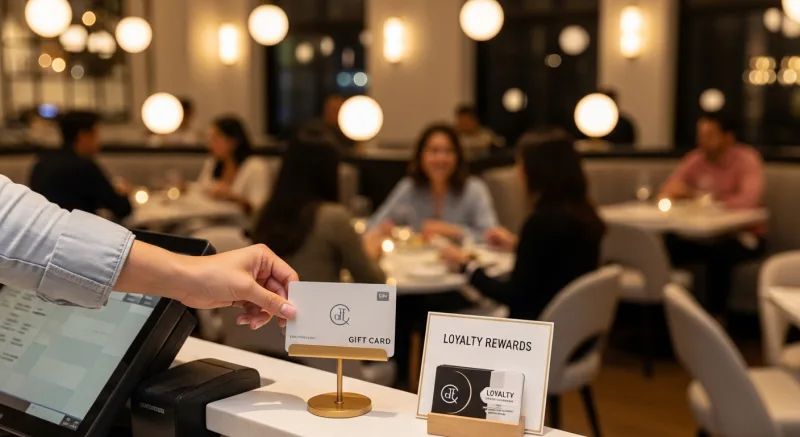
Gift Cards That Actually Drive Revenue
Here is what most restaurant owners do not realize: gift card buyers spend an average of 20-40% more than the card's face value. A $50 gift card typically generates $60-70 in actual spending. KwickOS supports both physical gift cards and electronic gift cards that customers can purchase, send, and redeem through their phones.
- Physical gift cards — branded plastic cards that sit on your counter and sell themselves during holidays
- E-gift cards — customers buy and send digitally via text or email, perfect for last-minute gifts
- Balance tracking — real-time balance across all your locations, no manual reconciliation
- Reload capability — customers top up their balance, creating a built-in prepayment habit
Loyalty Points That Keep Them Coming Back
KwickOS loyalty is not a punch card from 2005. It is a digital points system that tracks every dollar spent and automatically rewards your best customers:
- Earn points on every purchase — configurable ratio (e.g., $1 = 1 point, or $1 = 10 points)
- Tiered rewards — silver, gold, platinum levels to incentivize higher spending
- Birthday rewards — automated birthday offers that bring customers back during their special month
- Points-for-payment — customers redeem points directly at checkout, seamless for your staff
Membership Programs
For restaurants running VIP programs or subscription models (like monthly coffee clubs), KwickOS membership management handles recurring billing, exclusive pricing tiers, and member-only menu items — all within the same system your cashier already uses.
The bottom line: Toast charges $75/month extra for loyalty. Square's loyalty starts at $45/month. KwickOS includes gift cards, e-gift cards, loyalty points, and membership management in every plan. That is $540-900/year you keep in your pocket.