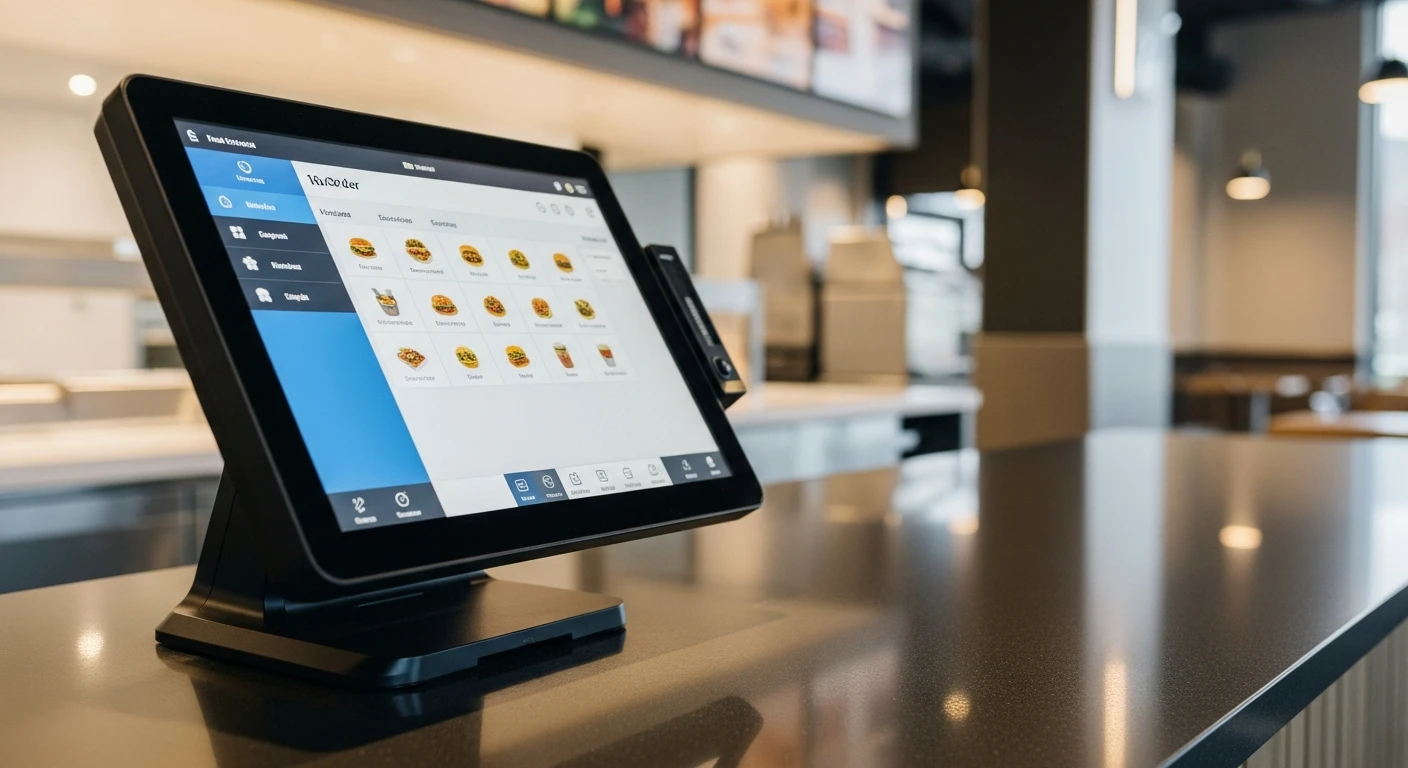
For quick-service restaurant operators, Scaling a QSR From 3 to 30 Locations isn't optional — it's the backbone of daily operations. The QSR business model is built on speed, consistency, and volume. Every additional second in a transaction costs throughput. Every menu inconsistency between locations costs customer trust. Every dollar overpaid on payment processing compounds across hundreds of thousands of transactions per year. At 3 locations, these inefficiencies are irritating. At 10 locations, they are expensive. At 30 locations, they are existential threats to the business.
I have deployed POS systems for QSR chains at every stage of growth. The pattern is predictable: the chains that invest in multi-location infrastructure early — centralized management, one-click sync, unified loyalty — are the ones that successfully scale. The ones that cobble together per-location solutions hit a wall between 5 and 10 stores where the operational overhead of managing disconnected systems exceeds the revenue benefit of adding another location.
Transaction Speed: The QSR Non-Negotiable
A quick-service restaurant processing 400-600 transactions per day per location needs every transaction to complete in under 3 seconds. That is not a preference — it is a throughput requirement. During lunch rush, when transactions arrive every 20-30 seconds, a POS that adds even 1 second of latency per transaction reduces throughput by 3-5%. At $10 average ticket and 30 transactions per hour during peak, that throughput loss costs $15-25/hour per register. Across 10 locations with 2 registers each during 4 peak hours, that is $1,200-2,000 per day in lost revenue from POS latency.
Cloud-only POS systems introduce latency that QSR operators cannot afford. Every transaction on Toast, Square, or cloud-based Clover makes a round trip to a remote server — typically 20-100ms per step, with multiple steps per transaction. Network jitter adds variability. On a good day, transactions take 1-2 seconds. On a day when the internet is slow, they take 3-5 seconds. On a day when the internet drops, they do not complete at all.
KwickOS processes transactions locally at 1ms speed. The register, the kitchen display, and the payment terminal communicate on the local network. Cloud connectivity is used for syncing data to the centralized dashboard, but core transaction processing never depends on internet speed. The difference between 1ms and 100ms is invisible for a single transaction, but across 500 daily transactions, it compounds into minutes of recovered throughput — and during peak hours, minutes matter.
One-Click Menu Sync at QSR Scale
QSR menus change more frequently than full-service restaurants. Limited-time offers (LTOs) rotate monthly. Combo pricing adjusts quarterly. Ingredient shortages require real-time item removal. A QSR chain running 6 LTOs per year, plus seasonal pricing changes, plus occasional emergency item removals, might make 40-60 menu changes per year across all locations.
At 10 locations with separate POS systems, 50 menu changes per year means 500 separate update sessions. Each session takes 15-30 minutes (log in, find item, change price/add item/remove item, verify at all terminals). That is 125-250 hours of manager time per year dedicated to menu updates — 3 to 6 full work weeks of administrative labor that adds zero revenue.
KwickOS one-click sync handles each change in seconds regardless of the number of locations. Add a new LTO combo, set the price and modifiers, click sync: 10 locations, 30 terminals, all updated simultaneously. Remove an item that is out of stock at all locations: one click, gone everywhere. Adjust combo pricing for a new quarter: one update, all locations aligned.
Crafty Crab Seafood manages this across 19 locations and 152 terminals. For a 10-30 location QSR chain, the labor savings alone justify the platform — but the bigger win is consistency. Every location runs the exact same promotion, the exact same pricing, the exact same combos, at the exact same time.
Self-Ordering Kiosks at Scale
QSR kiosks increase average ticket size by 15-30% because customers add more items when they are not facing a line or a cashier. At a QSR doing $15,000/day across 10 locations, kiosks driving 20% of orders at 20% higher average ticket add $600/day or $219,000/year in incremental revenue.
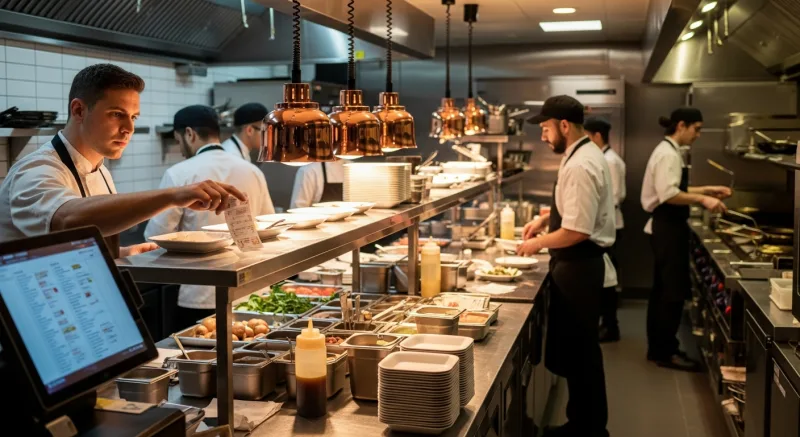
But kiosks at multiple locations need centralized management. When the LTO changes, every kiosk at every location needs the updated menu. When a promotional image changes, all kiosks need the new asset. When a kiosk goes offline at Location 7, the centralized dashboard needs to show the alert so IT can respond.
Rockin' Rolls Sushi Express runs 3 stores with 49 iPad self-ordering stations on KwickOS. Their KDS integration reduces serving time by routing kiosk orders directly to the kitchen display. At QSR scale, this same architecture supports hundreds of kiosks managed from one dashboard, with menu updates pushed centrally and health monitoring showing which devices need attention.
Centralized Reporting for QSR Operations
QSR operators make decisions based on metrics that most restaurant systems do not track well: transactions per labor hour, speed of service, drive-thru throughput, daypart performance, and combo attachment rates. At a single location, these metrics are useful. At 10+ locations, they become the basis for operational benchmarking that separates your best-performing stores from your worst — and the data to understand why.
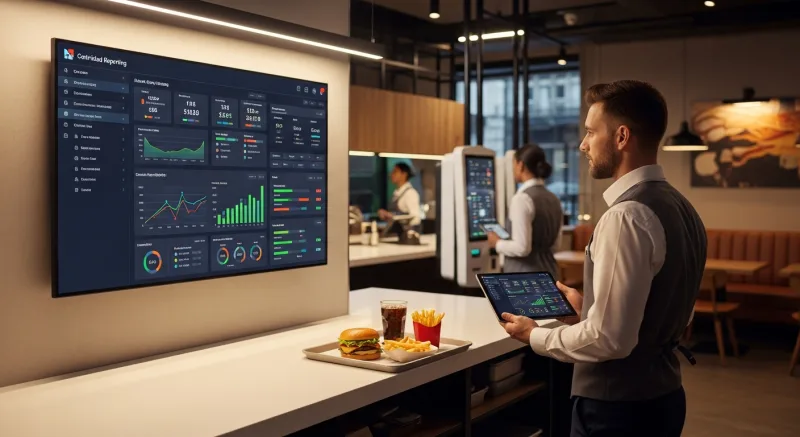
KwickOS's multi-location dashboard shows these metrics for every location simultaneously. At a glance: Location A processes 42 transactions per labor hour (best in the chain), Location F processes 31 (worst). Why? Drill into the data. Location F has higher average transaction time (speed of service issue), not lower traffic. The problem is not demand — it is kitchen efficiency or register speed at Location F. Now you have a specific problem to solve at a specific location.
T. Jin China Diner uses this dashboard across 15 locations and 75 terminals. For QSR chains where operational consistency is the brand promise, multi-location benchmarking is the tool that maintains standards across every store.
Gift Cards and Loyalty: The QSR Growth Loop
QSR loyalty programs are among the most effective in food service because of order frequency. A customer who visits a QSR 2-3 times per week earns rewards quickly, which drives continued visits. The loyalty loop — earn, engage, redeem, repeat — is tighter at QSR than at any other restaurant category.
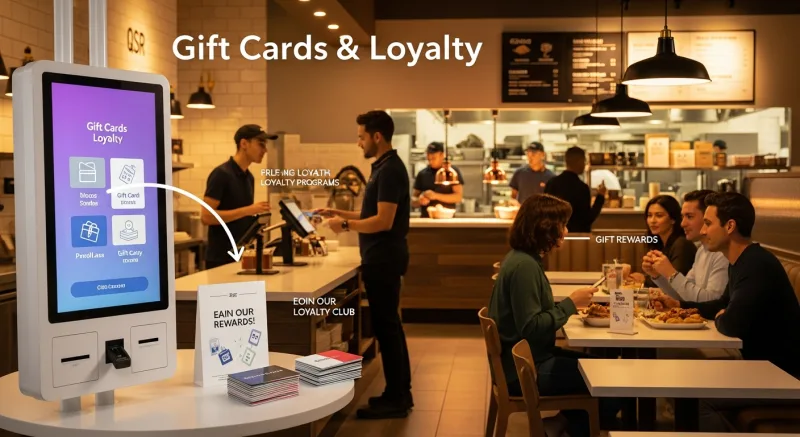
Fragmenting this loop across locations breaks the psychology. A customer who visits Location A twice and Location B once per week should earn 3 visits worth of points. On fragmented systems, they earn 2 at A and 1 at B — two separate accounts that each feel like slow progress. The motivational effect of "almost there" is diluted by data fragmentation.
KwickOS loyalty unifies across all locations and channels. In-store, kiosk, drive-thru, online, app — every order counts in one account. The customer reaches reward thresholds at the rate their total patronage deserves. Membership management from headquarters lets you create tiered programs (free tier, paid tier, VIP tier) that recognize your best customers across the entire chain.
Gift cards follow the same principle. KwickOS gift cards work at every location in real time. A parent buys a $25 gift card at the location near school. The kids use it at the location near home. No friction, no "sorry, wrong store," no lost sale.
Processing Costs: The QSR Scale Problem
QSR chains process the highest transaction volume per location of any restaurant format. At 500 transactions/day per location and $10 average ticket, a 10-location chain processes $50,000/day or $1,500,000/month.
On Toast (2.99% + $0.15/transaction): monthly processing costs approximately $67,350. On a negotiated rate through an independent processor (2.15% + $0.08): $44,700/month.
Annual savings: $271,800.
At 30 locations, the math triples. At that scale, processor freedom is not an optimization — it is the difference between profitability and break-even. Toast's locked processing rate takes 6.7% of a QSR chain's revenue at this volume. A negotiated rate takes 4.5%. That 2.2 percentage point difference funds expansion, marketing, equipment upgrades, and management salaries.
KwickOS is processor-agnostic. One processor, one rate, all locations. Negotiate based on aggregate volume. Switch if a better offer appears. Your POS does not hold your processing revenue hostage.
Offline Operation: The QSR Insurance Policy
A QSR location that goes offline during lunch rush loses $500-1,000/hour in revenue. On a cloud-dependent system, an internet outage shuts down or severely degrades operations. On KwickOS, the location keeps running at full capability because every transaction processes locally. The internet comes back, data syncs, and nothing was lost.

At 10 locations, the probability that at least one location experiences an internet issue on any given day is substantial. ISP outages, router failures, construction cutting a cable — any of these can take a cloud-dependent POS offline. KwickOS's hybrid architecture means the impact is zero: the location runs on local processing, and the centralized dashboard shows a temporary sync delay (not a revenue-stopping outage).
Employee Management Across QSR Locations
QSR chains share employees between locations more than any other restaurant format. Crew members pick up shifts at whichever store needs coverage. Shift managers rotate between locations based on scheduling needs. Area managers oversee 3-5 stores and need access at all of them.
KwickOS fingerprint authentication (1:N matching — touch and go, no ID entry) works at every location. A crew member clocking in at Location B on Tuesday uses the same fingerprint they used at Location A on Monday. One employee record, one timecard, one payroll export. Manager permissions follow the employee — an area manager with oversight of 5 locations has appropriate access at all 5 without separate login credentials at each.
The Multi-Location QSR Readiness Checklist
- Does the POS process transactions locally at sub-second speed regardless of internet status?
- Can you push menu changes, LTOs, and pricing updates to all locations in seconds?
- Are self-ordering kiosks managed centrally with remote menu updates and health monitoring?
- Does the dashboard benchmark all locations on throughput, speed of service, and labor efficiency?
- Do gift cards work at every location in real time?
- Does the loyalty program unify points from all locations and channels?
- Can you use one payment processor at one rate for all locations?
- Do employees use the same fingerprint authentication at every location?
KwickOS answers yes to all eight. The architecture was built for the scale, speed, and consistency that QSR chains demand — from 3 locations to 30 and beyond.
Scaling Your QSR Chain?
Schedule a demo and we will show you local transaction processing at 1ms, one-click menu sync, centralized kiosk management, multi-location benchmarking, and processor savings — calculated for your volume and growth plan.
Get Your Free Demo
Or call us directly: (888) 355-6996
Turn One-Time Diners into Regulars: Built-In Gift Cards & Loyalty
Most POS companies treat gift cards and loyalty as afterthoughts — expensive add-ons that cost $50-100/month extra. KwickOS includes them at no additional charge because we believe they are essential revenue tools, not luxury features.
Gift Cards That Actually Drive Revenue
Here is what most restaurant owners do not realize: gift card buyers spend an average of 20-40% more than the card's face value. A $50 gift card typically generates $60-70 in actual spending. KwickOS supports both physical gift cards and electronic gift cards that customers can purchase, send, and redeem through their phones.
- Physical gift cards — branded plastic cards that sit on your counter and sell themselves during holidays
- E-gift cards — customers buy and send digitally via text or email, perfect for last-minute gifts
- Balance tracking — real-time balance across all your locations, no manual reconciliation
- Reload capability — customers top up their balance, creating a built-in prepayment habit
Loyalty Points That Keep Them Coming Back
KwickOS loyalty is not a punch card from 2005. It is a digital points system that tracks every dollar spent and automatically rewards your best customers:
- Earn points on every purchase — configurable ratio (e.g., $1 = 1 point, or $1 = 10 points)
- Tiered rewards — silver, gold, platinum levels to incentivize higher spending
- Birthday rewards — automated birthday offers that bring customers back during their special month
- Points-for-payment — customers redeem points directly at checkout, seamless for your staff
Membership Programs
For restaurants running VIP programs or subscription models (like monthly coffee clubs), KwickOS membership management handles recurring billing, exclusive pricing tiers, and member-only menu items — all within the same system your cashier already uses.
The bottom line: Toast charges $75/month extra for loyalty. Square's loyalty starts at $45/month. KwickOS includes gift cards, e-gift cards, loyalty points, and membership management in every plan. That is $540-900/year you keep in your pocket.