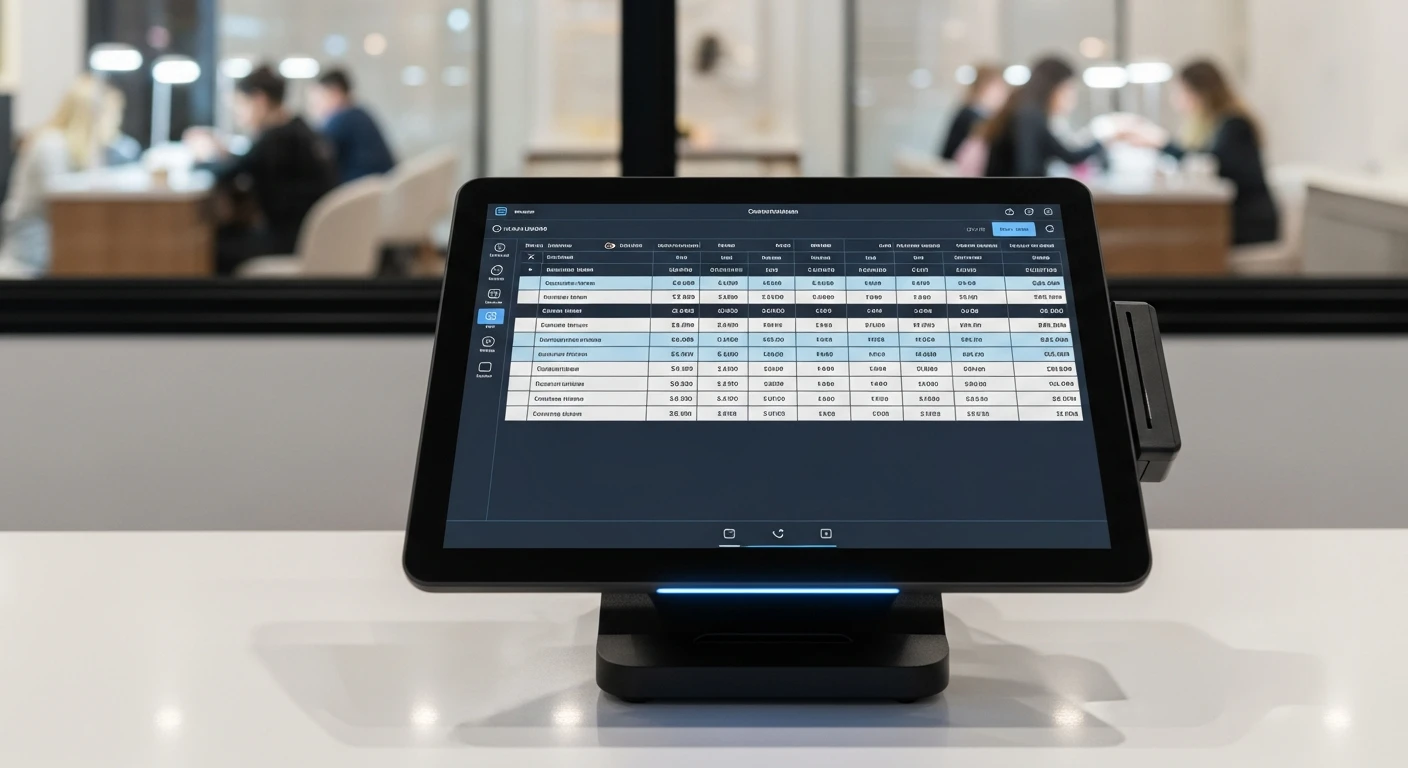
Running one nail salon is a balance of client flow, technician scheduling, and commission accuracy. Running four nail salons is that balance multiplied by four — plus the cross-location coordination that most POS systems were never designed to handle. The technician who works at two locations. The membership client who visits whichever salon is closest. The gift card purchased at your busiest store that should work at your newest one.
Diva Nail Beauty operates 4 stores and 4 terminals on KwickOS. They saw a 90% efficiency increase after switching to automated commission tracking. That number is not marketing — it reflects the reality of how much time nail salon owners spend on manual payroll calculations when their POS does not handle multi-location commissions natively.
The Commission Calculation Problem
Nail salon commission structures are some of the most complex in small business. A typical setup might look like this:
- Manicure technician: 40% commission on basic services, 45% on gel services, 50% on nail art
- Senior technician: 50% on all services, 20% on product sales
- Booth renter: fixed weekly rent, keeps all service revenue minus supplies
- New technician (training period): 30% commission for first 90 days, then graduated increase
Now multiply that by 40 technicians across 4 locations, where 6-8 technicians float between stores. Each pay period, someone — usually the owner — must calculate commissions for every technician at every location, combine the totals for floating technicians, apply any bonuses or deductions, and produce accurate payroll.
On separate POS systems, this means pulling commission reports from 4 different back offices, cross-referencing floating technicians manually, checking that commission rates match across systems (they often do not, due to entry errors), and producing a master payroll spreadsheet. This process takes 4-6 hours per pay period. With biweekly payroll, that is 104-156 hours per year dedicated to commission calculation — the equivalent of 2.5-4 full work weeks spent on payroll admin.
KwickOS calculates commissions automatically across all locations. Every service performed by every technician at every location is tracked with the correct commission rate. Floating technicians have one employee record with one commission structure — their work at Location A on Monday and Location C on Wednesday appears on one commission report. The biweekly payroll process drops from 4-6 hours to 15-20 minutes: review the auto-calculated report, approve, done.
The 90% efficiency increase that Diva Nail Beauty reported is the difference between 5 hours and 30 minutes per pay cycle. That recaptured time goes back to what actually grows the business: client relationships, marketing, and service quality.
Membership Programs: The Multi-Location Retention Engine
Nail salon memberships are growing in popularity because they solve the rebooking problem. A client who pays $79/month for unlimited basic manicures visits 3-4 times per month instead of 1-2 times. The salon gets predictable recurring revenue. The client gets value and convenience. Memberships increase average client lifetime value by 60-80% compared to pay-per-visit clients.
But memberships only work across multiple locations if the system supports it. A client who pays $79/month at Location A expects to use her membership at Location B when she is in that part of town. On separate POS systems, Location B has no record of her membership. She either pays out of pocket (frustrated, feeling cheated) or shows her receipt from Location A and the receptionist manually processes a "no charge" service (inaccurate records, potential abuse).
KwickOS manages memberships centrally. A membership purchased at any location is valid at every location. The client checks in at Location B, the system verifies her membership, and the service is processed under her membership allocation. Usage tracking shows how many services she has used this month across all locations. If her plan includes 4 manicures per month and she has used 3 (two at Location A, one at Location C), Location B sees that she has one remaining.
Membership management from headquarters lets you create, modify, and analyze membership tiers across the entire group. You can see which tier has the highest retention rate, which location has the most members, and which members are underutilizing their plans (a retention risk that needs proactive outreach).
Gift Cards: The Walk-In Acquisition Tool
Nail salon gift cards serve as customer acquisition instruments. A regular client buys a $50 gift card for a friend who has never visited your salon. That friend redeems it, experiences the service, and becomes a new regular. The lifetime value of that acquisition — driven by a $50 gift card — can reach $1,500-3,000 over the client's relationship with your salon.
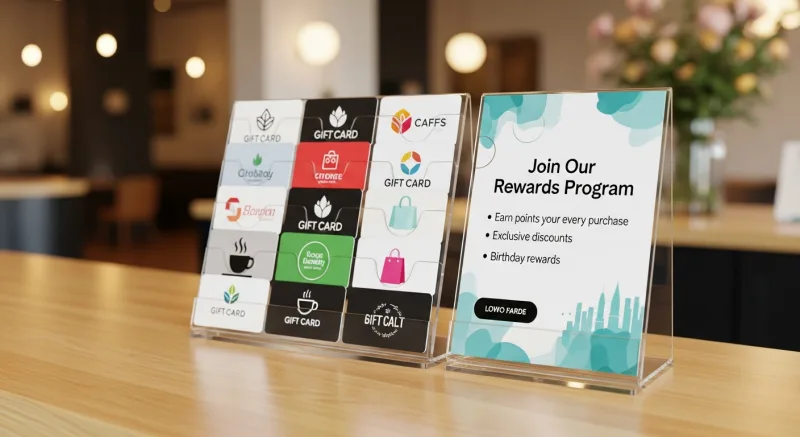
For multi-location groups, gift cards should drive acquisition at every store, not just the one where the card was purchased. If the friend lives near Location C but the gift card was bought at Location A, that acquisition only happens if the card works at Location C.
KwickOS gift cards sync across all locations in real time. Physical cards, digital gift cards purchased online, and promotional credits all work at every store. A $50 gift card purchased at Location A is immediately redeemable at Locations B, C, and D. The balance updates in real time — if the recipient uses $35 for a gel manicure at Location C, the remaining $15 is available at any location for her next visit.
Loyalty Programs for Cross-Location Nail Clients
Nail salon clients visit frequently — every 2-3 weeks for manicures, every 3-4 weeks for pedicures. This frequency makes loyalty programs particularly effective: the reward threshold can be reached quickly, maintaining engagement and motivation. A "10th visit free" program means a regular client earns a free service roughly every 5-7 months — frequent enough to feel achievable, infrequent enough to maintain margin.
On fragmented systems, a client who alternates between Location A and Location B accumulates points at half the expected rate in each system. Instead of reaching her free service in 5 months, each location's system shows 7-10 months. The motivational effect of "almost there" never kicks in because she is never almost there in either system.
KwickOS loyalty unifies across all locations. Every visit, every service, every dollar spent accumulates in one account regardless of which location the client visits. Shared loyalty points mean the client reaches rewards at the rate her total patronage deserves, not at a fragmented fraction.
Supply Inventory Across Multiple Salons
Nail salons consume supplies at rates that directly correlate with services performed: gel polish, acrylic powder, nail tips, sanitizer, cotton pads, cuticle oil. At a single location, supply ordering is straightforward — the manager watches levels and reorders when running low. At four locations, supply management becomes a logistics challenge.
Each location consumes supplies at different rates depending on service mix. A location that does primarily gel manicures consumes more UV gel and LED bulbs than a location focused on classic manicures. Without centralized inventory data, each location orders independently, often resulting in one location overstocking (tying up capital) while another runs out mid-day (lost revenue and rushed emergency supply runs).
KwickOS tracks supply consumption tied to services performed at each location. The centralized dashboard shows that Location A consumes $1,800/month in gel products (high gel service mix), while Location D consumes $900/month (lower gel demand). This data enables smarter bulk purchasing (aggregate orders across all locations for volume discounts), inter-store transfers (move surplus gel from D to A instead of ordering more), and waste identification (if Location C's supply consumption is 25% higher than expected for its service volume, investigate).
Real-Time Multi-Salon Dashboard
The Saturday afternoon rush is when nail salon owners need visibility most and have it least. On fragmented systems, you know how the location you are physically at is doing. The other three are a mystery until you call or visit.
KwickOS shows every salon on one screen. At 2 PM on Saturday, you can see that Location A has a 45-minute wait (all stations occupied), Location B has two open stations (redirect walk-ins from A's area), Location C has 3 technicians who clocked in late (investigate), and Location D is running a membership promotion that is driving 30% more traffic than normal (consider whether staffing is adequate).
T. Jin China Diner monitors 15 locations and 75 terminals through this same dashboard architecture. For nail salon groups, where walk-in traffic patterns shift by time of day and day of week, real-time cross-location visibility enables dynamic decisions: staff reallocation, client redirection, and promotion timing adjustments that maximize revenue across the entire group rather than optimizing one location while the others underperform.
The Multi-Location Staff Authentication Problem
Nail salons have a unique staffing model where technicians often work independently. They check in, serve clients, and check out with minimal direct supervision. At multiple locations, ensuring that the right technician is clocking in (preventing buddy punching), that their commissions are tracked accurately, and that their service records are attributed correctly requires secure authentication.
KwickOS 1:N fingerprint matching means each technician simply touches the sensor — no ID number, no password, no card swipe. The system identifies them from their fingerprint alone and activates their employee profile at whatever location they are working that day. Buddy punching is eliminated. Commission attribution is 100% accurate. Clock-in/clock-out times are verified biometrically.
For salon groups where tip allocation is divided among the technician, support staff, and the house, accurate service attribution is essential. Every service is linked to the technician who performed it, every tip is tracked to the transaction, and every commission calculation starts from verified data.
Why Toast, Square, and Clover Fail Nail Salons
Toast is a restaurant POS. It has no concept of technician commissions, service-provider scheduling, client service history, or membership plans. Using Toast for a multi-location nail salon is like using a fork to eat soup — technically possible, practically absurd.
Square has basic appointment scheduling but limited commission tracking and no real multi-location membership management. Each location operates as a semi-independent instance under a shared login. The integration is surface-level — it looks connected but the data is not truly unified.
Clover requires separate merchant accounts per location. Separate accounts mean separate client databases, separate loyalty programs, separate commission calculations, and separate reporting. For a nail salon group built on cross-location client relationships and floating technicians, Clover's architecture is fundamentally incompatible.
KwickOS is processor-agnostic (choose your own processor, negotiate one rate based on aggregate volume), provides true multi-location unification, and includes commission tracking, membership management, and client profiles designed for service businesses.
The Multi-Location Nail Salon Checklist
- Does the system calculate commissions automatically for technicians working at multiple locations?
- Are memberships valid at every location with centralized usage tracking?
- Do gift cards work at every location in real time?
- Does the loyalty program pool visits from all locations into one account?
- Can you see all salons' performance on one real-time dashboard?
- Do technicians use fingerprint authentication that works at every location?
- Can you push service menu and price updates to all locations with one click?
- Can you use one payment processor at one rate for all salons?
KwickOS handles all eight. Diva Nail Beauty's 90% efficiency increase across 4 stores is the proof point — and the principle scales to any number of locations.
Growing Your Nail Salon Group?
Schedule a demo and we will show you automated commission tracking, cross-location membership management, unified loyalty and gift cards, and real-time multi-salon dashboard — the same system that delivered Diva Nail Beauty's 90% efficiency increase.
Get Your Free DemoOr call us directly: (888) 355-6996
Turn One-Time Diners into Regulars: Built-In Gift Cards & Loyalty
Most POS companies treat gift cards and loyalty as afterthoughts — expensive add-ons that cost $50-100/month extra. KwickOS includes them at no additional charge because we believe they are essential revenue tools, not luxury features.
Gift Cards That Actually Drive Revenue
Here is what most restaurant owners do not realize: gift card buyers spend an average of 20-40% more than the card's face value. A $50 gift card typically generates $60-70 in actual spending. KwickOS supports both physical gift cards and electronic gift cards that customers can purchase, send, and redeem through their phones.
- Physical gift cards — branded plastic cards that sit on your counter and sell themselves during holidays
- E-gift cards — customers buy and send digitally via text or email, perfect for last-minute gifts
- Balance tracking — real-time balance across all your locations, no manual reconciliation
- Reload capability — customers top up their balance, creating a built-in prepayment habit
Loyalty Points That Keep Them Coming Back
KwickOS loyalty is not a punch card from 2005. It is a digital points system that tracks every dollar spent and automatically rewards your best customers:
- Earn points on every purchase — configurable ratio (e.g., $1 = 1 point, or $1 = 10 points)
- Tiered rewards — silver, gold, platinum levels to incentivize higher spending
- Birthday rewards — automated birthday offers that bring customers back during their special month
- Points-for-payment — customers redeem points directly at checkout, seamless for your staff
Membership Programs
For restaurants running VIP programs or subscription models (like monthly coffee clubs), KwickOS membership management handles recurring billing, exclusive pricing tiers, and member-only menu items — all within the same system your cashier already uses.
The bottom line: Toast charges $75/month extra for loyalty. Square's loyalty starts at $45/month. KwickOS includes gift cards, e-gift cards, loyalty points, and membership management in every plan. That is $540-900/year you keep in your pocket.