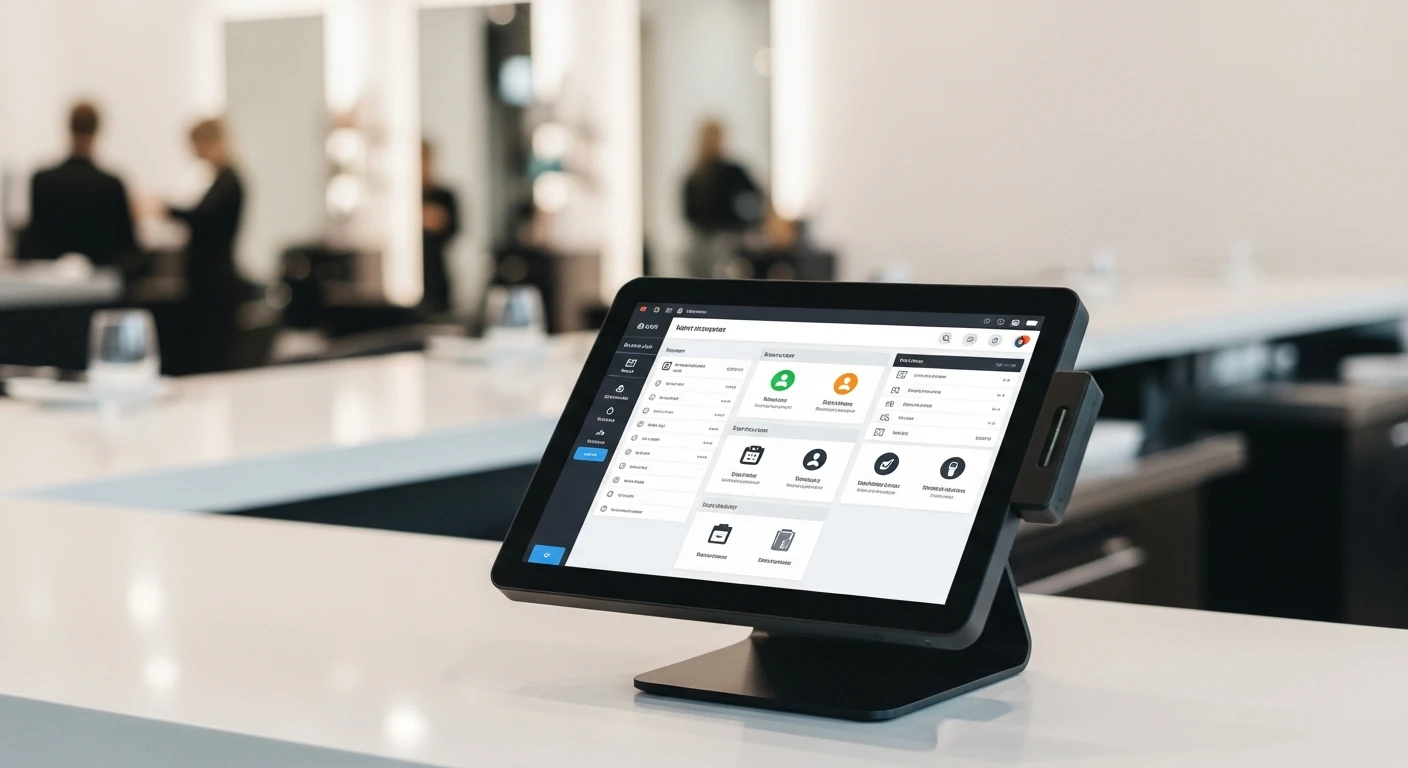
The hair salon business model is fundamentally different from restaurants, retail, or any other service industry. Revenue is generated by individual service providers (stylists) who build personal client relationships. When a salon group expands to multiple locations, the technology challenge is not just scaling the point of sale — it is scaling the relationship management, commission tracking, and scheduling infrastructure that makes the business work.
A 3-location salon group with 30 stylists might have 5-8 stylists who work at multiple locations, 200+ clients who follow their stylist between stores, and commission structures that vary by service type, product sales, seniority level, and location. Managing this on separate POS installations is not just inefficient — it is a payroll liability, a client retention risk, and a profit leak that compounds monthly.
Commission Tracking: The Multi-Location Payroll Minefield
Salon commissions are the most complex compensation model in small business. A senior stylist might earn 50% commission on color services, 45% on cuts, 15% on product sales, and a flat bonus for new client acquisitions. A junior stylist at the same salon earns 35% on color, 30% on cuts, and 10% on products. Now multiply those structures by 3 locations with 30 stylists, some of whom work at multiple stores.
On separate POS systems, commission tracking is per-location. If Stylist Sarah works Monday-Wednesday at Location A and Thursday-Saturday at Location B, her commissions are split across two systems. Payroll requires manual combination of two separate commission reports. If the commission rates differ slightly between locations (they often do, due to manual entry errors), Sarah's paycheck is wrong — and wrong paychecks create stylist turnover faster than any other management failure.
Diva Nail Beauty, with 4 stores and 4 terminals on KwickOS, achieved a 90% efficiency increase by automating commission tracking. The same principle applies to hair salons: one employee record, one commission structure, automated calculation across all locations. Sarah's commissions from Monday at Location A and Thursday at Location B appear on one report with one total. No manual reconciliation. No payroll errors. No angry stylists.
Client Profiles That Follow the Stylist
Hair salon clients are loyal to their stylist, not necessarily to the location. When Stylist Jessica moves from working exclusively at Location A to splitting time between A and B, her clients want to follow her. They need to know Jessica's schedule at each location, book accordingly, and have their service history (color formulas, preferred products, allergy notes, style preferences) available regardless of which location they visit.
On fragmented POS systems, client profiles exist per-location. When Jessica's client books at Location B for the first time, the receptionist has no record of her color formula, her processing time, her product preferences, or her allergy to a specific chemical. Jessica might remember, but if she is running behind and a different stylist checks the client in, that critical information is invisible.
The stakes are real. Applying the wrong color formula because the client history was not available can result in a color correction (2+ hours of chair time at no charge), product costs ($30-80 in additional color), and a damaged client relationship. One color correction per month across three locations costs $1,200-2,400/year in lost revenue and wasted product — purely from information fragmentation.
KwickOS creates one client profile across all locations. Color formulas entered at Location A are visible at Location B. Allergy notes travel with the client. Service history shows every visit at every location in chronological order. When Jessica's client books at Location B, every piece of information the stylist needs is already in the system.
Scheduling Across Multiple Salons
Salon scheduling is a Tetris game of stylist availability, service duration, chair capacity, and client preferences. At a single location, a good receptionist manages this mentally. At three locations with shared stylists, the complexity exceeds what any individual can track.
Consider: Jessica works at Location A on Monday, Tuesday, and Wednesday. Location B on Thursday and Friday. But this week, Location A has a gap on Thursday because another stylist called out. Can Jessica shift to Location A on Thursday? Only if her Location B clients for that day can be rescheduled or reassigned. The receptionist at Location B needs to coordinate with Location A's receptionist. Phone calls, text messages, schedule shuffling — 30 minutes of admin to move one stylist for one day.
KwickOS centralized scheduling shows every stylist's schedule at every location on one screen. The manager sees Jessica's week across all locations, sees the gap at Location A on Thursday, and can check whether Jessica's Location B Thursday clients are flexible. One system, one view, one decision — not a multi-location phone chain.
Gift Cards: Salon-Specific Revenue Dynamics
Hair salon gift cards have unique economics. They are premium gifts — the average salon gift card is $75-150, often purchased for birthdays, holidays, and bridal party gifts. Unlike restaurant gift cards that might be redeemed in one visit, salon gift cards often cover part of a service and create a return visit for the remainder. A $100 gift card used for a $130 color service generates $30 in out-of-pocket spend plus a client who now knows your salon and is likely to return.
For multi-location salon groups, gift card sales often happen disproportionately at one location (the busiest or most visible) while redemption happens at another (the one closest to the recipient's home). If the gift card only works at the purchasing location, you lose the cross-pollination benefit entirely.
KwickOS gift cards work at every location from the moment of purchase. A $150 gift card bought at your downtown salon is redeemable at your suburban location instantly. E-gift cards purchased through your website work at all locations. The balance syncs in real time — a client who uses $80 at Location A has $70 available at any other location for their next appointment.
Loyalty Programs for Salon Groups
Salon loyalty programs drive rebooking, which is the single most important metric for salon profitability. A client who rebooks before leaving has a 90%+ chance of actually returning. A client who says "I'll call" has a 30-40% chance. Loyalty programs with visible progress toward a reward incentivize rebooking: "You're 2 visits away from a free deep conditioning treatment — would you like to book your next appointment now?"
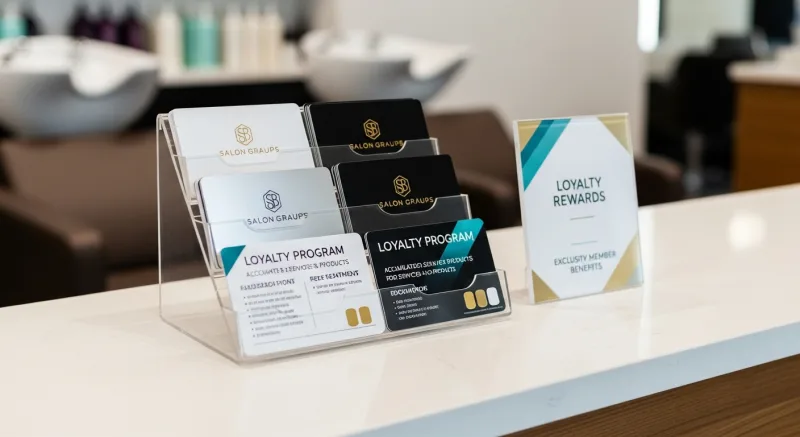
At multiple locations, fragmented loyalty kills this incentive. A client who visits Location A three times and Location B twice has split loyalty records that show low visit counts at each location. Neither location's staff knows this client is actually one of the group's most frequent visitors. The "you're 2 visits away" conversation never happens because, in each location's system, she appears to be 5 visits away.
KwickOS loyalty pools visits and spend across all locations. That client's 5 visits appear in one account. She is 2 visits away from her reward, and every receptionist at every location can see it and have the rebooking conversation. Membership tiers managed from headquarters let you create VIP programs where your most loyal cross-location clients receive priority scheduling, exclusive services, or birthday perks at every salon in your group.
Product Inventory Across Salons
Hair salons carry two types of inventory: back-bar products (used during services) and retail products (sold to clients). Both need tracking across multiple locations, but for different reasons.
Back-bar product consumption needs to correlate with services performed. If Location A performed 40 color services last month and consumed $2,400 in color product, while Location B performed 42 color services and consumed $3,100 in color product, there is a $700 variance that suggests waste, theft, or over-application at Location B. Without centralized reporting, this comparison requires manual data collection from both locations.
Retail product inventory needs centralized visibility for reordering and transfer decisions. If Location A has 15 units of a popular shampoo and Location B is sold out, you want to transfer 5 units from A to B rather than placing an emergency order. On separate inventory systems, you do not even know Location A has surplus until someone physically checks the shelf.
KwickOS tracks both back-bar and retail inventory across all locations on one dashboard. Product consumption per service, retail sales by location, and inter-location inventory comparisons are all visible centrally. When one location is overstocked and another is understocked, the system shows the imbalance so you can transfer rather than over-order.
The Processing Freedom Advantage for Salons
Hair salons process moderate-value transactions ($45-200 per service) with moderate frequency (20-50 transactions per day per location). The processing rate matters, but the per-transaction component matters less than for high-volume, low-ticket businesses.
A 3-location salon group processing $120,000/month total on Toast (2.99% + $0.15/transaction) pays approximately $3,765/month in processing. The same volume at a negotiated rate of 2.25% + $0.10 through an independent processor costs $2,820/month. Annual savings: $11,340.
KwickOS is processor-agnostic. Choose your own processor, negotiate based on your aggregate volume, and switch if a better offer comes along. Toast, Square, and Clover lock you in — you pay their rate at every location with no negotiating leverage.
Why General-Purpose POS Systems Fail Salons
Toast was designed for restaurants. Their commission tracking, appointment scheduling, and stylist-client relationship management capabilities are either nonexistent or rudimentary bolt-ons. Square has Square Appointments, but multi-location appointment management is limited — each location's calendar is essentially independent, and shared stylists require manual schedule coordination.
Clover requires separate merchant accounts per location, which means separate everything — separate client databases, separate loyalty programs, separate commission calculations. For a salon group, this is the worst possible architecture because the entire business model depends on continuity of client relationships across locations.
KwickOS integrates POS, scheduling, commission tracking, client management, loyalty, and gift cards into one platform that works across all locations. One client profile. One commission structure. One appointment calendar with multi-location visibility. One loyalty program. One gift card system.
Digital Signage for Salon Groups
Hair salons use digital displays for service menus, promotional pricing, and brand imagery. Across multiple locations, these displays need to show consistent pricing and current promotions. When you launch a "New Client Special — 20% Off First Color Service" promotion, it needs to appear on every display at every location simultaneously.
KwickOS digital signage syncs with the service menu. Update the promotion at headquarters, and every screen at every location reflects the change. No per-location manual updates. No inconsistency risk where Location C is still showing last month's promotion because someone forgot to change the screen.
The Multi-Location Salon Readiness Checklist
- Does the system track commissions across all locations for stylists who work at multiple stores?
- Are client profiles unified — color formulas, allergy notes, and service history available at every location?
- Can you see all stylists' schedules at all locations on one screen?
- Do gift cards work at every location in real time?
- Does the loyalty program pool visits across all locations?
- Can you compare product consumption per service across locations?
- Can you use one payment processor at one negotiated rate for all salons?
- Do employees use fingerprint authentication that works at every location?
KwickOS answers yes to all eight. The platform was built for multi-location service businesses where the relationship between provider and client is the product.
Expanding Your Salon Group?
Schedule a demo and we will show you unified commission tracking, cross-location client profiles, multi-salon scheduling, and integrated gift cards and loyalty — configured for hair salon operations.
Get Your Free DemoOr call us directly: (888) 355-6996
Turn One-Time Diners into Regulars: Built-In Gift Cards & Loyalty
Most POS companies treat gift cards and loyalty as afterthoughts — expensive add-ons that cost $50-100/month extra. KwickOS includes them at no additional charge because we believe they are essential revenue tools, not luxury features.
Gift Cards That Actually Drive Revenue
Here is what most restaurant owners do not realize: gift card buyers spend an average of 20-40% more than the card's face value. A $50 gift card typically generates $60-70 in actual spending. KwickOS supports both physical gift cards and electronic gift cards that customers can purchase, send, and redeem through their phones.
- Physical gift cards — branded plastic cards that sit on your counter and sell themselves during holidays
- E-gift cards — customers buy and send digitally via text or email, perfect for last-minute gifts
- Balance tracking — real-time balance across all your locations, no manual reconciliation
- Reload capability — customers top up their balance, creating a built-in prepayment habit
Loyalty Points That Keep Them Coming Back
KwickOS loyalty is not a punch card from 2005. It is a digital points system that tracks every dollar spent and automatically rewards your best customers:
- Earn points on every purchase — configurable ratio (e.g., $1 = 1 point, or $1 = 10 points)
- Tiered rewards — silver, gold, platinum levels to incentivize higher spending
- Birthday rewards — automated birthday offers that bring customers back during their special month
- Points-for-payment — customers redeem points directly at checkout, seamless for your staff
Membership Programs
For restaurants running VIP programs or subscription models (like monthly coffee clubs), KwickOS membership management handles recurring billing, exclusive pricing tiers, and member-only menu items — all within the same system your cashier already uses.
The bottom line: Toast charges $75/month extra for loyalty. Square's loyalty starts at $45/month. KwickOS includes gift cards, e-gift cards, loyalty points, and membership management in every plan. That is $540-900/year you keep in your pocket.